Tag Archives: undefined

Why Active Managers Like Volatility
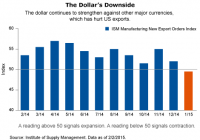
With quantitative easing finished and the Fed poised to raise rates, we are already starting to see stocks exhibit more volatility. We expect that to continue, and that stocks will rise or fall based on their fundamentals. In this environment, we believe active management is likely to become increasingly important to achieving sufficient returns. Capital markets offered some surprises for investors last week. Stocks rose globally with the Dow Jones Global Index rising 0.72%, while US stocks rallied with the S&P 500 hitting another record high. In addition, Treasury bonds sold off and oil continued its multi-week rebound. Clearly, asset classes are rotating and moving in different directions. A good example of this rotation can be found in the energy sector. Energy stocks have disappointed since last summer, falling in lockstep with the price of oil. However, in the past few weeks the price of oil has rapidly reversed course, helping energy stocks to rebound. The average energy-sector equity mutual fund returned almost 12% in the past month (as of February 13, 2015), well above every other sector fund average, according to Morningstar. Home and Away We’re also seeing divergent paths among fourth-quarter earnings reports. So far, earnings season has been positive, beating expectations. But there’s a substantial difference between companies that derive their earnings domestically from companies that derive their earnings largely from outside the United States. Why? Because the rising dollar has dragged down their fourth-quarter earnings results. A look at factory activity over the past few months drives home this point. The ISM manufacturing index has dropped to 53.5 in January from 57.6 in November. Weakness in foreign demand pushed new export orders down to their lowest level since November 2012. The caveat is that, like the price of oil, the dollar could reverse course relative to other currencies and the above scenario could change. Divergence can also be found in economic growth in the euro zone. For the fourth quarter, the euro zone skirted a recession and actually delivered modest growth. However, growth varied widely across member countries. Germany and Spain both saw their economies grow 0.7% in the quarter, beating expectations. Not surprisingly, some European countries didn’t fare as well, with both France and Italy falling short of expectations and Greece experiencing a -0.2% growth rate. Despite the disparity in growth, sovereign bond yields may not be dramatically different between these countries (except Greece) thanks to investors’ belief that the European Central Bank will stand behind this debt. Still, the performance of their stock markets could be where we see that growth gap reflected. The Perils of Indexing At Allianz Global Investors, we have long argued that once quantitative easing ended, we would see a change in the market environment. In other words, a move away from QE – which served as a rising tide lifting all boats – to an environment where stocks rise and fall on their individual fundamentals. We worry that the large number of investors who have enthusiastically embraced indexing in the past decade will be negatively impacted in this market environment, where we’re likely to see far more volatility, asset-class rotation and overall differentiation among individual securities. Unfortunately, indexing generally does not allow investors to avoid those companies that can be hurt by a rising dollar or the falling price of oil. And indexing does not allow investors to pivot when the dollar begins falling or the price of oil again changes course. In addition, as we look out on 2015, we expect relatively low stock returns. This again makes the case for active investing as investors will need to make active bets in an effort to surpass low market returns. In short, there are periods when markets are more conducive to index investing, as we saw over the past few years, but this environment isn’t one of them. We hope investors recognize the importance of active management in this unique and ever-changing market environment. We believe, a “buy the index and go home” strategy in times of uncertainty could come back to haunt investors.

Will Recent Strong Gains In The Greek ETF Last?

Although the Eurozone markets have perked up on the recent QE launch, Greece continues to trouble investors. The country is still deep in debt and its unemployment rate is a nagging concern. The malaise intensified in December 2014 when the Greek prime minister Antonis Samaras called snap elections in the wake of the political strife in Greece and lost it (read: Polls Indicate Syriza Win: More Pain for Greek ETF? ). Anti-austerity party Syriza came to power and kept on negotiating with the ECB to reach a debt-deal while reinforcing the cancellation of steep austerity measures. At the time of election, the leader of Syriza had vowed to cancel the austerities and quite expectedly, the intent to end austerities is flaring up a disagreement with the EU/IMF, lenders risking Greece’s stay in the Eurozone bloc. Last week, in an interview to Germany’s Stern magazine , Prime Minister Alexis Tsipras promised that Greece will be “a completely different country,” in the next six months. This positive vibe charged up the waning Greece ETF, at least for the time being, and pushed up Global X FTSE Greece 20 ETF (NYSEARCA: GREK ) by over 20% in the last five trading sessions (as of February 13, 2015), though the fund has added just 3% in the last one month. Shares of the country’s biggest bank National Bank of Greece S.A. (NYSE: NBG ) spiked on hopes that the country will retain its spot in the Euro bloc and get assistance from the ECB. The shares of NBG skyrocketed more than 45% in the last five trading sessions (as of February 13, 2015). Will the Uptrend Last? While the market was anticipating a positive outcome, the chances of a clean ending to this situation seem less likely. On February 16, dialogues between the foreign creditors and Athens failed as the latter proposed a six-month extension request of its international bailout package. If the parties fail to reach a unanimous decision by February 28, the date which connotes the expiry of the four-year bailout program offered to Greece, the country and its banks would crash into a cash crunch. The European Central Bank will decide on February 18 whether an emergency lending to the Greek banks, which definitely carry high interest rates, should be continued or not. Notably, the country is due for a hefty loan repayment in March, per Reuters. The Greece banks are already seeing signs of a capital flight at an expected rate of 2 billion euros ($2.27 billion) a week. Overall, Greece is in for trouble yet again and investors have nibbling doubts on this risky market. The Athens Stock Exchange General Index slipped more than 3.8% at the close on February 16 as drumbeats of losses were heard after the country failed to strike a debt deal (read: Greek ETF Faces Volatility on ECB Move ). Financials make up about 30% of GREK and is an important driver to the returns of the fund and the country’s current economic issues. The fund currently has a Zacks ETF Rank #3 (Hold). Bottom Line Investors should remember that despite the recent takeoff, GREK has been on a sale with a P/E (ttm) of 11 times versus the biggest European ETF Vanguard FTSE Europe ETF’s (NYSEARCA: VGK ) P/E of 15 times and the Euro zone powerhouse Germany’s iShares MSCI Germany’s (NYSEARCA: EWG ) 14 times of P/E (ttm) figure. So, a bit of a way up was probably long in arrears for GREK. This is more so given Greece’s Q3 2014 growth rate (0.7%) outstripped all other Eurozone countries (read: What is Behind the Greek ETF Surge? ). However, if the country fails to negotiate with its Eurozone associates, the rosy economy which Greece has just started to enjoy might wither away before being in full bloom. Moreover, a discord will find other Eurozone countries from Malta to Greece’s biggest creditor – Germany – in dire straits. So, all eyes should be now on the progression of the debt deal before one can surely predict the fate of the euro, Greece and the broader European market.

QuantShares Launches Long/Short Dividend Income ETF

By DailyAlts Staff Investors looking for high current yield and potential capital appreciation have somewhat limited pickings these days. With the launch of its QuantShares Hedged Dividend Income ETF (NYSEARCA: DIVA ) on January 20, FFCM LLC has made the pickings a little less slim. The QuantShares Hedged Dividend Income ETF is designed to follow the Indxx Hedged Income Index, which has been live since February 2013. In pursuit of its high dividend income objective, the fund invests in 100 stocks with attractive dividend characteristics: high dividend yield, consistent dividend payment, and/or dividend growth. The investments are selected from the 1,000 largest stocks in the Indxx Hedged Income Index and weighted equally. Not Just Another Long-Only Fund But the QuantShares Hedged Dividend Income ETF isn’t a long-only dividend fund. The fund will also short around 200 stocks from the same universe of 1,000 stocks. The stocks selected as short sales have little to no dividend history and low dividend yields. But despite the number of short positions doubling the number of longs, the fund is designed so that the value of the short positions is roughly half that of the longs. “Our exemptive relief with the SEC allows us to hedge and de-risk via an index-based, long-short strategy,” said Bill DeRoche, the fund’s portfolio manager, in a press release announcing the fund’s launch. The QuantShares Hedged Dividend Income ETF rebalances its holdings every month and reconstitutes every quarter. Its investment approach caps net exposure to no more than 12.5% per sector. The fund also pays dividends on a monthly basis, which is an attractive feature for income-oriented investors. The fund’s “monthly dividend payments, hedged portfolio, and ETF structure” offer investors a “transparent, tax efficient, and diversifying alternative” to both low-yield fixed income and higher-risk equity-dividend products, according to Mr. DeRoche. Alternative to Fixed Income Bill Carey, CEO of QuantShares investment advisor FFCM LLC, also says the fund makes a good alternative to fixed income and other equity-dividend products. For investors in corporate bonds, Mr. Carey says the QuantShares Hedged Dividend Income ETF “may offer a higher after-tax yield with similar return and risk characteristics.” The fund also offers “a number of potential advantages over widely used equity-based income-producing products,” due to its “lower risk and volatility relative to that of long-only equity strategies,” in Mr. Carey’s words. The new fund launch is QuantShares’ first since being acquired by Mosaic Investment Partners in May 2013. The firm reportedly required alternative financing at the time. For more information, visit the fund’s page .