Tag Archives: undefined

Equity CEFs: Will 2015 Be The Year Of The Rotation? Part II
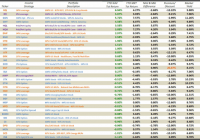
Summary Recently, I wrote an article offering what equity based CEFs might benefit from a sector rotation from the leaders over the last few years to some of the laggards. Though there have been fits and starts so far in January, and certainly 1-month does not make a trend, indications are that a rotation could very well be afoot. The bigger risk is that the end of Quantitative Easing will see a contraction in all asset prices across all sectors. Over the last few years, your best bet in fund investing would have been just to buy the biggest and most popular US based broad market index ETFs, such as the SPDR S&P 500 Trust (NYSEARCA: SPY ) , the PowerShares NASDAQ-100 (NASDAQ: QQQ ), the SPDR Mid-Cap 400 (NYSEARCA: MDY ) or the iShares Russell 2000 (NYSEARCA: RWM ) and forgot about them. Certainly there have been even better performing funds and ETFs that focused in sectors such as healthcare or biotechnology, but for mindless “invest and forget” funds, you could not go wrong with the most popular broad market US indices and any of the many ETFs that correlate with them. Because the vast majority of actively managed mutual funds and professional money managers have had a very difficult time competing with these US indices. The traditional fundamental stock analysis that many active portfolio managers relied on for alpha performance simply was overwhelmed by the massive amounts of liquidity and/or computer algorithm trading that benefited the largest and most liquid ETFs. The ramp up in these indices really began in 2012 and so here are the total returns of these four popular major market ETFs since then through January 30th, 2015. Index ETF Ticker Total Return SPDR S&P 500 SPY 67.1% PowerShares NASDAQ-100 QQQ 86.8% SPDR Russell Mid-Cap MDY 68.6% iShares Russell Small-Cap IWM 63.1% NOTE: The actual indices do not include dividends whereas these ETFs and others like them do. So total return means all dividends are added back to the ETFs but not on a reinvested basis. In addition, the NASDAQ-100 represents the largest 100 non-financial stocks listed on the NASDAQ and thus, holds far fewer stocks than the actual NASDAQ . And finally, there is also a lot of overlap in the technology dominated NASDAQ-100 and the S&P 500, as there would be with say, the Dow Jones Industrial Average (NYSEARCA: DIA ), whose 30 blue chip stock constituents would all be included in the S&P 500. Of course, this does not mean that all of the stock constituents in these indices have done this well and if you separated them out by sector, you would find that stocks in certain sectors, such as technology and healthcare, have far outperformed almost all of the other sectors, many of which may have shown one or two underperforming years or even negative years since 2012. Nonetheless, it’s unusual to see three straight years in which all market capitalizations have done this well even though the Russell Small Cap Index did not have nearly as good a 2014 as in the previous two years. But is there a reason for this mostly consistent performance over the last few years across all market capitalizations? Well, of course there is. The reason was the Federal Reserve’s Quantitative Easing which injected massive amounts of liquidity to financial institutions by buying bonds and other fixed-income assets. Though Quantitative Easing started well before 2012, much of the early liquidity brought more stability and traction to the markets rather than inflating them. But at some point, this sustained liquidity started to inflate the markets across all segments because if you were a financial institution that had excess liquidity you needed to put to work, the easiest way to invest it would be to throw it into the largest and most liquid ETFs. So Will 2015 Be The Year Of The Rotation? I’m not trying to imply that everything changes in a new year but there are certainly reasons why 2015 could easily be much different than the past three years. The biggest reason is Quantitative Easing ending in October, 2014 so the simplistic throw your money at the largest and most liquid broad based index ETFs is over. What this means is that financial institutions and other asset managers are going to have to start working harder to find places to invest and that bodes well for more individual stock and sector investing rather than index investing. In other words, the air in the balloon is not hooked up to the pump anymore and investors now have to put their fingers to the wind to find which way it is blowing. And that’s why I believe 2015 is setting up better for a rotation out of some of the high flying sectors over the last few years and into some of the more underperforming sectors, though certainly economic and geopolitical factors will play a huge role in which sectors perform better or worse. This was the basis of my article I wrote in late December, titled Will 2015 Be The Year Of The Rotation? Now I have no idea how the markets will perform in 2015 and it could be a down year for all sectors, but I felt pretty confident coming into the new year that we would see a sector rotation at least in the beginning of the year, and that one of the best ways to play that would be in equity CEFs because of their built-in valuations. If you go to the link above, I identified two equity CEFs in particular, the Gabelli (GAMCO) Global Gold, Natural Resource and Income Trust (NYSEMKT: GGN ) , $7.46 market price, $7.49 NAV, -3.0% discount, 11.3% current market yield , and the Gabelli Natural Resources, Gold and Income Trust (NYSE: GNT ) , $8.49 market price, $9.07 NAV, -6.4% discount, 10.0% current market yield , that I felt would be excellent rotational CEFs not just because of the sectors they invest in but also because of their valuations that tended to spike one direction at the end of one year only to spike the other direction at the beginning of the next. As it turned out, global geopolitical forces have also helped GGN and GNT since these funds invest mostly in gold sector stocks which have performed better, though energy and natural resource stocks remain weak. But as you’ll see in the table below, some sectors, such as healthcare, utilities and REITs continue to do well even after a very strong 2014. On the other hand, the technology and financial sectors have come under pressure so far this year. In other words, rotations can have fits and starts and nothing is a guarantee to move on your timetable. Here are the top performing equity CEFs I follow sorted by total return NAV performance YTD through January 30th, 2015. (click to enlarge) As you can see, GGN and GNT are among the top NAV and market price performers so far in 2015 and if you had actually invested in these gold and energy focused CEFs on the date I released my article, you would be up an even more impressive 11.4% in GGN and 6.5% in GNT . By comparison, the S&P 500 is down -3.0% YTD. so there are quite a number of equity CEFs that are already ahead of S&P 500 shown in the table above (only 30 can be shown in a screen shot. So why do I think this trend will continue? Because when you see a bellwether stock like Microsoft (NASDAQ: MSFT ) drop -14.4% in 1-week on heavy volume, that is more than just a road bump on the way to new highs, in my opinion. That is institutional investors lowering their weightings and expectations going forward not just for MSFT but for technology in general I would expect. Now the other alternative is that we’re in for something far worse and that no sector will be safe. The weakness in the financial sector is probably the most unsettling since this is where the seeds of something more ominous usually begin. But for now, I believe that the most popular sectors over years past are not going to be the leaders in 2015 and that investors will be looking more towards out-of-favor sectors and even overseas markets to provide better opportunities. Undervalued Equity CEFs Don’t Need Positive News To Turn It Around But It Sure Can Help In 2013, I strayed from my usual focus on equity CEFs and wrote several articles on Municipal Bond CEFs. If you didn’t follow what was going on with municipal bonds that year, let’s just say the news out of Detroit, Puerto Rico, Illinois and other municipalities was creating one of the worst years for muni bond funds and a downright bear market for muni bond CEFs, many of which dropped from premium valuations to double digit discounts in one year. However, at the end of 2013 I wrote this article, The Sad State Of Muni Bond CEFs , and said the worst was mostly reflected in their valuations and to start buying these funds even ahead of any tangible positive news flow. In hindsight, I wish I had bought even more muni bond CEFs as they have been one of the best fund investments I have owned since then. The point is, you don’t have to wait for positive news when buying CEFs, you just have to know when their valuations make their risk/reward too good to pass up. Geopolitical events are already beginning to help some of the down and out sectors so far in 2015 and as I’ve said, valuations of funds can often provide the best support for their market prices even if the sectors they invest in have yet to recover. We’re already seeing this in many of the energy related CEFs and energy MLP CEFs even while oil and energy prices remain weak. One extreme example of this is the BlackRock Energy and Resources fund (NYSE: BGR ) , which has magically risen from a -10% discount not long ago to an 8.1% premium. (click to enlarge) Not sure what’s behind the interest in BGR but it provides a good example of what can happen to more thinly traded securities like CEFs when a little confidence returns to a sector or when investors try and get ahead of the curve. Even many of the energy MLPs are seeing better valuations so far this year despite most energy prices remaining in a downtrend. So imagine what can happen when a few geopolitical or economic events start to turn in favor of your rotational sectors. One of the biggest news so far in 2015 was the announcement by the European Central Bank to begin their own Quantitative Easing program which has helped gold prices and brought renewed interest in European stocks. This was the basis of my last article, Global CEFs For A QE Europe . Conclusion Are we seeing the seeds of rotation in the markets? I believe we are and in my Part III article, I will go over the equity CEFs that I think will be primary beneficiaries. Disclosure: The author is long GGN, GNT. (More…) The author wrote this article themselves, and it expresses their own opinions. The author is not receiving compensation for it (other than from Seeking Alpha). The author has no business relationship with any company whose stock is mentioned in this article.

The Time To Hedge Is Now! February 2015 Update

Summary Brief overview of the series which began April 30, 2014. Why buy-and-hold investors should consider hedging. Current buy prices on some of my preferred put options. Discussion of the risks inherent to this strategy versus not being hedged. Back to January 2015 Update Strategy Overview If you are new to this series you will likely find it useful to refer back to the original articles, all of which are listed with links in this Instablog . In the Part I of this series I provided an overview of a strategy to protect an equity portfolio from heavy losses in a market crash. In Part II, I provided more explanation of how the strategy works and gave the first two candidate companies to choose from as part of a diversified basket using put option contracts. I also provided an explanation of the candidate selection process and an example of how it can help grow both capital and income over the long term. Part III provided a basic tutorial on options. Part IV explained my process for selecting options and Part V explained why I do not use ETFs for hedging. Parts VI through IX primarily provide additional candidates for use in the strategy. Part X explains my rules that guide my exit strategy. All of the above articles include varying views that I consider to be worthy of contemplation regarding possible triggers that could lead to another sizeable market correction. Part II of the December explains how I have rolled my positions. I want to make it very clear that I am not predicting a market crash. Bear markets are a part of investing in equities, plain and simple. I like to take some of the pain out of the downside to make it easier to stick to my investing plan: select superior companies that have sustainable advantages, consistently rising dividends and excellent long-term growth prospects. Then I like to hold onto to those investments unless the fundamental reasons for which I bought them in the first place changes. Investing long term works! I just want to reduce the occasional pain inflicted by bear markets. Why Hedge? With the current bull market having run more than 70 months, it is now more than double the average duration (30.7 months) of all bull markets since 1929. The current bull is now longer in duration than all but three bull markets during that time period (out of a total of 15). So, I am preparing for the inevitable next bear market. I do not know when the strategy will pay off, and I will be the first to admit that I am probably earlier than I suggested at the beginning of this series. However, I do feel confident that the probability of experiencing another major bear market will rise in the coming year(s). It may be 2015, 2016 or even 2017, before we take another hit like we did in 2000-2002 or 2008-09. But I am not willing to risk losing 50 percent (or more) of my portfolio to save the less than two percent per year cost of a rolling insurance hedge. I am convinced that the longer the duration of the bull market lasts the worse the resulting bear market will be. I continue to base my expected hedge position returns on a market swoon on 30 percent, but now believe that the slide could be much worse as this bull continues to outlive its ancestry. Current Premiums on select Candidates In this section I will provide current quotes and other data points on selected candidates that pose an improved entry point from the last update. All quotes and information are based upon the close on Friday, January 30, 2015. I am calculating the possible gain percentage, total estimated dollar amount of hedge protection (Tot Est. $ Hedge) and the percent cost of portfolio using either the “Last Premium” amount shown or the middle of the range between the “bid” and “ask” premiums. The last premium paid on the last transaction of the day generally provides an accurate example of the cost and potential for each trade, except when the last premium is either at or beyond either the bid or ask premium. When the last premium is at or beyond either the bid or ask premium I chose to use the mid-point between the bid and ask premium. You may need to adjust your bid slightly higher if you do not get a fill, but a few pennies does not ruin the return potential on the suggested option contracts. Please remember that all calculations of the percent cost of portfolio are based upon a $100,000 equity portfolio. If you have an equity portfolio of $400,000 you will need to increase the number of contracts by a factor of four to gain adequate coverage. Also, the hedge amount provided is predicated upon a 30 percent drop in equities during an economic recession and owning eight hedge positions that provide protection that approximates $30,000 for each $100,000 of equities. So, you should pick eight candidates from the list and make sure that the hedge amounts total to about $30,000. Since each option represents 100 shares of the underlying stock, we cannot be extremely precise, but we can get very close. If the market drops by more than 30 percent I expect that we will do better than merely protect our portfolios because these stocks are very likely to fall further and faster than the overall market, especially in a crash. Another precaution: do not try to use this hedge strategy for the fixed income portion of your portfolio. If the total value of your portfolio is $400,000, but $100,000 of that is in bonds or preferred stocks, use this strategy to hedge against the remaining $300,000 of stocks held in the portfolio (assuming that stock is all that is left). This is also not meant to hedge against other assets such as real estate, collectibles or precious metals. Goodyear Tire & Rubber (NASDAQ: GT ) Current Price Target Price Strike Price Bid Premium Ask Premium Last Premium Poss. % Gain Tot Est. $ Hedge % Cost of Portfolio $24.24 $8.00 $15.00 $0.25 $0.55 $0.40 1650 $3,960 0.24% GT stock is actually slightly lower than it was at the time of the last update. But the potential gain is still good if you can get in near the latest premium paid. I don’t expect a major drop in share price without a recession, but we could see some gradual downside movement over the coming months. You will still need six January 2016 GT put option contracts to cover one eighth of a $100,000 equity portfolio. Williams-Sonoma (NYSE: WSM ) Current Price Target Price Strike Price Bid Premium Ask Premium Mid-range Poss. % Gain Tot Est. $ Hedge % Cost of Portfolio $78.25 $20.00 $55.00 $1.15 $1.60 $1.30 2592 $3,370 0.13% We need only one January 2016 WSM put option contract to provide the indicated loss coverage for each $100,000 in portfolio value. The pricing in the January contracts has become more favorable. This is a good time to buy. In a recession, remodeling and painting projects get put on hold. United Continental Holdings (NYSE: UAL ) Current Price Target Price Strike Price Bid Premium Ask Premium Mid-range Poss. % Gain Tot Est. $ Hedge % Cost of Portfolio $69.37 $18.00 $35.00 $0.75 $1.26 $0.95 1627 $3,210 0.19% We need two January 2016 UAL put option contracts to provide the indicated loss coverage for each $100,000 in portfolio value. In the last update I used the June 2015 contracts; currently the January 2016 contracts are more cost effective than the June 2015 contracts. Travel is one of the first expense items to get cut by businesses during a recession. CarMax (NYSE: KMX ) Current Price Target Price Strike Price Bid Premium Ask Premium Mid-range Poss. % Gain Tot Est. $ Hedge % Cost of Portfolio $62.10 $16.00 $40.00 $0.90 $1.15 $1.00 2300 $4,600 0.20% We will need two January 2016 KMX put options with a strike of $40 to complete this position for each $100,000 in portfolio value. In the last update I used contracts with a $35 strike price, but the higher strike on these contracts will kick in sooner and afford us protection sooner in a downturn. The cost has gone up but the higher strike is worth it. Royal Caribbean Cruises (NYSE: RCL ) Current Price Target Price Strike Price Bid Premium Ask Premium Mid-range Poss. % Gain Tot Est. $ Hedge % Cost of Portfolio $75.55 $22.00 $42.00 $1.04 $1.26 $1.10 1718 $3,780 0.22% We need two January 2016 RCL put option contracts to provide the indicated loss coverage for each $100,000 in portfolio value. RCL stock price has fallen since the last update but this candidate still offers a good return potential and should drop like a sinking ship during a recession. L Brands (NYSE: LB ) Current Price Target Price Strike Price Bid Premium Ask Premium Mid-range Poss. % Gain Tot Est. $ Hedge % Cost of Portfolio $84.63 $20.00 $56.50 $1.10 $1.25 $1.20 2942 $3,530 0.12% We need only one January 2016 LB put option to provide the indicated loss coverage for each $100,000 in portfolio value. Those of you who have been following the series will notice that I continue to increase the strike price from $50 to $56.50 to have our hedge protect us sooner. I do so whenever the option premiums allow us to do so at a reasonable cost. Marriott International (NASDAQ: MAR ) Current Price Target Price Strike Price Bid Premium Ask Premium Mid-range Poss. % Gain Tot Est. $ Hedge % Cost of Portfolio $74.50 $30.00 $50.00 $1.10 $1.25 $1.15 1639 $3,770 0.23% We need two January 2016 MAR put option contracts to provide the indicated loss coverage for each $100,000 in portfolio value. Once again, business travel will suffer in a recession and MAR profits will be a victim. Tempur Sealy International (NYSE: TPX ) Current Price Target Price Strike Price Bid Premium Ask Premium Mid-range Poss. % Gain Tot Est. $ Hedge % Cost of Portfolio $55.03 $12.00 $35.00 $0.95 $2.10 $1.20 1817 $4,360 0.24% We will need two January 2016 TPX put option contracts to provide the indicated loss coverage for each $100,000 in portfolio value. TPX share price has rebounded bringing the stock back into the cross hairs for the strategy. Creation of new households will slow dramatically during a recession and the purchase of a new bed is something that gets put off until better economic times. I have chosen a premium price near the low end of the range but above the last premium paid price of $1.14. Micron Technology (NASDAQ: MU ) Current Price Target Price Strike Price Bid Premium Ask Premium Mid-range Poss. % Gain Tot Est. $ Hedge % Cost of Portfolio $29.27 $10.00 $19.00 $0.25 $0.29 $0.27 3233 $3,492 0.11% We need four July 2015 MU put option contracts to provide the indicated loss coverage for each $100,000 in portfolio value. I switched from the January 2016 contracts because the July has become more cost effective at a higher strike. Morgan Stanley (NYSE: MS ) Current Price Target Price Strike Price Bid Premium Ask Premium Mid-range Poss. % Gain Tot Est. $ Hedge % Cost of Portfolio $33.81 $15.00 $27.00 $0.47 $0.55 $0.50 2300 $3,450 0.15% We need three July 2015 MS put option contracts to provide the indicated loss coverage for each $100,000 in portfolio value. MS seems to me to be one of the more susceptible of the big banks in a downturn. Recessions usually do not treat the financial sector well and MS has a history that makes it a favorable candidate. Seagate Technology (NASDAQ: STX ) Current Price Target Price Strike Price Bid Premium Ask Premium Mid-range Poss. % Gain Tot Est. $ Hedge % Cost of Portfolio $56.44 $24.00 $40.00 $0.40 $0.48 $0.45 3456 $3,110 0.09% We will need a total of two June 2015 STX put options with a strike of $40 to complete this position at current pricing levels for each $100,000 in portfolio value. In an unusual move I dropped the strike price from $45 to $40 because the cost had gotten too high on the $45 strike contract. Having said that, there are more efficient options listed above so I would be inclined to wait on this one for better pricing. E*Trade Financial (NASDAQ: ETFC ) Current Price Target Price Strike Price Bid Premium Ask Premium Mid-range Poss. % Gain Tot Est. $ Hedge % Cost of Portfolio $23.05 $7.00 $20.00 $0.82 $1.03 $0.90 1344 $3,630 0.27% The position shown above would require three July 2015 ETFC put option contracts to provide the indicated loss coverage for each $100,000 in portfolio value. Remember that these options expire in July 2015 and will require us to replace them at additional cost if the bull market is sustained. The cost has come down enough to put this candidate in play for the strategy. Yet there are better choices so I will wait a little longer for better pricing or use another candidate for my hedge. Sotheby’s (NYSE: BID ) Current Price Target Price Strike Price Bid Premium Ask Premium Last Premium Poss. % Gain Tot Est. $ Hedge % Cost of Portfolio $42.55 $16.00 $30.00 $0.40 $0.80 $0.70 1900 $3,990 0.21% We would need three July 2015 BID put option contracts to provide the indicated loss coverage for each $100,000 in portfolio value. This candidate stock has risen enough to provide a reasonable return. BID is really a play on the slowing of the Chinese economy, and specifically on the falling real estate prices. As newfound wealth created from overbuilding begins to deteriorate, purchases of art and collectibles loses its glamour. BID always seems to fall precipitously when there is a global recession. Level 3 Communications (NYSE: LVLT ) option costs have risen and are too high to be considered at this time. If the situation changes I will include the candidate in a future update. Summary My top eight choices from the list above includes LB, KMX, GT, WSM, MAR, RCL, TPX and UAL. That group (using the put option contracts suggested above) should provide approximately $30,580 in downside protection against a 30 percent market correction at a cost of 1.57 percent of a $100,000 portfolio. None of the candidates will need to be replaced until next January thereby keeping the cost below two percent for nearly a year. Brief Discussion of Risks If an investor decides to employ this hedge strategy, each individual needs to do some additional due diligence to identify which candidates they wish to use and which contracts are best suited for their respective risk tolerance. I do not always choose the option contract with the highest possible gain or the lowest cost. I should also point out that in many cases I will own several different contracts with different strikes on one company. I do so because as the strike rises the hedge kicks in sooner, but I buy a mix to keep the overall cost down. My goal is to commit approximately two percent (but up to three percent, if necessary) of my portfolio value to this hedge per year. If we need to roll positions before expiration there will be additional costs involved, so I try to hold down costs for each round that is necessary. I do not expect to need to roll positions more than once, if that, before we see the benefit of this strategy work. I want to discuss risk for a moment now. Obviously, if the market continues higher beyond January 2016 all of our new option contracts could expire worthless. I have never found insurance offered for free. We could lose all of our initial premiums paid plus commissions. If I expected that to happen I would not be using the strategy myself. But it is one of the potential outcomes and readers should be aware of it. And if that happens, I will initiate another round of put options for expiration beyond January 2016, using from up to three percent of my portfolio to hedge for another year. The longer the bull maintains control of the market the more the insurance will cost me. But I will not be worrying about the next crash. Peace of mind has a cost. I just like to keep it as low as possible. Because of the uncertainty in terms of how much longer this bull market can be sustained and the potential risk versus reward potential of hedging versus not hedging, it is my preference to risk a small percentage of my principal (perhaps as much as three percent per year) to insure against losing a much larger portion of my capital (30 to 50 percent). But this is a decision that each investor needs to make for themselves. I do not commit more than five percent of my portfolio value to an initial hedge strategy position and have never committed more than ten percent to such a strategy in total before a major market downturn has occurred. The ten percent rule may come into play when a bull market continues much longer than expected (like three years instead of 18 months). And when the bull continues for longer than is supported by the fundamentals, the bear that follows is usually deeper than it otherwise would have been. In other words, I expect a much less powerful bear market if one begins early in 2015; but if the bull can sustain itself into late 2015 or beyond, I would expect the next bear market to be more like the last two. If I am right, protecting a portfolio becomes ever more important as the bull market continues. As always, I welcome comments and will try to address any concerns or questions either in the comments section or in a future article as soon as I can. The great thing about Seeking Alpha is that we can agree to disagree and, through respectful discussion, learn from each other’s experience and knowledge. Disclosure: The author has no positions in any stocks mentioned, and no plans to initiate any positions within the next 72 hours. (More…) The author wrote this article themselves, and it expresses their own opinions. The author is not receiving compensation for it. The author has no business relationship with any company whose stock is mentioned in this article. Additional disclosure: I either hold put options in the stocks listed or will be buying them in the next week.

There Are Few Bargains In Tax-Free Income… Here’s 3

Summary Municipal bonds are coming off one of their best years in a long time. Most municipal bond, closed-end funds are selling well above their usual discount/premium status, a situation nearly exactly opposite that of a few months past. In this article I consider three funds that still present attractive valuations and propose one as my top choice. Few Bargains in Tax-Free Income. Here’s Three. After a dismal 2013, municipal-bond closed-end funds turned in a strong showing in 2014. Let’s start by looking at the largest and most liquid municipal bond ETF as a benchmark. iShares S&P National AMT-Free Muni Bond ETF (NYSEARCA: MUB ) is up 5.42% for the past 12 months and has a 12 month tax-free yield of 2.74%. Not bad for muni bonds, but it doesn’t sound all that terrific, does it? Now, compare that to the median national municipal-bond closed-end fund: 12 month price return of 17.09% coupled with a current, tax-free yield of 5.87%. That’s a total return difference of nearly three fold. How is it that closed-end funds outperformed the benchmark ETF to such an extent? First is their use of leverage: the median muni-bond CEF is leveraged at 34.9%. This can provide a substantial boost in a year such as 2014 but will, of course, drag a fund’s performance down in a less favorable year such as 2013. A second factor is credit quality. Many CEFs will delve more deeply into the credit risk pool than MUB which holds 83% of its portfolio in bonds rated A and above compared to the category average of 74%. Here again, when things go well taking on credit risk can pay off. But in 2013 exaggerated fears of credit risk, driven largely by sentsationalist media coverage of the municipal bond market, proved costly to investors in this asset class. Finally, there’s the factor unique to CEFs: most sell at a discount to their NAVs. This cuts two ways: A discount pumps up the yield on NAV; buying a fund that pays, say, 6% on NAV at a 10% discount turns that 6% into 6.67% at market price. Plus, if a discount compresses, the holder of the fund enjoys capital appreciation unrelated to the price movements of the underlying assets. The first two factors, leverage and portfolio quality, tend to be stable for any given fund. The third, premium/discount status, tends to be quite volatile for municipal bond CEFs, and will often offer attractive buying opportunities. The strong showing for municipal bond CEFs over the last year, and the past few months in particular, has been driven in considerable part by discount compression. This has left few bargains for the tax-free income shopper. The median discount for national municipal-bond CEFs stands at -6.81%. Nearly -7% may look good at first glance but it compares poorly with recent history for the category. How poorly? That -6.81% is more than 2 standard deviations higher (i.e. less discounted) than the median discounts of 3 or 6 months ago. Such numbers do not offer much of an attractive market for buyers. Recent Changes in Premium/Discount Status in Municipal Bond CEFs The metric used to measure how a closed-end fund’s current premium/discount relates to its recent history is the Z-score which indicates how far from the average discount or premium a fund’s current discount or premium is. A fund with a positive Z-score is currently trading at discount or premium higher than its average. Negative Z-scores indicate distance below the average (deeper discounts). Only 4 months ago, when I last wrote about muni-bond CEFs, negative Z-scores were overwhelmingly the rule. That’s now turned around completely with the median Z-scores for 3, 6 and 12 months standing at 2.26, 2.17 and 0.97, respectively. This chart shows distributions of Z-scores for 3 and 6 month periods for 99 national municipal-bond closed-end funds. To see mean reversion in action, it’s worth comparing these to charts of the same metric in Figure 2 from October 2014 which present nearly exact mirror images of these charts in shape if not scale. Figure 1. Z-score distributions for national municipal-bond closed-end funds. In the entire universe of municipal-bond closed-end funds 5% have discounts deeper than their average for the last 3 months and only 8% for the 6 month average. A Moderate Fund-Trading Strategy for Muni-Bond CEFs That Combines Tax-Free Income and Periodic Capital Profits I consider closed-end funds to provide the best choice for exposure to tax-free income. I would argue that the municipal bond arena is the space where CEFs are the clear investment option of choice. They return consistently high-distribution yields on an absolute measure, and very high yields on a tax-adjusted basis in an investment category typified by low yield for essentially every other investment vehicle. Because CEFs often use high leverage and credit-risk as mechanisms to achieve those high returns they tend to be riskier alternatives in comparison with municipal-bond ETFs or holding individual bonds. To moderate some of that risk, I buy muni-bond closed-end funds when they are priced attractively relative to their typical discounts/premiums. To this end I rely on Z-scores to provide a measure of that relationship. I base this on an assumption that the funds with outsized Z-scores will tend to revert to their means over time. Some readers object to this emphasis on Z-scores, which I can appreciate. For the buy-and-hold investor they may be a relatively minor factor in an investment decision. But, I have been able to identify appealing opportunities by including this metric along with the more important considerations of yield and portfolio quality. Understand, as well, that I am always prepared to trade out of a fund if that carefully selected extreme discount reverts to the fund’s less deeply discounted mean, which is, in fact, what I expect to happen most of the time. An investor less inclined to trade funds will, of course, be less inclined to value this metric. Over the past few years I have purchased funds at outsized discounts and sold them at a profit as they reverted to something closer to their mean discounts, using the proceeds to purchase other funds with attractive entry points. With about 100 national muni-bond CEFs and another couple of dozen funds from my home state of California to select from there is always a lot of choice. This approach has provided steady, tax-free income in the 6 to 7% range and modest profits as I traded into new funds. By following this strategy, I presently hold muni-bond funds purchased when they had deeply negative Z-scores. Riding the rising tide in the asset class, they have logged substantial capital appreciation, a fair portion of which is attributable to mean reversion of their discounts. In fact they presently have Z-scores well over 2, so I would like to trade out of them and capture those profits. But there are precious few funds that meet the standards I’m looking for in a replacement. Screen Criteria and Results Can we find some reasonable buys in spite of the clear lack of the sorts of bargains that were available in the recent past? To find out, I downloaded the full list of national muni-bond CEFs from cefanlayzer.com and screened them using the following criteria: Market price yield at or above the median of 5.87%. Discount at or below the median of -6.81%. Z-score for 1, 6 and 12 months being negative for at least 2 of the 3 periods. These are pretty open filters. A few months ago they would have returned dozens of selections to explore. Today the screen passed only two funds: BlackRock Strategic Municipal Trust (NYSE: BSD ) and Dreyfus Strategic Municipal Bond Fund (NYSE: DSM ). With so few candidates, I opened the filter a bit more, stretching the market-price yield down to 5.80%, a bit below the median yield of 5.87%. This added a third candidate, Eaton Vance Municipal Bond Fund II (NYSEMKT: EIV ). This table summarizes yield on market-price, discount and Z-score values for the three funds. Figure 2. Yield, Discount and Z-Scores (Source: cefanlayzer.com ). When I write about tax-free municipal bond funds I like to show the equivalent tax-free yields for investors at a range of marginal tax rates, which I feel gives a better sense of how appropriate a yield point may be in for any individual’s case. Here’s the table. Figure 3. Taxable equivalents for Federal Marginal Tax Rates. As you can see, for an investor in the mid to upper tax brackets, the CEFs are providing extremely attractive tax-adjusted yields compared to what’s available in today’s fixed-income environment. Even at the lowest tax brackets one would be hard pressed to find fixed-income investments with comparable yield and safety. The Funds This next table summarizes some key features of each of the three closed-end funds under consideration. Figure 4. Leverage, Maturity, Duration, Credit Quality and Morningstar Ratings (Sources: cefanalyzer.com and Morningstar). BlackRock Strategic Municipal Trust has been selling at a discount between -4 and -8% since mid-2013. It’s current discount reflects a move upward from a low of -9.84% in August 2014. Distributions are paid monthly and have been steady at $0.074/share since 2010. The fund has not paid out return of capital since its inception. The top 5 states represented are Texas (13.3%), Illinois (11.2%), New York (9.2%), California (8.7%), New Jersey (6.1%). Tobacco bonds, generally considered the riskiest of muni bond categories, are not included in the top 5 sectors held in the portfolio. Morningstar rates the fund as having high to above average risk. The fund has a Sharpe ratio of 1.63 relative to the benchmark Barclays Index of 1.14. Dreyfus Strategic Municipal Bond Fund has been selling at a discount near -5% since early in 2013. Its present discount of -6.8% is marginally lower than its recent history and a full standard deviation below its one year average discount. Distributions are paid monthly. They were cut from $0.0475 to $0.0415/share in November 2014. The fund does not pay any return of capital in its distributions. Top five states are Texas (15.2%), California (12.6%), New York (11.8%), Massachusetts (8.1%), and Arizona ((4.5%). Morningstar rates the fund as having average risk. The fund’s Sharpe ratio is 1.09 relative to the benchmark’s 1.14. Some might express concern about the lead role of Texas in these two portfolios in light of the possible negative impacts of the oil crash on local municipal revenues. It’s just about impossible to sort out how much or little of a factor this may be. My inclination is to dismiss this as an immediate worry. Municipal bond default rates are so low relative to essentially all other bond categories, that I consider this risk exceptionally low on the list of possible risks for the funds. Eaton Vance Municipal Bond Fund II is the final of the three funds. It has seen its discount move to -8.1% at present which is above the -9% range it fell to during November and December 2014. Otherwise it’s about as low as it has been since late 2013. This is just short of one standard deviation below its 12 month average discount. The fund’s monthly $0.0631/share distribution has held steady since a drop in 2012. The fund does not pay return of capital in its distributions. The top holdings in the portfolio comprise bonds from New York (10.3%), Florida (7.5%), Pennsylvania (7.5%), New Jersey (7.1%) and Massachusetts (5.8%). Morningstar rates the fund as having above average risk metrics. Its Sharpe ratio is 1.21 compared to the benchmark’s 1.14. Most notable about EIV is that it has excellent credit quality. Recall that the category average for bonds rated A and above is 74% and for MUB, the benchmark ETF, it’s 83%. Compare EIV: With 92% of its bond portfolio rated A or better, credit risk becomes a near insignificant factor. Finally, EIV outperformed its category in 2014 on a NAV and market price basis despite having not suffered the significant discount compression along the way that its peer funds did. Summary and My Top Choice Any of the three I’ve listed here are, in my view, worthy of a hard, close look for those exploring an investment in tax-free high-yield. My top choice would be the Eaton Vance offering, EIV, but my enthusiasm for it as top choice is somewhat tempered. On the plus side is its portfolio characteristics (credit quality, maturity and duration) which are clearly the best of the three. At