Tag Archives: undefined

U.S. Stocks And U.S. Bonds: What The Heck?
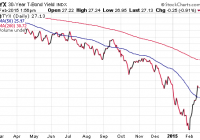
It is hard to believe just how many folks expect the U.S. stock market to rise substantially in the current environment. U.S. stocks and U.S. bonds are extremely overvalued. As long as one has a plan for exiting – rather than foolishly hoping-n-holding – one is able to minimize the risk of remaining invested in overvalued equities. Most people believe that Tom Cruise became an international superstar with the release of the action drama, “Top Gun” back in 1986. However, I remember the actor from an earlier film, “Risky Business.” The popular motion picture capitalized on teenage angst and harebrained ways to make money. In the film itself, the main character, Joel Goodson, turns his family home into a house of ill-repute to finance the repairs of his father’s Porsche – a car that he had been warned not to use, yet inadvertently destroyed. By the end of the movie, increasingly perilous behavior helped Joel get into Princeton, as opposed to him following a straighter-and-narrower path. Fans may recall the risk-taking tagline, “Sometimes you just gotta say, ‘What the Heck.'” In Hollywood, at least for the sake of on-screen comedy, irrational audacity may prove rewarding. In real life, however, investors tend to be compensated for taking reasonable risks. Granted, speculators can sometimes profit from bizarre decisions. Yet an investor who allows over-the-top exuberance to cloud sound judgment typically gets battered by panicky reversals of fortune. Indeed, it is hard to believe just how many folks expect the U.S. stock market to rise substantially in the current environment. Companies are not selling as much as they had anticipated as shown by rising manufacturer, wholesaler and retailer inventories. Companies in the S&P 500 are not profiting as much as executives had hoped either; analysts have been dramatically ratcheting down earnings expectations. Meanwhile, the parade of weak economic reports continue to flow in, from producer prices (excluding food and energy) registering an unexpected decline to smaller-than-expected gains in industrial production. Downward revisions to gross domestic product are a near certainty. What are the implications for the investing public? Sadly, it is a world where the two primary asset classes stateside – U.S. stocks and U.S. bonds – are extremely overvalued. And yet, the choices of how to manage the overvaluation in one’s portfolio are not particularly attractive either. Since there are no meaningful risk-free rates of return in a zero percent interest rate environment, investors have been choosing between risky and riskier alternatives. In one corner, expensive U.S. stocks may continue to appreciate on additional corporate buybacks as well as the possibility of economic acceleration. In the other corner, appallingly low-yielding U.S. bonds may produce total returns that exceed stocks due to the former’s relative value against developed world bonds; most of the developed world’s fixed-income yields are noticeably lower than comparable U.S. maturities. Of the two alternatives, I am still favoring long-term U.S. treasuries in client portfolios. The German 30-year bund yield is under 1%, while the Japanese 30-year is near 1.5%. As silly as those yields are, they are not likely to rise appreciably when the Bank of Japan (BOJ) and the European Central Bank (ECB) are in early stages of bond buying via quantitative easing exercises. Even more alarming? The 30-year yields for France, Canada and Italy are 1.45%, 2.12% and 2.61% respectively. We’re talking about fiscally irresponsible Italy having a lower yield than the U.S. at 2.71%. Does it not make sense to consider long-term U.S. bond exposure via the Vanguard Extended Duration Treasury ETF (NYSEARCA: EDV ) or the PIMCO 25+ Year Zero Coupon U.S. Treasury Index ETF (NYSEARCA: ZROZ ), especially when the 30-year yield has reverted back to a 50-day moving averages? Buying bond dips can be as rewarding as buying stock dips. The increasingly unattractive prospect of robust exposure to U.S. stocks has not kept me from sticking with the trends. My clients will continue to own funds like the iShares S&P 100 ETF (NYSEARCA: OEF ), the Health Care Select Sect SPDR ETF (NYSEARCA: XLV ), the Vanguard Mega Cap Growth ETF (NYSEARCA: MGK ) as well as the iShares MSCI USA Minimum Volatility ETF (NYSEARCA: USMV ) until there is a significant breach of the 200-day moving average on the downside. What-the-heck pricey? You bet. On the other hand, the market can remain insanely effervescent for a whole lot longer than an investor can accept 0% in a money market. As long as one has a plan for exiting – rather than foolishly hoping-n-holding – one is able to minimize the risk of remaining invested in overvalued equities. It is important to recognize, though, that stock uptrends in foreign markets come with lower P/E price-tags. Conservatively speaking, developed world stock assets trade at a 10%-15% P/E discount to the U.S., while broad-based emerging market stock assets may be trading at a 20% to 25% discount. It has been more difficult for me to embrace either the Vanguard FTSE Europe ETF (NYSEARCA: VGK ) or the Vanguard FTSE Emerging Markets ETF (NYSEARCA: VWO ) yet, as both have resistance at their respective 200-day trendlines and both do not have the currency-hedged exposure that I prefer at this moment. In contrast, I have advocated for several months on behalf of the iShares Currency Hedged MSCI Germany ETF (NYSEARCA: HEWG ) on the expectation that as the most successful exporter in the region, Germany will benefit the most from the battered euro. What’s more, HEWG’s uptrend is intact. Disclosure: Gary Gordon, MS, CFP is the president of Pacific Park Financial, Inc., a Registered Investment Adviser with the SEC. Gary Gordon, Pacific Park Financial, Inc, and/or its clients may hold positions in the ETFs, mutual funds, and/or any investment asset mentioned above. The commentary does not constitute individualized investment advice. The opinions offered herein are not personalized recommendations to buy, sell or hold securities. At times, issuers of exchange-traded products compensate Pacific Park Financial, Inc. or its subsidiaries for advertising at the ETF Expert web site. ETF Expert content is created independently of any advertising relationships.

West Port Congestion To Hurt These ETFs

The slowdown at 29 West Coast cargo ports is getting worse with operations having been suspended yet again last weekend. This represents the second partial shutdown at these ports in a week and is the result of an escalating labor dispute with the dockworkers’ union. The International Longshore and Warehouse Union, representing 20,000 dockworkers, has been in negotiations for nine months with the Pacific Maritime Association, with no effective labor deal till now. It is estimated that the partial shutdown will result in a loss of billions of dollars in trade, especially with Asia, hampering trade of electronics, clothes, toys and car parts. Notably, the 29 ports handle nearly half of all U.S. maritime trade and more than 70% of imports from Asia, representing around $1 trillion of cargo a year (read: Is Cheap Oil Driving Transport Earnings and ETFs? ). The conflict is disrupting the supply chain of American exporters, automakers, manufacturers, farmers and retailers, and is taking a toll on consumer goods, food, clothing and other products. It is also leading to higher expenses in the form of additional airfreight cost and other transportation fees that will likely dilute the profit margins of companies. Additionally, the impact has also been felt in the transportation sector due to slower freight traffic by trucks and rails. The National Retail Federation warned that a full strike or lockout at the West Coast ports could cost the economy $2.1 billion a day. Last time, the shutdown of West Coast ports for a 10-day period in 2002 had cost the U.S. economy about $1 billion a day. The situation has placed the retailers, who have to ship their inventories abroad before the busy spring shopping season, in a quandary. The labor strife has put a pause on shipping and may cost retailers as much as $7 billion this year. Notably, the U.S. footwear retail industry, which solely depends on imports, seems in deep trouble (read: Should You Keep Holding the Retail ETFs? ). The agricultural industry is no way behind as exports have fallen as much as 50%. California’s citrus industry has already seen a 25% decline in its export business, losing about $500 million in sales according to the trade group California Citrus Mutual. The deadlock is further threatening the $2.4 billion citrus industry at a time when the demand for California citrus usually peaks. Further, the meat and poultry industry is losing more than $40 million per week, as per the North American Meat Institute. Even if the nine-month labor dispute is resolved, it could take a couple of months for the economy to return to normal. Given this, a number of industries could see further slowdown from this 29-port dispute, pushing down the stocks and ETFs in the coming months. Below, we have highlighted three funds that are in focus. Though these products have a Zacks ETF Rank of 3 or ‘Hold’ rating, these could see rough trading in the days ahead given the port gridlock. iShares U.S. Consumer Goods ETF (NYSEARCA: IYK ) This fund provides exposure to 115 stocks that are engaged in a wide range of consumer goods, including food, automobiles and household goods. It tracks the Dow Jones U.S. Consumer Goods Index and charges 43 bps in annual fees. The fund is highly concentrated on the top five firms with the largest allocation going to Procter & Gamble (NYSE: PG ) at 10.8%, followed by Coca-Cola (NYSE: KO ) and PepsiCo (NYSE: PEP ) with at least 7% share each. All the three firms have an unfavorable Zacks Rank #4 (Sell), suggesting their underperformance in the months to come (read: Coca Cola, PepsiCo Earnings Stir Up Consumer Staples ETFs ). From a sector look, food & beverage accounts for 48.1% while household & personal products, consumer durables and autos & components round off the next three spots with a double-digit allocation. The product has amassed $656.8 million in its asset base and trades in moderate volume of about 72,000 shares a day on average. The ETF is up 1.8% so far in the year. iShares Transportation Average ETF IYT) The ETF tracks the Dow Jones Transportation Average Index, giving investors exposure to a small basket of 20 securities. The product puts heavy focus on the top five firms at roughly 43.2% with the largest allocation going to FedEx (NYSE: FDX ) , Union Pacific (NYSE: UNP ) , and Kansas City Southern (NYSE: KSU ) . The three firms currently carry a Zacks Rank #3 (Hold). From a sector perspective, about half of the portfolio is dominated by railroads while the delivery service sector makes up for nearly 28% share. The fund has accumulated $1.7 billion in AUM while it sees a good trading volume of more than 515,000 shares a day on average. It charges 43 bps in annual fees and has lost over 1% so far this year. iPath DJ-UBS Livestock Total Return Sub-Index ETN (NYSEARCA: COW ) This note tracks the Dow Jones-UBS Livestock Subindex Total Return, which delivers returns through futures contracts on livestock commodities. The benchmark provides 69% exposure to live cattle and the remainder to lean hogs. The product charges 75 bps in fees per year and has amassed $23.9 million in its asset base. It trades in average volume of about 18,000 shares a day, suggesting additional cost in the form of a wide bid/ask spread. The ETN is down 12.1% in the year to date time frame. Bottom Line These products could underperform in the coming months given that the malaise from the West port bottleneck will likely persist even if the dispute is resolved. As a result, investors should stay away from these ETFs for now.

Rising Interest Rates Are Great News For These Bond ETFs

With an improved economy and better employment prospects, a rate hike by the Fed is back on the table for 2015. We have already started to see rates move higher in recent weeks in anticipation of this, as benchmark 10-year debt is now around 2%, a sharp and sudden increase from levels, which were in the 1.65% range earlier in the month. If rates continue in this direction, bond investors will likely see something that they haven’t experienced in a while, losses. With rising rates bond prices will fall, hitting the returns for investors who have big holdings in the fixed income world (see Play Rising Rates with These ETFs ). What’s a Fixed Income Investor to Do? This puts fixed income investors in quite the quandary, as many still desire the stability that comes with bonds, but with the writing on the wall for rates, it is hard to be too optimistic about the space in the near term. However, should we see a burst in market volatility, investors will likely clamor for more bond holdings, putting many investors in a difficult spot. Fortunately, thanks to some relatively new bond ETFs, fixed income investors might have a solution on their hands. These new products are ‘negative duration’ bonds and they actually look to rise in price when rates rise and thus are basically built for a rising rate environment (see 3 Sector ETFs to Profit from Rising Rates ). Currently, there are two such funds both coming to us from WisdomTree. First up, we have the WisdomTree Barclays Aggregate Bond Negative Duration ETF (NASDAQ: AGND ), which has a -5 year duration, and then the WisdomTree BofA Merrill Lynch High Yield Bond Negative Duration ETF (NASDAQ: HYND ) , which has a -7 year duration for those who focus on the junk bond market. More Information These types of funds could be interesting stand alone picks, or ones to pair with other bond holdings as well. For example, an (iShares Core Total U.S. Bond Market ETF (NYSEARCA: AGG )) investor could use AGND in order to bring down their overall duration, while a similar strategy can be used by (iShares iBoxx $ High Yield Corporate Bond ETF (NYSEARCA: HYG )) or (SPDR Barclays Capital High Yield Bond ETF (NYSEARCA: JNK )) investors who are looking to ratchet down their interest rate risk levels with HYND. For more on these funds and how they can be used in a portfolio, watch our short video on the topic below!