Tag Archives: author

The Trouble With Zero

On Tuesday afternoon, West Texas Intermediate Crude is up 6.5%, after having put in large gains the previous two days. Also typical of these types of headline grabbing moves is a parade of portfolio managers on CNBC who traded this exactly right and have no exposure. The point here is not to make a prediction about what oil will do, but to take this as a learning opportunity for market action that very frequently repeats. By Roger Nusbaum, AdvisorShares ETF Strategist As I write this on Tuesday afternoon, West Texas Intermediate Crude is up 6.5%, after having put in large gains the previous two days. Last Thursday it was around $44.58, and right now it is $52.76, which makes for an 18% gain in three trading days. We have watched the decline in crude, noting the slow decline that started in June that then turned into a crash starting at around $75 at Thanksgiving. The circumstances of crashes are always “different”, but the market action is very similar almost every time, and the oil market is showing the same pattern for now. The usual arc is a crash, which triggers an emotional response begetting more selling, and then the extrapolators coming out and telling us why the price move will go much further in the same direction; in this case, there were calls for $25-30 per barrel. Then, for no reason at all, the price turns in the other direction and snaps back very quickly. Also typical of these types of headline-grabbing moves is a parade of portfolio managers on CNBC who traded this exactly right and have no exposure. I imagine that if the move to $52 is sustainable or keeps going, then there will be another parade of portfolio managers on CNBC who all loaded up with overweight positions last Thursday below $45. The point here is not to make a prediction about what oil will do, but to take this as a learning opportunity for market action that very frequently repeats. I made a couple of small changes to the volatility of my energy exposure a couple of months ago, but nowhere close to zero exposure, because while I had no idea how low oil prices would go, the selling was clearly emotional – and emotional selling often stops for no apparent reason, and prices retrace some large portion of the crash very quickly (repeated for emphasis). It would have been great to have loaded up on energy stocks last Thursday, but I didn’t – but by not going to zero, I am capturing the lift that has been happening in the last three days. As one of the big market sectors, energy is a big portion of a diversified equity portfolio – and going to zero, as we’ve talked about many times before, is a big bet, and big bets by definition are risky. I looked at a couple of domestic energy sector ETFs which are both up about 7% in the last three days. Did any of the pundits with zero exposure last week buy today? If so, what happens to those ETFs if oil goes right back down to $44? If they did not buy back in, what will happen to those ETFs if crude goes back to $75 or $100? When do they get back in? This is a great example of why I believe zero is a big bet not worth making. Disclosure: The author has no positions in any stocks mentioned, and no plans to initiate any positions within the next 72 hours. (More…) The author wrote this article themselves, and it expresses their own opinions. The author is not receiving compensation for it. The author has no business relationship with any company whose stock is mentioned in this article. Additional disclosure: The point here is not to make a prediction about what oil will do but to take this as a learning opportunity for market action that very frequently repeats. AdvisorShares is an SEC registered RIA, which advises to actively managed exchange traded funds (Active ETFs). The article has been written by Roger Nusbaum, AdvisorShares ETF Strategist. We are not receiving compensation for this article, and have no business relationship with any company whose stock is mentioned in this article.
Investing For Retirement Using T. Rowe Price Mutual Funds

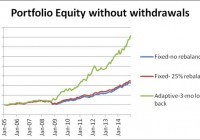
Summary T. Rowe Price offers a set of high-performing mutual funds which can be successfully used for construction of investment portfolios with good withdrawal rates. From January 2005 to December 2014, a T. Rowe Price portfolio with fixed allocation could produce a safe 5% annual withdrawal rate and 7.84% annual increase of the capital. Same portfolio with rebalancing at 25% deviation from the target allowed a safe 5% annual withdrawal rate and achieved 8.48% compound annual increase of the capital. Better performance could be achieved using adaptive asset allocation. Same portfolio could have produced a safe 15% annual withdrawal rate and 6.58% annual increase of the capital. The drawdowns of the portfolios are relatively small considering their high returns. This article belongs to a series of articles dedicated for investing in various mutual fund families. In previous articles, we reported our research on Fidelity and Vanguard mutual fund families. The current article does the same for T. Rowe Price family of mutual funds. Four mutual funds have been selected for investment. They are the following: T. Rowe Price U.S. Treasury Long-Term Bond Fund (MUTF: PRULX ) T. Rowe Price Health Sciences Fund (MUTF: PRHSX ) T. Rowe Price Media And Telecommunications Fund (MUTF: PRMTX ) T. Rowe Price Global Technology Fund (MUTF: PRGTX ) In this article, three different strategies will be considered: (1) Fixed asset allocation: The portfolio is initially invested 40% in the bond fund and 60% equally divided between the stock funds, without rebalancing. (2) Target asset allocation with rebalancing: The portfolio is initially invested 40% in the bond fund and 60% equally divided between the stock funds and is rebalanced when the allocation to any fund deviates by 25% from its target. (3) Momentum-based adaptive asset allocation: The portfolio is at all times invested 100% in only one fund. The switching, if necessary, is done monthly at closing of the last trading day of the month. All money is invested in the fund with the highest return over the previous 3 months. The data for the study were downloaded from Yahoo Finance on the Historical Prices menu for four tickers: PRULX, PRHSX, PRMTX, and PRGTX. We use the monthly price data from January 2005 to December 2014, adjusted for dividend payments. The paper is made up of two parts. In part I, we examine the performance of portfolios without any income withdrawal. In part II, we examine the performance of portfolios when income is extracted periodically from the accounts. Part I: Portfolios without withdrawals In Table 1, we show the results of the portfolios managed for 10 years, from January 2005 to December 2014. Table 1. Portfolios without withdrawals 2005-2014 Strategy Total increase% CAGR% Number trades MaxDD% Fixed-no rebalance 228.89 12.64 0 -28.82 Target-25% rebalance 247.01 13.25 4 -24.54 Adaptive 714.50 23.33 52 -11.57 The time evolution of the equity in the portfolios is shown in Figure 1. (click to enlarge) Figure 1. Equities of portfolios without withdrawals Source: This chart is based on Excel calculations using the adjusted monthly closing share prices of securities From Figure 1, it is apparent that the rate of increase of the adaptive portfolio is substantially greater than the rate of the fixed and target allocation portfolios. Part II: Portfolios with withdrawals Assume that we invest $1,000,000 for income in retirement. We plan to withdraw monthly a fixed percentage of the initial investment. That amount is increased by 2% annually in order to account for inflation. In Table 2, we show the results of the portfolios managed for 10 years, from January 2005 to December 2014. Money was withdrawn monthly at a 5% annual rate of the initial investment, plus a 2% inflation adjustment. Over the 10 years from January 2005 to December 2014, a total of $535,920 was withdrawn. Table 2. Portfolios with 5% annual withdrawal rate 2005-2014 Strategy Total increase% CAGR% Number trades MaxDD% Fixed-no rebalance 128.08 7.84 0 -30.71 Target-25% rebalance 127.68 8.48 4 -29.65 Adaptive 297.64 19.74 52 -14.08 The time evolution of the equity in the portfolios is shown in Figure 2. (click to enlarge) Figure 2. Equities of portfolios with 5% annual withdrawal rates Source: This chart is based on Excel calculations using the adjusted monthly closing share prices of securities To illustrate the effect of the withdrawal rates on the evolution of the capital, we report simulation results for two strategies: fixed target with rebalancing and momentum-based adaptive asset allocation. In Table 3, we report the results of simulations of the fixed target portfolio with the following withdrawal rates: 0%, 5%, 6%, 8%, and 10%. Table 3. Fixed Target Portfolios with rebalancing at 25% deviations for various annual withdrawal rates 2005-2014 Withdrawal rate % Total increase% CAGR% MaxDD% 0 247.00 13.25 -24.54 5 125.77 8.48 -29.65 6 95.96 6.96 -31.23 8 51.06 4.21 -34.16 10 1.32 0.13 -37.14 The time evolution of the equity in the portfolios is shown in Figure 3. (click to enlarge) Figure 3. Equities of fixed target portfolios with rebalancing at 25% deviation from targets and 5% annual withdrawal rates Source: This chart is based on Excel calculations using the adjusted monthly closing share prices of securities To illustrate the advantage of the adaptive allocation strategy and the effect of withdrawal rates on the evolution of the capital, we give in Table 4 the results of simulations for the following withdrawal rates: 0%, 5%, 10%, and 15%. Table 4. Adaptive Portfolios with various annual withdrawal rates 2005-2014 Withdrawal rate % Total increase% CAGR% MaxDD% 0 714.50 23.33 -11.57 5 506.07 19.74 -14.08 10 297.64 14.80 -19.05 15 89.21 6.58 -30.72 The time evolution of the equity in the portfolios is shown in Figure 4. (click to enlarge) Figure 4. Equities of momentum-based portfolios with various annual withdrawal rates Source: This chart is based on Excel calculations using the adjusted monthly closing share prices of securities Conclusion The set of four mutual funds, selected for this study, perform exceptionally well for all three strategies and generate high returns at relatively low drawdowns. Between 2005 and 2015, the fixed target allocation with rebalancing was able to sustain withdrawal rates of up to 10% annually. The adaptive allocation algorithm was able to sustain withdrawal rates up to 15% annually without any decrease of capital. Disclosure: The author has no positions in any stocks mentioned, and no plans to initiate any positions within the next 72 hours. (More…) The author wrote this article themselves, and it expresses their own opinions. The author is not receiving compensation for it (other than from Seeking Alpha). The author has no business relationship with any company whose stock is mentioned in this article. Additional disclosure: This article is the third in a sequence on investing in mutual funds for retirement accounts. To help the reader compare the past performance of various mutual fund families, I selected a benchmark 10-year time interval starting on 1 January 2005 and ending on 31 December 2014. The article was written for educational purposes and should not be considered as specific investment advice.

Best And Worst ETFs Of January

The year 2015 began on quite a volatile note and in fact saw the worst start to the New Year since 2008. Standard & Poor’s 500 index fell 3.1% in January while the Dow Jones Industrial Average lost 3.7% – marking its biggest monthly loss in a year. Concerns about the impact of a stronger dollar and lower oil prices on corporate earnings growth continued to bother investors. Moreover, global growth uncertainty also played foul with both the World Bank and International Monetary Fund having slashed their global growth forecasts. The three factors – oil, the strengthening U.S. dollar and lackluster global economic growth – worked in tandem pushing down corporate profitability for Q4 and the estimates for the current and subsequent quarters. Meanwhile, the Swiss National Bank dropped its long-standing exchange rate of the Swiss franc against the euro adding to the current market volatility. At the same time, the political situation in Greece worsened as the Syriza party won the country’s general elections, raising worries about Greece’s exit from the Euro zone. On the other hand, news that the U.S. consumer sentiment rose in January to its highest level in 11 years on better job and wage prospects and consumer spending in the fourth quarter expanded at the fastest pace since 2006 failed to bring in the much need relief to the U.S. markets. Adding to the woes, the U.S. economy expanded at a slower-than-expected pace of 2.6% during the final quarter of 2014. The pace signaled a slowdown in growth after an expansion of 5% in the third quarter and the 4.6% pace in the second. Given the huge market volatility, ultra-safe bond funds emerged as one of the biggest winners in January as investors rushed in for safety. Not surprisingly, some of the commodity and oil & gas ETFs emerged as losers shedding in the double digits. Best ETFs Volatility ETFs Volatility ETFs were the major gainers amid the ongoing turbulence, as these tend to outperform when markets are falling or fear levels are high for the future. The iPath S&P 500 VIX Short-Term Futures ETN (NYSEARCA: VXX ) has been leading the space with a 17% return in January, closely followed by 16.89% for the C-Tracks Citi Volatility Index ETN (NYSEARCA: CVOL ). VXX is the most popular volatility ETN on the market with an asset base of $937.7 million and average trading volume of 43.1 million shares. The fund tracks the S&P 500 VIX Short-Term Futures Index to provide exposure to a daily rolling long position in the first and second months of VIX futures contracts. The expense ratio came in at 0.89%. Bond ETFs Given the uncertainty in the global market, investors are flocking to safe haven long-term government bonds to protect their portfolio from losses. The PIMCO 25+ Year Zero Coupon U.S. Treasury Index ETF (NYSEARCA: ZROZ ), the Vanguard Extended Duration Treasury ETF (NYSEARCA: EDV ) and the iShares 20+ Year Treasury Bond ETF (NYSEARCA: TLT ) emerged as some of the biggest winners in this space gaining in excess of 9%. ZROZ tracks the BofA Merrill Lynch Long US Treasury Principal STRIPS index and holds 21 securities in its basket. The effective maturity and effective duration of the fund stand at 27.38 years. The fund manages an asset base of $164.2 million and charges 15 bps in annual fees. ZROV has a 30-day SEC yield of 2.30% and is up 16% quarter-to-date. iShares Residential Real Estate Capped ETF (NYSEARCA: REZ ) In the current ultra-low environment, investors in search of juicy yields are continuing to pile up real estate funds which offer attractive payouts. The fund follows the FTSE NAREIT All Residential Capped Index and provides exposure to 37 U.S. residential real estate stocks and real estate investment trusts (REITs). REZ manages an asset base of $347.2 million with a 30-day SEC yield of 3.18% and has returned 8% in the past one month. ETF Losers SPDR S&P Metals & Mining ETF (NYSEARCA: XME ) XME was the biggest loser last month dragged down by weakness within the broad commodity space. The fund lost 12.1% in January and is down 31% in the past one year. XME is the largest and most popular fund in the metals and mining space with an asset base of $370.6 million and is highly liquid with an average trading volume of 2 million shares. The fund tracks the S&P Metals & Mining Select Industry Index to provide exposure to a basket of 35 stocks. The ETF charges 35 basis points a year. SPDR S&P Oil & Gas Equip & Service (NYSEARCA: XES ) The persistent decline in oil prices over the past six months has taken a toll on the overall energy sector as well as on the growth prospects of a number of oil producers. XES tracks the S&P Oil & Gas Equipment & Services Select Industry Index providing exposure to a basket of 52 stocks. Sector-wise, Oil & Gas Equipment & Services occupies 72.3% of fund assets followed by 27.7% to Oil & Gas Drilling. The fund manages an asset base of $169.5 million and has lost 11.5% last month. The fund currently has a Zacks ETF Rank #5 or Sell rating. First Trust ISE-Revere Natural Gas Index Fund (NYSEARCA: FCG ) The fund offers exposure to the U.S. stocks that derive a substantial portion of their revenues from the exploration and production of natural gas. It follows the ISE-Revere Natural Gas Index and holds 28 stocks in its basket, which are well spread out across each component with none holding more than 7% of assets. The fund has gathered an AUM of $240 million so far and sees good average daily volume of over 1.3 million shares. The fund has shed 10.5% in January and currently has a Zacks ETF Rank #5 or Sell rating.