Tag Archives: undefined

The Little Worm That Is Destroying Capitalism

By Jason Voss, CFA In response to the Great Recession, central banks continue to engage in massive monetary stimulus to artificially depress the costs of capital. Many commentators have expressed concerns (and I concur) about the inflationary forces they believe must naturally be building up because of this stimulus. Yet, very few commentators have discussed the consequential little worm that is destroying capitalism, and the mindset thus birthed. Costs of Capital Generations of business schools have taught – and business leaders have implemented – capital budgeting philosophies based on expected rates of returns and weighted average cost of capital (WACC). First, cash flows over a time horizon are estimated for a proposed project. On the positive cash-flow side, these may include additional revenues created or future expenses saved. Either way, there is some benefit to a business of the proposed project. Netted against these benefits are the negative cash flows – the expenses – that are expected to be incurred to implement the project. Next, the net flows over time are discounted by the WACC, and the assumed risks of successfully implementing the project are built into this discount rate. If the net present value (NPV) of this calculation is positive, then businesses are supposed to proceed with the project. Still, others prefer to compare their expectations for internal rate of return (IRR) to the WACC. Either way, the process is the same. The Little Worm But this entire framework has a problem – the little worm that is destroying capitalism, albeit slowly. Namely, in calculating cost of debt and cost of equity for businesses, market-based rates are used, and with the misnamed “risk-free rate” serving as the root of all other costs of capital. What happens though when central banks’ loose monetary policy creates too much capital and artificially holds down root costs of capital? Companies adjust their required rates of return down, too. In fact, one could argue that this is a principal reason for why central banks are holding root costs of capital so low: to spur business investment. Yet when WACC is held artificially low, many projects are accepted that previously would never have been considered viable under normal circumstances. Put another way, the problem is using relative values – not absolute values – in calculating costs of capital. Examples of such projects providing marginal benefits are: improving financial reporting systems through better information technology, minor tweaks to supply chain logistics, cutting back on marketing or increasing low-cost advertising (like social media), “rationalization” of head count, holding average wages as low as possible, squeezing suppliers a little bit, not repatriating earnings to stave off taxation, refinancing rather than retiring debts, and the share buyback that is insensitive to a company’s current stock price. I could go on. It is not that these marginal WACC projects are unworthy and shouldn’t be done, it is that the lifeblood of capitalism is creative destruction. It is fiery and intense. Capitalism is supposed to be more like a volcano than a hot plate keeping the coffee warm! Evidence that the worm is eating away at capitalism is that revenues continue to grow much more slowly than do earnings per share (EPS) . Furthermore, revenues continue to miss consensus estimates even though EPS continue to beat estimates. Also, EPS continue to grow so quickly due mostly to a shrinking denominator (i.e., big share buybacks). Ask yourself: When was the last time you heard genuine risk-taking behavior on the part of your portfolio of businesses? I think you will agree that only a handful of companies are engaged in proper game-changing capitalistic risk taking. Normalized Cost of Capital In the developed nations, I estimate a normalized long-term project after-tax WACC of around 6.5%, versus an estimated late 2014 WACC of only 3.0%. Even if you disagree with my estimates, I believe if you calculate your own, you will find that current costs of capital are about less than half of a normalized figure. That means you should expect at least 100% more projects being approved than under normal cost of capital scenarios. Yet this high figure may actually understate the number of excess projects being funded. This is because as cost of capital asymptotically approaches zero (i.e., ” to negative nominal yields and beyond!” ), the actual number of projects thought of as viable may follow a power law distribution instead of behaving linearly. In other words, businesses are currently in the process of destroying what was, once upon a time, a precious resource to be conserved: capital. A Remedy? If you agree with me, I propose, as a simple remedy, that costs of capital for a business begin to be evaluated on an absolute, normalized basis, rather than on a relative basis. And, I would add, treating externalities as free/not considering economic, social, and governance (ESG) is not going to cut it either. As a shareholder – or prospective shareholder – you do not need to wait for a company to engage in this behavior. Instead, you can begin to use normalized costs of capital in your own estimates of fair value. This may shrink your universe of investible assets, so be wary of diversification being worse. Fear the Worm My big fear is that even once costs of capital begin to rise/normalize, a generation of gutless business leaders is being hatched in the current gutless business culture. In short, artificially low costs of capital are eroding the capitalist’s risk-taking, return-generating mindset. Yikes! In conclusion, which company would you rather invest in: the one using normalized costs of capital in capital budgeting, or the company just using traditional methods? Thought so! Disclaimer: Please note that the content of this site should not be construed as investment advice, nor do the opinions expressed necessarily reflect the views of CFA Institute.
Improve Your Sector Returns With Equal Weighting

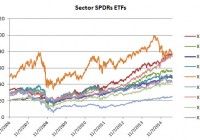
Summary Sector ETFs are great trading vehicles, but they are not weighted the best way for you. Equal weighting is always better than capitalization weighting. The problem with the existing equally-weighted ETFs is that they have too many stocks. You can do it yourself with fewer stocks and get better returns. There is no doubt that ETFs are a good way to invest. They reduce your exposure to the ups and downs of a single stock and avoid having to choose which stock in a sector is going to be the best next year. It turns out there is an easy way to get the same protection, better returns, and lower risk, doing it yourself. It goes back to understanding equal weighting versus capitalization weighting, but it doesn’t try to replicate the entire sector, it just focuses on the larger, more liquid stocks. Sector SPDRs are capitalization weighted, the same as the S&P. They deliver exactly what is expected, the portion of the S&P representing that sector, using the same calculations. We can’t evaluate every sector, so we’ll look at the best, Health Care (via the Health Care Select Sect SPDR ETF (NYSEARCA: XLV )) and one of the worst, Energy (via the Energy Select Sector SPDR ETF (NYSEARCA: XLE )). The chart below shows the performance of the major sector SPDRs since late 2006. If you combine them all, you get returns similar to the SPDR S&P 500 Trust ETF (NYSEARCA: SPY ). Equal weighting is not a new idea and the advantages are well known. Equal weighting maximizes diversification; therefore, it reduces risk. If you weight by capitalization, or any other scheme, then some stocks have greater exposure in the portfolio. For that to work, those stocks must have proportionately greater returns. Unfortunately, we don’t know that. It may turn out, strictly by chance, that the stock with the largest exposure also had the biggest returns. But the chances of that are small. The safest portfolio, and normally the most stable, is the one that has equal dollar exposure to each stock. In 2006, Guggenheim introduced ETFs that matched the sector SPDRs but were equally weighted. If there are 55 Health Care stocks in XLV then there are 55 stocks in the Guggenheim S&P Equal Weight Health Care ETF (NYSEARCA: RYH ). Similarly, there are 49 stocks in XLE and 49 in the comparable Guggenheim S&P Equal Weight Energy ETF (NYSEARCA: RYE ) . When we compare the returns of the SPDRs and the Guggenheim sectors, we see that the equally-weighted sectors performed slightly better. The information ratio, the annualized returns divided by the annualized risk, shows a similar pattern. Data source : CSI Is this what the investor, you and me, really wants? I would rather have a sector ETF that performed better than the weighted average of all the stocks in that sector, and we can do that. Components of XLV and RYH The Health Care SPDR, XLV, has 55 components, shown in the chart below in order of descending weights, with Johnson & Johnson (NYSE: JNJ ) at the top of the list with an allocation of 9.68%, and the 26 companies on the right all below allocations of 1%. Let’s look at the 9 on the left, representing 50% of the total weight of the XLV. Their performance from January 2010 is also shown below. (click to enlarge) Data source : sectorspdr.com Data source : CSI Nine stocks represent 50% of the index and the remaining 46 make up the other 50%. The smaller 50% are generally much less liquid, which tends towards greater relative volatility. More important, if we use them in an equally-weighted portfolio, will we be emphasizing companies that are very small and not representative of the performance we are seeking? Remember, we don’t care about duplicating the S&P, we are looking for better returns. Equally Weighting the Top 50% We’re going to select only a few of the stocks with the highest capitalization in the XLV, those that make up 50% of the index. Those are the 9 stocks shown in the previous chart. We’ll dollar weight them equally, then compare the results of XLV with the capitalization and equally-weighted versions using the smaller group of 9 stocks. The results are impressive. By discarding the smallest components of the index, you can increase returns significantly and reduce risk at the same time. The numbers can be seen in the Table below. Besides looking at the rate of return (AROR), the ratio of returns to risk shows that equal weighting had the best investment profile. Data source : CSI The Health Care Industry has taken off since 2008, not coincidentally timed with the passing of the Affordable Care Act. We’re not judging the merits or good intentions of that Act, but it gave the health care companies an opportunity to raise prices in advance of services, and maintain those high prices; hence, large and continued profits. Given the aging population, the industry should continue to prosper, although it seems unlikely that it could continue at this rate. The Energy Sector: XLE and RYE The Health Care sector may be an outlier, given its exceptional performance. While the energy stocks have seen wide ranging price swings, the net effect is nearly the worst performance of all sectors, certainly the highest risk. Does equally weighting the top members of this sector also improve returns? In this case we’ll choose the top 10, representing 60% of the allocations, because it’s a similar number of stocks and the allocations to energy stocks vary much more. We don’t think it makes any real difference if you use 50% or 60% of the weighting. Going through the same steps as with Health Care, we first compare the SPDR XLE with Guggenheim’s RYE in the chart below. In this case the XLE outperforms since 2010; however, the pattern is very similar. Data source : CSI We then take the 10 stocks that represent the top 60% of the XLE allocation and equally weight them. We construct cap-weighted and equally-weighted portfolios from 2010 using the same weighting as XLE. The results, in the chart below, show that equal weight again outperforms cap weighting. The numbers, also in the table that follows, shows a similar picture of higher returns and a better reward to risk ratio. Data source : CSI Doing It Yourself There is no magic in equally weighting a small number of stocks. You want enough companies to give diversification, but none of the low-cap ones. The weighting of the XLV and XLE will change regularly, but since we will be equally weighted, that won’t matter. Only the specific stocks in the top 9 for Health Care, and the top 10 for Energy will be used. “Equal” means allocating an equal dollar amount for each stock. Then an investment of $100,000 in 9 stocks means putting $11,111 into each, not much of a strain on the liquidity of these companies. JNJ at $99 would get 112 shares and Pfizer (NYSE: PFE ) at $34.50 would be allocated 322 shares. They should be rebalanced quarterly. Current Holdings The current top 50% holdings of the Health Care and 60% Energy sector ETFs are: (click to enlarge) Disclosure: The author is long XLV. (More…) The author wrote this article themselves, and it expresses their own opinions. The author is not receiving compensation for it (other than from Seeking Alpha). The author has no business relationship with any company whose stock is mentioned in this article.

Debt Ratios And Pension Ratios: Connecting The Dots Between Them

A company with too much debt is like a tall vase with a narrow base. Everything looks fine until you kick the table, at which point it falls over and explodes into thousands of pieces. In an attempt to avoid companies that might explode, I always look for those with “prudent” amounts of debt. At the same time, I try not to be so restrictive that I can’t find anything to invest in. Avoiding companies with too much debt Over the years, I’ve defined “prudent” in several different ways, but my current rules of thumb for interest-bearing debts are: Only invest in a defensive sector company if its Debt Ratio is less than 5 Only invest in a cyclical sector company if its Debt Ratio is less than 4 (doesn’t apply to banks) The Debt Ratio , for reference, is the ratio between the company’s current total borrowings and its 5-year average post-tax profit (preferably normalised or adjusted profits). There is no magic to this; it’s just an approach which I’ve found to be reasonably good at differentiating between companies that are going to run into trouble because of their debts, and those that aren’t (I think I first read it in “Buffettology”, a book I highly recommend). Another financial obligation I’ve kept an eye on for the last few years is defined benefit pension schemes. Many companies don’t have one, but if a company does have one then in most cases (possibly all) it is legally obliged to ensure the pension scheme is well funded. If the pension scheme’s assets do not cover its long-term liabilities, the scheme will have a pension deficit and the company will have a legal obligation to close that deficit at some point. That will often mean shovelling cash into the fund, which means less cash for dividends or other things that create shareholder value. Avoiding companies with excessively large pension obligations I have a rule of thumb for pension obligations as well, just because I like to systemise my decision-making as much as possible. The rule is: Only invest in a company if its Pension Ratio is less than 10 The Pension Ratio is more or less the same as the Debt Ratio, only this time the company’s total defined benefit pension obligations are compared to its 5-year average post-tax profit. So far I’ve always looked at the Debt and Pension Ratios separately; I guess because I never thought about joining the dots, and because I haven’t seen anyone else look at debt and pension liabilities as two sides of the same coin. But last week, when I was reviewing my latest sell decision (June was a “sell” month for me), I noticed that the company in question ( Serco ( OTCPK:SECCF ) ( OTCPK:SECCY ), which I’ll write about soon) had both high levels of debt and a relatively large pension obligation. Specifically, Serco had a Debt Ratio of 5.2, which is too high according to my rules of thumb (Serco is in a cyclical sector and should have, by my rules, a Debt Ratio below 4). That alone would be enough to make me avoid buying the company, although not enough to make me sell it. It also had a Pension Ratio of 8.2, which is okay according to my Pension Ratio rule of thumb, but it’s pretty close to the limit of 10. That got me thinking. What if Serco had a slightly lower Debt Ratio? What if its Debt Ratio was 3.8 and its Pension Ratio was 8.2? That would be “okay” according to my rules of thumb, but is that a sensible outcome? Treating debt and pension obligations as interdependent risks If a company carries interest-bearing debts, then it will need to use cash to pay the interest on those debts. On the other hand, if a company has a large pension obligation then it either has, or could potentially have, a large pension deficit, and that would also require large amounts of cash to clear. Since there is only so much cash to go around, I think it’s sensible to look at these two financial obligations together, rather than in isolation. I don’t have some magical answer that will tell me exactly what a prudent amount of debt is for a company with a particular pension liability, or vice versa. However, I can take a reasonable guess, and refine it from there with experience. So my first stab at a rule of thumb which treats debt and pension obligations as if they impacted one another (because they do) is this: Only invest in a company if the sum of its Debt and Pension Ratios is less than 10 It isn’t rocket science, but I think it’s a good place to start. If, for example, a company has “medium” levels of debt, with a Debt Ratio of perhaps 3, then I would buy it (after a detailed analysis , of course) if its Pension Ratio is below 7. Or, if a company has a pension ratio of 8 then I’ll only buy it if the Debt Ratio is below 2. I think that should give me a fair balance between ruling out companies with excessive obligations, without being so restrictive as to rule out companies that are perfectly capable of handling their current situation. Of course, you may or may not use the same ratios as I do, but even if you don’t, I think treating debt and pension obligations as interdependent risks is still a sensible thing to do.