Tag Archives: undefined

Momentum And Stop Losses

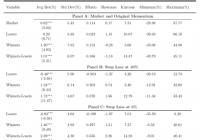
Stop losses are a form of trend following in which you switch from risky assets, such as stocks, to a risk-free or fixed income asset after there are pre-determined cumulative losses. The random walk hypothesis (RWH) was widely accepted in the 1960s and 1970s. It was synonymous with market efficiency. It effectively eliminated any academic interest in stop loss rules. Under RWH, with stock returns being independent, stop losses would decrease a strategy’s expected return. There remains a cultural affinity to RWH despite strong contrary evidence now. This may explain why there is still considerable indifference to stop loss policies and trend following in general among institutional investors, who were schooled in old academic ideas. In their paper, ” When Do Stop-Loss Rules Stop Losses? “, Kaminski and Lo (2013) show both theoretically and empirically that if stock returns have positive serial correlation (there is overwhelming evidence that they do), then stops can add value. Over monthly intervals of daily stock futures data from 1993 through 2011, the authors found that volatility-based stop loss rules could increase monthly returns 1.5% while substantially decreasing volatility. When stopped out of stocks, long-term bond futures are used as a safe harbor asset. In ” Taming Momentum Crashes: A Simple Stop-Loss Strategy “, Han, Zhou, and Zhu (2014) showed the effectiveness of a stop loss overlay applied to a momentum-based strategy. The authors examined the top decile of U.S. stocks from 1926 through 2011 based on relative strength momentum over the preceding 6 months (the authors showed similar results using 12-month momentum). They sold any stock if it dropped 10% below the beginning price of the month. They followed the same procedure for short positions. Portfolios were rebalanced monthly. This stop loss strategy raised the average monthly return from 1.01% to 1.73% (buy and hold was 0.62%) and reduced the monthly standard deviation from 6.07% to 4.67%. [1] Momentum crash risk (from short positions) was completely eliminated. The worst monthly return for buy and hold was -28.98%, while the worst monthly return for an equally weighted momentum strategy was -49.79%, showing the increased risk of applying momentum to individual stocks. The stop loss overlay improved the worst monthly return to only -11.34%. For value weighted portfolios, the maximum monthly loss for momentum and stop loss portfolios were greater at -65.34% and -23.69%, respectively. Average returns and Sharpe ratios doubled by using stops. This stop loss strategy had a positive skewness of 1.86, versus a negative skewness of -1.18 for the original momentum strategy, indicating a dramatic reduction in left tail risk when using stops. Both these papers show theoretically and empirically that risk control overlays, such as stop loss rules, can have dramatically positive effects on momentum-based strategies. This applies also to other trend following forms of risk control, such as moving average filters and absolute momentum, that may work as well or better than stops (the subject of a future post). Stop losses and other trend following methods are a way to head off some of the usual pitfalls of human judgement, such as the disposition effect, loss aversion, ambiguity aversion, and flight to safety. There is no reason why they should not be used by all momentum investors. [1] Stop loss strategies increased trading activity by 40%, but increases in return of about 70% helped overcome these high transaction costs.

The Monsters Under The Bed Are Real For Consumer Staples Stocks

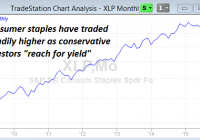
[ Editors Note: This is part one of our series on consumer staples stocks. Stay tuned for additional segments over the next few days.] Consumer staples stocks are considered some of the safest and most reliable equity investments available. Yet in today’s market, these stocks have hidden risks that could lead to serious losses for many conservative investors. Companies in the consumer staples category sell products that are used by consumers in both good times and bad. For example, shoppers aren’t likely to quit buying toothpaste, deodorant, and toilet paper just because their income dropped or they’re tightening the budget. Income investors love consumer staples stocks because the reliable businesses typically support robust dividend payments. In today’s low interest rate environment, these dividend payments are especially attractive to conservative investors who need income from their investment accounts. For the most part, consumer staples stocks are large blue-chip businesses with decades (if not centuries) of profitable operation. A long track record of profits make these stocks attractive for investors who want stability. In the investment business, professionals often overweight consumer staples stocks in the accounts of their most conservative investors. These “widow and orphan” stocks are supposed to be extremely safe for conservative customers. But today, these investments are likely to trade sharply lower. It’s a tragedy that the investors who can least afford to lose money will likely be the ones bearing the brunt of the losses over the next several months. While investors have been able to ignore these risks for quite some time now, the “monsters under the bed” are real (and very dangerous) when it comes to these traditionally safe investments. Two Major Risks For Consumer Staples Consumer staples stocks will likely trade sharply lower over the next few months because of two major factors: Extremely High Valuations Reach For Yield Unwind A stock’s earnings valuation tells us how much investors are willing to pay for a company, compared to how much profit that company will generate. According to Yardini Research Inc., the consumer staples sector is trading at a forward price/earnings (PE) ratio of 19.2. In other words, investors are paying $19.20 for every dollar that will be earned next year. This is the highest valuation seen in more than 15 years (since the dot-com bubble) . Part of the reason why consumer staples are trading at this high valuation is because income investors are reaching for yield . We all know that the Fed has kept interest rates at extremely low levels for years. While this may have helped to support the U.S. economy, an environment of low rates has hurt savers. Conservative investors who held money in CDs and other deposit accounts couldn’t generate as much income with rates lower. The only choice for many of these investors was to buy stocks that paid dividends. And since these investors were conservative by nature, the consumer staples sector was a natural place for them to invest their “safe” money into. The multi-year chart of the Consumer Staples Select Sector SPDR ETF (NYSEARCA: XLP ) below shows how this group of stocks has traded steadily higher over the period in which the Fed has kept rates at essentially zero. After a fantastic 6-year rally, the bullish trend for consumer staples is coming to an end. Valuations cannot be stretched much further, and a shift in the Fed’s interest rate policy spells trouble for this important group of income stocks. A New Era for Interest Rates During the financial crisis, the Federal Reserve lowered its federal funds target rate to a range between 0% and 0.25%. This target rate has significant influence over other interest rates including deposit accounts, mortgages and even bond yields. The Fed has kept the rate low in an effort to make cash cheap for financial institutions and to encourage lending. There’s also a strong argument that the Fed lowered rates in an attempt to inflate the stock market (making it easier for institutional investors to borrow cheaply and buy shares of stock – sending market prices higher). A discussion of Fed policy is outside the scope of this article. But suffice it to say that a period of low rates has helped to boost stock prices for consumer staples. And a reversal of that policy will likely have a very bearish effect on this sector. During the month of May, the U.S. economy added another 280,000 jobs. This figure came in well ahead of economists’ expectations. Meanwhile, the number of job openings in the U.S. rose to 5.4 million – the highest reading recorded since the Bureau of Labor Statistics started tracking the data in 2000. A strengthening labor market should lead to a Fed decision to raise rates this year. Already, traders are pricing in a probable rate hike when the Fed meets in September. Mortgage rates are already moving higher in anticipation of this hike, with the average rate on a new 30-year fixed mortgage now above 4%. Unwinding of the Reach For Yield When rates move higher, conservative investors will have more options for generating income. In particular, deposit accounts and treasury bonds will see their yields rise. When faced with a choice between stocks that pay a particular yield – and could lose value, and deposit accounts with a similar yield – which cannot lose value, the most conservative investors are likely to opt for the deposit accounts. As these conservative investors move cash out of dividend stocks like consumer staples, and into deposit accounts, the stock prices for this sector will likely decline sharply. We’ve been warning about this reach for yield unwind since our April alert, Don’t Touch That Blue Chip Dividend Stock! Looking at the daily chart for consumer staples below, we can see that the group has already started breaking down as investors anticipate higher interest rates. While consumer staples stocks have traditionally been a great source of stable income for investors, the current market environment makes this sector very dangerous. We’re encouraging investors to take profits in these stocks and avoid the area for the next several months. Once the sector trades lower and valuations are back to more attractive levels, it may be a great time to reinvest capital into this group. But for now, the “widow and orphan” stocks are some of the most dangerous investments in the market. Below is a list of the top stocks included in the consumer staples ETF as compiled by Morningstar. This is a good list to start with when reviewing your portfolio for exposure to consumer staples stocks. In addition to reducing exposure to consumer staples stocks, tactical traders may want to set up bearish trades to profit from a decline. Shorting shares of these stocks with a tight stop, or entering bearish spread trade with options are just two of the ways traders can profit from falling stock prices. In our next installment in this series, we’ll start looking at individual stocks in this group. In the meantime, we’d love to hear your thoughts on consumer staples. Please use the comment section below to let us know your thoughts on this group.
Don’t Follow The News? More Like Don’t Overreact To The News

Tadas Viskanta has a great blog post up titled Make More By Doing (and listening) Less. The general tone of the article is the extent to which investors too frequently are influenced by stock market media enough that they make changes to their portfolio. An additional bigger point made is that people are generally better off doing less in their portfolios not more. Tadas Viskanta has a great blog post up titled Make More By Doing (and listening) Less . The general tone of the article is the extent to which investors too frequently are influenced by stock market media enough that they make changes to their portfolio that end up being the wrong thing to have done. An additional bigger point made is that people are generally better off doing less in their portfolios not more. This is in line with an idea we have discussed here many times which is that if you go along with the market and have an adequate savings rate you have a good chance of having enough for your financial goal which presumably is retirement. This idea is not meant to ignore suitable asset allocation but to have the building blocks of how equity markets tend to work, they go up most of the time and every so often they go down a lot and scare the hell out of lot of people. From there an investor or advisor can employ some sort of strategy they believe will add value to their portfolio in whatever manner they believe is appropriate and over whatever period of time they find relevant. I personally believe in using individual stocks and ETFs, trying to increase the portfolio’s yield a little, maintain global diversification and take defensive action when risks of a large decline appear to increase. You, reading this likely have your own thoughts on how value might be added to a portfolio. Chances are that whatever your philosophy on investing is (so investing, not trading), an earnings report from a small cap social media company or the subsequent discussion about those earnings on stock market television does not play into that philosophy. Tadas’s point is in part that it can be easy to be compelled to stray out of your lane by what sounds like a good story or to get scared out of something in front of what turns out to be a 2% dip that a month from now won’t be visible in a chart. However, it is different for advisors. Although they probably should, the typical advisory client is probably not reading Tadas’s blog and they are prone to reacting to all sorts of news. We all have things we react to, that is ok so the conversation then becomes about having the self-awareness to know you’re a sucker for a good story or prone to overreact to bad news or something else. For the do-it-yourselfer it probably is a good idea to avoid media that leans sensational but I do believe in knowing what is going on in the world. Maybe this means avoiding most stock market television as well as taking control of what you’re vulnerabilities are. Advisors though need to be able to address questions that come up from clients. It is reasonable for clients to ask about anything, it’s their money and part of what they are paying for is the occasional hand holding in the form of understanding a news event (will rising rates hurt my portfolio or what happens if Greece goes under) and being able to explain whether it is or is not important and whether or not it impacts the strategy. This is harder to do for an advisor who consumes no news. Some will be able to have an effective dialogue with their client in this context without actually knowing the story but it is more difficult to do. Additionally while an advisor is presumably all in on whatever strategy they deploy for clients there are market environments where their strategy will struggle versus whatever their clients are seeing and hearing about from their friends. And picking your head up and looking around occasionally is a way to address these conversations more easily as well. I would say as opposed to not following the news, it might be better to train yourself to not overreact to the news. Disclosure: The author has no positions in any stocks mentioned, and no plans to initiate any positions within the next 72 hours. (More…) The author wrote this article themselves, and it expresses their own opinions. The author is not receiving compensation for it. The author has no business relationship with any company whose stock is mentioned in this article. Additional disclosure: To the extent that this content includes references to securities, those references do not constitute an offer or solicitation to buy, sell or hold such security. AdvisorShares is a sponsor of actively managed exchange-traded funds (ETFs) and holds positions in all of its ETFs. This document should not be considered investment advice and the information contain within should not be relied upon in assessing whether or not to invest in any products mentioned. Investment in securities carries a high degree of risk which may result in investors losing all of their invested capital. Please keep in mind that a company’s past financial performance, including the performance of its share price, does not guarantee future results. To learn more about the risks with actively managed ETFs visit our website AdvisorShares.com .