Tag Archives: undefined

IJR’s 2015 2nd-Quarter Performance And Seasonality
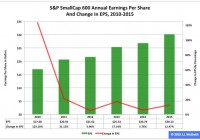
Summary The iShares Core S&P Small-Cap ETF in the first half ranked No. 2 among the three most popular exchange-traded funds based on the S&P Composite 1500’s constituent indexes. In the second quarter, the ETF’s adjusted closing daily share price climbed 0.17 percent. And in June, the fund’s share price rose 1.06 percent. The iShares Core S&P Small-Cap ETF (NYSEARCA: IJR ) during 2015’s first half was second by return among the three most popular ETFs based on the S&P Composite 1500’s constituent indexes: It advanced to $117.88 from $113.33, a gain of $4.55, or 4.02 percent. Over the same period, IJR performed worse than the SPDR S&P MidCap 400 ETF (NYSEARCA: MDY ) by -0.06 percentage point and better than the SPDR S&P 500 ETF (NYSEARCA: SPY ) by 2.91 percentage points. IJR last quarter lagged SPY by -0.06 percentage point and led MDY by 1.29 percentage points. And most recently, IJR last month outpaced MDY and SPY by 2.34 and 3.07 percentage points, respectively. Comparisons of changes by percentages in SPY, MDY, IJR, the small-capitalization iShares Russell 2000 ETF (NYSEARCA: IWM ) and the large-cap PowerShares QQQ (NASDAQ: QQQ ) during the first half, over Q2 and in June can be found in charts published in “SPY’s 2015 2nd-Quarter Performance And Seasonality.” Figure 1: S&P 600 EPS , 2010-2014 Actual And 2015 Projected (click to enlarge) Notes: (1) Estimates are employed for the 2015 data. (2) The EPS scale is on the left, and the change-in-EPS scale is on the right. Source: This J.J.’s Risky Business chart is based on analyses of data in the S&P 500 Earnings and Estimate Report released June 30. IJR may have done OK in the first half, but the ETF might have a hard time doing OK in the second half, with the analysts’ average 2015 earnings-per-share estimate for the S&P 600 index underlying the fund sliding to $30.13 June 30 from $33.60 March 31, as indicated by Howard Silverblatt, senior index analyst at S&P Dow Jones Indices, in the S&P 500 Earnings and Estimate Report series this year (Figure 1). I believe this EPS estimate continues to be unrealistic, as it would require growth of 12.47 percent over last year, so I think there will be more downward revisions in this estimate, which collectively will not constitute an IJR tailwind. In an attempt to put the S&P 600’s valuation in perspective, I calculated the index’s price-to-earnings ratio a couple of different ways based on its closing level of 717.55 Thursday. First I employed its actual EPS of $26.79 in 2014 to produce a P/E ratio of 26.78, and then I used its estimated EPS of $30.13 in 2015 to produce a P/E ratio of 23.82. Because I am a growth-and-value guy who does not anticipate a whole lot of earnings growth this year, I am underwhelmed by this overvaluation, especially at a time when the U.S. Federal Reserve is not expanding its balance sheet by making asset purchases under a quantitative-easing program. Figure 2: IJR Monthly Change, 2015 Vs. 2001-2014 Mean (click to enlarge) Source: This J.J.’s Risky Business chart is based on analyses of adjusted closing monthly share prices at Yahoo Finance . IJR behaved a lot worse in the first half of this year than it did during the comparable periods in its initial 14 full years of existence based on the monthly means calculated by employing data associated with that historical time frame (Figure 2). The same data set shows the average year’s weakest quarter was the third, with a relatively small negative return, and its strongest quarter was the fourth, with an absolutely large positive return. Figure 3: IJR Monthly Change, 2015 Vs. 2001-2014 Median (click to enlarge) Source: This J.J.’s Risky Business chart is based on analyses of adjusted closing monthly share prices at Yahoo Finance. IJR also performed a lot worse in the first half of this year than it did during the comparable periods in its initial 14 full years of existence based on the monthly medians calculated by using data associated with that historical time frame (Figure 3). The same data set shows the average year’s weakest quarter was the third, with a relatively small positive return, and its strongest quarter was the fourth, with an absolutely large positive return. Disclaimer: The opinions expressed herein by the author do not constitute an investment recommendation, and they are unsuitable for employment in the making of investment decisions. The opinions expressed herein address only certain aspects of potential investment in any securities and cannot substitute for comprehensive investment analysis. The opinions expressed herein are based on an incomplete set of information, illustrative in nature, and limited in scope. In addition, the opinions expressed herein reflect the author’s best judgment as of the date of publication, and they are subject to change without notice. Disclosure: I/we have no positions in any stocks mentioned, and no plans to initiate any positions within the next 72 hours. (More…) I wrote this article myself, and it expresses my own opinions. I am not receiving compensation for it (other than from Seeking Alpha). I have no business relationship with any company whose stock is mentioned in this article.

All That Crap About Not Panicking?

Markets were down on Monday, of course; right now the S&P 500 is at 2057, right around where it started the year. In a way, we have no idea what will happen; and in a way, we know exactly what will happen. More importantly, we know that whenever the market finishes going down, it will then go up and make a new high with the variable being how long it takes. By Roger Nusbaum, AdvisorShares ETF Strategist It is still true. As I write this post Monday after the close, there is still a lot of uncertainty on how Greece will precisely play out. Markets were down on Monday, of course; right now the S&P 500 is at 2057, right around where it started the year and is flirting with its 200 day moving average. We have seen this sort of thing many times before, and after this clears up, there will be other big scary events , a term Ken Fisher has used previously. In a way, we have no idea what will happen; and in a way, we know exactly what will happen. As I write this, again on Monday afternoon, we don’t know when the global selling in equities will end (it might already be over by the time this post is published); we don’t know whether or not China, Puerto Rico or anything else will pile on to send markets lower, even into a bear market (this is not a prediction). This could be serious or it could be one of the many big scary events that are quickly forgotten; we don’t know. We do know that the media will overreact. More importantly, we know that whenever the market finishes going down, it will then go up and make a new high, with the variable being how long it takes. The FTSE 100 recently eclipsed a high dating back to 2000; of course the NASDAQ broke its high from 2000 as well. At some point, the Nikkei will break the high from 1989, but again, no one knows when. There are different implications for different types of market participants, but they all revolve around the same things; not panicking and sticking to the strategy you thought would be a good idea when things hit the fan as they occasionally do. People in the accumulation phase need to keep accumulating. While the FTSE did just make a new high from 2000, that index has about doubled since 2009, so someone who kept accumulating should have caught most of that up move with the equity portion of their portfolio. People in the withdrawal phase should be prepared to take defensive action if that is the strategy they laid out for themselves ahead of time, or stand pat if that is the strategy they laid out for themselves ahead of time. A defensive strategy, which is what I believe in doing, offers the opportunity to make it a little easier emotionally to ride out large declines (remember, at this point we have no idea whether a large decline is coming) and standing pat (save for rebalancing) relies on remembering ahead of time that large declines will be uncomfortable, but that they end and then markets recover, with the only variable being how long it takes; repeated for emphasis. I realize none of this is new and at a high level this is something everyone knows, but knowing and doing can be two different things. Hopefully, a reminder is useful. Editor’s Note: This article discusses one or more securities that do not trade on a major U.S. exchange. Please be aware of the risks associated with these stocks. Disclosure: I/we have no positions in any stocks mentioned, and no plans to initiate any positions within the next 72 hours. (More…) I wrote this article myself, and it expresses my own opinions. I am not receiving compensation for it. I have no business relationship with any company whose stock is mentioned in this article. Additional disclosure: To the extent that this content includes references to securities, those references do not constitute an offer or solicitation to buy, sell or hold such security. AdvisorShares is a sponsor of actively managed exchange-traded funds (ETFs) and holds positions in all of its ETFs. This document should not be considered investment advice and the information contain within should not be relied upon in assessing whether or not to invest in any products mentioned. Investment in securities carries a high degree of risk which may result in investors losing all of their invested capital. Please keep in mind that a company’s past financial performance, including the performance of its share price, does not guarantee future results. To learn more about the risks with actively managed ETFs visit our website AdvisorShares.com .

Book Review: Quantitative Value

Wesley Gray, manager of the ValueShares US Quantitative Value ETF (BATS: QVAL ), may very well be the most interesting quant you’ll ever meet. Granted, the word “quant” brings to mind an old man in a white lab coat stooped over reams of data, but hear me out. Before getting his PhD in finance from the University of Chicago, Gray did four years of service as an active-duty U.S. Marine Corps ground intelligence officer in Iraq and other posts throughout Asia. Quantitative Value isn’t even his first book. That distinction goes to Embedded: A Marine Corps Adviser Inside the Iraqi Army . It’s hard to imagine the average fund manager crawling through the muck and gathering intelligence in Iraqi Arabic. But that is Dr. Gray, and his work is far from average. Quantitative Value , co-written by Gray and Tobias Carlisle, is a solid piece of research that combines the successful value investing framework of Benjamin Graham and Warren Buffett with the analytical rigor seen in Jim O’Shaughnessy’s What Works on Wall Street and Joel Greenblatt ‘s The Little Book that Beats the Market . In fact, Gray and Carlisle write extensively about Greenblatt’s “Magic Formula” and much of the book is an attempt to build the proverbial better mousetrap. We’ll take a look at some of Gray and Carlisle’s methods and then see how they perform in the real world by tracking the returns of the Quantitative Value ETF. The Quantitative Value screening process for stocks resembles a funnel: Step 1: Avoid Stocks That Can Cause a Permanent Loss of Capital This is a more elegant version of Warren Buffett’s first rule of investing: Don’t lose money. In first screening for risky stocks, Gray and Carlisle use some of the same metrics used by short seller John Del Vecchio to identify short candidates, such as days sales outstanding. They also give special attention to accrual accounting in the hopes of weeding out earnings manipulators and run additional screens for probability of financial distress. By removing the riskiest stocks from the pool at the beginning, Gray and Carlisle are a lot less likely to get sucked into a value trap. Step 2: Find the Cheapest Stocks Gray and Carlisle do extensive back testing on virtually every valuation metric under the sun, including industry standards such as price/earnings (“P/E”), price/sales (“P/S”) and price/book value (“P/B”). In the end, they opt to use the same valuation metric as Greenblatt in his Magic Formula: the Earnings Yield, defined here as earnings before interest and taxes (“EBIT”) divided by enterprise value. For those unfamiliar with the term, “enterprise value” is defined here as market cap (including preferred stock) + value of net debt, or what you might think of as the acquisition price of the company. Gray and Carlisle find that of all the assorted valuation metrics, the Earnings Yield yields the best results. Step 3: Find Highest-Quality Stocks This is another nod to both Buffett and Greenblatt. Buffett has repeated often that it is better to buy a wonderful business at a fair price than a fair business at a wonderful price, and Greenblatt tried to capture this mathematically by screening for companies that generated high returns on capital (“ROC”). Gray and Carlisle take it a step further by using an 8-year ROC figure. And they don’t stop there. Gray and Carlisle run additional screens for profitability and combine the metrics into a Franchise Power score. And taking it yet another step, they combine Franchise Power with Financial Strength to form a composite Quality score. Again, the objective here is to capture mathematically what makes intuitive sense: That companies with wide competitive moats, strong brands and strong balance sheets make superior long-term investments. So, how does the Quantitative Value model actually perform? In back-tested returns, it crushed the market. From 1974 to 2011, Quantitative Value generated compounded annual returns of 17.68% to the S&P 500’s 10.46%. Of course, we should always take back-tested returns with a large grain of salt. For a better comparison, let’s see how the Quantitative Value ETF has performed in the wild. We don’t have a lot of data to work with, as QVAL only started trading in late October 2014. But over its short life, QVAL is modestly beating the S&P 500’s price returns, 9.96% vs. 9.15%. As recently as April, it was beating the S&P 500 by a cumulative 4%. Looking at the returns of a substantially-similar managed account program managed by Gray’s firm, the “real world” results look solid. From November 2012 to May 2015, the Quantitative Value strategy generated compounded annual returns of 21.1% vs. the 18.3% return of the S&P 500. The Quantitative Value strategy was modestly more volatile (beta of 1.2) and had slightly larger maximum drawdowns (-6.0% vs. -4.4%). But this is exactly what you would expect from a concentrated portfolio. I look forward to seeing how QVAL performs over time, and I congratulate Gray and Carlisle on a book well written. Note: When referring to the book, “Quantitative Value” is italicized. When referring to the ETF or to the broader strategy, it is not. Original post Disclaimer: This article is for informational purposes only and should not be considered specific investment advice or as a solicitation to buy or sell any securities. Sizemore Capital personnel and clients will often have an interest in the securities mentioned. There is risk in any investment in traded securities, and all Sizemore Capital investment strategies have the possibility of loss. Past performance is no guarantee of future results.