Tag Archives: undefined

February May Be A Blessing Or A Blessing In Disguise For Investors In Nigeria

Nigeria is set for elections next month. The presence of Boko Haram is growing. The dividedness of the Christian and Muslim communities and political parties is concerning. If the election isn’t certain, things could go from bad to worse for Nigeria and investors. Several weeks ago, I opined that Global X MSCI Nigeria Index ETF (NYSEARCA: NGE ) may very well be a great pick-up after oil, tax-loss selling and other market externalities play themselves out. Since then, the price has still been thrust down by oil and currency devaluation. This is a great concern over the nation’s GDP and government budget, the bulk of which are derived from oil. With elections due up next month, how in the world does anyone see opportunity now? First off, I would like to point out that non-oil sector growth has vastly outpaced estimates and has given some relief to many concerns of global entities. Agriculture has done surprisingly well and on a micro level, there are some companies in Nigeria that seem to beat estimates and perform very well, even while Nigeria is in the midst of a potential panic. A great example is Seven Up Bottling Company of Nigeria, PLC. The demographics of Nigeria are also important. The younger people make up the workforce and spending, leading most costs to not be on healthcare unlike MDCs. Spending on healthcare is actually one of the least economically fruitful ways of spending money. Think of it this way; you have an Oldsmobile that you drive to work every day. The car is reliable, until one day it just goes kaput. Instead of spending money on making yourself better off economically, be that a new suit or what-have-you, you have to put that money into getting that car back to where it was a few days ago. You have not gained anything from that spending and that spending is on a service that, spare parts, only makes money for the mechanic(s). The same can be said for health. You are not buying something, an asset, instead you are receiving a treatment. It is nontransferable and only valuable once it is given. For more long term reasons for NGE, please read my other article . Let’s look ahead to what’s important now. Nigeria has an election coming up. For those of you not quite familiar, I will give a brief summary of the situation and the possible conclusions and ramifications for investors. I shan’t go much past the now. I think this is more important currently, but you can read more about other long term aspects elsewhere in conjunction with this. I do this separation because I am long the entire Nigerian market, but currently, I am bearish for the short term. The President of Nigeria, Goodluck Jonathan, is up for reelection. His base of support is the oil-rich Niger delta and the southern portion of the country. His opponent, Muhammadu Buhari, is expected to be favored in the northern portion of the country, which is believed to be primarily Islamic, and has been the boiling pot of attacks from terrorist group, Boko Haram. Boko Haram has been attacking much more frequently and it is highly feared that it will jeopardize not only the ability of people to vote, but also the legitimacy of the vote itself. In Nigeria, a president has to win a majority and obtain 25% of the vote from 2/3 of all states. If not all are able to vote, Nigeria may not have a clear winner and with Boko Haram attacking and Christian-Muslim, South-North tensions escalating, it is quite possible, even probable, that the post-election climate will be that of violence. Let’s examine the possibilities. If Goodluck Jonathan wins with the majority and other stipulations needed, the Nigerian market will likely bounce from the loss of uncertainty. Investment in the country may slowly return, after an overwhelming capital flight last year. That would be a bullish sign and would resolve one of the few issues barring my full-on investment in Nigeria. If Buhari were to win with the necessary requirements, this may not seem so bullish. The oil giants have really taken a shine to Jonathan and may not think, and perhaps for reasons, that Buhari will be as amenable to them in passing legislation to reduce vandalism, tax burdens, etc. This would be bearish, but not completely devastating. If no one were to clearly win, then it is highly likely that a physical struggle will ensue. Those with investments still in the country may flee for fear of nationalization or damages. It is evident in Nigeria’s history that this is a real possibility. Guinea, Burkina Faso, Central African Republic, Chad, Mali, and Ivory Coast are just a few nearby countries that have experienced instability in the past few years. We have seen a recession in an already vacuum of wealth, the Central African Republic, due to insurgency which overtook that country and a complete market collapse, of 70 to 80% plus, in the Ivory Coast due to riots in Abidjan. Instability doesn’t bode well for investors, even in a stable nation like the US. Here, when an election is hotly contested and speculative, the market bounces and drops at the drop of a hat. That said, Nigeria is not a bad investment. It just isn’t a good one right now, but if Nigeria’s ducks are in a row, you better believe I will be the first to dump a pile of cash into it.
Dogs Of The Dow Part II And The Return Of The Goldbugs?

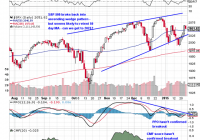
Summary SunAmerica Focused Dividend has turned it around in 2015, are the Dogs of the Dow back? Can active managers catch up after a disastrous 2014? Can the Goldbugs find a way to shine in 2015? It has only been three weeks since our posting on SunAmerica Focused Dividend (MUTF: FDSAX ) and while the ‘Dogs of the Dow’ may have continued to slumber since then, something is definitely working for the fund. In the 7th percentile on a YTD basis, the fund has delivered a solid 2.79% return since our posting compared to 1.55% for the S&P 500 and .82% for the Russell 1000 Value iShares. While we always like to see ourselves proven right (who doesn’t?), the reasons why FDSAX has outperformed so far in 2015 could spell more trouble for active management in the year to come. The secret to FDSAX’s strong performance in 2015 really isn’t that hard to figure out; just head over to Morningstar.com and check it out. What’s in the secret sauce? Well it’s not the Dogs of the Dow although only 4 of the Dogs it holds are underperforming the Dow Jones Industrial Average so far this year. The secret to their success; video games and cigarettes or put another way a deeply discounted retailer (Gamestop (NYSE: GME )) and the 4 largest remaining cigarettes manufactures in the world, the foundations of the consumer staples category. What’s made FDSAX so successful is that incredible difference in performance between the different sectors of the market with a spread of nearly 800 bps between utilities (the Utilities Select Sector SPDR ETF ( XLU) – up 4.07%) and financials (the Financial Select Sector SPDR ETF ( XLF) – down 3.88%) in 2015. For the same period of 16 trade days at the start of 2014, the spread between healthcare and consumer cyclicals was only 594 bps. If the trend continues, 2015 is shaping up to be another year that separates the true active managers from the closer indexers. Let’s start by taking a look at the broader market to see what we can make of the situation. Starting with a daily chart, the S&P 500 was pulled back into the late 2014 ascending wedge on the promise of the new ECB QE program along with a spate of negative economic reports here at home that lite the hope that the Fed’s anticipated rate hike program is on hold. (click to enlarge) While Thursday’s price action was a welcome change, all things considered the weekly action was unimpressive. The volume heading into Thursday was steadily diminishing and Friday’s close just off the lows failed to confirm the move higher. Today’s election of a new leftist government in Greece probably won’t help the open on Monday. As of press time (10:30), the VIX futures had jumped although we backing off the highs. On a weekly basis, you can see the S&P bounced off the first potential stopping out point, but we’ll need to see follow through this week to confirm whether this is just a bounce off one day’s positive news. The fact that the news that lifted the market originated overseas rather than here doesn’t strike me as particularly positive. (click to enlarge) What’s more worrying for trying to separate the closet cases from the true active managers is that the internal make-up of the market doesn’t show any signs of improving although the recent trend towards defensive sectors might be running out of steam. First let’s start with this chart showing the percentage of stocks above their 200 day moving average. You can see that the percentage is way off, even after Thursday’s big one day spike but you have to consider what did well versus what lagged last week. (click to enlarge) Sector wise, Healthcare and Financials make up nearly 30% of the S&P 500 and both lagged noticeably; the financials have been hit hard on weak earnings and healthcare stocks are showing signs that they’re running on fumes after so many years of strong performance. That strong performance is probably the biggest detractor to stronger returns going forward as long term investors have serious gains to protect. Consumer defensive’s and healthcare stocks also underperformed for the week although they make up a much smaller portion of the index at a little more than 12% while high flying REIT’s make up only around 2%. (click to enlarge) (click to enlarge) (click to enlarge) (click to enlarge) For the S&P 500 to really breadth stabilize and give the market a fighting chance to making serious gains, the last need to become the first. Consumer cyclicals and industrials make up over 22% of the S&P 500 and have had…well mixed performance following tough 2014’s. And the best that can be said about energy stocks is that they haven’t gotten lot worse. This is why market prognosticators always say defensive-led rallies are doomed to failure in the long run. They make up such a relatively small part of the market that as long as they’re pulling the market higher, the advance will be tepid and unstable. Goldbugs Take Heart: What about the Yinzer Analyst’s favorite wager of 2015, European equities? Well you can see that the unhedged iShares MSCI EMU ETF ( EZU) managed a decent advance for the week although it underperformed SPY, up 1.36% to 1.66%. On a daily chart basis, the advance off a retesting of the downtrend line was confirmed by a shift in momentum and the sharp rise in the CMF (20) score although the failure to break above the 50 day moving average was disheartening. (click to enlarge) On a weekly basis, the sharp uptick in volume was offset by a middling CMF score for the week leading to a decline in the CMF 20 and failing to confirm the breakout. With Sunday’s election in Greece, the most likely direction will be lower to retest the downtrend line. (click to enlarge) Who has enjoyed a seriously strong and undeniably positive start to 2015 are the gold miners. After so many bad years, could the global uncertainty over deflation and equity weakness here at home be ready to push the miners back towards their 2014 highs? Take a look at the daily chart below, you can see the Market Vectors Gold Miners ETF ( GDX) managed to push back into its 2014 trading range before getting stuck at the 200 day moving average, but the real handicap for the week wasn’t profit taking (we hope) or covering old losses, but a positive week for the S&P 500. Despite the best efforts of the Permanent Portfolio Fund (MUTF: PRPFX ) which is killing it in 2015, gold has lost its luster for most investors and the miners especially aren’t playing a big role in their portfolios anytime soon. But hey, room to grow right? (click to enlarge) Longer term, the miners are still stuck in the falling wedge pattern that has been guiding its destiny ever downwards since 2012. This week GDX ran smack into the upper boundary and managed to push through it before running out of steam and closing below the trend line. For those gold bugs out there, take heart. Volume was lower on the week and didn’t damage the uptrend line while the MACD seems to be in the early stages of rolling over to turn positive. Even if the move turns out to be another false rally, take heart goldbugs, the pattern continues to narrow indicating a breakout could be in the cards later in 2015. (click to enlarge) That’s it for the Yinzer Analyst tonight; he’s going to need his rack time before getting up to clear some snow. But tomorrow is a new day and another change to make some money, make sure you’re ready for whichever way the market bends.

GLD And Its Relation To The Greek Elections, ECB’s QE And FOMC Meeting

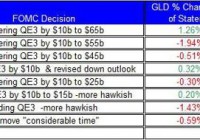
The rise in uncertainty in Europe over the recent Greek elections results in ECB’s QE program play in favor of GLD. Will the upcoming FOMC meeting and GDP update for the fourth quarter impact the direction of GLD? The market has revised down the probabilities of a rate hike in the coming FOMC meetings. The results of the latest elections in Greece along with ECB’s decision to start its quantitative easing program have provided back-wind for the SPDR Gold Trust ETF (NYSEARCA: GLD ). Let’s examine the recent developments in Europe and the upcoming reports in the U.S. including FOMC statement and GDP update. The latest news about election results in Greece, in which the extreme left party Syriza won, is likely to bring this country one step closer towards leaving the European Union, could stir up the markets, raise the uncertainty levels and depreciate the Euro against leading currencies. But it’s not likely to have substantial long-term adverse ramifications on the EU, as suggested in this analysis . This news along with ECB’s decision to implement a $1.3 trillion QE program could still drive higher the demand for precious metals investments including GLD, which tend to strive when central banks devalue their currency and the uncertainty level in the markets rise. Nonetheless, bear in mind that the ongoing rally of the U.S. Dollar against the Euro and other currencies will eventually curb down the rise in the price of GLD. This week the FOMC will convene for the first time this year. In the previous meeting back in December, the FOMC concluded its meeting with the decision to repurpose the term “considerable time” with respect to the timing of the rate hike; the FOMC kept the term as a reference point to its current policy – the normalization process will continue to be data dependent and a rate hike won’t happen anytime soon with the key word being patience: “… the Committee judges that it can be patient in beginning to normalize the stance of monetary policy.” Moreover, in the press conference that followed, FOMC Chair Yellen also pointed out that the FOMC is likely to raise rates in the next couple of meetings. (click to enlarge) Source of data: FOMC’s site and Bloomberg This time, the FOMC meeting will include a press conference or an update for the economic progress of the U.S. But the last updates by the IMF and World Bank showed that the U.S. economy is likely to grow in 2015 by 3.6% and 3.2%, respectively. In both cases, these organizations revised up their assessments from their previous estimates, in part, due to low oil prices. The current low oil prices are also likely to bring down GLD – after all potential rise in inflation is among the main reasons for people to invest in gold assets such as GLD. Well, this doesn’t seem to be the case. Despite the expected higher growth in GDP, the markets have started to revise their expectations about the next rate hike of the FOMC. According to the CME , the probability of a rate hike in the June meeting is currently only 12% – a month ago this probability was around 30%. Further, the implied probability of a rate hike in the July meeting has been updated from 57% a month ago to 28%. So the markets have updated their projections based on the current low inflation. The low inflation could eventually result in the FOMC pushing forward the first and subsequent rate hikes. Such a scenario is likely to keep pushing up the price of GLD: After all, low cash rate tends to translate to low long-term treasury yields. If U.S. treasury yields remain low, this could contribute to the short-term recovery of GLD. But the upcoming FOMC meeting isn’t likely to stir up the markets considering Yellen’s promise not to rock the boat in the next two meetings. Therefore, the market reaction is likely to moderate and GLD isn’t expected to do much – we could see a similar reaction as we did in the last meeting. Another report to consider is the upcoming GDP report – first estimate for the last quarter of the year. The current estimates are for the GDP report to show a gain of 3.1%. In the past, these reports didn’t seem to have much of a strong impact on the prices of GLD, as you can see in the table below. Source of data taken from Bloomberg and BEA Nonetheless, this report is still likely to influence FOMC members with respect to their rate decision. If the U.S. economy keeps showing a steady growth, this is likely to bring the FOMC closer to pushing the trigger on the rate hike. Despite the latest developments in Europe, the direction of GLD is mostly related to the changes in U.S. including the FOMC’s policy and the progress of the U.S. economy. If the FOMC were to push forward its first rate hike, this could keep up the price of GLD. For more see: What are the advantages of GLD?