Tag Archives: setpageviewname

Leveraged Homebuilding ETFs Planned By Direxion

Direxion is a renowned player in the leveraged and inverse leveraged ETF world, alone possessing a major share of this segment of the investing corner. The issuer is in no mood to let go off its strong status as it recently filed up for two leveraged homebuilding ETFs – one regular, another inverse. Let’s take a look at the newly filed products. The Proposed ETFs in Focus Direxion Daily Homebuilders Bull 2X Shares ETF has been designed to replicate double the daily performance of the S&P Homebuilders Select Industry Index while Direxion Daily Homebuilders Bear 2X Shares ETF does exactly the opposite. This leveraged bear ETF gives the double inverse daily performance of the same index. The bull and bear ETFs charge 1.04% and 0.95% in expense ratio, respectively. The index follows the performance of a basket of 35 homebuilding companies. The index is not heavily concentrated on the top 10 holdings as it puts just 34% of assets in the portfolio. No stock accounts for more than 3.8% of the total. How Do These Fit in a Portfolio? These ETFs could be intriguing choices for those looking for a targeted exposure to the U.S. homebuilding sector. The homebuilding space has been performing well in recent times on sustained economic recovery despite a soft start to the year, a healing job market, moderating home prices and, certainly, low interest rates long prevailing in the country. As long as these economic attributes remain in place, homebuilding stocks should see a smooth journey. However, investors should not forget that the Fed is on the verge of policy tightening this year. Since homebuilding is an interest rate sensitive sector, it might be in disarray post Fed rate hike. Investors can play the pullback via the bear ETF then. Competition As of now, only five ETFs have true focus on the homebuilding sector. Among these, four are regular ETFs. Only one ETF, the ETRACS Monthly Reset 2xLeveraged ISE Exclusively Homebuilders ETN (NYSEARCA: HOML ) might pose as a threat to Direxion’s proposed leveraged bull ETF, if the latter gets an approval. Moreover, the expense ratio of the proposed ETF is higher than HOML which charges 85 bps in fees. The difference between daily (in the case of the proposed ETF) and monthly resetting technique (for HOML) might have caused this disparity in expense ratio. However, the coast is clear for the leveraged bear ETF as no such fund has hit the space as yet. Link to the original post on Zacks.com

ETF Deathwatch For June 2015: List Grows To 323

The ETF Deathwatch membership roll grew eight names larger for June. Seventeen products were added and nine came off. Escapees included seven products with improved health and two that closed up shop. The count now stands at 323, consisting of 225 ETFs and 98 ETNs. Actively managed ETFs continue to have a disproportionally large representation with nearly half of the eligible funds showing up on the list. Product deaths reached a major milestone last month, attaining the level of 500 closures . Funds offering +/- 200% leveraged market exposure were extremely popular with day-traders and the high frequency trading crowd when they were introduced. As noted in the past, these traders have been migrating toward the 300% leveraged funds for the extra “juice” they provide. ProShares Ultra S&P Regional Banking (NYSEARCA: KRU ) is an example of a 200% long product targeting an industry that has been performing quite well lately. It is up more than twice as much as the broader and more leveraged Direxion Daily Financial Bull 3x Shares (NYSEARCA: FAS ) over the past month. Despite its much better performance, KRU is joining ETF Deathwatch this month, while FAS has more than $1 billion in assets and averaged $144 million in daily trading the past three months. Today, 40 products using 200% leverage are on ETF Deathwatch versus only seven that use 300% leverage. Smart beta seems to be a very popular theme in the ETF space these days, and it is difficult to go more than a few days without some article making reference to it. However, it takes more than tagging an ETF as a “smart beta” product to ensure success. FlexShares Credit-Scored US Corporate Bond (NASDAQ: SKOR ) and PowerShares DB Optimum Yield Diversified Commodity Strategy (NASDAQ: PDBC ), smart beta funds targeting bonds and commodities, respectively, were added to ETF Deathwatch this month. The primary concern with any of these products is liquidity. It is always prudent to have an exit plan before making your purchase, and this usually entails knowing what will prompt you to sell. A key ingredient is having someone willing to buy your shares at a fair price when you are ready to sell. There were 233 ETFs and ETNs that had zero volume on the last day of May. More than 13% of all listed products did not trade that day. Additionally, there were 21 funds that went the entire month without seeing any action. Today, the iPath Long Extended Russell 1000 ETN (NYSEARCA: ROLA ) is being quoted with a bid of $170.01 and an asking price of $276.34, creating a $106.33 spread. Its last trade occurred on January 8, 2015. Even if you could buy ROLA at a discount, who will buy your shares when you want to sell? The average asset level of products on ETF Deathwatch decreased from $6.9 million to $6.8 million, and 49 currently have less than $2 million in assets. The average age increased from 47.2 to 48.3 months, and 99 are now more than five years old. Here is the Complete List of 323 Products on ETF Deathwatch for June 2015 compiled using the objective ETF Deathwatch Criteria . The 17 ETPs added to ETF Deathwatch for June: C-Tracks Citi Volatility Index TR ETN (NYSEARCA: CVOL ) ETRACS CMCI Gold TR ETN (NYSEARCA: UBG ) ETRACS CMCI Livestock TR ETN (NYSEARCA: UBC ) ETRACS Daily Long-Short VIX ETN (NYSEARCA: XVIX ) Huntington US Equity Rotation Strategy (NYSEARCA: HUSE ) iShares Industrials Bond (NYSEARCA: ENGN ) ProShares CDS Short North America HY Credit (BATS: WYDE ) ProShares Global Listed Private Equity (BATS: PEX ) ProShares Ultra S&P Regional Banking ( KRU ) ProShares UltraShort MSCI EAFE (NYSEARCA: EFU ) RBS China Trendpilot ETN (NYSEARCA: TCHI ) WisdomTree Indian Rupee Strategy (NYSEARCA: ICN ) First Trust Emerging Markets Local Bond ETF (NASDAQ: FEMB ) First Trust International IPO ETF (NASDAQ: FPXI ) First Trust Low Duration Mortgage Opportunities (NASDAQ: LMBS ) FlexShares Credit-Scored US Corporate Bond ( SKOR ) PowerShares DB Optimum Yield Diversified Commodity Strategy ( PDBC ) The 7 ETPs removed from ETF Deathwatch due to improved health: ALPS STOXX Europe 600 ETF (NYSEARCA: STXX ) DB 3x German Bund Futures ETN (NYSEARCA: BUNT ) iShares Interest Rate Hedged Corporate Bond (NYSEARCA: LQDH ) iShares MSCI Europe Minimum Volatility (NYSEARCA: EUMV ) iShares MSCI Japan Minimum Volatility (NYSEARCA: JPMV ) PowerShares S&P Intl Developed High Beta (NYSEARCA: IDHB ) ProShares MSCI EAFE Dividend Growers (NYSEARCA: EFAD ) The 2 ETPs removed from ETF Deathwatch due to delisting: Deutsche X-trackers In-Target Date (NYSEARCA: TDX ) Deutsche X-trackers 2010 Target Date (NYSEARCA: TDD ) Disclosure covering writer: No positions in any of the securities mentioned . No positions in any of the companies or ETF sponsors mentioned. No income, revenue, or other compensation (either directly or indirectly) received from, or on behalf of, any of the companies or ETF sponsors mentioned.

RPG Is A Solid Growth ETF That Thoroughly Outperformed SPY Over The Last 9 Years

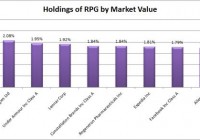
Summary The ETF looked solid all around. The standard deviation is a bit high relative to SPY, but that should be expected for tracking a smaller portion of the index. The strong liquidity may reflect many investors coming to the same conclusion about the ETF. It looks worthy of deeper consideration. Diversification within the ETF is solid, but investors should be aware that the portfolio turnover is very high. Investors should be seeking to improve their risk-adjusted returns. I’m a big fan of using ETFs to achieve the risk-adjusted returns relative to the portfolios that a normal investor can generate for themselves after trading costs. A substantial portion of my analysis will use modern portfolio theory, so my goal is to find ways to minimize costs while achieving diversification to reduce my risk level. In this article, I’m reviewing the Guggenheim S&P 500 ® Pure Growth ETF (NYSEARCA: RPG ). What does RPG do? RPG attempts to track the investment results of S&P 500 ® Pure Growth Index. The ETF falls under the category of “Large Growth”. Standard deviation of monthly returns (dividend adjusted, measured since April 2006) The standard deviation isn’t going to make a strong case for investing in RPG. For the period I’ve chosen, the standard deviation of monthly returns was 5.210%. For SPY, it was 4.416% over the same period. The higher level of volatility for RPG is a challenge since the correlation between the two funds is 94.87%. Yield & Taxes The distribution yield is .69%. I prefer higher yields so that they are more appealing for retiring investor portfolios. Sure, they could sell shares to generate income, but that may create a temptation to change the portfolio strategy at the wrong time. Expense Ratio The ETF is posting a gross expense ratio of .35% and a net expense ratio of .35%. Unfortunately, most ETFs have expense ratios higher than I’d like to see. This is another case where I prefer lower, but it isn’t going to be high enough to make me eliminate an ETF that otherwise has a fairly strong performance. The expense ratio for RPG isn’t all profit to the manager of the fund either. The fund should be incurring substantially more costs than a passive index fund because the portfolio turnover has been running at 46%. The holdings of RPG one year may be very dramatically different than the holdings in the following year. For comparison, only 19.2% of the portfolio value is in the top 10 holdings. The fund could completely exit those positions twice per year and still have a lower portfolio turnover. Market to NAV The ETF is trading at a .06% premium to NAV currently. I think any ETF is significantly less attractive when it trades above NAV and more attractive below NAV. A .06% premium is not enough to matter though. Investors should check prior to placing an order, but the liquidity in RPG should be a great hedge against any meaningful premiums or discounts. Liquidity The liquidity is excellent. I see no concerns. Average volume has been around 100,000 shares per day with share prices around $82 per share. That’s over $8 million changing hands each day. Largest Holdings The diversification within the ETF is pretty solid. Where else will you find an ETF that includes Apple (NASDAQ: AAPL ) but only has it in 10th place for weighting? (click to enlarge) Conclusion This is another Guggenheim ETF worthy of consideration. While I’d like to see lower expense ratios, I find them reasonable for the level of turnover in the holdings. On an economic level, I find it doubtful that investors will produce alpha over the long term through frequent trading when accounting for the costs of that trading. On the other hand, RPG is precisely the fund to contract me on that. Just look at the returns on the fund and you’ll see what I mean: (click to enlarge) RPG thoroughly outperformed SPY over the sample period. I’ve included comparisons that use RPG for smaller portions of the portfolio since I think few investors would decide to invest their entire portfolio into RPG. The correlation is fairly high, but it is also expected since the ETF is tracking part of the same index. The standard deviation of returns is fairly high relative to SPY, but can be tolerated if expected returns are higher. Since the ETF is on the Schwab One Source list, regular rebalancing is definitely an option for funds with strong liquidity. All around, this appears to be a solid ETF for investors that are willing to accept additional volatility and believe that the regular trading can lead to higher risk-adjusted returns. Disclosure: The author has no positions in any stocks mentioned, and no plans to initiate any positions within the next 72 hours. (More…) The author wrote this article themselves, and it expresses their own opinions. The author is not receiving compensation for it (other than from Seeking Alpha). The author has no business relationship with any company whose stock is mentioned in this article. Additional disclosure: Information in this article represents the opinion of the analyst. All statements are represented as opinions, rather than facts, and should not be construed as advice to buy or sell a security. Ratings of “outperform” and “underperform” reflect the analyst’s estimation of a divergence between the market value for a security and the price that would be appropriate given the potential for risks and returns relative to other securities. The analyst does not know your particular objectives for returns or constraints upon investing. All investors are encouraged to do their own research before making any investment decision. Information is regularly obtained from Yahoo Finance, Google Finance, and SEC Database. If Yahoo, Google, or the SEC database contained faulty or old information it could be incorporated into my analysis.