Tag Archives: setpageviewname

Fed Risk Vs. Grexit: A Volatility-Based Approach

Long-term horizon, energy, currencies “}); $$(‘#article_top_info .info_content div’)[0].insert({bottom: $(‘mover’)}); } $(‘article_top_info’).addClassName(test_version); } SeekingAlpha.Initializer.onDOMLoad(function(){ setEvents();}); The spread of implied volatilities on both the S&P500 (VIX) and the Euro Stoxx 50 (VSTOXX) has widened to a new high. It is clearly attributable to the renewed tensions on a possible Grexit. Yet, the forthcoming Fed tightening might lead to an increase in the VIX, hence my suggestion to play a tightening of the volatility spread. The post-winter acceleration of growth in the U.S. has been a blessing but also a curse since it increases the probability of a liftoff in the second half of 2015. So far, the risk associated to what we could call a traditional cyclical/monetary policy related risk has been overwhelmed by that related to Greece. The chart below shows the spread between implied volatilities on European vs. U.S. stocks. Since the beginning of the year, it has been very responsive to the news flow pertaining to the “Grexit”. The link is also visible on a month-over-month basis, where it shows that the volatility spread might widen a little bit more. The same pattern is also visible in the FX space where the implied volatility on the EUR/USD has risen much more against the CVIX. Interestingly enough, the EUR/USD is well above parity even though the distance to default of Greece has never been that short. The strength of the trade balance of the Euro area is probably part of the explanation. The view here is simple. Any worsening of the Greek crisis should not be rejected but given 1. The width of the spread between Vstoxx and VIX; 2. It’s tendency to mean revert 3. The possibility that Yellen remains evasive enough to increase the uncertainty related to the aggressiveness of the Fed between now and year-end. I would not be surprised by a tightening, over the next few weeks, of the volatility spread across the Atlantic. Disclosure: The author has no positions in any stocks mentioned, and no plans to initiate any positions within the next 72 hours. (More…) The author wrote this article themselves, and it expresses their own opinions. The author is not receiving compensation for it (other than from Seeking Alpha). The author has no business relationship with any company whose stock is mentioned in this article. Share this article with a colleague

3 ETFs To Watch On Weak Industrial Data

The U.S. economy is growing at a slower pace after the first-quarter slump. Though an accelerating job market, recovering housing fundamentals, and rising consumer confidence are propelling growth in the economy, manufacturing and industrial activities are lagging far behind. This is especially true if we go by the latest sluggish data, which shows that manufacturers are being held back by a strong dollar, deep spending cuts by oil and gas drillers and weak demand. Industrial Activity in Downslide Industrial production surprisingly dropped 0.2% in May, marking slowdown for six consecutive months. The figure was nowhere closer to the last 4.8% growth seen in November. Manufacturing, which accounts for 12% of the U.S. economy and more than 72% of industrial production, also slid 0.2% last month while mining production fell 0.3%, marking the fifth straight monthly decline. Meanwhile, industrial capacity utilization inched down from 78.3% in April to 78.1% in May. A separate report on June 2015 – Empire State Manufacturing Survey – shows that business conditions have deteriorated for New York manufacturers. Notably, the Empire State general business conditions index shrank to minus 1.98 in June from plus 3.09 in May, representing the weakest reading since January 2013 and the second negative reading in the past three months. Further, the six-month outlook index worsened to the lowest level since January 2013 to 25.8 in June from 29.8 in May. According to the Markit data, U.S. Manufacturing Purchasing Managers’ Index (PMI) slightly fell to 54 from 54.1 in April while U.S. Services Business Activity Index slipped to 56.2 from 57.4. The U.S. Composite PMI Output Index (covering manufacturing and services) was 56 in May, down from 57 in April and new business volumes increased at the slowest pace in almost one and a half years. Weak Trend to Continue Overall, industrial sector activities will likely remain weak in the coming months, as a strong U.S. dollar has been the major culprit. The Fed is preparing for interest rates hike in contrast to other developed and developing nations that are extending their monetary easing policies. The divergent path will continue to bolster the U.S. dollar against a basket of major currencies, making exports less competitive and thereby hurting sales and profit margins of the big American firms. This puts U.S. factories at a greater disadvantage against foreign rivals. ETFs to Watch Given this, some investors may want to take a closer look at the industrial ETFs. While industrial ETFs have been laggards for most of this year so far, some are standing tall in the current softness and are expected to keep up their momentum in the coming months. Further, these funds have a favorable Zacks Rank of 2 (Buy) or 3 (Hold), suggesting smooth trading ahead. iShares U.S. Industrials ETF (NYSEARCA: IYJ ) This product provides exposure to 213 industrial stocks by tracking the Dow Jones U.S. Industrials Index. It is heavily concentrated on the top firm – General Electric (NYSE: GE ) – with 10.24% of assets while others make up for less than 3.8% share. Further, the ETF is tilted toward capital goods’ companies at 61.1% while transportation and software services round off the next two spots with double-digit exposure each. The fund has an AUM of $744.7 million and average daily volume of around 109,000 shares. Expense ratio came in at 0.43%. The product has gained nearly 1.5% in the year-to-date time frame and has a Zacks ETF Rank of 3 with a Medium risk outlook. First Trust Industrials AlphaDEX ETF (NYSEARCA: FXR ) This fund follows the StrataQuant Industrials Index, which uses AlphaDEX stock selection methodology to select stocks from the Russell 1000 Index and ranks the stocks on both growth and value factors. Then, the bottom 75% stocks are eliminated from inclusion. The approach results in a basket of 103 securities, which are widely spread out across components with none holding more than 2.13% of assets. In terms of industrial exposure, machinery and aerospace & defense take the top two spots at 24.6% and 14.1%, respectively, while others make up for single-digit allocation each. The fund is rich in AUM of $459 million and sees good trading volume of about 208,000 shares a day. It charges a bit higher annual fee of 67 bps and is up 0.7% so far in the year. FXR has a Zacks ETF Rank of 2 with a Medium risk outlook. Fidelity MSCI Industrials Index ETF (NYSEARCA: FIDU ) This fund tracks the MSCI USA IMI Industrials Index, holding 346 stocks in its basket. Like IYJ, it is concentrated on GE at 11.4% while other firms hold less than 4.2% share. Here, aerospace and defense industry is the top sector with nearly one-fourth of the portfolio, followed by industrial conglomerates (18.8%) and machinery (17.4%). The product has amassed $159.7 million in its asset base while trades in good volume of more than 70,000 share a day on average. It is one of the low cost choices in the space, charging 12 bps in annual fees from investors. The fund added 0.6% in the year-to-date period and has a Zacks ETF Rank of 2 with a Medium risk outlook. Link to the original article on Zacks.com

Profit From The Stock Market’s Newest Red-Hot Tech Sector

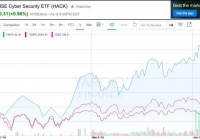
The “Internet of Everything” offers incalculable benefits as millions of devices become connected across the planet. At the same time, the explosion in connectedness has introduced the world to a new word in our vocabulary – “cybercrime.” Ironically, this also offers traders and investors one of the most exciting investment opportunities in an otherwise flatlining U.S. stock market. Over the past year, cybercrime has become a staple of the evening news. In October of 2014, the breaches of the databases of The Home Depot (NYSE: HD ), JPMorgan Chase (NYSE: JPM ) and Target (NYSE: TGT ) resulted in the compromised security of 56 million credit cards, 76 million households, seven million small businesses and 110 million accounts. Last month, the IRS announced that the identities of 2.7 million taxpayers were hacked last year. Last week, the government revealed that hackers stole personnel data and Social Security numbers for every federal staffer, past and present. According Symantec’s annual Internet Security Threat report, cyber attacks and cybercrime against large companies – those with over 2,500 employees – rose 40% globally in 2014. Attacks on small and medium-sized companies, which accounted for 60% of targeted attacks, increased 26% and 30%, respectively. And as the world becomes ever more interconnected through ever-expanding computerized networks, the frequency and scale of cyber attacks are likely to increase. By 2020, Gartner estimates that there will be over 26 billion Internet-connected devices, 250 million Internet-connected automobiles and a $50-billion market for surveillance. And as mobile payment technologies like Apple (NASDAQ: AAPL ) Pay and Google (NASDAQ: GOOG ) Wallet take off, mobile devices will become more prominent victims of cyberattacks. The Eye-Popping Costs of Cybercrime The costs of cybercrime are already huge. The Home Depot estimated that investigation, credit monitoring, call center and other costs of its breach last year could top $62 million. Target estimates that its breach-related expenses hit an eye-popping $146 million. That’s a lot of money. No wonder an estimated 60% of all companies experiencing a cybersecurity breach go out of business within six months of suffering an attack. Overall, cybercrime costs the globe over $400 billion per year. That’s more than the annual gross domestic product (GDP) of the Philippines, a country of 100 million people. And cyber attacks are about more than just losing money. Attacks can potentially shut down or manipulate a country’s energy infrastructure, weapons defense systems, medical devices and transportation systems. Russia launched the first cyber war against tiny Estonia in 2007. The president of Stanford University told me two years ago that the Silicon Valley-based university was being attacked dozens of times a day, with most of the attacks coming from China. How to Profit from the Cybersecurity Boom Cybersecurity companies claim they can stop more than 99% of cyber attacks from happening. And defense against cyber attacks is becoming a very big business. Gartner estimates cybersecurity spending topped $71 billion worldwide last year. FBR Capital Markets predicts a global 20% increase in spending in 2015. This year’s spending, in turn, could double to more than $155 billion by 2019. Of course, picking the long-term winners within the dynamic and ever-changing cybersecurity sector is a challenge. That said, savvy investors know that the pattern for making money in any new sector is similar, whether it’s automobiles in the early 1990s or the Internet in 1999. Stage one involves a general run-up in the sector across a wide range of players. Stage two is a painful period of consolidation. In the end, there will be a handful of winners. If you are holding one of them, you will make a fortune. But if you bet on one of the losers, you can lose a lot of money. As I recently recommended to my Alpha Investor Letter subscribers, the PureFunds ISE Cyber Security ETF (NYSEARCA: HACK ) – a broad-based bet on the cybersecurity investment theme – is one way around this. HACK tracks the ISE Cyber Security Index, investing in 31 stocks across the planet, each focused on software systems and other solutions that defend against cyberattacks. HACK’s top three holdings include Cyberark Software Ltd. (NASDAQ: CYBR ), 6.09%; Fireeye Inc. (NASDAQ: FEYE ), 5.96%; and Infoblox Inc. (NYSE: BLOX ), 5.14%. The fund invests 49.35% of its portfolio in the top 10 holdings. This means that the risk in the fund is quite concentrated. And, as a result, it is quite volatile. HACK has outperformed both the S&P 500 and the NASDAQ 100 – by more than 27% and 23% over the past 12 months, respectively. HACK itself is up 22.54% this year. (click to enlarge) Still, most of today’s biggest opportunities in cybersecurity lie in next-generation solutions, including cloud security and big data security analytics. It is these cyber startups that are providing the most innovative solutions, and many are doubling and tripling revenues annually. That’s why cybersecurity is a sector best suited for short-term traders skilled at playing both the long and short side of highly volatile individual stocks. But whether you’re a long-term investor or short-term trader, just realize that the cybersecurity rocket ship has taken off. So strap yourself in for the ride.