Tag Archives: seeking

If I Could Invest In Only One Fund . . .

Which fund is my #1 pick out of 7,000 mutual funds? Attributes of my top fund: low fee, low turnover, low risk of strategy obsolescence. Value beats Growth; Small Cap beats Large Cap. If I could invest in only a single fund . . . . . . and I had to invest all of my equity investment dollars in this fund . . . and I could only own this single fund for the rest of my life . . . which fund would I pick? Given that there are roughly 7,000 mutual funds available in the U.S. today, the above scenario of having to invest in only a single fund is admittedly not realistic. However, if you can come up with a good answer for it then you have probably found yourself a fund that deserves a significant share of your investment dollars. For me, I am looking for a fund that has a combination of the following attributes: 1. A time-tested, consistent and successful investment strategy based on empirical evidence of what actually works in investing. The strategy must also have low risk of obsolescence over time. (Thus, it must be a numbers-driven strategy). 2. Broad diversification – I can’t have the risk of too much money in a single stock 3. Low fees – I want a very cheap fund that is an excellent business proposition. 4. Tax efficiency – I need a fund that has very low turnover (trading)-and consequently high tax efficiency and very low drag on returns. Here is my personal investment profile: I am a long-term oriented and risk tolerant investor looking to maximize wealth over decades, not in any one year. Given my investment objective and my fairly high tolerance for risk, the fund I would choose for myself out of the 7,000 possibilities if I were able to invest in only one fund for the rest of my life is the Dimensional Small Cap Value Portfolio (MUTF: DFSVX ). Why does this particular fund top my list? There are many reasons, but here are my biggest 5: 1. Value Beats Growth The first reason is the fund’s value focus. Investors everywhere should understand a basic historical fact of stock markets: Value stocks-stocks that are cheap by financial measures-have outperformed growth stocks, their more expensive, glamorous and news-worthy cousins, by a wide margin. This is true both in the U.S. and in overseas stock markets. Does value outperform growth every year? No. Is there any guarantee that value will outperform growth in the future? No. But that’s a risk I’ll happily take. The data are compelling. And this Dimensional fund takes value seriously: the average price-to-book value ratio of its individual holdings is a mere 1.16x. It’s chock full of cheap stocks. 2. Small-Cap Beats Large-Cap The second reason is the fund’s small-cap focus. Here’s another thing all investors should know: it is a matter of record that historically small company stocks have delivered better investment performance than large company stocks, albeit with more volatility. For me, the extra volatility is ok. Remember, I’m a long-term investor looking to maximize my wealth over the coming decades-not in any one year. Any big swoons will just be opportunities for me to increase my small-cap value holdings. And as with the value versus growth comparison, the phenomenon of small-caps outperforming large-caps is true in both U.S. and overseas stock markets. Do small-caps outperform large-caps every year? No. (In fact, U.S. small-caps lagged large-caps in 2014-after beating them handily in 2013. Does the fact that large-caps beat small caps in 2014 do anything to diminish my confidence in the long-term outlook for small caps? No.) 3. Broad Diversification The Dimensional Small Cap Value Portfolio is also very well diversified-much more so than the vast majority of small-cap funds. The fund currently holds more than 1,200 stocks, thereby greatly reducing the possibility that the performance of any single stock will dramatically affect overall fund performance. It is important to understand that the fund’s objective is to efficiently capture the returns of the world’s top performing equity segment-small-cap value stocks-not hit a home run on any single stock. The fund’s numerous underlying holdings enable it to do just that. 4. Consistency of Strategy and Low Risk of Obsolescence If I’m going to be locked into an investment for the next 50 years (I hope), I want it to have a consistent, reliable, data-driven strategy that does not depend on the investment acumen of any human (or group of humans). My chosen fund is managed according to quantitative factors. Stocks enter or exit the portfolio based on their quantitative value or size characteristics, not because of a judgment someone had to make. It is of course true that humans created Dimensional’s investing algorithms, but now the strategy has 30-plus years of successful performance history under its belt and requires minimal tinkering (in my opinion). 5. Very Low Costs It is critical for investors to mind the costs of their funds. The range of expenses among funds is very wide and fees are often disclosed only deep in mind-numbing fund prospectuses. The net expense ratio of my chosen fund is a mere 0.52%, however, which is a significant discount to the average fund. In addition, my chosen fund has annual turnover of only 14%. Its light touch on trading keeps a lid on costs and makes the fund more tax-efficient as well. Portfolio turnover (buying and selling) creates costs for a fund but such trading costs are not disclosed explicitly and cannot be predicted accurately. Many mutual fund managers turn their funds over in excess of 100% per year (i.e. only hold the average stock for one year), and in the process rack up huge costs that are passed through to the underlying investors. In some cases investors may be squandering 2%-3% per year of performance right out of the gate simply by owning a high-turnover fund. To sum it up, Dimensional Small Cap Value Portfolio has the right combination of attributes that make it my top pick out of 7,000 funds if I were required to put all of my money into a single fund for the rest of my life. Investors considering taking a similar approach to me but with ETFs instead of mutual funds may want to check out the iShares Russell 2000 Value ETF (NYSEARCA: IWN ) or the iShares S&P Small Cap 600 Value ETF (NYSEARCA: IJS ). For an option that has a more large-cap focus but useful rebalancing methodology, the Guggenheim S&P 500 Equal Weight ETF (NYSEARCA: RSP ) might be worth some consideration. Investors should take note that the average market cap of the holdings in each of these funds is substantially higher than that of the holdings of the DFA Small Cap Value Portfolio, however. To learn more about Dimensional Funds and how we employ them in client portfolios, please visit us at www.orionportfolios.com .
GAMCO Natural Resources, Gold & Income Trust: Similar But Different Discounted CEF Opportunity

Summary GNT invests in hard assets and trades at a discount to NAV, like its sibling GGN. GNT, however, has a more diversified portfolio and doesn’t use leverage. Although GNT has a lower yield than GGN, it may be a better option for some investors. GAMCO Natural Resources, Gold & Income Trust (NYSE: GNT ) is a sister fund to GAMCO Global Gold, Natural Resources & Income Trust (NYSEMKT: GGN ), another closed-end fund, or CEF, that I recently wrote about . GNT shares many similarities with its older sibling, but the differences could make it more appropriate for some investors looking for a combination of hard asset exposure, income, and “outsourcing.” The same but different Like GGN, GNT is heavily invested in the precious metals, mining, energy, and energy services sectors (this quartet makes up around 80% of its portfolio). That fits tightly with its name and is roughly similar to GGN’s allocation. GNT, however, has more leeway in its security selection, putting another 15% of assets in the specialty chemicals, agriculture, and machinery sectors. This is likely the reason for the very slight difference in the naming of these two closed-end funds. (Note the switched places of natural resources and gold in the two names.) What it means for investors is that GNT is a bit more diversified. That can be a good thing on one hand, but also tells you that this CEF isn’t a pure play precious metals and energy fund. If that’s what you are looking for, you’re better off with GGN or some other option. Another big difference between the two is the use of leverage. GGN uses leverage, GNT does not. That could limit performance at GNT in an up market, but won’t exacerbate losses in a down market. And since weak gold prices and recently plummeting oil prices have been a big issue for the fund, that’s not such a bad thing right now. GNT, however, does make use of options, like its sibling, to meet its primary goal of income generation. That’s why income investors should like this CEF and its monthly dividend. Currently it’s paying $0.07 a share, a reduction from $0.09 a share paid in December. The yield based on the lowered dividend is a touch over 10%. Although that’s nothing to sneer at, GGN’s yield is closer to 12%. But that higher yield comes with the added risk of leverage and with a less diversified portfolio mandate. A trade off worth spending some time considering. But don’t forget the dividend cut, because such dividend changes are a risk inherent to both CEFs. On sale Last year wasn’t any kinder to GNT than it was to GGN (down nearly 24%), with GNT shares falling around 22% (total return, which includes dividends was a loss of around 13%). That’s largely because commodities of all sorts were out of favor. Gold, for example, has been a laggard for some time and oil’s quick fall is filling the headlines right now. However, such hard assets, including other commodities like food, can be a haven in a storm. Gold, for example, is an inflation hedge and a safety vest when the market gets stormy. It’s why asset allocation models include such securities, they provide diversification. That doesn’t mean load up on either GGN or GNT, but it does mean that adding a little of either to an otherwise diversified portfolio could be a good long-term decision. And now is a good time to consider it if you haven’t already. First off, the fund had a bad year last year because the sectors on which it focuses underperformed. There are various reasons for that, and fear of further downside risk could keep you away, but it also means that these sectors are on sale. If you wanted to own them, but haven’t pulled the trigger, they’re cheap right now. But that’s not the only sale going on. GNT is a closed-end fund, which means its market price often deviates from its net asset value, or NAV. NAV is the actual value of what GNT owns on a per share basis. Over the last couple of years, GNT has traded at a discount to its NAV in late December and early January, with the gap narrowing as the new year progresses. Investors selling shares that have gone down in value to lock in losses for tax purposes is a part of this. The discount is currently nearly 9%, larger than sibling GGN’s 5% or so. And while GNT doesn’t have as long a history, the trends for the two are roughly similar. So you could view GNT as being on double mark down. That allows you to pick up a high yield, the chance for the discount to narrow, and exposure to out of favor hard assets. Very similar to what GGN offers, but without the leverage and with a bit more portfolio level diversification. Author’s Note: The comments on the GGN article referenced above brought up some valid points that will be similar for GNT for long-term investors. They are worth a read if you haven’t seen them. This article, like the one about GGN, speaks more to new investors. I plan to address some of the thoughts presented by long-term investors in a future article. It’s number four or five in the cue of ideas brought out by recent comments on articles I’ve written. And I want to thank those who have respectfully disagreed with me. Respectful discussion makes this community better and more fun.

Can The Lift Of Sanctions Start The Growth Of The Russian Share Market?

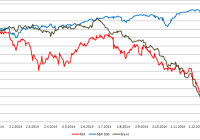
Summary The French president proclaimed that the sanctions against Russia should be lifted. The main problem of the Russian stock market is the collapse of oil prices right now. The investors shouldn’t expect that the end of sanctions will have a strong effect on the Market Vectors Russia ETF. The French president Francoise Hollande said that the sanctions against Russia should be lifted . The sanctions were imposed during 2014 in order to force Russia to not support the rebels in eastern Ukraine. The sanctions have limited the access of some of the biggest Russian companies to financial markets. But the real problem for the Russian economy and the Russian share market is the collapse of oil prices right now. The chart below shows the 2014 development of the Market Vectors Russia ETF (NYSEARCA: RSX ), S&P 500 and Brent valuations. As we can see RSX had very volatile first half of 2014. But it managed to recover most of the losses during May and June. The major decline has started in early July and it coincided with the start of the oil price collapse. Both of the curves are almost identical on the September-December time frame. (click to enlarge) Source: own processing The correlation coefficient between RSX and Brent was 0.866 in 2014. It was only 0.355 in the 1H 2014 but it rose to 0.96 in the 2H 2014, which means almost perfect positive correlation. The chart below shows 20-day moving correlation between RSX and Brent prices. It clearly shows that the huge decline of the RSX price is related to the oil price collapse more than to anything other. (click to enlarge) Source: own processing Yes, the sanctions are a complication for Gazprom ( OTCQX:GZPFY ), Sberbank ( OTCPK:SBRCY ), VTB or Rosneft ( OTC:RNFTF ). But the Western financial markets are not the only source of money. There is a country called China right to the south of Russia. And although China has some problems right now it still holds huge foreign currency reserves. Investing in Russia would help to diversify the Chinese reserves out of dollars and it would also help them to satisfy their long term appetite for natural resources. So yes, the sanctions are a complication for the Russian companies but it is nothing that should be able to endanger their existence and bring their share prices to the current levels. The ultimate problem is the collapse of oil prices. Conclusion The opinion of president Hollande is really positive and the sanctions should be definitely canceled. The European economy is impacted by the sanctions and anti-sanctions probably equally if not even more than the Russian economy. Also the situation in Ukraine has calmed down lately and the peace talks are underway. But if the sanctions will be or won’t be lifted, it will have only a limited impact on the Russian share market and on the price of RSX. All RSX needs to start growing is growth of the oil price and its stabilization somewhere over $80/barrel. I am sure that the oil price will return to the $100 level and above it but I don’t know whether it will be in 2015, 2016 or maybe in 2017. The big Russian companies will survive the waiting but they will not shine. This time period is a good opportunity to accumulate shares of selected companies and RSX. Now that you’ve read this, are you Bullish or Bearish on ? Bullish Bearish Sentiment on ( ) Thanks for sharing your thoughts. Why are you ? Submit & View Results Skip to results » Share this article with a colleague