GAL Is An ETF Built From Other ETFs, Let’s Peer Inside
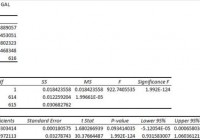
Summary I’m taking a look at GAL as a candidate for inclusion in my ETF portfolio. The description of GAL in the prospectus is a little weird, but I can provide a simpler one. The correlation to SPY is remarkably low for an ETF that holds 24% of the portfolio in shares of SPY. The ETF looks more appealing to investors that are constrained by commissions on trading ETFs. For investors that can build their own portfolio commission free, it is less appealing. I’m not assessing any tax impacts. Investors should check their own situation for tax exposure. Investors should be seeking to improve their risk adjusted returns. I’m a big fan of using ETFs to achieve the risk adjusted returns relative to the portfolios that a normal investor can generate for themselves after trading costs. I’m working on building a new portfolio and I’m going to be analyzing several of the ETFs that I am considering for my personal portfolio. One of the funds that I’m considering is the SPDR SSgA Global Allocation ETF (NYSEARCA: GAL ). I’ll be performing a substantial portion of my analysis along the lines of modern portfolio theory, so my goal is to find ways to minimize costs while achieving diversification to reduce my risk level. What does GAL do? GAL is a relatively weird ETF compared to most of the ETFs I have covered. Lacking a better option, I’m going to begin by quoting the prospectus: Under normal circumstances, the Fund invests substantially all of its assets in the SSgA Global Allocation Portfolio (the “Portfolio”), a separate series of the SSgA Master Trust with an identical investment objective as the Fund. As a result, the Fund invests indirectly through the Portfolio. As an analyst, I’m used to digging through complicated statements, but I’m no familiar with the incentives for this structure. I expect most readers won’t know what to make of that either, so I’m providing an alternate description based on my understanding of the ETF. In my estimation, GAL is an ETF that purchases shares in several other ETFs. That should be simple enough to understand, and it’ll make perfect sense when we get to the section on holdings. The category for GAL is “World Allocation.” Does GAL provide diversification benefits to a portfolio? Each investor may hold a different portfolio, but I use the SPDR S&P 500 Trust ETF (NYSEARCA: SPY ) as the basis for my analysis. I believe SPY, or another large cap U.S. fund with similar properties, represents the reasonable first step for many investors designing an ETF portfolio. Therefore, I start my diversification analysis by seeing how it works with SPY. I start with an ANOVA table: (click to enlarge) The correlation is way better than I would expect. The correlation in this regression is 75%. I want to see low correlations on my international investments. Extremely low levels of correlation are wonderful for establishing a more stable portfolio. I consider anything under 50% to be extremely low. However, for equity securities an extremely low correlation is frequently only found when there are substantial issues with trading volumes that may distort the statistics. Standard deviation of daily returns (dividend adjusted, measured since July 2012) The standard deviation is incredible. For GAL it is .5495%. For SPY, it is 0.7063% for the same period. SPY usually beats other ETFs in this regard, so a lower volatility level is very impressive. Because the ETF has fairly low correlation for equity investments and a low standard deviation of returns, it should do fairly well under modern portfolio theory. Liquidity looks fine Average trading volume isn’t very high, a bit over 55,000, but that also isn’t low enough to be a major concern for me. This is extremely important to the analysis of GAL because the combination of low standard deviation and low correlation immediately set off red flags to watch for low levels of liquidity that might distort the statistics. Mixing it with SPY I also run comparisons on the standard deviation of daily returns for the portfolio assuming that the portfolio is combined with the S&P 500. For research, I assume daily rebalancing because it dramatically simplifies the math. With a 50/50 weighting in a portfolio holding only SPY and GAL, the standard deviation of daily returns across the entire portfolio is 0.5921%. With 80% in SPY and 20% in GAL, the standard deviation of the portfolio would have been .6539%. If an investor wanted to use GAL as a supplement to their portfolio, the standard deviation across the portfolio with 95% in SPY and 5% in GAL would have been .6925%. Why I use standard deviation of daily returns I don’t believe historical returns have predictive power for future returns, but I do believe historical values for standard deviations of returns relative to other ETFs have some predictive power on future risks and correlations. Yield & Taxes The distribution yield is 2.65%. This ETF could be worth considering for retiring investors. I like to see strong yields for retiring portfolios because I don’t want to touch the principal. In my opinion, anything over 2% is high enough to warrant some consideration. Overall, a 2% yield on a portfolio wouldn’t be great for covering retirement costs, but I wouldn’t fill the portfolio with only high yield investments. By investing in ETFs I’m removing some of the human emotions, such as panic. Higher yields imply lower growth rates (without reinvestment) over the long term, but that is an acceptable trade off in my opinion. I’m not a CPA or CFP, so I’m not assessing any tax impacts. Expense Ratio The ETF is posting a .35% expense ratio. I want diversification, I want stability, and I don’t want to pay for them. The expense ratio on this fund is higher than I want to pay for equity securities, but not high enough to make me eliminate it from consideration. I view expense ratios as a very important part of the long term return picture because I want to hold the ETF for a time period measured in decades. Market to NAV The ETF is at a .27% premium to NAV currently. Premiums or discounts to NAV can change very quickly so investors should check prior to putting in an order. The ETF is large enough and liquid enough that I would expect the ETF to stay fairly close to NAV. Generally, I don’t trust deviations from NAV and I will have a strong resistance to paying a premium to NAV to enter into a position. Largest Holdings The diversification looks terrible if you are only looking at the percentage of the fund in each investment. However, since the investments are other ETFs, the actual diversification is phenomenal. This level of diversification is the reason the fund has such a low level of volatility. A chart of the holdings by market value is available below: (click to enlarge) Conclusion I’m currently screening a large volume of ETFs for my own portfolio. The portfolio I’m building is through Schwab, so I’m able to trade GAL with no commissions. I have a strong preference for researching ETFs that are free to trade in my account, so most of my research will be on ETFs that fall under the “ETF OneSource” program. I’m having a difficult time deciding what to think on GAL. It’s the first ETF filled with ETFs that I’ve analyzed. I’m curious about the expense ratio. Before investing in GAL, I would want to know if the .35% expense ratio was strictly the amount that went to the managers of GAL, or if was including all fees charged at all levels of the portfolio. As investors, we already have to pay management of the company and the expense ratio of one ETF; I don’t want to pay the expense ratios twice. However, the correlation to SPY is remarkably low for an ETF that is already holding SPY as nearly a quarter of the portfolio. In my opinion, GAL looks like a better option for investors that are paying commissions on every trade. For those investors, a position in GAL could be combined with a position in SPY (or a similar ETF). If the investor was facing commissions on trades that encouraged them to hold a smaller number of ETFs directly, this could be a viable way of constructing the portfolio. For investors that are have access to a large volume of commission free ETFs, the appeal of GAL is much weaker. Despite the complications on the expenses, I may run more statistics on GAL in a diversified portfolio. It might still be worth a 2% to 5% allocation. The efficient frontier on portfolio structures doesn’t take into account the amount of time required to build very tiny positions in obscure securities. I would be willing to pay some additional expense ratio for that exposure. Additional disclosure: Information in this article represents the opinion of the analyst. All statements are represented as opinions, rather than facts, and should not be construed as advice to buy or sell a security. Ratings of “outperform” and “underperform” reflect the analyst’s estimation of a divergence between the market value for a security and the price that would be appropriate given the potential for risks and returns relative to other securities. The analyst does not know your particular objectives for returns or constraints upon investing. All investors are encouraged to do their own research before making any investment decision. Information is regularly obtained from Yahoo Finance, Google Finance, and SEC Database. If Yahoo, Google, or the SEC database contained faulty or old information it could be incorporated into my analysis. The analyst holds a diversified portfolio including mutual funds or index funds which may include a small long exposure to the stock.