Tag Archives: seeking-alpha

Investing Is Not Gambling, Part 2
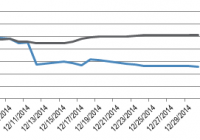
Summary Recap on Part 1: top short idea (AYA CN) has paid off. Part 2 introduces more ways to play the responsible investing theme. See below for blended strategy and a more conservative fixed-income strategy in a world of record-setting equity markets. Recap on Part 1 Socially responsible investing is becoming a mainstream phenomenon. Just this week, CNBC caught wind of it and featured the slumping of sin stocks, As a recap of Investing is Not Gambling, Part 1 , AYA CN was featured as the most overvalued gambling stock in the note. Since Part 1 was published, AYA stock has underperformed the SPTSX index: AYA slumped 20+% while the index finished the year essentially flat. Source: Bloomberg In this article, Part 2, I will introduce more ways to play the social responsibility theme. More ways to play this strategy I. Equity-Fixed Income Blended Strategy A Bloomberg screen returns over 130 mutual funds that either exclude or restrict gambling related investments. Strategies of these funds range from equities to bonds, and from balanced to international. To be clear, the exclusion/restriction is not a simple black-and-white rule. If you read the prospectuses (which you should), sophisticated fund managers conduct in-depth analysis . If the overall social impact and financial returns outweigh the profit contribution from gambling products, the security may be retained in the portfolio. For example, if an innovative machine manufacturer derives 5% of its profit from slot machines and the rest from carbon control devices, its securities may well be included. If you are leery about excessive exposure to equities (at near-record level one has sufficient reasons to think so), you should look for blended strategy among the 130 or so funds. When selecting funds, investors should pay attention to their different benchmarks. The highest returning fund may not be the best investment just because it has the most aggressive strategy (i.e. higher allocation to equities). With that in mind, I have laid out funds with blended strategy and grouped them by benchmarks. They are then ranked by equity exposure. As shown in the chart below, PWMAX , PWMCX , and PWMIX all are compared against a benchmark with only 24% equity exposure and, not surprisingly, have the lowest returns. The equity weight then goes up to 42% for PMPAX, PWPCX, and PWPIX; it rises to 55% for PGPAX and PMMIIX; and it finally reaches 60% for CBAIX, CSGCX, and WSBFX. Next, comparing fund returns against their respective benchmark, one will get a real picture of each fund’s alpha. It turns out, PWMIX has the highest alpha and the third lowest management fees. For investors with a higher risk appetite, PGPAX and PMIIX offer a good compromise between aggressiveness and alpha. Chart: fund returns Source: Bloomberg II. Fixed Income Focus Strategy Again, if you are bearish on the equity market in 2015, excluding funds with equity exposure, you can still choose from 50-odd funds. Following a similar selection process as above, investors will see that Praxis Genesis Conservative Strategy Fund (MUTF: MCONX ) offers outstanding risk-adjusted returns with a management fee of only 0.05%. Last but not the least, for the purists out there, MCONX strictly excludes any security related to the gambling industry. One thing I did not explore so far is project-based investments, such as the Social Impact Bonds pilot program in the UK. Institutional investors such as high-net worth individuals and foundations are invited to either guarantee first loss or lend capital into the program. Such projects are usually off limit to retail investors. However, I am all ears if you know of projects accessible to all.
SPDR S&P 500 ETF: SPY’s 2014 And Fourth-Quarter Performance And Seasonality

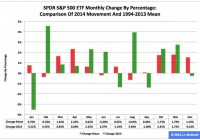
Summary The SPDR S&P 500 ETF ranked No. 1 in 2014 among the three most popular exchange-traded funds based on the S&P 1500’s constituent indexes. Most recently, the ETF’s adjusted closing daily share price last month declined to $205.54 from $206.06, a loss of -$0.52, or -0.25 percent. The last time the ETF had a negative return in the seasonally strong month of December was 2007. The SPDR S&P 500 ETF (NYSEARCA: SPY ) ranked first by return during 2014 among the three most popular ETFs based on the S&P 1500’s constituent indexes, which also encompass the SPDR S&P MidCap 400 ETF (NYSEARCA: MDY ) and the iShares Core S&P Small-Cap ETF (NYSEARCA: IJR ). SPY advanced to $205.54 from $181.15, a gain of $24.39, or 13.46 percent, in terms of adjusted closing daily share prices. Neither seasonality nor U.S Federal Reserve policy appears likely to be supportive of SPY at its current elevated level over the coming quarter. The Federal Open Market Committee announced the end of asset purchases under its third formal quantitative-easing program Oct. 29 and may announce the beginning of its next round of federal-funds-rate increases April 29. Figure 1: SPY Monthly Change, 2014 Vs. 1994-2013 Mean (click to enlarge) Source: This J.J.’s Risky Business chart is based on analyses of adjusted closing monthly share prices at Yahoo Finance . SPY behaved better in 2014 than it did over its initial 20 full years of existence based on the monthly means calculated by employing data associated with that historical time frame (Figure 1). The same data set shows the average year’s strongest quarter was the fourth, with an absolutely large positive return, and its weakest quarter was the third, with an absolutely small positive return. The last time the ETF had a negative return in the seasonally strong month of December was 2007. Figure 2: SPY Monthly Change, 2014 Vs. 1994-2013 Median (click to enlarge) Source: This J.J.’s Risky Business chart is based on analyses of adjusted closing monthly share prices at Yahoo Finance. SPY behaved worse in 2014 than it did over its initial 20 full years of existence based on the monthly medians calculated by using data associated with that historical time frame (Figure 2). The same data set shows the average year’s strongest quarter was the fourth, with an absolutely large positive return, and its weakest quarter was the third, with a relatively small positive return. Last year, the ETF performed best in the second quarter and worst in the third quarter. Disclaimer: The opinions expressed herein by the author do not constitute an investment recommendation, and they are unsuitable for employment in the making of investment decisions. The opinions expressed herein address only certain aspects of potential investment in any securities and cannot substitute for comprehensive investment analysis. The opinions expressed herein are based on an incomplete set of information, illustrative in nature, and limited in scope. In addition, the opinions expressed herein reflect the author’s best judgment as of the date of publication, and they are subject to change without notice. Now that you’ve read this, are you Bullish or Bearish on ? Bullish Bearish Sentiment on ( ) Thanks for sharing your thoughts. Why are you ? Submit & View Results Skip to results » Share this article with a colleague

10.6% Yielding ETW Offers Both Income And A Capital Appreciation Opportunity

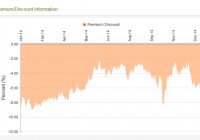
Summary ETW is a global option-income fund that uses a covered call strategy to deliver a 10.6% yield. High-volume selling of ETW has dropped its discount to a level not seen in the last 18 months. Buying ETW today locks in a higher yield and also provides the opportunity for capital appreciation if the discount reverts back to its historical average. Introduction Eaton Vance Tax Managed Global Buy Write Opportunities Fund (NYSE: ETW ) is an option-income close-ended fund [CEF] from Eaton Vance (NYSE: EV ). Thi s fund seeks t o achieve “current income with capital appreciation through investment in global common stock and through utilizing a covered call and options strategy.” ETW currently sports a -10.3% discount and a 10.6% market yield. This yield is generated by maintaining a long exposure to common stocks, while writing call options against the underlying indices. ETW is a global fund which benchmarks itself against a composite of 33% S&P 500, 22% NASDAQ 100, 34% FTSE E100 and 11% Nikkei 225. According to data supplied by Eaton Vance , ETW writes index call options on 94% of its portfolio, with an average of 15 days to expiration, and at 1.6% out of the money. Therefore, ETW can be considered to be a relatively defensive option-income fund. The covered call strategy generates a high level of current income, but caps the upside potential of the fund. This is because the maximum upside of a call option is equal to the strike price of the option plus the premium received. Hence, equity option-income funds are expected to lag the market index in a rising market. On the other hand, option-income funds will likely outperform in sideways or declining markets, which, given the tremendous performance of the U.S. stock market over the past few years, could very well be in store for us in 2015. Additionally, the 10.6% yield is highly attractive to investors seeking decent income from their equity holdings. In a previous article in June 2014, we noted that ETW’s discount of -3.3% was much higher than its 52-week average of -7.7%, while the -8.45% discount of Eaton Vance Tax-Managed Global Diversified Equity Income Fund (NYSE: EXG ) discount was similar to its 52-week average of -8.33%. Given the similar investment mandates of the two funds, the article recommended to sell ETW and buy EXG to take advantage of mean reversion in CEFs. Six weeks later , the discount for ETW had widened from -3.31% to -3.93% while the discount for EXG had narrowed from -8.45% to -5.60%. Hence, this pairs trade was up more than 2.6% in 6 weeks (~23% annualized). Taking advantage of mean reversion in CEFs is a potential strategy o obtain outsized profits. In a July 2014 paper entitled Exploiting Closed-End Fund Discounts: The Market May Be Much More Inefficient Than You Thought , authors Patro, Piccotti and Wu provide significant evidence of mean reversion in closed-end fund premiums. This article identifies an opportunity to buy ETW at a greater discount than its 1-year average. Widening discount The graph below is from CEFConnect and shows the premium/discount value of ETW over the past year. (click to enlarge) The table below shows the current, average 1-year, 3-year and 5-year discount values of ETW (source: CEFConnect). Time Discount 1-year -5.32% 3-year -9.43% 5-year -4.18% Current -10.33% We can see from the data above that ETW’s discount is lower its average discount over all three time periods. According to CEFAnalyzer , the 1Y Z-score for ETW is -1.71, indicating that the current discount of ETW is significantly below its 1Y average discount (adjusted for standard deviation). The 2Y and 4Y Z-scores are -0.48 and 0.37, respectively. What was the reason for this relatively large discount? One culprit may have been the high-volume selling of the fund on the final few trading days of last year. Over 956K shares changed hands in the last four days of 2014 (avg. daily volume = 400K), with the final day’s volume of 1.6M exceeding the volume of any other trading day in 2014. Over the course of those four days, ETW dropped 6.1%, compared to 1.1% for the U.S. stock market (NYSEARCA: SPY ) and 1.4% for the global stock market (NASDAQ: ACWI ). (click to enlarge) However, remember that the market price of a close-ended fund has no relationship to its net asset value. Therefore, the decline in share price of ETW caused by the high-volume selling of the fund over the past couple of days is the equivalent of sweaters going on sale after the holiday: you get the exact same product but at a lower price. The graph below was generated using data from Yahoo . We can see that the yield currently offered by ETW is higher than at any other time point in 2014. Based on the above analysis, I purchased ETW today at a price of $11.23 Buying thesis Lock in a high current yield of 10.6% while being exposed to some upside of the global stock market. Outperform the underlying index in a flat or declining market. Capital appreciation if the current discount of -10.33% narrows back to its average. Risks The discount may widen further. In late 2011, the discount widened to over 15%. The fund will underperform in a strong bull market. Loss of capital in a declining market (albeit with some downside protection due to the call premiums received).