Tag Archives: seeking-alpha

Rising Interest Rates Are Great News For These Bond ETFs

With an improved economy and better employment prospects, a rate hike by the Fed is back on the table for 2015. We have already started to see rates move higher in recent weeks in anticipation of this, as benchmark 10-year debt is now around 2%, a sharp and sudden increase from levels, which were in the 1.65% range earlier in the month. If rates continue in this direction, bond investors will likely see something that they haven’t experienced in a while, losses. With rising rates bond prices will fall, hitting the returns for investors who have big holdings in the fixed income world (see Play Rising Rates with These ETFs ). What’s a Fixed Income Investor to Do? This puts fixed income investors in quite the quandary, as many still desire the stability that comes with bonds, but with the writing on the wall for rates, it is hard to be too optimistic about the space in the near term. However, should we see a burst in market volatility, investors will likely clamor for more bond holdings, putting many investors in a difficult spot. Fortunately, thanks to some relatively new bond ETFs, fixed income investors might have a solution on their hands. These new products are ‘negative duration’ bonds and they actually look to rise in price when rates rise and thus are basically built for a rising rate environment (see 3 Sector ETFs to Profit from Rising Rates ). Currently, there are two such funds both coming to us from WisdomTree. First up, we have the WisdomTree Barclays Aggregate Bond Negative Duration ETF (NASDAQ: AGND ), which has a -5 year duration, and then the WisdomTree BofA Merrill Lynch High Yield Bond Negative Duration ETF (NASDAQ: HYND ) , which has a -7 year duration for those who focus on the junk bond market. More Information These types of funds could be interesting stand alone picks, or ones to pair with other bond holdings as well. For example, an (iShares Core Total U.S. Bond Market ETF (NYSEARCA: AGG )) investor could use AGND in order to bring down their overall duration, while a similar strategy can be used by (iShares iBoxx $ High Yield Corporate Bond ETF (NYSEARCA: HYG )) or (SPDR Barclays Capital High Yield Bond ETF (NYSEARCA: JNK )) investors who are looking to ratchet down their interest rate risk levels with HYND. For more on these funds and how they can be used in a portfolio, watch our short video on the topic below!
Why Active Managers Like Volatility

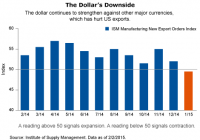
With quantitative easing finished and the Fed poised to raise rates, we are already starting to see stocks exhibit more volatility. We expect that to continue, and that stocks will rise or fall based on their fundamentals. In this environment, we believe active management is likely to become increasingly important to achieving sufficient returns. Capital markets offered some surprises for investors last week. Stocks rose globally with the Dow Jones Global Index rising 0.72%, while US stocks rallied with the S&P 500 hitting another record high. In addition, Treasury bonds sold off and oil continued its multi-week rebound. Clearly, asset classes are rotating and moving in different directions. A good example of this rotation can be found in the energy sector. Energy stocks have disappointed since last summer, falling in lockstep with the price of oil. However, in the past few weeks the price of oil has rapidly reversed course, helping energy stocks to rebound. The average energy-sector equity mutual fund returned almost 12% in the past month (as of February 13, 2015), well above every other sector fund average, according to Morningstar. Home and Away We’re also seeing divergent paths among fourth-quarter earnings reports. So far, earnings season has been positive, beating expectations. But there’s a substantial difference between companies that derive their earnings domestically from companies that derive their earnings largely from outside the United States. Why? Because the rising dollar has dragged down their fourth-quarter earnings results. A look at factory activity over the past few months drives home this point. The ISM manufacturing index has dropped to 53.5 in January from 57.6 in November. Weakness in foreign demand pushed new export orders down to their lowest level since November 2012. The caveat is that, like the price of oil, the dollar could reverse course relative to other currencies and the above scenario could change. Divergence can also be found in economic growth in the euro zone. For the fourth quarter, the euro zone skirted a recession and actually delivered modest growth. However, growth varied widely across member countries. Germany and Spain both saw their economies grow 0.7% in the quarter, beating expectations. Not surprisingly, some European countries didn’t fare as well, with both France and Italy falling short of expectations and Greece experiencing a -0.2% growth rate. Despite the disparity in growth, sovereign bond yields may not be dramatically different between these countries (except Greece) thanks to investors’ belief that the European Central Bank will stand behind this debt. Still, the performance of their stock markets could be where we see that growth gap reflected. The Perils of Indexing At Allianz Global Investors, we have long argued that once quantitative easing ended, we would see a change in the market environment. In other words, a move away from QE – which served as a rising tide lifting all boats – to an environment where stocks rise and fall on their individual fundamentals. We worry that the large number of investors who have enthusiastically embraced indexing in the past decade will be negatively impacted in this market environment, where we’re likely to see far more volatility, asset-class rotation and overall differentiation among individual securities. Unfortunately, indexing generally does not allow investors to avoid those companies that can be hurt by a rising dollar or the falling price of oil. And indexing does not allow investors to pivot when the dollar begins falling or the price of oil again changes course. In addition, as we look out on 2015, we expect relatively low stock returns. This again makes the case for active investing as investors will need to make active bets in an effort to surpass low market returns. In short, there are periods when markets are more conducive to index investing, as we saw over the past few years, but this environment isn’t one of them. We hope investors recognize the importance of active management in this unique and ever-changing market environment. We believe, a “buy the index and go home” strategy in times of uncertainty could come back to haunt investors.

My Duke Energy Fourth-Quarter Earnings Prediction

I predict the stock to report a $1.27 earnings number on $6.344 billion in revenue. Analysts are predicting an average of $0.80 and $6.25 billion. Duke is definitely a solid name to hold onto to during difficult times and the 4% dividend yield offers pretty good protection for when the stock price drops. As earnings season continues we’ve seen the utility sector of the market show some chinks in the armor as the ten-year treasury yield has begun to climb. Duke has been the beneficiary stock recently of falling yields and now is becoming a victim of rising yields. I selected this stock for my portfolio of thirty back in May of 2013 because I liked the prospect of having a great dividend and a business which is always going to have a customer. During the past year the stock price has increased 11.74% excluding dividends and only just in the past two weeks has it lost 10% due to rising treasury yields. With that said I’d like to make my prediction for Duke Energy for the fourth quarter of 2014 that the company will be announcing on February 18, 2015 before the market opens. DUKE ENERGY CORPORATION (NYSE: DUK ) INCOME STATEMENT Fiscal year ends in December. USD in millions except per share data. 2014-12 2014-09 2014-06 2014-03 2013-12 2013-09 Revenue $6,344 $6,395 $5,949 $6,624 $6,112 $6,709 Cost of revenue $2,275 $2,307 $2,287 $2,531 $2,281 $2,474 Gross profit $4,069 $4,088 $3,662 $4,093 $3,831 $4,235 Operating expenses Operation and maintenance $1,398 $1,409 $1,467 $1,506 $1,527 $1,458 Depreciation and amortization $810 $788 $761 $790 $763 $707 Other operating expenses $491 $272 $318 $1,739 $338 $327 Total operating expenses $2,699 $2,469 $2,546 $4,035 $2,628 $2,492 Operating income $1,370 $1,619 $1,116 $58 $1,203 $1,743 Interest Expense $412 $405 $413 $406 $419 $379 Other income (expense) $175 $137 $122 $131 $211 $87 Income before income taxes $1,132 $1,351 $825 -$217 $995 $1,451 Provision for income taxes $340 $460 $209 -$127 $309 $457 Net income from continuing operations $793 $891 $616 -$90 $686 $994 Net income from discontinuing ops $100 $378 -$3 -$3 $6 $14 Other $3 $5 -$4 -$4 -$4 -$4 Net income $896 $1,274 $609 -$97 $688 $1,004 Net income available to common shareholders $896 $1,274 $609 -$97 $688 $1,004 Earnings per share Basic $1.27 $1.80 $0.86 -$0.14 $0.97 $1.42 Diluted $1.27 $1.80 $0.86 -$0.14 $0.97 $1.42 Weighted average shares outstanding Basic 707 707 707 706 706 706 Diluted 707 707 707 706 706 706 So you may notice that I have revenue to be about equal to what it was during the past quarter and that’s because I don’t believe the economy has excelled much during the past couple of quarters. The average analyst estimate for the quarter is $6.25 billion with a high of $6.8 billion. So I appear to be a bit optimistic for the quarter on revenue than the average but on a GAAP basis I’m predicting earnings to be $1.27 while the average estimate is $0.80 with a high of $0.98. I’m actually quite a bit higher than the rest of the pack because I’ve assumed best case scenarios for operating expenses as all their commodity prices have dropped significantly during the fourth quarter. We’ll have to wait and see what happens in a few days, but one thing is for sure, I’m not going to be buying any of the stock before the earnings report. However, I purchased a batch last week right before the ex-dividend date so I can increase my dividend a little. Duke is definitely a solid name to hold onto to during difficult times and the 4% dividend yield offers pretty good protection for when the stock price drops. Disclaimer: This article is in no way a recommendation to buy or sell any stock mentioned. This article is meant to serve as a journal for myself as to the rationale of why I bought/sold this stock when I look back on it in the future. These are only my personal opinions and you should do your own homework. Only you are responsible for what you trade and happy investing! Disclosure: The author is long DUK. (More…) The author wrote this article themselves, and it expresses their own opinions. The author is not receiving compensation for it (other than from Seeking Alpha). The author has no business relationship with any company whose stock is mentioned in this article. Are you Bullish or Bearish on ? Bullish Bearish Neutral Results for ( ) Thanks for sharing your thoughts. Submit & View Results Skip to results » Share this article with a colleague