Tag Archives: seeking-alpha

A Diverse Momentum System Using Vanguard Allocation Funds
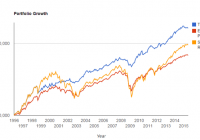
One of the criticisms of momentum systems is they are prone to crashes when momentum reverts. The system highlighted in this article can be implemented using any number of “life style” or target-risk funds or ETFs. The system chooses from a small number of funds that reflect a range of asset allocation models. The purpose is to employ a diverse, momentum-based asset allocation system. Rather than allocate based on momentum to singular asset classes which increases the potential for momentum crashes, we allocate to asset allocation models themselves. The tests were conducted using Portfolio Visualizer . If you have not checked out their site I highly recommend this free tool. Also, for additional research on this topic please see this award-winning paper by Corey Hoffstein of Newfound Research which served as the original inspiration for these tests. I ran 5 tests using Vanguard Target-risk funds and the Vanguard Five Hundred Index Fund (MUTF: VFINX ) . The Target-risk funds used were the Vanguard LifeStrategy Conservative Growth Fund (MUTF: VSCGX ) , the Vanguard LifeStrategy Growth Fund (MUTF: VASGX ) , the Vanguard LifeStrategy Income Fund (MUTF: VASIX ) and the Vanguard LifeStrategy Moderate Growth Fund (MUTF: VSMGX ) . According to Vanguard these funds are “a series of broadly diversified, low-cost funds with an all-index, fixed allocation approach that may provide a complete portfolio in a single fund. The four funds, each with a different allocation, target various risk-based objectives.” The funds allocate different percentages to bonds (international and domestic) and stocks (international and domestic). The tests consisted of two simple momentum systems I frequently use on Scotts Investments . The first is a simple relative strength system where the best performing asset based on trailing returns is purchased. The seconds is a “dual momentum” system that holds the best performing fund based on trailing returns. A second filter is used, absolute momentum, to switch the best performing asset to cash if its total returns were below the risk-free rate of cash over the lookback period. This is similar to my Dual Momentum Portfolio , which is inspired by a paper written by Gary Antonacci and available on Optimal Momentum . Antonacci’s book, Dual Momentum Investing: An Innovative Strategy for Higher Returns with Lower Risk , also highlights his specific system in greater detail. The test results for the relative momentum system is below. All tests were from 1996 – present. The first model used a single performance window of 5 months. The best performing fund was held, and trades were performed at the start of each month. For comparison purposes an “equal-weight” version each portfolio is also provided but since these are asset allocation funds the comparison is a bit redundant (equal weight is essentially a balanced fund itself): Timing Model Assets Ticker Name VSMGX Vanguard LifeStrategy Moderate Growth Fund VASIX Vanguard LifeStrategy Income Fund VSCGX Vanguard LifeStrategy Conservative Growth Fund VASGX Vanguard LifeStrategy Growth Fund Portfolio Initial Balance Final Balance CAGR Std.Dev. Best Year Worst Year Max. Drawdown Sharpe Ratio Sortino Ratio Stock Market Correlation Timing Portfolio $10,000 $51,597 8.78% 8.53% 24.22% -10.53% -18.49% 0.75 1.14 0.84 Equal Weight Portfolio $10,000 $35,621 6.73% 8.56% 19.57% -22.73% -32.75% 0.53 0.75 0.96 S&P 500 Total Return $10,000 $48,177 8.40% 15.47% 33.36% -37.00% -50.95% 0.45 0.64 0.99 What if we add VFINX to the pool of potential assets? We would expect higher volatility with potentially higher returns since a 100% stock allocation is held at various times ( you will also see the equal weight portfolio has slightly higher returns/volatility because it is tilted towards stocks with its allocation to VFINX): Portfolio Initial Balance Final Balance CAGR Std.Dev. Best Year Worst Year Max. Drawdown Sharpe Ratio Sortino Ratio Stock Market Correlation Timing Portfolio $10,000 $70,161 10.51% 10.21% 33.21% -10.53% -18.49% 0.8 1.24 0.82 Equal Weight Portfolio $10,000 $38,242 7.12% 9.85% 21.35% -25.59% -36.63% 0.51 0.73 0.98 S&P 500 Total Return $10,000 $48,177 8.40% 15.47% 33.36% -37.00% -50.95% 0.45 0.64 0.99 (click to enlarge) Returns and standard deviation increase, which may have been expected. However, max drawdown and the worst year remained the same, so adding a 100% stock allocation did not impact our biggest loss. Next, we test a dual momentum approach with a 12-month look back period. The top 1 fund is purchased based on 12-month returns, but only if the returns are also greater than the return on the risk free rate of cash. Testing the 4 life style funds (excluding VFINX) yielded the following results: Portfolio Initial Balance Final Balance CAGR Std.Dev. Best Year Worst Year Max. Drawdown Sharpe Ratio Sortino Ratio Stock Market Correlation Timing Portfolio $10,000 $49,142 8.51% 8.78% 22.26% -7.61% -16.17% 0.71 1.08 0.73 Equal Weight Portfolio $10,000 $35,621 6.73% 8.56% 19.57% -22.73% -32.75% 0.53 0.75 0.96 S&P 500 Total Return $10,000 $48,177 8.40% 15.47% 33.36% -37.00% -50.95% 0.45 0.64 0.99 What if we include VFINX? Portfolio Initial Balance Final Balance CAGR Std.Dev. Best Year Worst Year Max. Drawdown Sharpe Ratio Sortino Ratio Stock Market Correlation Timing Portfolio $10,000 $59,952 9.62% 10.45% 33.21% -6.73% -17.29% 0.71 1.09 0.73 Equal Weight Portfolio $10,000 $38,242 7.12% 9.85% 21.35% -25.59% -36.63% 0.51 0.73 0.98 S&P 500 Total Return $10,000 $48,177 8.40% 15.47% 33.36% -37.00% -50.95% 0.45 0.64 0.99 (click to enlarge) Finally, what is we use a 5-month look back period, like the relative strength tests, instead of 12 months? Portfolio Initial Balance Final Balance CAGR Std.Dev. Best Year Worst Year Max. Drawdown Sharpe Ratio Sortino Ratio Stock Market Correlation Timing Portfolio $10,000 $62,456 9.85% 9.72% 33.21% -4.74% -15.38% 0.77 1.22 0.7 Equal Weight Portfolio $10,000 $38,242 7.12% 9.85% 21.35% -25.59% -36.63% 0.51 0.73 0.98 S&P 500 Total Return $10,000 $48,177 8.40% 15.47% 33.36% -37.00% -50.95% 0.45 0.64 0.99 (click to enlarge) The sharpe ratio in all 5 tests ranged from .71 – .80 and in each instance outperformed an equal weight portfolio and the S&P 500. Investors looking for a simple, momentum based system that avoids “all-in” investments in single asset classes should consider a system using asset allocation funds. Disclosures: None
HEWW: An Currency Hedged Version Of EWW

A currency hedged version of a long established fund. A carefully weighted fund through the use of a 25/50 ‘capping methodology’. The fund selects from the full range of Mexican companies: small, medium and large caps. The iShares Currency Hedged MSCI Mexico ETF (NYSEARCA: HEWW ) is the most recent of Mexico focused funds, having been incepted on June 29, 2015. Since the fund has been trading only a few weeks, it offers no real return metrics to compare. However, by examining a nearly identical fund, the fund’s allocation, the structure of the Mexican economy and the relative stability of the Mexican Peso, the interested investor will have a gauge of the future potential of the fund. Name and Symbol Description Inception iShares Currency Hedged MSCI Mexico Tracks the MSCI Currency Hedged IMI Mexico 25/50 Capped Index June 29, 2015 SPDR MSCI Mexico Quality Mix ETF (NYSEARCA: QMEX ) Tracks the Total Return performance of the MSCI Mexico Quality Mix A-Series Index September 17, 2014 Deutsche X-trackers MSCI Mexico Hedged Equity ETF (NYSEARCA: DBMX ) Tracks the MSCI 25/50 U.S. Dollar Hedged Index January 23, 2014 iShares MSCI Mexico Capped ETF (NYSEARCA: EWW ) Tracks the MSCI unhedged IMI Mexico 25/50 Capped Index Data from iShares, SPDR, DeutschebankMarch 12, 1996 (Data from iShares, SPDR, Deutschebank) The new fund tracks the Morgan Stanley Capital International Indices (MSCI) Mexico Investible Market Index (IMI) 25/50 100% U.S. Dollar Hedged Index . According to the prospectus , the fund is passively managed. The fund is ‘capped’: it is a capitalization weighted index . The 25/50 ‘capping methodology’ means that no single issue exceeds 25%. All issues with a weight above 5% do not cumulatively exceed 50% of the underlying index weight. The index includes large, mid and small cap companies. (click to enlarge) (Data from iShares, SPDR, Deutschebank) The careful investor is sure to ask how necessary is it to have a currency hedge? There’s a clear answer to this question. In a nutshell, central banks are obligated to maintain a stable currency. Having a too strong or too weak currency will create negative effects on any economy. For example, the usual way for a central bank to slow inflation is to raise short term interest rates. However, this runs the risk of slowing the economy too much; something the recently emerged Mexican economy would not want to do. Banco de Mexico has come up with an innovative solution. It regularly auctions U.S. Dollars from its currency reserves. This enables the central bank to strengthen the currency by reducing the supply of Pesos in the economy, while at the same time maintaining sustainable lending rates. Because of the scope and scale of the top global reserve currency U.S. Dollar, Mexico’s export product prices to the U.S. are hardly affected. However, large swings in relative currency values could negatively impact the dollar value conversion of a portfolio, a Mexican focused fund for instance, even though the portfolio’s fundamentals are unchanged. (Data from iShares) As mentioned above, HEWW has just recently been listed for trading. Fortunately, there’s a way to accurately gauge market performance by examining the identical but ‘unhedged’ capped index fund, the iShares MSCI Mexico Capped ETF and compare that with other Mexico focused funds. It was a simple matter to download the holdings of each fund to a spreadsheet, alphabetizing them and then comparing entry by entry. Indeed the holdings of EWW and HEWW are identical with the exception that the dollar hedged fund has positions for currency forward contracts, naturally. (Data from iShares) There are two other funds for comparison. DBMX also tracks the MSCI 25/50 capped index, although it omits a consumer discretionary and a financial holding which occur in the iShares funds. QMEX tracks about half of the companies in the 25/50 capped index, 34 in total, along with two others not listed in the 25/50 capped index. QMEX also holds a position of liquid U.S. Dollars reserves. Fund Net Assets (millions) Shares Outstanding Number of Holdings Average Volume Premium to Discount Expense Ratio P/E Equity Beta 12 month Trailing Yield EWW $1479.953 26,100,000 60 734,113 0.00% 0.48% 31.11 1.09 1.62% DBMX $4.5399 200,001 57 2,621 0.29% 0.50% 17.7 0.76 2.79% QMEX $2.44 100,000 33 224 -0.16 0.40% 22.99 1.61 1.43 (Data from iShares, SPDR, Deutschebank) Investing in a country focused fund is essentially investing in the overall economy. So a basic understanding of what drives the Mexican economy is needed. As mentioned, Mexico has an export economy and it’s clear from the chart below, it is heavily dependent on its NAFTA partner U.S. economy. (Data from iShares) Bilateral trade with the U.S. is just over $500 billion comparable to bilateral U.S.-Canadian trade of about $600 billion. In total, bilateral trade with both Canada and the U.S. well exceeds trade with any other individual nation; however, Mexico has other large regional partnerships and free trade agreements. The Mexican government has focused on building an extensive free trade network. Nearly 90% of Mexico’s global trade transacts through free trade agreements. According to the Secretariat of Economy, other free trade partnerships in force exist with Australia, Korea, Singapore, Israel, India and the European Free Trade Association. Mexico is a participant in the future Trans-Pacific Partnership. In the America’s, aside from NAFTA, Mexico has free trade agreements throughout Latin America, South America and with Cuba. The point of the matter is that even though Mexico’s largest trading partner is the U.S.; Mexico has an extensive free trade network outside of North America. The Mexican economy has been affected by the collapse of global oil prices. However, Mexico is not a petro-economy. Surprisingly, 14% of total power production is derived from renewable resources: 11% from hydro plants and 3% from geothermal and biomass, according to U.S. EIA data. The government is expanding wind generation projects including plants on the Baja peninsula for power exports to the U.S. Mexico is a net exporter of crude petroleum, producing about 2.5 million bbl of crude oil per year and consuming about 2 million bbl; the remainder is exported. Mexico has proven reserves of 9.8 billion bbl, approximately. Mexico is a net importer of natural gas, producing about 1.64 billion ft 3 consuming almost 2.3 billion ft 3 . Lastly it is a net importer of coal, mining 16.7 million tons and consuming 20.7 million tons. What it adds up to is that the economy is somewhat affected by global petroleum markets, but it is certainly not totally dependent on volatile global petroleum markets. (Data from iShares) In the recent downturn in global oil prices, the government responded accordingly by reducing government spending, which is about 0.7% of GDP. The Ministry of Finance estimates GDP growth to be within the range of 2.2% to 3.2% in 2015; 2.9% to 3.9% for 2016. The Bank of Mexico expects inflation to remain at the 3% target rate. The important point is that the fiscally responsible government is doing a good job keeping inflation very close to the target, keeping the Peso stable and maintaining slow but steady growth. As it stands now, an increase in demand from the U.S. will bode well for the Mexican economy. To be sure, Mexico has many domestic and international concerns which must be solved. However, while negative news might make attention getting headlines, those headlines obscure the years of positive achievements of the Mexican government and Banco de Mexico since the currency crises of 1994-1995. Those achievements include maintaining a sustainable inflation rate and a stable currency in spite of a global credit crisis, still reverberating in Europe and Asia. Also, the Ministry of Trade has done a remarkable job in establishing what might be the most comprehensive ‘free trade network’ in the world. In the private sector, banks are well capitalized and regulated. Industry isn’t just manufacturing but also includes research and development with global partners. Unhedged EWW Returns After 1 Year After 3 Years After 5 Years After 10 Years Since Inception 3/12/1996 Total -14.14% -0.73% 5.00% 9.48% 11.46% Market Price -14.45% -1.08% 5.04% 9.41% 11.43% Benchmark Index -13.86% -0.73% 4.75% 9.03% 12.12% (Data from iShares, SPDR, Deutschebank) According to iShares the currency hedged ETF H EWW fund has net assets of $2,466,407. The expense ratio is rather high at 1.10%; however, there is a ‘fee waiver’ which results in an expense ratio of 0.51%. The fund is virtually identical to the long established iShares EWW fund with the addition of a currency hedge. To sum up, several Mexico focused funds have been created over the past two years. This most recent addition is virtually identical to the long established iShares Mexico Capped ETF. Recently, the returns reflect the still recovering global economy but returns of EWW since inception are respectable. Naturally, the investor must choose between competing funds, however, upon close examination, the brand new iShares currency hedged fund actually has a long established track record. Disclosure: I/we have no positions in any stocks mentioned, and no plans to initiate any positions within the next 72 hours. (More…) I wrote this article myself, and it expresses my own opinions. I am not receiving compensation for it (other than from Seeking Alpha). I have no business relationship with any company whose stock is mentioned in this article. Additional disclosure: “CFDs, spread betting and FX can result in losses exceeding your initial deposit. They are not suitable for everyone, so please ensure you understand the risks. Seek independent financial advice if necessary. Nothing in this article should be considered a personal recommendation. It does not account for your personal circumstances or appetite for risk.”

Liquid Alternatives May Solve The Problem Of Stock-Bond Correlation

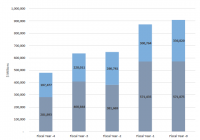
By DailyAlts Staff While everyone likes to see their portfolio rise in value, Cognios Capital senses something “artificial” about the current stock and bond markets. In a white paper published in June 2015 – before the Chinese stock market imploded and its government launched a series of proposals designed to re-inflate the overheated market – Cognios warned against the “unprecedented interventions” by central banks in North America, Europe, and Asia. What once was a choir of gold-bug cranks is now a common refrain of mainstream financial analysts: Stocks and bonds both face serious headwinds, and investors need to significantly reduce their expectations for future returns. This, of course, puts added emphasis on the emergence of liquid alternative investments – hence the title of Cognios’s white paper: Alternatives: An Answer to Risk Diversification . QE and the Search for Yield From the beginning of its quantitative easing program in December 2008 through its conclusion on Halloween 2014, the Federal Reserve’s balance sheet grew by a staggering $3.5 trillion – that’s $100 million more than the annual GDP of Germany, the world’s fourth-largest economy! Approximately $2.3 trillion of this total is comprised of U.S. Treasury bonds, as the Fed’s objective was to push down the risk-free rate of return and thereby encourage risk-taking in the stock market, under the idea that this would create a “wealth effect” for U.S. consumers. Of course, this has really resulted in excessive risk-taking, as stocks have reached historically dangerous valuation metrics and bond yields are at all-time lows, with nowhere to go but up. As of April 2015, the yield on 30-year U.S. Treasury securities was a paltry 2.75% – less than half its historic average of 5.54%. Cognios worries that the Fed may be forced to raise interest rates faster than currently expected, just like they did in 2004; and if they do, the results for Treasury bondholders would be staggering: According to Cognios, a reversion of the 30-year Treasury yield to its historical average over the next year would result in losses of more than 37% for the securities. Facing Reality The Federal Reserve overtly propped up bond prices and pushed down yields as part of its QE, but in doing so, they also caused stocks to rise. After all, by reducing the risk-free rate of return, the Fed effectively pushed money into stocks, and what’s more, low interest rates encouraged publicly traded companies to borrow money to pay dividends or buy back their own shares. By buying back their own shares, S&P 500 companies have created the greatest disparity between their market value and U.S. GDP in history. Cyclically adjusted price-to-earnings (“CAPE”) ratios are also near all-time highs, above 25.0. According to Cognios, whenever CAPE ratios have exceeded 25.0 in the past, the likelihood of the market generating positive returns of the next five years has been less than 50%. The Role of Alts Facing the reality that both stocks and bonds are likely to generate below-average returns over the next five years, investors are turning to liquid alternatives. These products, which emulate strategies once reserved for only high-net-worth and institutional investors, have grown to more than $154 billion in assets under management from less than $40 billion in 2008. Alternatives are designed to have low correlation to traditional assets such as stocks and bonds. Given the highly correlated nature of the stock and bond markets that has resulted from the Fed and other central banks implementing their own versions of QE, alternatives have the potential to provide upside participation in rising markets while offering downside protection.