Tag Archives: pro

Don’t Follow The News? More Like Don’t Overreact To The News

Tadas Viskanta has a great blog post up titled Make More By Doing (and listening) Less. The general tone of the article is the extent to which investors too frequently are influenced by stock market media enough that they make changes to their portfolio. An additional bigger point made is that people are generally better off doing less in their portfolios not more. Tadas Viskanta has a great blog post up titled Make More By Doing (and listening) Less . The general tone of the article is the extent to which investors too frequently are influenced by stock market media enough that they make changes to their portfolio that end up being the wrong thing to have done. An additional bigger point made is that people are generally better off doing less in their portfolios not more. This is in line with an idea we have discussed here many times which is that if you go along with the market and have an adequate savings rate you have a good chance of having enough for your financial goal which presumably is retirement. This idea is not meant to ignore suitable asset allocation but to have the building blocks of how equity markets tend to work, they go up most of the time and every so often they go down a lot and scare the hell out of lot of people. From there an investor or advisor can employ some sort of strategy they believe will add value to their portfolio in whatever manner they believe is appropriate and over whatever period of time they find relevant. I personally believe in using individual stocks and ETFs, trying to increase the portfolio’s yield a little, maintain global diversification and take defensive action when risks of a large decline appear to increase. You, reading this likely have your own thoughts on how value might be added to a portfolio. Chances are that whatever your philosophy on investing is (so investing, not trading), an earnings report from a small cap social media company or the subsequent discussion about those earnings on stock market television does not play into that philosophy. Tadas’s point is in part that it can be easy to be compelled to stray out of your lane by what sounds like a good story or to get scared out of something in front of what turns out to be a 2% dip that a month from now won’t be visible in a chart. However, it is different for advisors. Although they probably should, the typical advisory client is probably not reading Tadas’s blog and they are prone to reacting to all sorts of news. We all have things we react to, that is ok so the conversation then becomes about having the self-awareness to know you’re a sucker for a good story or prone to overreact to bad news or something else. For the do-it-yourselfer it probably is a good idea to avoid media that leans sensational but I do believe in knowing what is going on in the world. Maybe this means avoiding most stock market television as well as taking control of what you’re vulnerabilities are. Advisors though need to be able to address questions that come up from clients. It is reasonable for clients to ask about anything, it’s their money and part of what they are paying for is the occasional hand holding in the form of understanding a news event (will rising rates hurt my portfolio or what happens if Greece goes under) and being able to explain whether it is or is not important and whether or not it impacts the strategy. This is harder to do for an advisor who consumes no news. Some will be able to have an effective dialogue with their client in this context without actually knowing the story but it is more difficult to do. Additionally while an advisor is presumably all in on whatever strategy they deploy for clients there are market environments where their strategy will struggle versus whatever their clients are seeing and hearing about from their friends. And picking your head up and looking around occasionally is a way to address these conversations more easily as well. I would say as opposed to not following the news, it might be better to train yourself to not overreact to the news. Disclosure: The author has no positions in any stocks mentioned, and no plans to initiate any positions within the next 72 hours. (More…) The author wrote this article themselves, and it expresses their own opinions. The author is not receiving compensation for it. The author has no business relationship with any company whose stock is mentioned in this article. Additional disclosure: To the extent that this content includes references to securities, those references do not constitute an offer or solicitation to buy, sell or hold such security. AdvisorShares is a sponsor of actively managed exchange-traded funds (ETFs) and holds positions in all of its ETFs. This document should not be considered investment advice and the information contain within should not be relied upon in assessing whether or not to invest in any products mentioned. Investment in securities carries a high degree of risk which may result in investors losing all of their invested capital. Please keep in mind that a company’s past financial performance, including the performance of its share price, does not guarantee future results. To learn more about the risks with actively managed ETFs visit our website AdvisorShares.com .
Avoiding The Pitfalls Of Factor-Based Investing

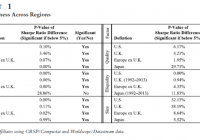
By DailyAlts Staff The proliferation of smart beta ETFs may be a relatively recent phenomenon, but the risk factors used to construct smart-beta indexes – most notably value, momentum, low beta, quality, illiquidity, and size – have been a popular topic for financial researchers for nearly three decades. Building off the early handful of factors, factor-based investing has since been expanded to as many as 250 distinct factors that have allegedly generated historical outperformance, but Research Affiliates’ Jason Hsu, Vitali Kalesnik, and Vivek Viswanathan argue that the supposed outperformance of most (if not all) of these new factors is illusory, based on cherry-picking by researchers and “artifacts” of the data. In fact, Mr. Hsu and his colleagues believe at least one of the traditional factors may be unlikely to generate superior risk-adjusted returns going forward. The researchers make their case in the Summer 2015 edition of The Journal of Index Investing , in an article titled “A Framework for Assessing Factors and Implementing Smart Beta Strategies.” Factor Robustness Hsu, et al. allege that economists, financial researchers, and other quantitative analysts are constantly trying to determine new factors, and that only their positive results are likely to get published. New research undermining an existing and semi-popular factor is unlikely to make it to the stage of peer review, according to Research Affiliates. This means that investors, advisors, and other decision-makers must test would-be factors for robustness themselves. Behind the quantitative data, Hsu, et al. insist that factors must be based on economic intuition and make sense within a theoretical framework – otherwise, they’re likely to be statistical noise. Factor premiums can be based on risk or behavioral issues, but in either case, they should span across geographic markets. If back-testing reveals a factor premium for U.S. stocks, that same premium should be evident in Japan and elsewhere. But when analyzed across geographic regions, only the value and low-beta factors consistently hold up; while momentum, quality, and illiquidity are mixed; and size shows no consistency whatsoever. (click to enlarge) Factor Perturbations Since legitimate factors must make intuitive sense, it stands to reason that they should hold up under “perturbations” of their definitions. For example, the value factor is typically defined with book-to-price ratio, but dividend yield and earnings yield (earnings-to-price) also make sense. Therefore, if the value premium were only evident when measured according to book-to-price, the theoretical framework would crumble. Fortunately for value investors, Research Affiliates’ research indicates that value holds up well under a variety of definitions – as do the momentum, low-beta, and illiquidity factors – but quality and size do not. (click to enlarge) Size Doesn’t Matter? According to Hsu, et al., the small-size factor premium is based on back-testing that includes several months of major small-cap outperformance back in the 1930s, and the factor has not generated alpha since its discovery in the early 1980s. Of course, the 1930s were a time of deflation (strengthening dollar) and the 1980s kicked off a 30-year bull market in bonds (weakening the dollar), which could play a significant role in the data. Today, it is generally assumed that small-cap stocks – with a higher degree of U.S. dollar exposure – benefit from a strong currency. Implementation and Allocation Hsu, et al.’s paper looks into implementation and allocation issues, as well, and notes that transaction costs are rarely taken into account by factor-based investors – and this is a mistake. To maximize risk-adjusted returns, factor-based investors should rotate their portfolios only as often as is necessary to capture the factor premium, and no more. The authors say that factor allocation faces many of the same challenges as asset allocation, and that smart-beta solutions should be customized to meet individual investors’ unique risk tolerances. For more information, visit researchaffiliates.com to download a pdf copy of the paper .

Trying To Hedge 7-10 Bond Yields? Consider TBX

Summary TBX provides a well correlated hedge for intermediate treasury bonds. TBX is associated with significant risks and is intended for achieving short term goals. Recommended for investors who believe interest rates will rise dramatically over an intermediate time frame. Basic Information The ProShares Short 7-10 Year Treasury ETF (NYSEARCA: TBX ) is a n exchange traded note (ETN). ETN’s are unsecured, unsubordinated debt securities. This type of debt security differs from other types of bonds and notes because ETN returns are based upon the performance of a market index minus applicable fees, no period coupon payments are distributed and no principal protections exist. TBX is intended to move inversely (-1x) to the 7-10 year Barclay’s Bond Index. The Barclay’s Bond Index is tied to U.S. treasury yields. TBX seeks investment results for a single day only, not for longer periods. A “single day” is measured from the time the Fund calculates its net asset value (“NAV”) to the time of the Fund’s next NAV calculation. The return of the Fund for periods longer than a single day will be the result of each day’s returns compounded over the period, which will very likely differ from the inverse (-1x) of the return of the Barclays U.S. 7-10 Year Treasury Bond Index (the “Index”) for that period. For periods longer than a single day, the Fund will lose money when the level of the Index is flat, and it is possible that the Fund will lose money even if the level of the Index falls. Longer holding periods, higher index volatility, and inverse exposure each exacerbate the impact of compounding on an investor’s returns. During periods of higher Index volatility, the volatility of the Index may affect the Fund’s return as much as or more than the return of the Index. Expense Ratio: .95% + Portfolio turnover (currently 0% because cash instrument and derivative transactions are not included). How Could it be used? If you are looking for a 10-year hedge, TBX could be a very good play. It is highly correlated to the market and is a useful tool for any skilled investor. I cover a multitude of reasons in this article to illuminate the risks of investing in an ETN, but with adequate forethought TBX is not a bad strategy, especially with the threat of rising interest rates. Principal Investment Strategy All investment strategies are used in combination to achieve similar daily return characteristics as -1x of the index: Derivatives – financial instruments whose value is derived from the value of an underlying asset or assets, such as stocks, bond, funds, interest rates, or indexes. Swap agreements – Contracts entered into primarily with major global financial institutions for a specified period ranging from a day to more than one year. In a standard “swap” transaction, two parties agree to exchange the return (or differentials in rates of return) earned or realized on particular predetermined investments or instruments. The gross return to be exchanged or “swapped” between the parties is calculated with respect to a “notional amount,” e.g., the return on or change in value of a particular dollar amount invested in a “basket” of securities or an ETF representing a particular index. Futures Contracts – Standardized contracts traded on, or subject to the rules of, an exchange that call for the future delivery of a specified quantity and type of asset at a specified time and place or, alternatively, may call for cash settlement. Money Market Instruments U.S. Treasury Bills – that have maturities of one year or less and supported by full faith and credit of the U.S. government. Repurchase Agreements – Contracts in which a seller of securities, usually U.S. government securities or other money market instruments, agrees to buy them back at a specified time and price. Repurchase agreements are primarily used by the Fund as a short-term investment vehicle for cash positions. These are the Principal Risks associated with TBX Risks Associated with the Use of Derivatives Compounding Risk Correlation Risk Fixed Income and Market Risk Counterparty Risk Debt Instrument Risk Interest Rate Risk Intraday Price Performance Risk Inverse Correlation Risk Liquidity Risk Early Close/Late Close/Trading Halt Risk Market Price Variance Risk Valuation Risk Non-Diversification Risk Portfolio Turnover Risk Short Sale Exposure Risk As you can see below, estimated returns are volatile, and the funds actual results may be significantly better or worse than the underlying index. Bolded values, not including the x and y axis percentages, are where the fund performed worse than expected. This is meant to illuminate the possibility of under or over performance. Estimated Fund Returns Index Performance One Year Volatility Rate One Year Index Inverse (-1x) of the One Year Index 10% 25% 50% 75% 100% -60% 60% 147.50% 134.90 94.70 42.40 (8.00) -50% 50% 98.00 87.90 55.80 14.00 (26.40) -40% 40% 65.00 56.60 29.80 (5.00) (38.70) -30% 30% 41.40 34.20 11.30 (18.60) (47.40) -20% 20% 23.80 17.40 (2.60) (28.80) (54.00) -10% 10% 10.00 4.40 (13.50) (36.70) (59.10) 0% 0% (1.00) (6.10) (22.10) (43.00) (63.20) 10% -10% (10.00) (14.60) (29.20) (48.20) (66.60) 20% -20% (17.50) (21.70) (35.10) (52.50) (69.30) 30% -30% (13.80) (27.70) (10.10) (56.20) (71.70) 40% -40% (29.30) (32.90) (44.40) (59.30) (73.70) 50% -50% (34.00) (37.40) (48.10) (62.00) (75.50) 60% -60% (38.10) (41.30) (51.30) (64.40) (77.00) Correlation to 7-10 year yields I aligned TBX with its foil the iShares 7-10 Year Treasury Bond ETF ( IEF). IEF seeks to track the investment results of an index composed of U.S. Treasury bonds with maturities between seven and ten years. IEF is comprised entirely of intermediate government bonds. It is essentially perfectly correlated to the Barclays U.S. 7-10 Year Treasury Bond Index. If IEF moving up in value it is likely overall interest rates are falling due to the nature of the bond. If IEF is moving down in value it is likely overall interest rates are rising. Due to the inverse relationship of IEF and TBX, TBX provides a hedge for 7-10 year bonds. Conclusion If you are trying to hedge your investment on intermediate treasury yields then TBX is probably an ETN you ought to consider. However, it is important for any smart investor to weigh the risks associated with any ETN before jumping into any investment long or short. Disclosure: The author has no positions in any stocks mentioned, and no plans to initiate any positions within the next 72 hours. (More…) The author wrote this article themselves, and it expresses their own opinions. The author is not receiving compensation for it (other than from Seeking Alpha). The author has no business relationship with any company whose stock is mentioned in this article.