Tag Archives: pro

Health Care Provider ETF In Focus On M&A Talks

The merger mania is not showing any sign of slowdown in the health care space. Now, health care insurers, which are facing the double whammy of margin erosion and increased regulatory oversight due to Health Care Reform Act or Obamacare, have stepped up consolidation activities. In fact, the five big managed health care insurers are seeking a series of potential mega-mergers that could change the landscape of the whole managed care industry. M&A Talks in Focus Health insurers – UnitedHealth Group (NYSE: UNH ), Anthem (NYSE: ANTM ), Aetna (NYSE: AET ), Humana (NYSE: HUM ) and Cigna Corp (NYSE: CI ) – have been in some kind of merger talks with each other over the last couple of weeks. The coldest match-up war is between Aetna-Humana and Aetna-UnitedHealth. This is especially true as Aetna made a takeover proposal to Humana last weekend, as per the Wall Street Journal, while on the other hand, UnitedHealth made a preliminary takeover approach to Aetna last week. Meanwhile, Anthem renewed a sweetened offer to acquire Cigna for $54 billion, including debt. The deal includes $184 per share in cash and stock. About 31% would be paid in Anthem shares, which represents 29% premium to Cigna’s average closing price in the past 20 trading sessions, and the rest in cash. The combination could be the industry’s biggest takeover in history and could make Anthem bigger than the industry leader UnitedHealth – and thus the largest U.S. insurer in terms of membership. However, Cigna rejected the proposal citing the bid as “inadequate” and not in the best interests of its shareholders. Both companies have been in talks for months and the latest bid is the second in the last 10 days. The mergers – if these come through – could dampen competition in the managed care industry leading to heavy concentration in the hands of a few. This is because a merger could shrink the top insurers names from five to just three with revenues of over $100 billion each. However, it could enhance operational efficiencies with more revenue opportunities from Obamacare and privatization of Medicare and Medicaid at an adequate margin and return on capital. Given the series of M&A talks in the health insurer corner of the broad health care space, the iShares U.S. Healthcare Providers ETF (NYSEARCA: IHF ) could be worth a look for investors seeking to ride out the surge on the merger wave. IHF in Focus This ETF follows the Dow Jones U.S. Select Healthcare Providers Index with exposure to companies that provide health insurance, diagnostics and specialized treatment. In total, the fund holds 51 securities in its basket. UnitedHealth takes the top spot in the basket with 11.98% share while the other in-focus four firms – AET, ANTM, CI and HUM – are also among the top 10 holdings making up for a combined 24.2% of assets. The fund has amassed $958.6 million in its asset base while volume is moderate at about 81,000 shares per day on average. It charges 43 bps in annual fees from investors and added 4.9% over the past couple of weeks. The product has a Zacks ETF Rank of 1 or ‘Strong Buy’ rating with a Medium risk outlook. Originally published on Zacks.com
Momentum In High Yield Has Shifted: Buy Some Protection

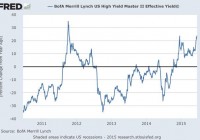
Summary Since bottoming on May 27, junk bond yields have begun steadily rising again. Corporate profits indicate that yields will continue to rise. With default risk increasing, buy credit protection for high upside. Starting around the latter half of 2014, one of the major changes to take hold in the market (besides the rise of the dollar index and collapse in oil prices) has been with bond yields. Junk bond yields have been rising substantially and quickly over the past few months. Much of the change has been due to oil prices, but another cause has been the weakening of corporate profits starting in 2014. With the trend continuing strong through the first half of 2015, there is still time to buy protection against rising yields. As profits fall and oil prices stay low, rising default rates are likely in the future. In fact, default rates in junk bonds have risen to their highest level in 6 years. This article will examine the current state of the junk bond market, the sustainability of current trends, and also recommend a way to play the rising yields and default risks using a credit default swap ETF. Current State of Bond Yields (click to enlarge) Since the European Debt Crisis, which peaked in 2012, junk bond yields had been steadily falling outside of a small blip in 2014. Starting around the end of 2014, however, the increase in yields began in earnest and is now accelerating to the quickest pace since 2011. Yields are spiking, and while this is still far from what is seen during a credit crisis, the warning signs are there. Junk bond yields are now more than 20% higher than they were just a year ago, and there is no sign of an impending correction. On the contrary, the fundamentals seem to be pointing toward a further rise in junk bond yields. Explaining Recent Price Action (click to enlarge) Much of the current trend in junk bond yields can be explained by referring back to oil prices. As oil prices started to fall in 2014, yields immediately began to rise in response. When the oil price bottomed at the start of 2015, yields steadied a bit, though the trend toward rising yields remained. There was hope that oil prices would continue to rebound in the second quarter of the year, but those hopes have been dashed as oil has stood its ground around $60 a barrel. At this point, yields have responded by rising even more and accelerating. While oil explains much of this phenomenon, the increase in yields cannot be blamed totally on the black liquid. (click to enlarge) Another major trend that came about starting in 2014 has been falling corporate profits. These numbers have been showing consistent deterioration since then, and while the Q1 2015 numbers give a sign of possible hope, the historical record does not look good. The last time that corporate profits fell this much, bond yields soared in response after about a year and a half. If that sets any precedent, then bond yields are again about to soar either at the end of this quarter or in the next, especially if corporate profits are weak yet again. Given the past, now is absolutely the time to buy protection against rising yields and bond defaults. The ProShares CDS Short North American HY Credit ETF (BATS: WYDE ) may be the perfect way to play the current situation. As the ETF is short high yield credit, it profits when default rates rise, as the ETF owns a broad basket of high yield credit default swaps. While offering protection against default risk, WYDE has also shown itself to protect against time decay. Since its inception in August of 2014, WYDE has lost less than 5% of its value. CDS protection does have a cost over time, and given that it has lost so little over the time, WYDE is a safe way to play the high yield bond market with little time decay. Summary and Action to Take Junk bonds are a risky proposition right now. Oil prices look to have stalled and a quick recovery to previous levels looks a long way off. In addition, corporate profits have been weak and have been deteriorating at a pace not seen since the onset of the financial crisis. Now is the perfect time to buy protection against a spike in junk bond yields by buying credit default swaps. For the small retail investor, CDS exposure is difficult, and thus gaining exposure via the WYDE ETF may be the perfect way to do so. Disclosure: I am/we are long WYDE. (More…) I wrote this article myself, and it expresses my own opinions. I am not receiving compensation for it (other than from Seeking Alpha). I have no business relationship with any company whose stock is mentioned in this article.

What Happens When ‘Engineered Growth’ Is No Longer Viable?

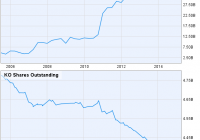
The Fed’s zero interest rate policy has led to a number of unnatural distortions in today’s market. More importantly, the end of the Fed’s zero interest rate policy will likely halt or reverse these distortions, causing many investors to sustain significant losses. We’ve already discussed the “reach for yield trend” in which conservative income investors have bought dividend stocks to replace income previously generated from bonds and deposit accounts. When the Fed allows rates to rise again, this trend will likely reverse sending “safe” stocks lower . Today, we’re going to look at another distortion caused by the Fed’s low rate policy, using one of the world’s most popular consumer staples stocks as an example. What happens when a profitable company can borrow massive amounts of capital at an extremely low interest rate? More specifically, what strategy should an executive team adopt to take advantage of cheap available capital? Executives at many blue chip companies – have been forced to wrestle with these questions as borrowing costs have dropped to historically low levels. The Fed’s zero interest rate policy has made it possible for blue chip companies in good financial shape to borrow huge amounts of capital at very attractive interest rates. The Fed did this intentionally, in an attempt to cause companies to invest in growth opportunities – and thus stimulate the economy. For many large companies, it made perfect sense to issue long-term bonds with very low yields. Even if the companies didn’t have immediate projects to spend the cash on, they simply couldn’t responsibly pass up the opportunity to borrow so cheaply. The availability of cheap cash led many publicly-traded companies to “engineer growth” by borrowing capital and using the funds to buy back shares of stock. Here’s how the practice works: Let’s say a company has 1 billion shares outstanding, trading at a price of $25 per share. This gives our company a market cap of $25 billion. Over the next year, our company is expected to earn $1.2 billion, or $1.20 per share. Our company’s executive team decides to borrow $5 billion at a rate of 2.5% and use that money to buy back shares of stock. Purchasing the shares at an average cost of $25, the company buys back 200 million shares of stock, leaving 800 million shares outstanding. During the year, our company then earns the $1.2 billion it expected to earn, less $125 million in interest paid on the $5 billion borrowed. So the net earnings come out to $1,075 million after counting for the interest expense. If you divide the $1,075 million in earnings by the new share count of 800 million shares of stock, the company’s earnings add up to $1.34 per share. This is 11.7% higher than the company would have earned without borrowing capital at a low interest rate. So in this example, borrowing cheap money and buying back shares of stock resulted in 11.7% in “engineered growth.” The company’s actual business didn’t grow. But the earnings per share was significantly higher. With interest rates pegged at extremely low levels for an extended period of time, companies have had an irresistible incentive to borrow capital and use the money to buy back shares of stock. The result has been widespread “engineered growth” in earnings per share for U.S. blue chip stocks. Now is this a bad thing? Not necessarily. The demand for shares of stock (as companies have spent billions to buy back their own shares) has helped to push stock prices higher. Meanwhile, more cash has been made available for dividend payments. This is true both because the companies have ample cash from selling bonds and also because there are fewer shares outstanding (so dividend payments can be bigger for each of the remaining shares). The Coca-Cola Company (NYSE: KO ) is a great example of this, as the company has issued nearly $40 billion in new debt over the last ten years, while reducing its share count by more than 400 million shares. Strong demand for the company’s shares – both from buyback programs as well as from the reach for yield trend – has led to a premium valuation for shares of KO. Today, shares of KO are trading near the high end of its valuation range as investors are paying roughly $18.50 for every dollar that KO is expected to earn over the next year. It is important to note that this metric measures KO’s price compared to next year’s expected earnings. So the valuation is affected not only by the share price of KO, but also by shifting expectations for the company’s earnings over the next year. Observant investors will note that KO has already declined significantly from its high in the fourth quarter of 2014. But even though the stock has pulled back 12% from its high of $45, KO could have further to drop as the distortions from the Fed’s zero interest rate policy unwind. (click to enlarge) Once the Fed begins hiking rates later this year (or at the very latest in Q1 2016), borrowing costs for blue chip stocks will increase. The trend of buying back shares to increase earnings will no longer be a viable growth strategy, and these companies will need to generate actual revenue and profit growth to please investors. An unwinding of the reach for yield will ad selling pressure for blue-chip dividend stocks, and this should cause forward valuations to drop to a more reasonable levels. Meanwhile, currency headwinds are likely to continue to pummel U.S. companies who generate the majority of their revenue overseas. We’ll discuss these currency pressures in the next installment of our consumer staples series. Note: This is part three of our series on consumer staples stocks. See also: – Part I: The Monsters Under the Bed are Real for Consumer Staples Stocks – Part II: Don’t Get Caught Holding This “Safe” Stock When the Fed Hikes Rates