Tag Archives: nreum

Why Dave Ramsey Is Wrong

There is no denying that Dave Ramsey has done a commendable job of bringing back our grandparents’ financial values into popular culture. Many Americans have been poor stewards of their finances and have been saddled with avoidable debt. Ramsey’s advice has helped thousands get back on the right financial track. Even at my own company, we use the debt snowball of Financial Peace University to help right the finances of our pro-bono planning clients. Ramsey has become a multimillionaire by simply telling people to live within their means by creating and maintaining their household budget. Certainly, in today’s society of zero interest and only three easy payments of $19.99, this is no simple task. However, once a person overcomes modern-day financial temptation and begins investing in his or her future, Ramsey drops the ball and becomes a spokesperson for one of the most confusing industries in America, financial product sales. Ramsey recommends his followers work with brokers who are paid high commissions for investing in mutual funds. Ramsey, as popular as he is – and no one disputes that – has missed the boat on one thing – dismissing the credibility and sensibility of a fiduciary and fee-only financial advisor. That may not sound like a big deal, until you understand that picking the right financial advisor can lead to an overall stronger financial foundation for your family, your future and your state of mind. Let’s look at this a bit closer. The Fee-Only Advantage Fiduciary (your best interest) fee-only advisors take a different approach to investing. There are no selling products; fee-only advisors are not paid a commission from a product. This removes the conflict of interest that brokers carry in their relationships with their clients. This also causes the advisor to look differently at the product that he or she recommends to the client, which is why we see a much higher usage of index funds from the fee-only community. These highly diversified funds carry very low fees, because they don’t pay any advisor any commission, and historically have beat actively managed, commission mutual funds over long periods of time. A well-diversified index fund portfolio should cost no more that 0.25% a year, with most of the funds trading at no charge. Fee-only advisors are compensated as a percentage of assets they manage, by a flat monthly retainer, or bill hourly for financial planning. Each of these options are free from any conflict that the advisor gives to the client. Most fee-only firms also include financial planning in their asset management fees. A financial plan sets how the portfolio should be allocated. Proper asset allocation is a large ingredient to successful long-term investing. A mutual mess Ramsey, on the other hand, encourages his followers to contact a broker within his referral network when they are ready to start investing. In the interest of full disclosure, his network rejected my firm telling me that being a fiduciary fee-only financial services firm we did not qualify because his network is made up of only commission brokers. Ramsey recommends that his flock work with a broker and invest in a mutual fund that has a long track record of good results vs. the S&P 500. He then adds that the investor should purchase and stay put, meaning don’t sell when the market falls, be a buy and hold investor. The broker will collect a 5% +- commission from the sale and will receive a smaller percentage on a quarterly basis, assuming the investor does not sell the fund. Additional investments into the fund, whether it is annually or monthly, will also be charged the large upfront fee. Ramsey supports this model because he believes this to be the cheapest form of investing compared to fee-based firms that would be charging 1.2% a year to give advice and provide planning services. In the 80’s and early 90’s this may have been the correct advice, but unfortunately the US brokerage business has taken a turn for the worst, in that products are not built to benefit the client, they are built to make money for the firm and the broker. A retired executive from a large brokerage company recently told me he got out because his firm no longer focused on the client, they focused on what they could get away with selling to the client. Even if Ramey’s referral network has the best intentions, history is against them. There have been very few mutual funds that actually beat the S&P 500 net of fees over long periods of time. Some get lucky over a 10 year stretch, but after 15 years the list is very short. Historically we see less than 1% of funds beat the S&P 500 (after fees) over 30 years. This might be a long time, but how long are you going to be invested? If you live to age 95 and are in your 40’s or 50’s, 30 years is not that long. Another issue is Ramsey’s buy and hold philosophy. The idea is great on the surface, but when a year like 2008 strikes many individual investors, without a good financial support system, are going to sell. If you get burnt, you first want to stop the pain (sell low) and when you go back, if at all, it will be when you feel ready (buy high). Buy and hold is the correct advice, but when you call the broker for reassurance there is always the potential of him or her selling you another fund at 5% commission to help “make you feel better,” while padding his or her pockets with more of your money. This is where a fee-only advisor earns their fee. By keeping the client focused long term, buy high and sell low tendencies can be eliminated, increasing the client’s rate of return. Ramsey also recommends that you not own bonds. He states “bonds are mistakenly believed to be safe.” While it is true – not all bonds are safe – there is a good case to be made for adding the right bonds to a portfolio to lower volatility. Bonds in a portfolio help keep you from hitting the panic button when it feels like the stock market is falling into oblivion. A fee-only advisor can help choose the right bonds for the portfolio. Ramsey also wants his followers to stay away from Exchange Traded Funds (ETFs). ETFs, if used properly are more tax efficient than any mutual fund, held outside retirement accounts, are more liquid and offer cheaper fees. There are good ETFs and bad ETFs, and I think Ramsey has thrown the baby out with the bath water with this advice. Perhaps it is because his network of advisors would not receive a commission or trailing fee if ETFs were used. What should Ramsey do? If Ramsey and his network of brokers wanted to truly work in the best interest of his radio and print flock, I propose that he endorse a network of fee-only advisors, simply being paid by the hour. These advisors would help create portfolios for the Ramsey following at a fraction of the cost of his commission advisors, all while giving unbiased investment advice. In the end, Ramsey’s math does not add up and the investor loses. Ramsey, who tweeted that he was the “big dog on the porch” in a recent tweet with fee-only advisor Carl Richards, could use his status to help make all advisors work in the best interest of their clients, as is being discussed at the SEC in 2015. Instead, he sits in the pockets or every big insurance company on Wall Street who wants to maintain the current system of taking from Main Street to pad the profits of Wall Street.
Duke Energy: A Utility Stock For Your Income Portfolio For 2015

Summary Company’s long-term performance will be positively affected by planned growth investments. Growth investments will drive its rate base and earnings growth in the long run. DUK remains committed to achieving its targeted dividend payout ratio of 65%-70%. I reiterate my bullish stance on Duke Energy (NYSE: DUK ). In this article, I will discuss in more detail the ongoing capital expenditures that the company is making, which will portend well for its financial performance. Also, I will briefly discuss the 4Q’14 earnings outlook. DUK has been progressing well with its healthy capital expenditures in regulated operations. The company’s planned capital expenditures for the next five years remain healthy, and I believe DUK will deliver decent earnings growth in the long run. Moreover, the effect of the healthy earnings growth will improve its cash flow base, due to which the company will make hefty dividend payments in the long run. The stock offers an attractive dividend yield of 3.6%, which makes it a good investment option for dividend-seeking investors. Smart Growth Investments set to Improve DUK’s Financial Performance U.S. utility stocks delivered healthy performances in 2014. Moving forward, I believe 2015 will be another good year for the utility sector. As far as DUK is concerned, the company has carved out its plans to deliver a healthy performance in the long term through acceleration in capital expenditure for long-term growth generating projects. As per its growth plans, focused on regulated operations, the company is planning to spend approximately $16-$20 billion on several growth projects from 2014 to 2018, focused on its new power generation projects. The company revealed that it will be constructing three major generation projects in Florida, with an investment of approximately $1.9 billion . Also, DUK is planning to build a 1,640MW joint cycle plant worth $1.5 billion. In addition, the company has been making progress with its two new combustion turbine plants in Suwannee, which are expected to be in service by the end of 2018. Moreover, regulators have approved DUK’s project to build a 750MW Lee natural gas plant in South Carolina, which will start providing services by the end of 2017. The value of these growth investments lies in the betterment of the company’s power generation capacity due to a significant improvement in regulated operations, which will portend well for its rate base and earnings growth in the long run. Along with power generation projects, DUK has been gradually increasing its renewable energy portfolio. So far, the company is progressing well with the constructions of its 400MW wind energy project and 100MW solar project. DUK has recently acquired a 20MW solar project from Geenex and ET solar Energy Corporation; the project’s site, being located in Dominion North Carolina Power’s service area, will allow the company to generate revenue by selling electricity generated from the project for a period of 15 years. In future, DUK will be making more investments in its renewable generation projects. All these renewable energy generation investments will not only diversify the company’s generation mix, but will help it meet environmental standards. I believe DUK’s increased focus on renewable energy sources will deliver a significant upside to the company’s financial performance in the long run. In addition, DUK is actively evaluating all growth opportunities in international markets to generate growth in the long run. Also, DUK is conducting a strategic examination of international operations to get tax benefits of approximately $1.7 billion . The company’s strategic overview of international operations is still in progress, but by the time DUK will start pursuing tax saving initiatives for its international operations, its stock price will be positively affected. Owing to DUK’s healthy capital expenditures for the next five years, active investments in renewable energy resources and international growth opportunities, I believe the company’s earnings will be positively affected in the long term. Analysts are expecting that DUK’s long-term earnings will grow at approximately 4.76% , better than Southern Company’s (NYSE: SO ) earnings growth of 3.63% . The company is scheduled to report its 4Q’14 earnings next month. The company will provide an update on its future capital expenditure outlook; any increases in planned capital expenditures will positively affect the company’s growth potential and stock price. Also, the company will provide the 1Q’15 and full year 2015 earnings guidance. Analysts are expecting DUK to report an EPS of $0.88 for 4Q’14. In the last four quarters, the company reported three earnings beats. The one earnings miss was due to an impairment charge related to Midwest assets. I believe that as the company has finalized the sale of Midwest assets, it will report strong earnings for 4Q’15. The following table shows the actual EPS and consensus EPS estimates for the last four quarters. (click to enlarge) Source: Yahoofinance.com Healthy Returns DUK has been sharing its success with shareholders through dividends. The company recently announced a quarterly dividend payment of $0.795 , which marked its 85th consecutive year of dividend payments. The company currently offers a healthy dividend yield of 3.60% . The company’s impressive cash flows have been backing these impressive dividend payments, as shown below. DUK’s healthy growth prospects indicate that its cash flow productivity will improve in the years ahead, helping it affirm its commitment to rewarding shareholders through dividend payments. Owing to its ability to pay dividends consistently in upcoming years, I believe DUK remains a good investment option for shareholders. Moreover, the company can use $2.8 billion in cash proceeds from the Midwest assets sale to repurchase shares or boost dividends. Owing to DUK’s shareholder-friendly cash return policy, I believe the company will utilize all growth prospects that could support its healthy cash return policy in order to ensure consistent dividend increases in the years ahead. The following table shows the ongoing increases in dividend per share, ROE, dividend payout ratio and dividend coverage for the company, for 2012 and 2013. The table also includes my estimated figures for 2014 and 2015. (Note *Dividend Coverage Ratio = Operating Cash Flow/Annual Dividends) Dividend Per Share Dividend Payout Dividend Coverage ROE 2012 $3.03 70% 3x 9.5% 2013 $3.12 71.7% 2.9x 6.3% 2014(E) $3.15 69.6% 3.2x 7.6% 2015(E) $3.25 68.7% 3.8x 7.7% Source: Company’s Reports and Equity watch’s Calculations Using Estimates Conclusion DUK’s long-term performance will be positively affected by planned growth investments. The growth investments, directed at improving the company’s operational performance, will drive its rate base and earnings growth in the long run. Also, DUK’s healthy growth prospects will portend well for the betterment of its cash flow base, which will allow the company to consistently increase dividends. Moreover, DUK remains committed to achieving its targeted dividend payout ratio of 65%-70% . Due to the aforementioned factors, I remain bullish on DUK.

A Diversified, High-Income Bond Portfolio For 2015

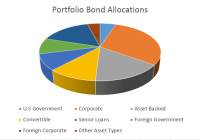
Summary A portfolio of selected bond CEFs provides an average distribution of 8.6%. Since 2007, the composite portfolio of selected bond CEFs outperformed HYG, the popular high-yielding bond ETF. Bond CEFs offer excellent diversification when included in a traditional high-yield bond portfolio. I recently wrote an article on a diversified closed-end fund (CEF) portfolio that included a range of equity funds but had only 28% of the assets allocated to bonds. I realized that many retirees would like to have a higher percentage in bonds, so I wrote this article, which focuses exclusively on bond CEFs. I chose only funds that were in existence during the 2008 bear market so that I could judge performance during a recessionary period. Other criteria included: An average daily volume of at least 100,000 shares per day to facilitate liquidity A distribution of at least 6% without excessive amounts of Return of Capital (ROC) A market cap of at least $150 million, but the larger the better A premium of no more than 5% Using these criteria, I then selected funds that would provide a diversified mix of: government and corporate bonds from both the U.S. and internationally, asset-backed bonds, convertible bonds, and senior loans. The 10 CEFs that I chose are summarized below. There is a large universe of bond CEFs, so I welcome alternative suggestions from readers. BlackRock Duration Income Trust (NYSE: BLW ): This CEF sells for a discount of 8.2%, which is a substantially larger discount than the 3-year average discount of 1.7%. The fund concentrates on intermediate-duration debt securities and senior loans. It has a portfolio of 873 securities, with 41% invested in corporate bonds, 32% in loans, and 12% in asset-backed bonds. About 25% of the portfolio is investment-grade. In 2008, the price of this fund dropped about 25%. The fund utilizes 30% leverage and has an expense ratio of 1.1%. The distribution is 7.6%, funded by income with no ROC. Calamos Convertible Opportunities & Income Fund (NASDAQ: CHI ): This CEF sells for a small premium of 1.1%, which is in contrast to 0.1% average discount over the past 3 years. The fund has a portfolio of 278 securities, with 53% in convertible bonds and 41% in corporate bonds. Only about 17% of the portfolio is rated investment-grade. In 2008, the price of this fund dropped 35%. The fund utilizes 28% leverage, and has an expense ratio of 1.5%. The distribution is 8.9%, funded mostly by income but with some ROC. Calamos Convertible & High Income Fund (NASDAQ: CHY ): This CEF sells at a premium of 3.4%, in contrast to a 3-year average discount of 3.7%. The fund has a portfolio of 277 securities, with 59% in convertibles and 36% in corporate bonds. Only about 15% of the bonds are investment-grade. This fund dropped 27% in price during 2008. It utilizes 28% leverage, and has an expense ratio of 1.5%. The distribution is 8.6%, funded primarily from income, but with some ROC. This fund is about 74% correlated with its sister fund CHI. Western Asset Global High Income Fund (NYSE: EHI ): This CEF sells for a discount of 8.8%, which is a greater discount than the 3-year average discount of 4%. The fund has a portfolio of 558 securities, with 77% in high-yield bonds and 16% in government bonds. This fund lost 30% in 2008. It utilizes 22% leverage, and has an expense ratio of 1.5%. The distribution is a high 10.6%, funded by income with no ROC. Wells Fargo Advantage Multi-Sector Income Fund (NYSEMKT: ERC ): This CEF sells at a discount of 11.5%, which is a larger discount than the 3-year average discount of 8.8%. The fund has a portfolio of 679 securities, spread among corporate bonds (54%), government bonds (19%), senior loans (12%), and asset-backed bonds (6%). About 36% of the holdings are investment-grade. The fund only lost 20% in 2008. It utilized 25% leverage, and has an expense ratio of 1.2%. The distribution is 8.5%, funded by income with no ROC. Eaton Vance Limited Duration Income Fund (NYSEMKT: EVV ): This CEF sells at a discount of 10.8%, which is a larger discount than the 3-year average discount of 4.4%. The fund has a large portfolio of 1692 securities spread across loans (38%), corporate bonds (35%), and asset-backed bonds (24%). About 32% of the holdings are investment-grade. The price of this fund dropped 27% in 2008. The fund utilizes a relatively high 40% leverage, and has an expense ratio of 1.7%. The distribution is 8.7%, funded primarily by income, with a very small ROC component. Western Asset Emerging Markets Debt Fund (NYSE: ESD ): This CEF sells at a discount of 11.1%, which is a larger discount than the 3-year average discount of 7.2%. The fund has a portfolio of 222 securities, with 54% in government bonds, and 46% in corporate bonds. About 64% of the bonds in the portfolio are rated investment-grade. This fund only lost about 20% in 2008. The fund only uses 10% leverage, and has an expense ratio of 1%. The distribution is 8.7%, funded by income with no ROC. MFS Charter Income Trust (NYSE: MCR ): This CEF sells at a discount of 11.7%, which is a larger discount than the 3-year average discount of 7.8%. The fund has a portfolio of 857 securities, with about 45% in corporate bonds, 12% in government debt, and 35% in foreign securities. About 34% of the portfolio is investment-grade. The fund utilizes 15% leverage, and has an expense ratio of 0.9%. The distribution is 6.2%, funded by income with no ROC. PCM Fund (NYSE: PCM ) : This CEF sells at a discount of 1.3%, which is well below the 3-year average premium of 5.8%. The fund focuses on commercial mortgage backed securities and non-investment grade securities. The portfolio is spread over 247 holdings, with 82% in asset-backed bonds and 18% in corporate bonds. About 35% of the holdings are investment-grade. The price of the fund dropped about 30% in 2008. The fund utilizes 32% leverage, and has an expense ratio of 2%. The distribution is 9%, with only a small ROC component. PIMCO Income Opportunity Fund (NYSE: PKO ): This CEF currently sells at a discount of 2.2%, which is in contrast to the 3-year average premium of 2.5%. The portfolio has 470 holdings allocated primarily among asset-backed bonds (42%) and corporate bonds (40%). Only about 30% of the holdings are investment-grade. The price of the fund dropped 24% in 2008. The fund utilizes 38% leverage, and has an expense ratio of 1.9%. The distribution is 8.3%, with only a small return of capital component. For comparison with other popular high-yield bond funds, I also added the following Exchange Traded Fund (ETF) to my analysis. iShares iBoxx $ High Yield Corporate Bond ETF (NYSEARCA: HYG ): This ETF tracks an index of about a thousand high-yield U.S. corporate bonds across all sectors of the economy. The fund does not use leverage, and has an expense ratio of 0.5%. It yields 5.7% without any ROC. During 2008, the price of this ETF dropped by 17%, but the NAV dropped by 23%. It is unusual for an ETF to have a large difference between price and NAV, but this just illustrates the dislocations that occurred during the 2008 bear market. Composite Portfolio If you equal-weight each of the selected CEFs, the resulting composite portfolio has the allocations shown graphically in Figure 1. As you can see, the composite portfolio is well diversified. Numerically, the allocations are: 5% U.S. government, 30% corporate, 16% asset-backed, 11% convertibles, 9% senior loans, 9% foreign government, 16% foreign corporate, and 4% other (cash, preferred issues, etc.). Personally, I would have liked a larger allocation to U.S. government bonds, but it was difficult to find Treasury-focused funds that had distributions exceeding 6%. Overall, this portfolio had 31% investment-grade securities. Figure 1: Composition of bond portfolio The composite portfolio has an average distribution of 8.6%, which certainly meets my criteria for high income. But total return and risk are as important to me as income, so I plotted the annualized rate of return in excess of the risk-free rate (called Excess Mu in the charts) versus the volatility for each of the component funds. I used a look-back period from October 12, 2007 (the market high before the bear market collapse) to 21 January, 2015. The Smartfolio 3 program was used to generate the plot shown in Figure 2. (click to enlarge) Figure 2: Risks versus rewards over the bear-bull cycle The plot illustrates that the CEFs have booked a wide range of returns and volatilities since 2007. To better assess the relative performance of these funds, I calculated the Sharpe Ratio. The Sharpe Ratio is a metric developed by Nobel laureate William Sharpe that measures risk-adjusted performance. It is calculated as the ratio of the excess return over the volatility. This reward-to-risk ratio (assuming that risk is measured by volatility) is a good way to compare peers to assess if higher returns are due to superior investment performance or from taking additional risk. In Figure 2, I plotted a red line that represents the Sharpe Ratio associated with HYG. If an asset is above the line, it has a higher Sharpe Ratio than HYG. Conversely, if an asset is below the line, the reward-to-risk is worse than HYG. Over the bear-bull cycle, all the individual bond CEFs were more volatile than HYG. However, when combined into an equally weighted composite portfolio, the volatility was only slightly more than HYG. This is an illustration of an amazing discovery made by an economist named Markowitz in 1950. He found that if you combined certain types of risky assets, you could construct a portfolio that had less risk than the components. His work was so revolutionary that he was awarded the Nobel Prize. The key to constructing such a portfolio was to select components that were not highly correlated with one another. In other words, the more diversified the portfolio, the more potential volatility reduction you can receive. Some other interesting observations are evident from the figure. All the bonds CEFs had a higher volatility than HYG, but in each case, this was coupled with a higher return. All the CEFs except for CHI were above the “red line,” which means that the investor was adequately compensated for increased risks. The best-performing bond CEF on a risk-adjusted basis was MCR, but PKO was not far behind. The worst-performing bond CEF was CHI, which had a higher return than HYG, but a much larger volatility. This caused the risk-adjusted return associated with CHI to lag slightly behind HYG. The least volatile bond CEF was MCR, and the most volatile was CHI. The composite portfolio handily outperformed HYG on a risk-adjusted basis. I next wanted to assess the diversification of this portfolio. To be “diversified,” you want to choose assets such that when some of them are down, others are up. In mathematical terms, you want to select assets that are uncorrelated (or at least not highly correlated) with each other. I calculated the pair-wise correlations associated with the funds. The data is presented in Figure 3. All the CEFs had relatively low correlations with HYG (in the 40%-60% range). This bodes well for including these CEFs in a more traditional high-yield bond portfolio. Among the CEFs, the correlations were also low, with only a few above 70%. Overall, these results were consistent with a well-diversified portfolio. (click to enlarge) Figure 3: Correlations over the bear-bull cycle My next step was to assess this portfolio over a shorter time frame when the stock market was in a strong bull market. I chose a look-back period of 5 years, from January 2010 to January 2015. The data is shown in Figure 4. During this period, the bond CEFs did not fare as well, with many of the CEF booking a risk-adjusted performance less than HYG. Only 3 of the CEFs (CHY, PKO, and PCM) outperformed HGY. However, I was happy to see that the combined portfolio continued to outperform HYG during this bull market period. (click to enlarge) Figure 4: Risks versus rewards over the past 5 years Based on the above, I wanted to see if the outperformance continued during the more recent past. I next used a look-back period of 3 years, and the results are shown in Figure 5. As you might have expected, HYG had an impressive run during this strong bull period. Only the convertible CEFs (CHI and CHY) were able to keep pace on a risk-adjusted basis. However, as with the 5-year period, the combined portfolio performed well, lagging HYG by only a small amount on a risk-adjusted basis. The major detriment to the portfolio performance was ESD, which has had a horrible 3 years, just barely managing to remain in the black. This was because of a general sell-off in emerging market assets that has only recently abated. Many investors might be tempted to drop ESD from the portfolio, but I am inclined to give it the benefit of the doubt with the expectation that emerging markets may recover in the future. Overall, I continue to be pleased with the portfolio performance. (click to enlarge) Figure 5: Risks versus rewards over the past 3 years Bottom Line The bond CEFs in this portfolio were all volatile, and taken individually, they would not be suitable for a risk-averse investor. As discussed, most of these funds also had substantial losses during 2008. However, if you risk profile allows you to purchase high-yield bonds, the composite portfolio delivered some excellent risk-adjusted performances over the periods analyzed. No one know how this portfolio will perform in the future, but based on past history, I believe it is worthy of consideration for an income investor who is also seeking total return at a reasonable risk.