Tag Archives: nreum

Investing In France: Yes, You Can
Summary Growth is back in France. Why you should consider the country as an investing opportunity. The iShares MSCI France ETF will rise and shine next year. Investing In France: yes, you can. It has always been a fun – yet interesting – exercise to reflect on the cultural differences and similarities that existed between the foreign countries that I visited and my own. Long story short, I eventually realized (after living in the U.S. for a year) that despite the legendary French cynicism , I had every reason to be proud of being French. Once back in France, I became more and more aware of how my country was perceived by foreign investors and analysts. Economically speaking, France is seen as the laughing stock of the Eurozone, rather than a role model. Of course, if our social model allows our country to be more resilient in times of crises, it is also true that it slows down the economic recovery in times of global growth. But ever since François Hollande got elected, the French Bashing in financial literature has reached a level never seen before. Agreed, there are plenty of reasons to worry about France’s future: unemployment rate, fiscal policy, lack of support for entrepreneurs, lack of reforms, you name it. To add insult to the injury, we even have a socialist government! And yet, in May 2015 ” the French economy smashed expectations , expanding by 0.6% in the first quarter following zero growth in the previous quarter ” and in June, according to the Banque de France’s macroeconomic projections : ” after three years of virtually flat growth, French GDP will expand by an annual average of 1.2% in 2015, 1.8% in 2016 and 1.9% in 2017. ” The institution lists three different types of factors behind the recovery of the French economy: external (cheaper oil and a cheaper Euro), specific to the Eurozone (expansionary monetary policy), and domestic factors (improvement in corporate profit margins). ” On a domestic level, the measures introduced to cut labor costs should also start to support activity via gains in cost competitiveness which will in turn boost exports, job creations and business investment.” Indeed, despite Mr. Hollande being a socialist scarecrow, reforms (that were voted within the first years of its mandate) are starting prove themselves efficient. And several factors allow us to be more optimistic about the country’s future: Finance Minister, Emmanuel Macron is currently pushing a rather liberal agenda – that should help French companies during their journey through the infamous French fiscal maze. For instance, stores are now allowed to open 12 Sundays a year . It might seem insignificant, but it actually indicates that the government has decided to go against its left wing, even if it means discussing topics that had been considered ‘taboo’ until this day. Regional elections will take place in late 2015, and the socialist party is expected to be crushed by former President Nicolas Sarkozy’s brand new “Republicans”. Due to the nature of the election, the impact on French policies won’t be significant but it will send a positive signal to foreign investors. In 2016, regional reforms will be put in place and France will be the theater of a ‘regional big-bang’ that will see the creation of ‘super-regions’. If the process will need a few months (if not years) to be effective, the new regional entities will be amongst the most important within the European Union. For instance, the future Auvergne-Rhône-Alpes will rank 7th in ” Europe’s economic ranking “, and its capital Lyon will finally reach the critical size it needed to compete with other European metropolis. The easiest way to bet on France’s recovery would be to invest in the iShares MSCI France ETF (NYSEARCA: EWQ ) , the only U.S.-listed fund to be exclusively composed of French stocks. Next chart presents its top 10 holdings (they amount to 45.8% of the total holdings), with their respective weights in the total assets: As we can see in the following charts , its sector exposures differ than the CAC 40 (France’s top 40 stocks by market cap, balance sheet, liquidity…), the usual benchmark for the French stock market. iShares MSCI France ETF’s Sector Exposure (click to enlarge) The three main sectors represent around 15% each of the global holdings and are the following: Industrials, Consumer Cyclical and Financial Services. Their combined weight drive the ETF’s performance away from the CAC 40 as a whole: CAC 40 vs EWQ: One Year Return (click to enlarge) As we can see, the ETF consistently underperformed the CAC 40 over the past year, even sinking in the negatives when the CAC delivered a return of 8.8% over the same period. This can be explained by the fact that one of the fund’s top holding, TOTAL SA (NYSE: TOT ), has been heavily impacted by the fall in oil prices this past year. Still, when compared to the Crude Oil performance, Total isn’t doing so bad: Fortunately, SANOFI SA (NYSE: SNY ) and BNP PARIBAS SA ( OTCQX:BNPQY ), the other main holdings (with respectively 9.02% and 4.98% of Total Assets) saw their stock value rise this past year: SANOFI SA BNP PARIBAS SA The fund’s focus on Consumer Cyclical and Financial Services stocks reduced its performance as well, as the French economy was slowed down by higher tax rates (both personal and professional) and investors were reluctant to make significant moves due to the lack of political vision regarding the upcoming economic reforms. Nevertheless, one should keep in mind the bigger picture: over the past five years, we can see EWQ clearly outperforming the CAC 40. CAC 40 vs EWQ: Five Year Return (click to enlarge) At this point, one could legitimately question the opportunity of boarding a sinking ship. But I see this past year as a blessing for someone willing to invest in EWQ (obviously, EWQ holders might feel differently), as it is now quite inexpensive compared to the potential returns. Indeed, Consumer Cyclical and Financial Services stocks should thrive on the cost-cutting reforms that the Banque de France underlined, as well as on the expected GDP growth rates. We can also be optimistic about future reforms as the government recently operated a more liberal turn. Last but not least, the regional reforms will lead to bigger regions, and could strengthen the industrial firms as it will ease their clients and suppliers networks. EWQ: Two Year Return (click to enlarge) Currently ( data obtained on June 06, 2015; via YAHOO Finance) at 26.70, the ETF is 4 dollars cheaper than last year’s high of 30.73, and as a result it becomes very affordable to invest in. As previously explained in this article, EWQ is bound to rise in the upcoming year. Last but not least: even if it is easy to make fun of France’s bureaucracy, or of its overall business environment, it would be a strategic mistake to disregard all investing opportunities. In case of a crisis in the Eurozone (think about Greece), France (along with Germany) will remain a safe heaven, as the 2nd strongest economy of the EU. It happened not too long ago, and an early taste of French markets could come handy in uncertain times. Editor’s Note: This article discusses one or more securities that do not trade on a major U.S. exchange. Please be aware of the risks associated with these stocks. Disclosure: The author has no positions in any stocks mentioned, and no plans to initiate any positions within the next 72 hours. (More…) The author wrote this article themselves, and it expresses their own opinions. The author is not receiving compensation for it (other than from Seeking Alpha). The author has no business relationship with any company whose stock is mentioned in this article.
Will The Fed Push Back Down GLD?

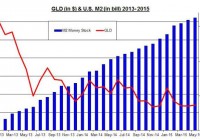
Summary The FOMC will convene again next week. If the FOMC hints about raising rates anytime soon, this could drag down GLD. The recovery of the U.S. dollar and rise in long-term treasury yields will keep pressuring down GLD. The recent strong labor report brought up the odds of the FOMC coming closer towards raising rates. It also cooled down the gold market. Nonetheless, the SPDR Gold Trust ETF (NYSEARCA: GLD ) is still flat for the year even though the U.S. dollar and long-term yields have picked up again in recent weeks. The FOMC isn’t expected to make any big changes in the upcoming meeting. But the price of GLD could start coming down again if the FOMC even drops a hint about raising rates in its upcoming meeting. The better-than-expected non-farm payroll report along with the sharp rise in JOLTS – number of job openings reached 5.38 million while market expectations were set at 5.03 million – have both driven a bit higher the implied probabilities of a rate hike in September to 33% and for December to 70%. The FOMC will convene on June 16-17 and release the press statement on June 17 accompanied with a press conference and release updated economic outlook. On the one hand, the GDP contracted back in Q1 and inflation is still contained below 2%. On the other hand, the U.S. labor market continues to show recovery, and there are possible speculative bubbles in the housing and stock markets, which could be popped once interest rates start to rise again. In the meantime, even though the FOMC is considering normalizing its monetary policy, this doesn’t mean the M2 isn’t growing – as of May, M2 is up by 5.3% year on year. This higher M2 comes despite the tumble in oil prices in the past few months. But the rise in M2, which is another indication for the changes in U.S. inflation, hasn’t driven up the price of GLD in recent years, as presented in the chart below. Moreover, the core PCE , which is the indicator the FOMC follows, has gone down to 1.2% – the lowest level in over a year. This low level doesn’t vote well for the FOMC to turn hawkish in the coming meeting. (click to enlarge) Source: FRED, Google Finance Despite the rise in M2, the U.S. money base remained relatively flat and rose by only 0.7% year over year. But this hasn’t resulted in a sharp rise in the money base as it was the case back when the FOMC implemented QE1, QE2, and QE3. After ending QE3, the FOMC only continued purchasing new bonds to substitute expiring bonds in order to maintain its big balance sheet. Thus, it would take a 180-degree change in the FOMC’s policy for the gold market to heat up again. The weakness of the Euro and other major currencies mainly due to ECB’s QE program, the Greek bailout talks also play a minor role in keeping the Euro weak, is likely to further drive up the U.S. dollar, which doesn’t help the price of gold or the price of GLD. Another factor that could keep slowly bringing down GLD is the recovery of long-term treasury yields, which have picked up in recent weeks. The correlations among GLD and long-term yields, as seen below, are negative and strong and suggest that if yields keep rising, GLD could also start to come down. (click to enlarge) Source: U.S Department of Treasury and Bloomberg Final note The upcoming FOMC meeting could be another nail in the gold market’s coffin – especially if the FOMC turns more hawkish by improving its outlook and providing a clearer picture about raising rates. Currently, the market doesn’t expect the FOMC to make any major changes to the policy and the Fed could remain dovish, which helps to keep GLD from tumbling. The major shift is only likely to occur closer to the end of the year – when the FOMC is more likely to raise rate, assuming the U.S. economy continues to progress in its current pace. Until then, the stronger U.S. dollar and higher long-term treasury yields are likely to keep GLD slowly dwindling. For more, please see: 3 Questions About Gold Disclosure: The author has no positions in any stocks mentioned, and no plans to initiate any positions within the next 72 hours. (More…) The author wrote this article themselves, and it expresses their own opinions. The author is not receiving compensation for it (other than from Seeking Alpha). The author has no business relationship with any company whose stock is mentioned in this article.

Highland Capital Launches 3 Hedge Fund Style ETFs

Dallas-based Highland Capital Management is expanding its presence in the ETF world with a focus on alternative investing. Early this year, the issuer filed for 17 alternatives ETFs all targeting four broad hedge funds styles – equity hedge, event driven, macro and relative value. The successful debut of these funds will make Highland one of the largest managers of alternative ETFs in the market. Out of these, Highland Capital recently rolled out a trio of products that aim at giving investors new options in the hedge fund space. The three funds – the Highland HFR Global ETF (NYSEARCA: HHFR ) , the Highland HFR Event-Driven Activist ETF (NYSEARCA: DRVN ) and the Highland HFR Equity Hedge ETF (NYSEARCA: HHDG ) – are designed in collaboration with HFR and are the first of their kind to replicate hedge fund positions in an ETF. The trio provides global hedge fund exposure by investing in equity and debt securities of the U.S. and international companies, charging investors 85 bps in annual fees. The introduction of these ETFs quadrupled the size of Highland Capital’s ETF lineup. HHFR in Focus This ETF seeks to tracks the HFRL Global Index, which uses all the four hedge fund strategies to select the stocks. These strategies may include event-driven, long/short equity, macro, relative-value and other strategies commonly used by hedge fund managers. DRVN in Focus This fund looks to target the stocks of event-driven strategies, which take advantage of transaction announcements and other specific one-time events. The strategy then utilizes an investment process that identifies equity opportunities in companies which are currently engaged in a corporate transaction, such as mergers, restructurings, financial distress, tender offers, shareholder buybacks, debt exchanges, security issuance or other capital structure adjustments. The ETF seeks to track the HFRL Event-Driven Index. HHDG in Focus This fund follows the HFRL Equity Hedge Index, which measures the performance of stocks based only on equity hedge strategies that combine long holdings of equity securities with short sales of stock, stock indices or derivatives related to equity markets. How Do They Fit in a Portfolio? The new products appear interesting choices for investors seeking some smart stock-selection techniques to avoid risks in the market. Hedge-fund replication ETFs have been gaining immense popularity in recent years as these seek to outperform the market over the long term. The funds try to either replicate the investing styles of renowned investors or mimic an index that aims to provide specific hedge fund strategies. This results in a solid and well-diversified portfolio having superior adjusted risk returns. After all, the hedge funds have proven their supremacy by making huge money in any market environment. Competition While there are a number of hedge-fund replication ETFs on the market that use a fund-of-fund approach, there are only a few that use a stock-selection methodology. The ultra-popular the Global X Guru Index ETF (NYSEARCA: GURU ) uses a proprietary methodology to compile the best ideas from a select pool of hedge funds by looking at the 13F document on a quarterly basis. The ETF has AUM of $266 million and expense ratio of 0.75%. The other popular name in this regard is the AlphaClone Alternative Alpha ETF (NYSEARCA: ALFA ) , which has garnered $161.6 million in its asset base while charging 95 bps in fees per year. It uses a proprietary ranking system, ‘Clone Score’, which ranks hedge funds and institutional investors based on the efficacy of replicating their publicity disclosed positions. The IQ ARB Merger Arbitrage ETF (NYSEARCA: MNA ) is an event-driven hedge fund that might give stiff competition to DRVN. This fund offers capital appreciation by investing in global companies for which there has been a public announcement of a takeover by an acquirer yet provides short exposure to global equities as a partial equity market hedge. The product has amassed $130 million in its asset base and charges 75 bps in annual fees. Given that all these products have been able to build up decent assets, it might not be difficult for the Highland products to see solid inflows and garner investor interest given that the interest rate hike might lead to uncertainty and bouts of volatility. Link to the original post on Zacks.com