Tag Archives: nreum

Is This The Right Time To Bet On Volatility ETFs?

The U.S. stocks finally managed to cross all hurdles that came in their way in the past few weeks with a sharp rise in yesterday’s trading session. Both the S&P 500 and Dow Jones industrials average posted their biggest one-day gains in more than a month. Though these gains were broad-based, the rally is unlikely to last long as a large number of concerns have already built up. Despite the impressive one-day gain, the S&P 500 index has been trading in a tight range of around 6.5% this year and the stocks in the index are moving at an average of 18%, the narrowest in two decades. In fact, the index has been moving under 1% over the past six weeks, representing the longest stretch of calm since May 1994. In addition, about 59% of the stocks closed above their 200-day moving averages at the end of last week, the lowest in eight months, according to Bloomberg . This suggests that the market breadth (higher number of stocks advancing versus declining) is deteriorating, signaling some pullbacks in the weeks ahead. Further, the current economic fundamentals are signaling huge volatility and uncertainty for the coming months. This is because a raft of upbeat economic data and an accelerating job market after the first-quarter slump are raising speculation of a sooner-than-expected (as early as September) rate hike for the first time since 2006. On the other hand, downward revision to first-quarter GDP growth, sluggish consumer spending, and falling consumer confidence for two consecutive months raises questions on the health of the economy. Yesterday, the World Bank cut its growth outlook for the U.S. from 3.2% to 2.7% for this year and from 3% to 2.8% for the next. Moreover, an aging bull market, lofty stock valuations, a strong dollar, and the Greek debt drama are weighing on investor sentiment. Apart from these, the yields on 10-year Treasuries have been rising, reaching the highest level since September 30, 2014 at 2.478%. All these factors might keep the fear levels up. Added to the concern is the sliding transportation sector, which is alarming the broader stock market. According to the century-old Dow Theory, any long-lasting rally in the Dow Jones Industrial Average should be accompanied by a rally in Dow Jones Transportation Average. It seems both indices are on the diverging path given that the former has added nearly 1% in the year-to-date time frame against the 8.5% decline in the transportation index. This signifies that the stock market might not stay healthy going forward and see a sharp fall anytime soon. In a woe-begotten backdrop, investors could look into volatility products that have proven themselves as short-time winners in turbulent times. They can use these products for hedging purpose to ensure safety when the stock market starts plunging. Volatility ETFs in Focus Volatility in the stock market is best represented by the CBOE Volatility Index (VIX), also known as fear gauge. It is constructed using the implied volatilities of a wide range of S&P 500 index options and tends to outperform when markets are falling or fear levels over the future are high. A popular ETN option providing exposure to volatility, iPath S&P 500 VIX Short-Term Futures ETN (NYSEARCA: VXX ), sees a truly impressive volume level of about 44 million shares a day. The note has amassed $1.2 billion in AUM and charges 89 bps in fees per year. The ETN focuses on the S&P 500 VIX Short-Term Futures Index, which reflects implied volatility in the S&P 500 Index at various points along the volatility forward curve. It provides investors with exposure to a daily rolling long position in the first and second month VIX futures contracts. The two products – ProShares VIX Short-Term Futures ETF (NYSEARCA: VIXY ) and VelocityShares Daily Long VIX Short-Term ETN (NASDAQ: VIIX ) – also track the same index. VIXY has $152.7 million in AUM and sees good average daily volume of 1.3 million shares, while VIIX is the unpopular of the two with just $11.1 million in its asset base and sees moderate volume of more than 81,000 shares per day. The former charges 85 bps in annual fee, while the latter is costlier charging 0.89% annually from investors. The three products lost less than 2% over the past one month. Another product – C-Tracks on Citi Volatility Index ETN (NYSEARCA: CVOL ) – linked to the Citi Volatility Index Total Return, provides investors with direct exposure to the implied volatility of large-cap U.S. stocks. The benchmark combines a daily rolling long exposure to the third and fourth month futures contracts on the VIX with short exposure to the S&P 500 Total Return Index. The product has amassed $3.8 million in its asset base while charging 1.15% in annual fees from investors. The note trades in a moderate volume of 111,000 shares per day and lost nearly 3.5% in the trailing one month. AccuShares Spot CBOE VIX Fund Up Class Shares (NASDAQ: VXUP ) debuted in the volatility space last month. It provides direct access to the spot price return of the CBOE Volatility Index, or VIX and charges 95 bps in fees per year from investors. The fund trades in a small volume of about 48,000 shares a day on average and is down 0.4% since inception. Bottom Line These products are suitable only for short-term traders and have been terrible performers over the medium or long term. This is because most of the time, the VIX futures market trades in ‘contango’, a condition in which near-term futures are cheaper than long-term futures contracts. Since volatility ETFs and ETNs like VXX must roll from month to month in order to avoid ‘delivery’, a contango situation can eat away returns over long periods. Original Post

Wall Street Lunch

Summary A mid-day update on arbitrage, event-driven opportunities, and value. Details of price changes and progress on POM, TWC, and DTV. In each case, there are still double-digit returns available. Lunch is for wimps. – Gordon Gekko Arbitrage Here are my collected thoughts on arbitrage, wandering from the academic to the practical definitions, with a heavy dose of the middle ground. The definition is indeed a tortured one. However, in both its strong and weak forms, the idea focuses on the key to investing: mispricing. In the recently launched Sifting the World , arbitrage will be a major focus. What arbitrage opportunities are available today? *Available as of today. The word “arbitrage” in academia means “certain profits,” whereas in practical investing, arbitrage often means “a trade we kind of like.” Some in the industry adhere to a perhaps reasonable middle ground: that arbitrage is not riskless, but unlike much of investing, it involves going long and short very similar securities and betting on a price difference. I can live with that. But it is clear that many use it in the loosest sense and, therefore, strip it of its meaning. – Cliff Asness Dresser-Rand / Siemens Update DHR has returned 4% since the last update. (click to enlarge) The buyer completed a $7.7 billion note placement as a component of the acquisition financing. The EU review is going well and is likely to result in approval this summer. Pepco / Exelon Update POM has returned over 8% since I last discussed it. (click to enlarge) Since then, it has remained an attractive long opportunity with a positive expected value. I have not added to my position, but I am holding onto it. From the outside looking in, this situation involves a lot of political noise. From the inside looking out, it is a negotiation like any other. There is a regulatory cost that needs to be paid, and both the applicants and the regulators have preferences on what that cost would be. The difference was surmountable. In the Maryland PSC approval, the commission majority split the difference with an order that was acceptable to both sides. Subsequent to the Maryland PSC approval, the deal was also approved in Delaware. Additionally, EXC completed its five-tranche $4.2 billion senior notes acquisition financing through Barclays (NYSE: BCS ) and Goldman Sachs (NYSE: GS ). Time Warner Cable / Charter Update TWC returned over 30% since I first discussed it. (click to enlarge) It remains a safe position; I still have $13 million of TWC, based on confidence in the current deal. DirecTV / AT&T Update This position is up over 5% since the last update. (click to enlarge) The parties appear to be progressing towards regulatory approvals later this summer. Event-Driven Event-driven, my wife was sorry to learn, is not used in the same sense as event planning. It involves few parties or cocktails in the backyard. Instead, the ones I focus on tend to involve: Mutual conversions Odd lot tender offers Merger securities Squeeze outs Here is how it worked out so far. I am thrilled that Seeking Alpha’s exclusive research program will include several such authors. Value Value is like honesty and fidelity – few people own up to being in the opposite camp. Also, like honesty and fidelity, talking about it a lot does not make it so. The core of value investing is thinking about securities as pieces of a business, valuing that business, and then underpaying for it. The remaining problem involves finding a counterparty with something at stake besides the same value that you are trying to capture. Today, my favorite values include this and this . Conclusion Arbitrage, event-driven, and value are often categorized separately, but I think of them as points on a spectrum. In the case of arbitrage, the investment opportunity has an explicit process for unlocking value. In event-driven opportunities, there is still a catalyst, but it is somewhat less explicit and there is greater variance in the outcomes. Value investing has the greatest range in outcomes. However, successful value investing frequently results in securities becoming targeted by M&A and other corporate events. These events often unlock value, whether or not that was explicitly part of the original investment thesis. Editor’s Note: This article discusses one or more securities that do not trade on a major U.S. exchange. Please be aware of the risks associated with these stocks. Disclosure: The author is long TEG, POM, IGTE, HE, TWC, OWW, OVTI, BRLI, ODP, BHI, DTV, PRGO, KRFT. (More…) The author wrote this article themselves, and it expresses their own opinions. The author is not receiving compensation for it (other than from Seeking Alpha). The author has no business relationship with any company whose stock is mentioned in this article. Additional disclosure: Chris DeMuth Jr is a portfolio manager at Rangeley Capital. Rangeley invests with a margin of safety by buying securities at deep discounts to their intrinsic value and unlocking that value through corporate events. In order to maximize total returns for our investors, we reserve the right to make investment decisions regarding any security without further notification except where such notification is required by law.

SCHE: Avoiding China Is The Key To Improving Risk Adjusted Returns

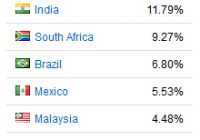
Summary The Chinese market looks very dangerous and that risk could severely damage SCHE for allocating 28% of equity to Chinese securities. The level of education attained by a new wave of domestic investors in China should be shocking. The only thing more bearish than investors buying securities they don’t understand is those same investors on margin. Driving the potential for a correction to come sooner rather than later is the potential for new regulations restricting margin trading. If the bubble pops, retail investors in China may face dramatic losses that would prevent them from buying goods and services. My international exposure comes from two ETFs. I’m holding the Vanguard Global Ex-U.S. Real Estate Index ETF (NASDAQ: VNQI ) and the Schwab International Equity ETF (NYSEARCA: SCHF ). In my opinion, SCHF is dramatically better positioned than the Schwab Emerging Markets Equity ETF (NYSEARCA: SCHE ). My perspective favoring SCHF is tied to the enormous position that SCHE is holding in Chinese equities. It is my belief that SCHE may have some substantial volatility and may face significantly worse performance over the next few years due to the large position in Chinese equities. The table below shows the strong allocation to China in SCHE. Why I’m bearish on China The Chinese market has been on fire hitting one high after another. I wasn’t bearish on the Chinese equity market before the valuations soared, but I’m not a fan of higher prices or the lack of fundamentals driving the growth in valuations. That sure sounds like a bubble I’d like to share an excerpt from the International Business Times . These are the kind of warnings that can easily be swept under the rug when investors are chasing the potential for huge returns. One resident, Liu Lianguo, told the channel that playing mahjong, the residents’ former spare time occupation, might lead people astray, into a life of gambling — whereas the government was ‘encouraging us to invest in the stock market.’ Some villagers were reported to have earned tens of thousands of U.S. dollars in just a few weeks. And with stories of students investing in shares, and a wave of novels about playing the markets now attracting readers, it’s no wonder that one Dragon TV news presenter said this week that, “if you’re not frying shares at the moment you feel embarrassed to talk to people, you don’t know what to talk about.” Remember that the domestic Chinese equity market is dominated by A-shares which have been restricted from foreign investment and which were previously very difficult for investors to short. The combination of a closed market, difficulty initiating shorts, and investors with more leverage than education is a recipe for disaster. It may sound like I’m being cruel when I suggest that investments are being fueled by those with low education, but I’m referencing data coming out of China. A survey of “New Investor Households” indicated that there was a substantial growth in investments made by people with less education. (click to enlarge) I’m going to be bearish whenever I see an enormous volume of investors without substantial training. How many people do you know with a Bachelor’s degree that you wouldn’t trust to change your oil? In my opinion, one of the biggest signs for a bubble is when people are investing without knowing what they are doing. Buying on margin If there is one thing that concerns me more than naive investors, it is naïve investors on margin. In 2010 the government opened up to trading on margin. The Wall Street Journal reports that Chinese regulators are amending rules on margin-trading. If margin trading is severely restricted, it could trigger the kind of selling events that would force other traders into margin calls and trigger more selling events. Euphoria combined with margins is a recipe for disaster, and I don’t have room for more disaster in my portfolio. I already have Freeport-McMoRan (NYSE: FCX ), so I’m pretty much full on disasters. Conclusion The investments in China are becoming more dangerous as the potential for a major correction heats up. Even if share price levels can be justified by fundamental analysis, a restriction on margins could create the collapse that would prevent Chinese investors from being Chinese consumers. If the domestic investors lose their shirts in the correction, the drop should be dramatic because the sales prospects and earnings potential of the companies should fall because their customers will be financially ruined by the loss on margins. My strategy is to stick to international investments that are underweight on China. My shares of VNQI have some exposure to China, with 8.28% of holdings in China. That’s about as much exposure to China as I want to stomach at this point. When I’m adding to my international holdings I’ll be using SCHF instead of VNQI to prevent China from gaining further exposure in my portfolio. I’m completely avoiding shares of SCHE because of the enormous exposure to China. In a nutshell: Sell SCHE to buy SCHF Disclosure: The author is long SCHF, VNQI. (More…) The author wrote this article themselves, and it expresses their own opinions. The author is not receiving compensation for it (other than from Seeking Alpha). The author has no business relationship with any company whose stock is mentioned in this article. Additional disclosure: Information in this article represents the opinion of the analyst. All statements are represented as opinions, rather than facts, and should not be construed as advice to buy or sell a security. Ratings of “outperform” and “underperform” reflect the analyst’s estimation of a divergence between the market value for a security and the price that would be appropriate given the potential for risks and returns relative to other securities. The analyst does not know your particular objectives for returns or constraints upon investing. All investors are encouraged to do their own research before making any investment decision. Information is regularly obtained from Yahoo Finance, Google Finance, and SEC Database. If Yahoo, Google, or the SEC database contained faulty or old information it could be incorporated into my analysis.