Tag Archives: nreum

5 Mid-Cap Growth Mutual Funds To Enhance Your Return

Mid-cap funds are an ideal investment option for investors looking for high return potential that comes with lower risk than small-cap funds. Mid-cap funds are not as susceptible to volatility in broader markets when compared to small- and micro-cap stocks, making them a good bet given that macroeconomic conditions have generally offered a roller-coaster ride in recent years. Meanwhile, when capital appreciation over the long term takes precedence over dividend payouts, growth funds become a natural choice for investors. These funds focus on realizing an appreciable amount of capital growth by investing in stocks of firms whose value is projected to rise over the long term. However, a relatively higher tolerance to risk and the willingness to park funds for the longer term are necessary when investing in these securities. This is because they may experience relatively more fluctuations than other fund classes. Below, we will share with you 5 top-rated mid-cap growth mutual funds . Each has earned either a Zacks #1 Rank (Strong Buy) or a Zacks #2 Rank (Buy), as we expect these mutual funds to outperform their peers in the future. To view the Zacks Rank and past performance of all mid-cap growth funds, investors can click here to see the complete list of funds . Invesco Mid Cap Growth Fund A (MUTF: VGRAX ) seeks capital appreciation over the long run. The fund invests a lion’s share of its assets in mid-cap companies that are believed to have impressive growth prospects. VGRAX focuses on acquiring common stocks of companies. The Invesco Mid Cap Growth Fund A has returned 12.1% over the past one year. James Leach is the fund manager and has managed VGRAX since 2011. T. Rowe Price Mid Cap Growth Fund No Load (MUTF: RPMGX ) maintains a diversified portfolio by investing a large chunk of its assets in companies having market capitalizations similar to those listed on the S&P MidCap 400 Index or the Russell Midcap Growth Index. The fund invests in companies having above-average growth potential. Though RPMGX focuses on acquiring common stocks of domestic companies, it may also invest in companies located outside the U.S. The T. Rowe Price Mid-Cap Growth fund has returned 16.2% over the past one year. RPMGX has an expense ratio of 0.77%, as compared to a category average of 1.30%. Vantagepoint Aggressive Opportunities Fund No Load (MUTF: VPAOX ) seeks long-term capital growth. It generally invests in common stocks of growth companies included in the Russell Midcap Index. VPAOX invests in stocks listed in the Russell Midcap Growth Index. The fund may also invest in small-cap companies with growth prospects. The Vantagepoint Aggressive Opportunities Investor fund has returned 8.3% over the past one year. As of April 2015, VPAOX held 627 issues, with 1.48% of its assets invested in SBA Communications Corp (NASDAQ: SBAC ). AMG Managers Brandywine Advisors Mid Cap Growth Fund No Load (MUTF: BWAFX ) invests a major portion of its assets in mid-cap companies that are witnessing a growth rate of a minimum of 20% a year. The fund primarily focuses on acquiring common stocks of domestic companies. It may also invest a small portion of its assets in non-U.S. firms that are traded in the U.S. The AMG Managers Brandywine Advisors Mid Cap Growth Fund has returned 7.5% over the past one year. Scott W. Gates is the fund manager and has managed VGRAX since 2010. Government Street Mid Cap Fund No Load (MUTF: GVMCX ) seeks capital growth over the long term. The fund invests heavily in common stocks of mid-cap companies having market capitalizations between $500 million and $8 billion. GVMCX may also invest not more than 25% of its assets in mid-cap ETFs. A maximum of one-fourth of GVMCX’s assets may be invested in non-US securities. The Government Street Mid-Cap fund has returned 6.1% over the past one year. GVMCX has an expense ratio of 1.06%, as compared to a category average of 1.30%. Original Post

A New Spin On The Price/Sales Ratio: The PSG Ratio

Peter Lynch introduced the concept of PEG over two decades ago. While it is a great concept, it has its limitations. Price-to-sales ratio was popularized by Ken Fisher. It, too, is a great idea, but also has its shortcomings. What if we compared the price/sales ratio to a company’s sales growth rate? Here we find out. Many of us who utilize stock screen programs have seen the PEG option; the Price-to-Earnings Ratio to Earnings Growth. According to Peter Lynch , “The p/e ratio of any company that’s fairly priced will equal its growth rate. I’m talking about growth rate of earnings here.” Later, he says, “We use this measure all the time in analyzing stocks for the mutual funds.” Timothy Connolly goes one step further, and says, “If we think about what Lynch was saying in terms of a formula, we could say ‘Fair P/E = Growth rate.’ Dividing both sides by the growth rate yields ‘Fair P/E/Growth rate = 1.'” According to Lynch, “a p/e ratio that’s half the growth rate is very positive, and one that’s twice the growth rate is very negative.” Essentially this means he looked for companies with a PEG less than 0.5. There are limitations to this function, and I won’t get into all of them, but it is worth pointing out that it has two mathematical drawbacks, from it being a piecewise operation. First, it assumes that a company has been profitable for the trailing 12 months. For any company to have a P/E ratio, it has to be profitable. While that is usually a good thing, it does eliminate young companies that are not yet in the black from any consideration. For one who is looking for the next big stock, the analyst might miss opportunities if s/he were solely reliant on PEG. Second, it only works if the growth rate for earnings is positive. Again, this is not a negative, but if one is not careful in their workflow, then it is conceivable that one could divide a negative P/E with a negative growth rate and yield a positive result; that cannot happen. In researching a way around this, I took another look at the Price-to-Sales ratio (PSR). I have written how this ratio has been utilized by Ken Fisher , and how it can improve your screening results. Generally, one should look for companies with a PSR less than 1.5, and 0.75, according to Fisher. By using this metric, one is able to find relatively cheap stocks. The question I have is, “How cheap is cheap?” There are two definitions that one can use for the word “cheap.” First, it implies that something is low cost. For the purveyors of PSR, it assumes that one should not have to overpay for a company’s revenues. If one says that the PSR should be less than 1.5, then the forecaster is saying that one should not have to pay more than $1.50 for every $1 in revenues. The second implied definition for “cheap” is that it is something of poor quality. It’s the kind of thing one finds at a local flea market. It might be inexpensive, but the quality of the product is so bad, that it could not warrant a higher price. Perhaps a company has a low PSR because it is simply not a very good business. If one merely looks for low PSR, then there is the potential for dumpster diving, and coming out with garbage. For these reasons, I humbly suggest a modified version of the PEG ratio. Because of the lack of true imagination, I will call it the PSG (Price/Sales-to-Growth) ratio. The formula is pretty easy to calculate with a spreadsheet. Simply divide the PSR by the five-year revenue growth rate (as a percent). For example, Apple (NASDAQ: AAPL ) has a current PSR of 3.51. Its five-year revenue growth rate is 33.63%. If one divides 3.51 by 33.63, it yields a PSG of 0.10. I have attempted to find out if there has been any major works or discussions regarding PSG. There is a blog talking about it, but the conversation diverts to a discussion about free cash flow. Other than that, any search about PSG leads me to a threads about the merits of PEG, financial pages about the company Performance Sports Group (NYSE: PSG ), or about a soccer team in Paris. There does not seem to be any real discussion about it, and that is surprising. What I wanted to know was whether it was possible to find a PSG ratio that would yield better results than the overall market. Chart 1 shows the results. It truncates the bins based 0.1 intervals for the ratio. Each category, including the data for the overall market, assumed each stock was equally weighted, regardless of market cap or price. All data is for 12 month returns for monthly rolling periods since 1997. (click to enlarge) Chart 1 The data is clear. Companies that have a PSG between 0.0 and 0.2 outperformed the over market [11.28% (±20.72%) v. 10.05% (± 22.07%)]. Companies that have negative sales growth cannot beat the market (6.87% ± 26.23%), and companies where the PSR is too high compared to the sales growth of the company will also underperform (7.84% ± 20.76%). The data also shows this is consistent with cheap stocks (PSR < 0.75) where the annual return was 11.76% (±23.46%) and for companies that some might find expensive (PSR > 3) where returns were 15.17% (±27.58%). What the data ultimately tells us is that the sales growth rate must be at least five times the PSR. Table 1 has a partial list of Russell 3000 companies with PSR < 0.75 and the lowest PSG ratios. Ticker Name PSG PBF PBF Energy Inc 0.00016 VEC Vectrus Inc 0.000782 RCAP RCS Capital Corp 0.002046 PARR Par Petroleum Corp 0.002133 AE Adams Resources & Energy Inc. 0.002814 INT World Fuel Services Corp 0.002914 SSE Seventy Seven Energy Inc 0.005346 SPTN SpartanNash Co 0.005903 CJES C&J Energy Services Ltd 0.005968 NOG Northern Oil and Gas Inc 0.006485 ZEUS Olympic Steel Inc 0.006705 BIOS Bioscrip Inc 0.006504 RUSHA Rush Enterprises Inc 0.007292 TA TravelCenters of America LLC 0.007547 REGI Renewable Energy Group Inc 0.007307 CTRX Catamaran Corp 0.007652 HK Halcon Resources Corp 0.00785 SHLO Shiloh Industries Inc 0.007871 PEIX Pacific Ethanol Inc 0.008433 QUAD Quad/Graphics Inc 0.008582 Table 1 Table 2 is a partial list of Russell 3000 companies with PSR > 3 and the lowest PSG Ticker Name PSG MDXG MiMedx Group Inc 0.008972 UDF United Development Funding IV 0.009005 REI Ring Energy Inc 0.017516 CTIC CTI BioPharma Corp 0.020947 TWO Two Harbors Investment Corp 0.022737 VMEM Violin Memory Inc 0.022758 BRG Bluerock Residential Growth REIT Inc 0.023918 SYRG Synergy Resources Corp 0.026827 PACB Pacific Biosciences of California Inc 0.027763 GPT Gramercy Property Trust Inc 0.032698 ZLTQ ZELTIQ Aesthetics Inc 0.034167 FSIC FS Investment Corp 0.035582 NSAM NorthStar Asset Management Group Inc 0.035939 NLNK NewLink Genetics Corp 0.037607 OREX Orexigen Therapeutics Inc 0.039077 CZNC Citizens & Northern Corp 0.04621 ACHC Acadia Healthcare Co Inc 0.047659 P Pandora Media Inc 0.051713 ECYT Endocyte Inc 0.054804 LC LendingClub Corp 0.061073 Where do we go from here? While it looks like the potential for this metric is high, it does not narrow down the stock universe enough to give one a nice manageable list. Currently, 713 Russell 3000 companies have a PSR less than 0.2. It will be important to find other measures that will help one find a stock screen that will outperform the overall market. What it does give someone, is a measure that generates companies that will outperform the market by significant amounts. Hopefully, this gets the conversation started. Happy Investing! Disclosure: The author has no positions in any stocks mentioned, and no plans to initiate any positions within the next 72 hours. (More…) The author wrote this article themselves, and it expresses their own opinions. The author is not receiving compensation for it (other than from Seeking Alpha). The author has no business relationship with any company whose stock is mentioned in this article.

NextEra Energy’s Valuation Still Too Rich, Catalysts For Long-Term Growth Strong

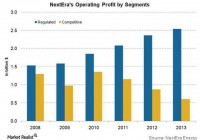
Summary Our pricing has moved up, but we are still looking at a $96 price tag. NextEra’s strong quarter in the latest earnings show great strength in renewable energy but comps were weak. Hawaiian Electric deal is moving along well, but it will still take another 9-12 months to finalize. Today, we are going to take a refreshed look at NextEra Energy (NYSE: NEE ). We first looked at the company in late February. At that time, we thought the company was fairly priced with potentially some room for a pullback. The reason was that we believed that the market was slightly overvaluing the utility space, and a correction was due. Since that report, the stock has dropped over 5% to the upper-90s. We noted we would be interested at the 90-level. Our main thesis was that, while the company’s health and catalysts were strong, valuations were pricing in a best-case scenario of 6% revenue growth and 22% operating margins consistently moving forward. We worried that was too aggressive perhaps, and even if not, an even better scenario would be needed to see upside. Today, we want to revisit our catalysts in the wake of the last set of earnings as well as other developments that have occurred. Additionally, we will take another look at our pricing model to update that given this analysis. 2015 Catalysts Revisited Economic Moat Strength What we saw as really the overall #1 strength of NEE was its dominant economic moat that it was able to have due its non-competitive arrangements with municipalities. What that means is that the company negotiates a “fair price” for a certain area if the municipality agrees to limit competition. Most areas of the country have similar agreements, and it helps to establish infrastructure and investment from utilities, while guaranteeing power, service, and price to end customers. As we noted before, NEE is very attractive because about 80% of its business is in the regulated arena, where profitability is strongest. This image from Market Realist tells the tale: (click to enlarge) The company maintains one of the highest margins in the industry with this strong mix, and there is little threat to a major push down. As long as the company can maintain this strong mix, it will be attractive for income, long-term investors. The real benefit or issue that could move the needle, though, was the company’s work in Hawaii… Hawaii – Another Regulated Market to Add Shareholder Value In 2014, NEE bought Hawaiian Electric (NYSE: HE ) for north of $4B. The move was a chance to come into a new market that was in need of cost savings and be able to combine a regulated market with the company’s practice of making efficient utility deliveries. Additionally, the company will bring its penchant for renewable energy to help build a better “mousetrap” in the state. The company had plans to revolutionize the space with solar energy. The state is one of the best for solar energy. So, how have things been moving since the last time we looked at the company. There have been quite a few developments. Right now, the main aspect of the deal is just to get it done and approved. In April, HE’s CEO came out saying he was confident that the deal would be completed within a year, and the Hawaiian House of Representatives put a resolution in place to complete the deal by June 2016. Given the market is regulated, it is a major decision for Hawaii, consumers, etc. In the latest earnings transcripts , when CEO James Robo was asked about approval, he stressed that he still believes it will be done by the end of the year: Steven Isaac Fleishman – Wolfe Research LLC Yeah. Hi, everyone. Just further on the Hawaiian deal, what’s the latest in terms of timelines for approval? James L. Robo – Chairman, President & Chief Executive Officer Steve, we’re still hopeful that we’re going to be able to get all regulatory approvals by the end of the year and that’s the target that we’re working towards. Steven Isaac Fleishman – Wolfe Research LLC Okay. Is there any movement toward like settlement discussions or still more formal process? James L. Robo – Chairman, President & Chief Executive Officer I think, Steve, that we’re very early in the process right now and discovery will be ongoing through the summer. And we expect all of the filings to be done by the end of August and so, anything on the settlement front would be very premature. Moray P. Dewhurst – Vice Chairman & Chief Financial Officer Steve, just data; we filed formal testimony. I think we’ve had some 300 interrogatories or data requests so far. We can expect to have a lot more over the coming months. That’s good. We want to make sure that all legitimate questions are appropriately aired and that people get the answers to the questions they have because we firmly believe this is fundamentally a good deal for folks in Hawaii, customers, as well as for shareholders. So we want to make sure that all the facts come out, but it will take a while and the schedule calls for that to go through the summer. It looks like this summer will be key to briefing the necessary parties, filing all the necessary paperwork, and completing the process. Overall, the process is moving along like most deals with some hiccups but generally fine. One item that did come up was that HE had to extend the shareholder vote to get the majority they needed for the acquisition, which does not necessarily mean that it wasn’t liked by shareholders. Overall, though, we believe this deal is very important to NextEra Energy. As we noted previously: The company brings the expertise of how to apply a mix of renewable energy and create consistent returns. With the prices that Hawaii is used to paying, the company should reduce costs for Hawaiians yet also make a strong profit. The company’s mix, though, of more green energy plays has not been as profitable. The company still makes its bread and butter in Florida where it uses a majority natural gas. So, the question will be if they can return the type of 20% operating margin in Hawaii? The nice thing that is baked into the cake for them is that Hawaiians are used to paying more than most Americans, so they will be able to invest more easily. We will continue to monitor this situation, but for now, the company looks like they are still on track. Current Pricing The latest earnings for NEE were pretty solid in the latest quarter. EPS came in at 1.41 versus 1.28 expectations as well as a beat for revenue as well. The company’s results were helped by an improving Florida economy that led to more additions as well as a lot of strength in NextEra Energy Resources, which saw a 41% increase in revenue. The NEER division is the renewable contracted part of the business, and that type of growth shows just how in demand renewable energy is becoming. In this section, we will want to take a look at our last pricing analysis, update it, and determine what we believe is a fair value price for NEE. In order to price the company, we need to make certain assumptions. In our last article, we modeled revenue growth will continue at a clip of 4-5% per year, and we believe that level will maintain for the next several years. The gains in NEER are not sustainable, and a lot of the gains were going up against the very adverse weather conditions one year prior. Most analysts are only modeling for 1% growth still for this year, but we are using an annualized figure. Utility revenue is fairly consistent. The key to the company is definitely margins. Operating margins are key to our DCF analysis. The coming has forecast that they will come in at the 22-23% in 2015, but I imagine this number will dip some with the onslaught of Hawaiian Electric when it is approved. In Q1, the company’s operating margins were strong at 28%. Again, the 42% operating cash flow return at NEER buoyed this higher, and the company stated they see a 20-25% overall operating cash flow return in that division for the full year. For 2015, we believe 22-23% is a bit light, and we will increase our expectation to 25%. As for the HE deal, it should add roughly $4.5B in sales in 2016, but the company operates with a 10% operating margin. The deal is really essentially to take what is a tough market for making money, revolutionize it, and improve it. This plan, though, will take several years. Therefore, margins will drop in 2016 but gradually improve again through 2020. Taxes have averaged roughly 25% for the past five years, and it’s likely this will stay around 28%-30% over the next several years. We may see it jump even a bit more beyond 2016 when more solar credits are expected to expire. Depreciation will continue to grow at about the same rate as revenue growth. Capex should come down in 2015 to around $6B and again in 2016 to $4B.The $4B rate, though, is pretty standard for the company. Our WACC rate is 5% for discounting. When we use this math in our five-year DCF analysis, we were looking at a low-90s number. We have made some positive adjustments, and here is our projections:   PROJECTIONS   1 2 3 4 5   2015 2016 2017 2018 2019 Income from Operations 4350 3654 3990 4347.2 4726.73 Income Taxes 1218 1023.1 1117.2 1217.2 1323.48 Net Op. Profit After Taxes 3132 2630.9 2872.8 3130 3403.25             Plus: Depreciation 2600 2700 2800 2900 3000 Less: Capex -3600 -3900 -4000 -4100 -4200 Less: Increase in W/C -100 -100 -100 -100 -100 Available Cash Flow 2,232 1,531 1,773 2,030 2,303 When we complete the math here, we are now looking at a $96 price tag. The key areas to contemplate are how much will margins drop when HE comes online and how much growth will it bring about. Further, will CapEx be drastically higher in 2016 as the company invests into the infrastructure? These questions are tough to model, but this model appears to be friendly and mid-to-best-case. Thus, we are still coming in around where NEE is performing today. Conclusion NextEra has interesting catalysts to 2015, but after a tremendous run in 2014, the company looks like its upside may be limited in the near-term. The recent pullback is a sign that the stock has gotten ahead of itself, and valuations are still rich. Right now, we like the stock as a long-term play in safety, but it will only be an income play with limited value upside. Yet, for its socially responsible model, the company presents another interesting dynamic. Disclosure: The author has no positions in any stocks mentioned, and no plans to initiate any positions within the next 72 hours. (More…) The author wrote this article themselves, and it expresses their own opinions. The author is not receiving compensation for it (other than from Seeking Alpha). The author has no business relationship with any company whose stock is mentioned in this article.