Tag Archives: nreum

Best And Worst: Large Cap Blend ETFs, Mutual Funds, And Key Holdings
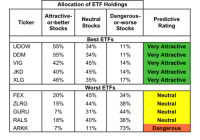
Summary Large Cap Blend style ranks second in 2Q15. Based on an aggregation of ratings of 53 ETFs and 908 mutual funds. UDOW is our top rated Large Cap Blend ETF and GQLOX is our top rated Large Cap Blend mutual fund. The Large Cap Blend style ranks second out of the 12 fund styles as detailed in our 2Q15 Style Ratings report . It gets our Attractive rating, which is based on aggregation of ratings of 53 ETFs and 908 mutual funds in the Large Cap Blend style. Figures 1 and 2 show the five best and worst rated ETFs and mutual funds in the style. Not all Large Cap Blend style ETFs and mutual funds are created the same. The number of holdings varies widely (from 15 to 1364). This variation creates drastically different investment implications and, therefore, ratings. Investors seeking exposure to the Large Cap Blend Style should buy one of the Attractive-or-better rated ETFs or mutual funds from Figures 1 and 2. Figure 1: ETFs with the Best & Worst Ratings – Top 5 (click to enlarge) * Best ETFs exclude ETFs with TNAs less than $100 million for inadequate liquidity. Arrow QVM Equity Factor ETF (NYSEARCA: QVM ) IS excluded from Figure 1 because its total net assets are below $100 million and do not meet our liquidity minimums. Figure 2: Mutual Funds with the Best & Worst Ratings – Top 5 (click to enlarge) * Best mutual funds exclude funds with TNAs less than $100 million for inadequate liquidity. ProShares UltraPro Dow30 ETF (NYSEARCA: UDOW ) is our top-rated Large Cap Blend ETF and GMO Quality Fund (MUTF: GQLOX ) is our top-rated Large Cap Blend mutual fund. Both earn a Very Attractive rating. One of our favorite stocks held by Large Cap Blend funds is Johnson & Johnson (NYSE: JNJ ). In 2014, Johnson & Johnson earned an after-tax operating profit ( NOPAT ) of almost $17 billion; its highest ever in our model. The company has been very consistent over the last decade with regard to its financial performance. NOPAT has grown by 8% compounded annually since 2004 and Johnson & Johnson’s return on invested capital (NASDAQ: ROIC ) has also remained above 14% every year over the last decade. This consistency has allowed the company to continually increase economic earnings every year over this same time frame. Despite the growth in the business, the stock is currently undervalued. At its current price of $98/share, JNJ has a price to economic book value (PEBV) ratio of 1.0. This ratio implies the market expects Johnson & Johnson’s NOPAT to never grow from current levels. Meanwhile, if Johnson & Johnson can grow NOPAT by 7% compounded annually for the next 5 years , the company is worth $140/share- a 43% upside from current levels. These expectations could be easily surpassed given the company’s long and consistent history of generating shareholder value. Ark Innovation ETF (NYSEARCA: ARKK ) is our worst-rated Large Cap Blend ETF and Lazard Enhances Opportunities Portfolio (MUTF: LEOOX ) is our worst-rated Large Cap Blend fund. ARKK earns a Dangerous rating and LEOOX earns a Very Dangerous rating. One of the worst stocks held by Large Cap Blend funds is recent Danger Zone stock Athenahealth (NASDAQ: ATHN ). Over the last three years many of the key financial metrics of the company have deteriorated. Athenahealth’s ROIC has declined from 14% in 2011 to just 1% in 2014. NOPAT has also had a very similar path, declining 42% compounded annually since 2011. In addition, for the past three years, Athenahealth’s cost of capital ( WACC ) has exceeded its ROIC. This has caused the company to earn negative economic earnings and is an indication that the company is destroying shareholder value. Athenahealth’s stock price, however, has not reflected the fundamental deterioration of its underlying business. Since going public in 2007, the stock price has more than tripled. However NOPAT for Athenahealth has declined by 50% since 2007. To justify its current price of $117/share, the company would need to grow NOPAT 60% compounded annually for the next 11 years . This seems very optimistic considering the declining business operations as described above Figures 3 and 4 show the rating landscape of all Large Cap Blend ETFs and mutual funds. Figure 3: Separating the Best ETFs From the Worst Funds (click to enlarge) Figure 4: Separating the Best Mutual Funds From the Worst Funds (click to enlarge) Sources: Figures 1-4: New Constructs, LLC and company filings D isclosure: David Trainer owns JNJ. David Trainer and Allen L. Jackson receive no compensation to write about any specific stock, style, style or theme. Disclosure: The author is long JNJ. (More…) The author wrote this article themselves, and it expresses their own opinions. The author is not receiving compensation for it. The author has no business relationship with any company whose stock is mentioned in this article.

5 Impressive Large-Cap Blend Mutual Funds To Beat Peers

Blend funds are a type of equity mutual funds which holds in its portfolio a mix of value and growth stocks. Blend funds are also known as “hybrid funds”. Blend funds aim for value appreciation by capital gains. It owes its origin to a graphical representation of a fund’s equity style box. In addition to diversification, blend funds are great picks for investors looking for a mix of growth and value investment. Meanwhile, large-cap funds usually provide a safer option for risk-averse investors, when compared to small-cap and mid-cap funds. These funds have exposure to large-cap stocks, providing long-term performance history and assuring more stability than what mid-caps or small-caps offer. Below we will share with you 5 large-cap growth mutual funds . Each has either earned a Zacks #1 Rank (Strong Buy) or a Zacks #2 Rank (Buy) as we expect these mutual funds to outperform their peers in the future. To view the Zacks Rank and past performance of all large-cap blend funds, investors can click here to see the complete list of funds. Principal Capital Appreciation A (MUTF: CMNWX ) seeks long-term capital appreciation. Though CMNWX generally invests in large-cap companies, it may also invest a small portion of its assets in small- and mid-cap firms. CMNWX uses a “blend” strategy to invest in equity securities of companies. The Principal Capital Appreciation A fund has a three-year annualized return of 19.5%. As of April 2015, CMNWX held 154 issues with 3.34% of its assets invested in Apple Inc. Steward Large Cap Enhanced Index Individual (MUTF: SEEKX ) invests a lion’s share of its assets in securities listed in the benchmark index. SEEKX changes relative weighting of value and growth stocks by following style of the benchmark. SEEKX also uses quantitative analysis of factors such as valuation, growth and dividend yield for investing in securities other than those included in the index in order to maintain its social responsible investment policies. The Steward Large Cap Enhanced Index Individual fund has a three-year annualized return of 20.7%. SEEKX has an expense ratio of 0.90% as compared to category average of 1.04%. Fidelity Disciplined Equity (MUTF: FDEQX ) seeks capital appreciation over the long run. FDEQX invests a major portion of its assets in common stocks of companies. FDEQX follows the companies’ weighting in the S&P 500 Index before investing in securities of firms across a wide range of sectors. FDEQX invests in companies throughout the globe by using quantitative analysis of factors such as growth potential, valuation and financial strength. The Fidelity Disciplined Equity fund has a three-year annualized return of 21.8%. Alex Devereaux is the fund manager and has managed FDEQX since 2013. Vantagepoint Growth & Income Investor (MUTF: VPGIX ) invests a large chunk of its assets in common stocks of domestic companies that are believed to be undervalued and have an impressive earnings growth potential. VPGIX focuses on acquiring stocks of companies that are expected to pay dividends. The Vantagepoint Growth & Income Investor fund has a three-year annualized return of 20%. As of April 2015, VPGIX held 208 issues with 2.22% of its assets invested in Microsoft Corp. Dreyfus Disciplined Stock (MUTF: DDSTX ) seeks capital growth over the long-term. DDSTX invests s majority of its assets in large-cap companies having market capitalizations above $5 billion. DDSTX is expected to follow the weighting of the S&P 500 Index to invest in both value and growth stocks. The Dreyfus Disciplined Stock fund has a three-year annualized return of 17.5%. DDSTX has an expense ratio of 1.00% as compared to category average of 1.04%. Original Post

The Little Worm That Is Destroying Capitalism

By Jason Voss, CFA In response to the Great Recession, central banks continue to engage in massive monetary stimulus to artificially depress the costs of capital. Many commentators have expressed concerns (and I concur) about the inflationary forces they believe must naturally be building up because of this stimulus. Yet, very few commentators have discussed the consequential little worm that is destroying capitalism, and the mindset thus birthed. Costs of Capital Generations of business schools have taught – and business leaders have implemented – capital budgeting philosophies based on expected rates of returns and weighted average cost of capital (WACC). First, cash flows over a time horizon are estimated for a proposed project. On the positive cash-flow side, these may include additional revenues created or future expenses saved. Either way, there is some benefit to a business of the proposed project. Netted against these benefits are the negative cash flows – the expenses – that are expected to be incurred to implement the project. Next, the net flows over time are discounted by the WACC, and the assumed risks of successfully implementing the project are built into this discount rate. If the net present value (NPV) of this calculation is positive, then businesses are supposed to proceed with the project. Still, others prefer to compare their expectations for internal rate of return (IRR) to the WACC. Either way, the process is the same. The Little Worm But this entire framework has a problem – the little worm that is destroying capitalism, albeit slowly. Namely, in calculating cost of debt and cost of equity for businesses, market-based rates are used, and with the misnamed “risk-free rate” serving as the root of all other costs of capital. What happens though when central banks’ loose monetary policy creates too much capital and artificially holds down root costs of capital? Companies adjust their required rates of return down, too. In fact, one could argue that this is a principal reason for why central banks are holding root costs of capital so low: to spur business investment. Yet when WACC is held artificially low, many projects are accepted that previously would never have been considered viable under normal circumstances. Put another way, the problem is using relative values – not absolute values – in calculating costs of capital. Examples of such projects providing marginal benefits are: improving financial reporting systems through better information technology, minor tweaks to supply chain logistics, cutting back on marketing or increasing low-cost advertising (like social media), “rationalization” of head count, holding average wages as low as possible, squeezing suppliers a little bit, not repatriating earnings to stave off taxation, refinancing rather than retiring debts, and the share buyback that is insensitive to a company’s current stock price. I could go on. It is not that these marginal WACC projects are unworthy and shouldn’t be done, it is that the lifeblood of capitalism is creative destruction. It is fiery and intense. Capitalism is supposed to be more like a volcano than a hot plate keeping the coffee warm! Evidence that the worm is eating away at capitalism is that revenues continue to grow much more slowly than do earnings per share (EPS) . Furthermore, revenues continue to miss consensus estimates even though EPS continue to beat estimates. Also, EPS continue to grow so quickly due mostly to a shrinking denominator (i.e., big share buybacks). Ask yourself: When was the last time you heard genuine risk-taking behavior on the part of your portfolio of businesses? I think you will agree that only a handful of companies are engaged in proper game-changing capitalistic risk taking. Normalized Cost of Capital In the developed nations, I estimate a normalized long-term project after-tax WACC of around 6.5%, versus an estimated late 2014 WACC of only 3.0%. Even if you disagree with my estimates, I believe if you calculate your own, you will find that current costs of capital are about less than half of a normalized figure. That means you should expect at least 100% more projects being approved than under normal cost of capital scenarios. Yet this high figure may actually understate the number of excess projects being funded. This is because as cost of capital asymptotically approaches zero (i.e., ” to negative nominal yields and beyond!” ), the actual number of projects thought of as viable may follow a power law distribution instead of behaving linearly. In other words, businesses are currently in the process of destroying what was, once upon a time, a precious resource to be conserved: capital. A Remedy? If you agree with me, I propose, as a simple remedy, that costs of capital for a business begin to be evaluated on an absolute, normalized basis, rather than on a relative basis. And, I would add, treating externalities as free/not considering economic, social, and governance (ESG) is not going to cut it either. As a shareholder – or prospective shareholder – you do not need to wait for a company to engage in this behavior. Instead, you can begin to use normalized costs of capital in your own estimates of fair value. This may shrink your universe of investible assets, so be wary of diversification being worse. Fear the Worm My big fear is that even once costs of capital begin to rise/normalize, a generation of gutless business leaders is being hatched in the current gutless business culture. In short, artificially low costs of capital are eroding the capitalist’s risk-taking, return-generating mindset. Yikes! In conclusion, which company would you rather invest in: the one using normalized costs of capital in capital budgeting, or the company just using traditional methods? Thought so! Disclaimer: Please note that the content of this site should not be construed as investment advice, nor do the opinions expressed necessarily reflect the views of CFA Institute.