Tag Archives: lists

GLD And Its Relation To The Greek Elections, ECB’s QE And FOMC Meeting
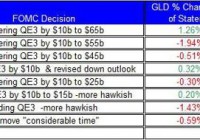
The rise in uncertainty in Europe over the recent Greek elections results in ECB’s QE program play in favor of GLD. Will the upcoming FOMC meeting and GDP update for the fourth quarter impact the direction of GLD? The market has revised down the probabilities of a rate hike in the coming FOMC meetings. The results of the latest elections in Greece along with ECB’s decision to start its quantitative easing program have provided back-wind for the SPDR Gold Trust ETF (NYSEARCA: GLD ). Let’s examine the recent developments in Europe and the upcoming reports in the U.S. including FOMC statement and GDP update. The latest news about election results in Greece, in which the extreme left party Syriza won, is likely to bring this country one step closer towards leaving the European Union, could stir up the markets, raise the uncertainty levels and depreciate the Euro against leading currencies. But it’s not likely to have substantial long-term adverse ramifications on the EU, as suggested in this analysis . This news along with ECB’s decision to implement a $1.3 trillion QE program could still drive higher the demand for precious metals investments including GLD, which tend to strive when central banks devalue their currency and the uncertainty level in the markets rise. Nonetheless, bear in mind that the ongoing rally of the U.S. Dollar against the Euro and other currencies will eventually curb down the rise in the price of GLD. This week the FOMC will convene for the first time this year. In the previous meeting back in December, the FOMC concluded its meeting with the decision to repurpose the term “considerable time” with respect to the timing of the rate hike; the FOMC kept the term as a reference point to its current policy – the normalization process will continue to be data dependent and a rate hike won’t happen anytime soon with the key word being patience: “… the Committee judges that it can be patient in beginning to normalize the stance of monetary policy.” Moreover, in the press conference that followed, FOMC Chair Yellen also pointed out that the FOMC is likely to raise rates in the next couple of meetings. (click to enlarge) Source of data: FOMC’s site and Bloomberg This time, the FOMC meeting will include a press conference or an update for the economic progress of the U.S. But the last updates by the IMF and World Bank showed that the U.S. economy is likely to grow in 2015 by 3.6% and 3.2%, respectively. In both cases, these organizations revised up their assessments from their previous estimates, in part, due to low oil prices. The current low oil prices are also likely to bring down GLD – after all potential rise in inflation is among the main reasons for people to invest in gold assets such as GLD. Well, this doesn’t seem to be the case. Despite the expected higher growth in GDP, the markets have started to revise their expectations about the next rate hike of the FOMC. According to the CME , the probability of a rate hike in the June meeting is currently only 12% – a month ago this probability was around 30%. Further, the implied probability of a rate hike in the July meeting has been updated from 57% a month ago to 28%. So the markets have updated their projections based on the current low inflation. The low inflation could eventually result in the FOMC pushing forward the first and subsequent rate hikes. Such a scenario is likely to keep pushing up the price of GLD: After all, low cash rate tends to translate to low long-term treasury yields. If U.S. treasury yields remain low, this could contribute to the short-term recovery of GLD. But the upcoming FOMC meeting isn’t likely to stir up the markets considering Yellen’s promise not to rock the boat in the next two meetings. Therefore, the market reaction is likely to moderate and GLD isn’t expected to do much – we could see a similar reaction as we did in the last meeting. Another report to consider is the upcoming GDP report – first estimate for the last quarter of the year. The current estimates are for the GDP report to show a gain of 3.1%. In the past, these reports didn’t seem to have much of a strong impact on the prices of GLD, as you can see in the table below. Source of data taken from Bloomberg and BEA Nonetheless, this report is still likely to influence FOMC members with respect to their rate decision. If the U.S. economy keeps showing a steady growth, this is likely to bring the FOMC closer to pushing the trigger on the rate hike. Despite the latest developments in Europe, the direction of GLD is mostly related to the changes in U.S. including the FOMC’s policy and the progress of the U.S. economy. If the FOMC were to push forward its first rate hike, this could keep up the price of GLD. For more see: What are the advantages of GLD?
Is Water Utility Artesian Resources A Buy?

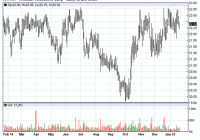
Water shortages in North America are becoming more acute. Infrastructure costs are becoming increasing large for municipal governments. Artesian Resources is positioned to garner increasing revenues from local governments. We had briefly touched on Artesian Resources Corp (NASDAQ: ARTNA ) on our website recently and wanted to revisit it with a bit more ‘meat on the bone.’ When you think about regulated utility companies in North America you likely think of the local electric company or natural gas company–the ones we write checks to year around, but as investors we need to cast the net a bit further. Throughout the United States and Canada our water and sewer service comes from municipal systems in over 70% of households. Another 15% of us have our own well (like all 10 houses in our subdivision have their own well), while 11% are served by investor utilities. About the same percentages hold true for sewage systems. All of us North Americans understand that water is becoming an increasingly valuable resource and this is truer and truer everyday. Whether it be irrigating crops or fracking oil wells the need for water simply continues to grow. Similarly, the need to treat sewage in a way that allows the liquid and solid waste to be disposed of in a way that doesn’t harm the environment is taxing our infrastructure which is old and inefficient. Local municipalities are stressed financially trying to maintain their water and sewage plant and equipment, yet both state and federal regulations simply continue to pile on in a way that demands a huge amount of capital to address water safety and environmental concerns. Thinking about this one has to believe there is a huge potential long term opportunity in investor owned companies that can help address the water and sewer issues of the nation. Certainly many investors have followed these companies for a very long time and maybe owned shares, but given the modest level of dividends paid by most of the water utility companies they had not really hit our radar screen. Only by attempting to discern where we would find the safety we desired coupled with the dividends and long term potential for capital gains did we start to dig deeper around the water arena. Artesian Resources Corp is primarily operating in Delaware, but with operations in Pennsylvania and Maryland. They have been providing water services (and now sewer) to the area for over 100 years–so they certainly have the experience necessary to be successful. Recently they have acquired a couple additional local water systems and are shopping for more–there goal is to be aggressive. We think they have the background that will allow them to move strongly forward. Artesian Resources Corp is a rather small company (we prefer companies that are smaller for some reason) with revenue that is likely to hit $72 or $73 million in the year that just ended (December 31). From this the company will garner around $10 million in net income–around $1.10-$1.15 per share. Additionally, if we look at free cash flow we can add back another $9 million in depreciation–giving relatively huge cash flow of around $2/share. From this they will pay out around 85 cents/share in dividends (a current yield of 3.82%). This is a reasonable payout ratio of about 40-45% leaving a good deal of cash for re-investment–and believe me there will be no shortage of projects vying for the capital. Now as we look at some of the most recent financial history of the company we are impressed by a near 30% year over year income gain last quarter and a 10% gain for the 9 month period. These were attained with revenue growth of just 8% and 4% respectively. Looking at dividends the company has raised them twice a year for the last 5 years. We definitely like these rising payouts even if they are just around 3-4% a year. One must remember that this is mainly a regulated utility – not a high tech supercharged company. As a utility they have plenty of debt (have you ever known a utility to have little debt?), but they are borrowing at reasonable interest rates and their ability to refi this debt when it comes due should be no issue. The share price has remained relatively stable over the last year–in fact essentially flat. As a conservative income investor we would like to a stable fair dividend and the opportunity for future capital gains (not a guarantee of that gain–just the opportunity). Here is how the shares have performed in the last year. (click to enlarge) Now for a few negatives. First off the company has 2 classes of common stock–and the class that you and I own is Non-Voting . Insiders own all of the voting stock, thus you have to have good faith in the management as you have no say in the operations and management of the company. In principle we dislike this with a passion, but on the other hand we buy preferred stocks all the time and we have no problem with having no vote in the company so I guess we can live with it with Artesian. secondly the company recently lost a lawsuit in which they disputed some contract terms and will need to anty up $3 million to settle the claims. Fortunately, the company accrued the bills as they received them so the payment should not affect their income statement although it will cause a ding on the balance sheet. With the above in mind we have personally purchased a small personal position in these shares (as well as in our most recent Model portfolio) Our belief is that this should be bought with a 5 year invest commitment. The company website is here . For those wanting the ‘unvarnished’ financials here is the latest SEC filed 10Q.

Spike In eBay Shares On Q4 Earnings Puts These ETFs In Focus

The e-commerce giant eBay Inc (NASDAQ: EBAY ) came out with Q4 results after the closing bell on January 21. Overall, the mood was optimistic on an earnings beat and restructuring initiatives, though a sales-miss restrained investors from full-hearted optimism on the stock. Net income in the fourth quarter rose to $0.81 from $0.66 per share a year earlier, based on Zacks data. This beat the Zacks Consensus Estimate of $0.77, which excludes stock options and non-recurring expenses. Net revenues of $4.92 billion fell shy of the estimate of $4.97 billion but grew 9% year over year. Revenues were primarily volume driven. eBay’s Marketplaces segment generating revenues from the sale of goods available on eBay properties, recorded a 1% jump in net transaction revenues. However, as expected, pricing was an issue for the company which is why on the margin front, the e-commerce giant clearly underperformed. The non-GAAP operating margin was down 150 bps to 29.2% in the quarter. Restructuring procedure is on with the e-commerce player. eBay’s plan to spin off the PayPal business will be completed in the second half of 2015 and the online marketplace announced that it would lay off 7% of its workforce in the first quarter. The company also announced it has entered into a standstill agreement with Carl Icahn, who is the company’s largest activist shareholder . Weak Guidance Though the story was decent so far, the guidance took a beating. The company expects net revenues in the range of $4.35-$4.45 billion, failing the analysts’ projection of $4.71 billion, per Bloomberg . The company’s non-GAAP earnings per share are guided in the range of $0.68-$0.71. The company expects net revenues of $18.60-$19.1 billion for the full year and non-GAAP earnings per diluted share of $3.05-$3.15. Market Impact The company’s streamlining initiatives might have given its stock a boost post earnings. The stock gained 3.5% after hours on January 21. The results have put some ETFs with considerable exposure to eBay in focus. These funds are highlighted below: PowerShares Nasdaq Internet Portfolio (NASDAQ: PNQI ) This fund follows the Nasdaq Internet Index, giving investors exposure to the broad Internet industry. The fund holds about 94 stocks in its basket with AUM of $248 million while charging 60 bps in fees per year. The in-focus eBay occupies the second position with an 8.37% allocation. In terms of industrial exposure, Internet software and services make up for more than two-thirds of the basket, followed by Internet retail. PNQI has lost nearly 2.2% so far this year (as of January 21, 2015). First Trust Dow Jones Internet Index (NYSEARCA: FDN ) This is one of the most popular and liquid ETFs in the broad tech space with AUM of over $1.96 billion and average daily volume of more than 250,000 shares. The fund tracks the Dow Jones Internet Index and charges 57 bps in fees per year. In total, the fund holds 41 stocks in its basket with the in-focus eBay taking the third spot with a 5.53% share. From a sector look, information technology accounts for about 70% of the portfolio while consumer discretionary makes up 22%. The ETF is down about 2.9% year to date. Market Vectors Wide Moat ETF (NYSEARCA: MOAT ) This ETF follows the Morningstar Wide Moat Focus Index and provides equal-weighted exposure to 21 U.S. securities that have a unique sustainable competitive advantage in their respective industries. Here, eBay occupies the tenth position in the basket, accounting for 5% of total assets. The product is pretty spread out across various sectors with energy, information technology and consumer discretionary taking double-digit allocation. The fund has accumulated $898 million in its asset base and sees good volume of about 200,000 shares a day. Its expense ratio comes in at 0.49%. The fund has added nearly 5% so far this year. Bottom Line eBay currently carries a Zacks Rank #4 (Sell) with poor fundamentals. However, investors should note that Internet commerce segment – the industry eBay operates in – presently resides in the top 23% allocation of Zacks Industry Rank. The company itself is also striving hard to turn around by adopting every possible measure. All these point to a moderately bullish long-term outlook. So, investors counting on the long-term potential in the space can consider the recent rally in eBay shares as a start to the wining trend. However, an ETF approach may be better; at least it can cover up eBay’s short-term weakness with some other components’ strength.