Tag Archives: lists

Smart-Beta, Small-Cap ETFs Could Outperform

Small caps have been underperforming large caps. New research paper suggests investors should compare like with like, and small caps would outperform when controlling for quality. Focus on alternative index-based small-cap ETFs. When picking out small-capitalization stock exposure, exchange-traded fund investors may be better of with funds based on alternative indices that weed out weaker companies. For instance, small-cap ETFs like the WisdomTree SmallCap Dividend Fund (NYSEARCA: DES ) , PowerShares Fundamental Pure Small Cap Core Portfolio (NYSEARCA: PXSC ) and First Trust Small Cap Core AlphaDEX Fund (NYSEARCA: FYX ) track alternative or smart-beta indices that don’t follow traditional market-capitalization weighted methodologies, as opposed to the widely monitored iShares Russell 2000 ETF (NYSEARCA: IWM ) , which is based of the Russell 2000 benchmark. According to a recent research note, ” Size matters, if You Control Your Junk ,” conducted by US hedge fund AQR, along with Tobias Moskowitz, a finance professor at Chicago Booth, small-cap stocks outperform large caps when quality of the companies is taken into account, reports James Mackintosh for Financial Times . “Controlling for quality/junk also explains interactions between size and other return characteristics such as value and momentum,” according to the research paper. Many small-cap stock investors have been disappointed by last year’s nine percentage point underperformance to large-cap stocks. However, the research paper explains that investors should compare like with like. For instance, small high-quality companies outperformed larger high-quality companies while small junk beat out large junk stocks. Consequently, funds and ETFs based off of benchmark indices like the Russell 2000 or the FTSE Small Cap, which carry more junky stocks at the bottom end of the market, would offset potential benefits of quality small-cap stocks. However, when controlling for quality, small caps have generated decent returns. For example, DES weights holdings based on the aggregate cash dividends that companies are projected to pay in the coming year. PXSC is based on a RAFI Fundamental Index, which selects components based on fundamental factors like sales, cash flow, dividends and book value. FYX ranks stocks from the S&P SmallCap 600 Index on growth factors including three, six and 12-month price appreciation, sales to price and one-year sales growth, and separately on value factors including book value to price, cash flow to price and return on assets. Over the past year, DES has increased 7.3% and PXSC gained 8.4%. In contrast, IWM rose 2.8% over the past year. Nevertheless, over the short term, “beta
Big Energy ETFs Could Face Big Dividend Cuts

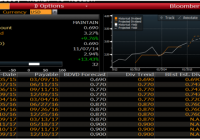
Energy stocks have been pummeled by lower oil prices. Now, energy companies may be forced to cut dividends. The highlight of oil sector ETFs and potential areas of weakness. By Todd Shriber & Tom Lydon Already under considerable pressure with oil prices falling and valuations on the rise, energy sector exchange traded funds are confronting a new problem: The potential, emphasis on “potential,” for dividend cuts from some of the sector’s largest companies. Major equity-based energy ETFs from the Energy Select Sector SPDR ETF (NYSEARCA: XLE ) to the Vanguard Energy ETF (NYSEARCA: VDE ) and the Fidelity MSCI Energy Index ETF (NYSEARCA: FENY ) could be stung by dividend cuts from marquee holdings if oil prices remain and/or fall further, forcing producers to look for ways to conserve cash. If the options market is accurate, the specter of energy sector dividend reductions must be acknowledged. Perusing 2016 at-the-money options data, the options market is pricing in dividend cuts for some of the biggest U.S. oil companies and some of the largest holdings in the aforementioned ETFs. For example, Bloomberg data indicate, based on the company’s recent dividend growth trajectory, Occidental Petroleum (NYSE: OXY ) will grow its payout to $3.20 per share per year over the next 12 months from the current level of $2.88 per share. However, the options market says Occidental’s payout could fall to $2.60. ConocoPhillips (NYSE: COP ), the largest U.S. independent oil and gas producer, assuming the options market is accurate, will also see its annual payout fall to $2.60 from $2.92 per share. ConocoPhillips and Occidental are XLE’s sixth- and seventh-largest holdings, respectively, combining to make up 7.3% of the largest energy ETF ‘s weight. Schlumberger (NYSE: SLB ), the world’s largest oilfield services provider, recently announced a 25% dividend increase, bringing its payout to $2 per share per year. The options market is not impressed, and sees the potential for that dividend to fall to $1.40 a share. Schlumberger is XLE’s third-largest holding, at a weight of almost 7.2%, and the largest holding in the Market Vectors Oil Services ETF (NYSEARCA: OIH ) , at 20.2% of that fund’s weight. OIH and rival oil services ETFs have already endured ample dividend cut speculation, some of which was confirmed in November when Seadrill (NYSE: SDRL ) said it was suspending its $1 per share quarterly dividend until at least the end of 2015. Analysts have noted Diamond Offshore’s (NYSE: DO ) special dividend policy is at risk, while highlighting Transocean (NYSE: RIG ) as a potential dividend cutter . In what could be a real shocker, the options market is also pricing in potential dividend cuts by Exxon Mobil (NYSE: XOM ) and Chevron (NYSE: CVX ), the two largest U.S. oil companies. Based on recent dividend growth, it would be reasonable to expect Exxon’s and Chevron’s dividends to rise to $3 and $4.52, respectively, over the next year. However, options data say $2.71 and $3.99, both below current levels, could be in the cards for Exxon and Chevron. Exxon and Chevron combined for 30.3% of XLE’s weight as of Monday and 34.8% of VDE at the end of December. Several factors should not be overlooked, not the least of which is that the options market could be proven wrong. Second, the companies mentioned here have options for cash conservation before moving to dividend cuts, including reducing capital expenditures and trimming buybacks. Exxon is one of the largest repurchasers of its own shares in the U.S. Third, several of these companies have proven they are highly committed to consistently raising their dividends. For example, Exxon and Chevron are members of the S&P Dividend Aristocrats Index, which requires dividend increase streaks of at least 25 years for inclusion. With its new dividend, Schlumberger’s payout has nearly doubled since 2008. Occidental’s dividend has more than doubled since 2010. Still, even the thought of dividend cuts comes when energy stocks are vulnerable to negative earnings revisions and valuations that are high despite slumping oil prices. “The forward 12-month P/E ratio for the S&P 500 now stands at 16.6, based on (last week’s closing price (2063.15) and forward 12-month EPS estimate ($124.04). Given the high values driving the ‘P’ in the P/E ratio, how does this 16.6 P/E ratio compare to historical averages? What is driving the increase in the P/E ratio? The current forward 12-month P/E ratio of 16.6 is now well above the three most recent historical averages: 5-year (13.6), 10-year (14.1), and 15-year (16.1)” – Rareview Macro founder, Neil Azous. (click to enlarge) Chart Courtesy: Bloomberg

Gold-In-Euro-Terms ETF Capitalizes On ECB’s QE Plan

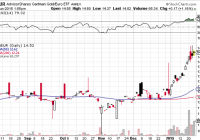
Summary Gold is falling after ECB’s bond purchasing plan. Stronger USD is weighing on gold. However, bullion investors can use a euro-denominated gold ETF to hedge the depreciating value of the EUR. Gold exchange traded funds rose on a knee-jerk reaction Thursday, following the European Central Bank’s aggressive bond-purchasing plan, as traders anticipated a rise in inflation. However, investors soon realized that the ECB actions would benefit the dollar or weigh on USD-denominated bullion. The SPDR Gold Trust ETF (NYSEArca: GLD ) has increased 10.3% year-to-date but was down 0.9% Friday and again Monday. Gold strengthened Thursday after traders assumed the ECB’s quantitative easing would flood the market with cash and induce inflationary pressures, but many soon realized that the money created were euros and not dollars. Since the ECB’s announcement, the euro continued to depreciate toward an 11-year low against the U.S. dollar. Consequently, the stronger USD should hurt gold as it becomes costlier for foreign traders to acquire USD-denominated assets. “What you saw was uncertainty about what the ECB was going to do-I think that’s what lifted gold higher. But I think now that this is all going to kind of settle down,” Anthony Grisanti of GRZ Energy, said on CNBC . “I don’t understand why you would think something that would strengthen our dollar would strengthen gold at this point.” Alternatively, gold ETF traders can take a look at the AdvisorShares Gartman Gold/Euro ETF (NYSEArca: GEUR ) , an actively managed ETF tracking gold in euro terms. While GLD dipped Friday, GEUR gained 1.2%. “Holding gold in a non-U.S. dollar denominated currency may help to limit the downside risk during stressed market environments where the U.S. dollar becomes a safe haven store of value,” according to AdvisorShares . Some gold investors quickly picked up on the GEUR trade as well, with the Gold/Euro ETF trading volume up to 65,000 late Friday, or more than 10 times its average daily volume, according to Morningstar data. Looking at the futures market, COMEX gold traded down 0.7% to $1,291.6 per ounce late Friday, whereas Euro Spot gold rose 0.5% to €1,151.1 per ounce. AdvisorShares Gartman Gold/Euro ETF (click to enlarge) Full disclosure: Tom Lydon’s clients own shares of GLD.