Tag Archives: lists

Best And Worst ETFs Of January

The year 2015 began on quite a volatile note and in fact saw the worst start to the New Year since 2008. Standard & Poor’s 500 index fell 3.1% in January while the Dow Jones Industrial Average lost 3.7% – marking its biggest monthly loss in a year. Concerns about the impact of a stronger dollar and lower oil prices on corporate earnings growth continued to bother investors. Moreover, global growth uncertainty also played foul with both the World Bank and International Monetary Fund having slashed their global growth forecasts. The three factors – oil, the strengthening U.S. dollar and lackluster global economic growth – worked in tandem pushing down corporate profitability for Q4 and the estimates for the current and subsequent quarters. Meanwhile, the Swiss National Bank dropped its long-standing exchange rate of the Swiss franc against the euro adding to the current market volatility. At the same time, the political situation in Greece worsened as the Syriza party won the country’s general elections, raising worries about Greece’s exit from the Euro zone. On the other hand, news that the U.S. consumer sentiment rose in January to its highest level in 11 years on better job and wage prospects and consumer spending in the fourth quarter expanded at the fastest pace since 2006 failed to bring in the much need relief to the U.S. markets. Adding to the woes, the U.S. economy expanded at a slower-than-expected pace of 2.6% during the final quarter of 2014. The pace signaled a slowdown in growth after an expansion of 5% in the third quarter and the 4.6% pace in the second. Given the huge market volatility, ultra-safe bond funds emerged as one of the biggest winners in January as investors rushed in for safety. Not surprisingly, some of the commodity and oil & gas ETFs emerged as losers shedding in the double digits. Best ETFs Volatility ETFs Volatility ETFs were the major gainers amid the ongoing turbulence, as these tend to outperform when markets are falling or fear levels are high for the future. The iPath S&P 500 VIX Short-Term Futures ETN (NYSEARCA: VXX ) has been leading the space with a 17% return in January, closely followed by 16.89% for the C-Tracks Citi Volatility Index ETN (NYSEARCA: CVOL ). VXX is the most popular volatility ETN on the market with an asset base of $937.7 million and average trading volume of 43.1 million shares. The fund tracks the S&P 500 VIX Short-Term Futures Index to provide exposure to a daily rolling long position in the first and second months of VIX futures contracts. The expense ratio came in at 0.89%. Bond ETFs Given the uncertainty in the global market, investors are flocking to safe haven long-term government bonds to protect their portfolio from losses. The PIMCO 25+ Year Zero Coupon U.S. Treasury Index ETF (NYSEARCA: ZROZ ), the Vanguard Extended Duration Treasury ETF (NYSEARCA: EDV ) and the iShares 20+ Year Treasury Bond ETF (NYSEARCA: TLT ) emerged as some of the biggest winners in this space gaining in excess of 9%. ZROZ tracks the BofA Merrill Lynch Long US Treasury Principal STRIPS index and holds 21 securities in its basket. The effective maturity and effective duration of the fund stand at 27.38 years. The fund manages an asset base of $164.2 million and charges 15 bps in annual fees. ZROV has a 30-day SEC yield of 2.30% and is up 16% quarter-to-date. iShares Residential Real Estate Capped ETF (NYSEARCA: REZ ) In the current ultra-low environment, investors in search of juicy yields are continuing to pile up real estate funds which offer attractive payouts. The fund follows the FTSE NAREIT All Residential Capped Index and provides exposure to 37 U.S. residential real estate stocks and real estate investment trusts (REITs). REZ manages an asset base of $347.2 million with a 30-day SEC yield of 3.18% and has returned 8% in the past one month. ETF Losers SPDR S&P Metals & Mining ETF (NYSEARCA: XME ) XME was the biggest loser last month dragged down by weakness within the broad commodity space. The fund lost 12.1% in January and is down 31% in the past one year. XME is the largest and most popular fund in the metals and mining space with an asset base of $370.6 million and is highly liquid with an average trading volume of 2 million shares. The fund tracks the S&P Metals & Mining Select Industry Index to provide exposure to a basket of 35 stocks. The ETF charges 35 basis points a year. SPDR S&P Oil & Gas Equip & Service (NYSEARCA: XES ) The persistent decline in oil prices over the past six months has taken a toll on the overall energy sector as well as on the growth prospects of a number of oil producers. XES tracks the S&P Oil & Gas Equipment & Services Select Industry Index providing exposure to a basket of 52 stocks. Sector-wise, Oil & Gas Equipment & Services occupies 72.3% of fund assets followed by 27.7% to Oil & Gas Drilling. The fund manages an asset base of $169.5 million and has lost 11.5% last month. The fund currently has a Zacks ETF Rank #5 or Sell rating. First Trust ISE-Revere Natural Gas Index Fund (NYSEARCA: FCG ) The fund offers exposure to the U.S. stocks that derive a substantial portion of their revenues from the exploration and production of natural gas. It follows the ISE-Revere Natural Gas Index and holds 28 stocks in its basket, which are well spread out across each component with none holding more than 7% of assets. The fund has gathered an AUM of $240 million so far and sees good average daily volume of over 1.3 million shares. The fund has shed 10.5% in January and currently has a Zacks ETF Rank #5 or Sell rating.
An Analysis Of 5 Materials ETFs

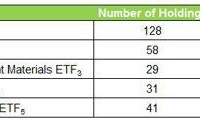
Summary These ETFs allow investors to obtain exposure to companies that provide a variety of inputs and raw materials essential to global economic function. As a whole, materials ETFs are more volatile and yield less than the S&P 500, but exceptions can be found. These funds offer varying risk and composition profiles that can be appropriate for a wide range of investors. Profiling the contenders (unless otherwise stated, market prices, NAV and SEC yield as of 1/29/15) : Vanguard Materials ETF (NYSEARCA: VAW ) This ETF seeks to track the performance of a benchmark index that measures the investment return of stocks in the materials sector and includes stocks of companies that extract or process raw materials. Market price: $104.73 30-day SEC Yield: 1.88% Number of holdings at 12/31/14: 128 iShares U.S. Basic Materials ETF (NYSEARCA: IYM ) This ETF seeks to track the investment results of an index composed of U.S. equities in the basic materials sector. It offers exposure to U.S. companies involved with the production of raw materials including metals, chemicals, and forestry products. Market price: $79.97 30-day SEC Yield: 1.67% Number of holdings at 01/28/15: 58 Guggenheim S&P 500 Equal Weight Materials ETF (NYSEARCA: RTM ) This ETF seeks to replicate as closely as possible, before fees and expenses, the performance of the S&P 500 Equal Weight Index Materials. Market price: $83.16 30-day SEC Yield: 1.45% Number of holdings at 01/29/15: 29 Materials Select Sector SPDR ETF (NYSEARCA: XLB ) This ETF seeks to provide investment results that, before fees and expenses, correspond generally to the price and yield performance of the S&P Materials Select Sector Index. Market price $47.88 30-day SEC Yield: 2.00% Number of holdings at 01/28/15: 31 Powershares DW A Basic Materials Momentum ETF (NYSEARCA: PYZ ) This ETF seeks to provide investment results that, before fees and expenses, correspond generally to the price and yield performance of the S&P Materials Select Sector Index. Market price $51.56 30-day SEC Yield: 1.06% Number of holdings at 01/28/15: 41 1) Diversification Diversification is the process of reducing non-systematic risk by investing in a variety of assets or asset classes that (hopefully) do not move up or down in value at the same time or magnitude. For the purposes of analyzing materials ETFs, I will look at both the number of holdings and also the industry diversification of constituents. a) Number of holdings An ETF does not need to hold every company of every sector that comprises its benchmark index, but 2 – 3 companies per industry is my subjective minimum to achieve adequate diversification. The basic materials sector can be broken up into roughly 20 industries including: agricultural chemicals, aluminum, chemicals – major diversified, copper, gold, independent oil & gas, industrial metals & minerals, major integrated oil & gas, nonmetallic mineral mining, oil & gas drilling & exploration, oil & gas equipment/services, oil & gas pipelines, oil & gas refining & marketing, silver, specialty chemicals, steel & iron, and synthetics. (click to enlarge) Winner: Vanguard. While some sub-sectors in the basic materials universe move in tandem, (think Oil and Gas drilling and Oil and gas marketing/refining both benefit from higher oil prices), other industries do not. Vanguard’s 128 holdings double its next closest competitor giving it the best shot at reducing non-systematic risk to an acceptably low level. b) Industry concentration Vanguard Materials ETF Courtesy of Vanguard iShares U.S. Basic Materials ETF Courtesy of BlackRock Guggenheim S&P 500 Equal Weight Materials ETF (click to enlarge) Courtesy of Guggenheim Investments Materials Select Sector SPDR ETF Courtesy of State Street Powershares DW A Basic Materials Momentum ETF Courtesy of Invesco Winner: Guggenheim. While Vanguard appears to be the most diversified with no component making up more than 25%, a closer look at captions reveals it is nearly 60% chemicals (just broken into various subcategories). Guggenheim is more balanced with three industries making up 10% or more of total weighting and while it is still heavy on chemicals, its overall chemical concentration is the lowest. 2) Expense ratio Expense ratio is the total of a funds operating expenses, expressed as percentage of average net assets. These expenses include management fees, Distribution/service or “12b-1” fees, custodial, legal, accounting, etc. Lower expense ratios, either through larger ETF size or smaller nominal expenses means higher investment returns. (click to enlarge) Winner: Vanguard, and everyone else. According to Morningstar , the average expense ratio for similar funds was 1.47%. Keeping fees and transaction costs as low as possible is something investors should always keep on the forefront of their mind. 3) Total return (click to enlarge) Winner: Powershares. I am always mentally benchmarking indexes and companies based on how they fared through and since the financial crisis. To look at that, you need to include several years before 2008. Powershares Basic Materials ETF was established in 2006, and its 3, 5 and (almost) 10 year returns (including the 2008 ordeal) are essentially on track with the S&P. That is saying something for a relatively narrowly focused ETF. 4) Valuation multiples (click to enlarge) Winner: SPDR. The SPDR ETF is trading at a discount to the S&P 500 (19.71) on a price to earnings basis. Honorable mention, iShares and Powershares whose earnings are also cheaper than those of the S&P 500. 5) Liquidity The ability to get out of a great investment is just as important as the ability to get in. While ETFs are generally regarded as having higher liquidity than mutual funds (primarily because they can be traded throughout the day, rather than just at the end), there are reasons to avoid ETFs with excessively low volume. Chief among these are higher bid-ask spreads, which may result in the inability to profitably execute a short-term trade (not a real issue for long-term investors). However, one of the issues that arises from low liquidity (a deviation between price and NAV) can actually be an opportunity. If an ETF is trading slightly below its NAV, but the market is not active enough for it to quickly resume equilibrium, you can shave a few points off your basis by looking for opportune entry points. (click to enlarge) Winner: SPDR. Higher volume means tighter bid-ask spreads, full stop. 6) Yield (click to enlarge) Winner: SPDR. SPDR is the only ETF that has a 30 day SEC yield greater than the S&P 500. The 30-day SEC yield is an annualized yield formula mandated by the Securities and Exchange Commission that is based on projected dividend yield of the fund’s holdings over a trailing 30 day period. 7) Volatility (click to enlarge) Winner: SPDR. This ETF exhibited lower volatility than all of its competitors over a three-year time frame and all but Guggenhem over five years. 8) Dividend history and growth (click to enlarge) Winner: Guggenheim. While it had a big drop off in distributions from 2010 – 2011, it has increased total distributions every year since then. Note for consideration, all of these funds pay quarterly distributions except for Vanguard, which pays annually. So, which Materials ETF should you own? SPDR! The Materials Select Sector ETF by SPDR is: the most active (liquid), the least volatile, offers the highest yield, the second lowest expense ratio, and trades at the lowest multiple of earnings. A word of caution Materials ETFs lagged the market as a whole in 2014. While last year’s losers can become this year’s winners, that is not always the case. A strong dollar can hurt the materials sector as it makes purchases of materials sector goods by foreign companies more expensive. Do your homework, review the composition and risk profile of each of these ETFs and monitor your holdings. Disclosure: The author has no positions in any stocks mentioned, and no plans to initiate any positions within the next 72 hours. (More…) The author wrote this article themselves, and it expresses their own opinions. The author is not receiving compensation for it (other than from Seeking Alpha). The author has no business relationship with any company whose stock is mentioned in this article.

Will The Fed Bring Down SLV?

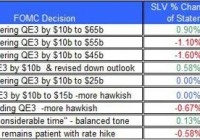
The FOMC’s statement was released on January 28. The price of SLV could come down once the FOMC starts to raise rates. The concerns over the global economy aren’t likely to change the FOMC’s view about raising rates this year. The recent decision of the FOMC didn’t stir up the silver market as shares of iShares Silver Trust ETF (NYSEARCA: SLV ) slightly declined on the day the statement was released. But, the sentiment of the recent statement may suggest the FOMC is still on its road to raise its cash rate in the coming months, which could curb down the recent rally of SLV. Let’s review the latest from the Fed and the potential ramifications of its policy on SLV. The recent FOMC meeting concluded with little changes to the wording of the statement. The FOMC reiterated its stance about being patient over its next rate hike: The Committee judges that it can be patient in beginning to normalize the stance of monetary policy. The FOMC still remains bullish about the U.S. economy mainly when it comes to the labor market – this is partly due to the fall in oil prices. Nonetheless, the FOMC estimates inflation could fall further in the near-term albeit rise back up to its target in the medium-term: Inflation is anticipated to decline further in the near-term, but the Committee expects inflation to rise gradually toward 2 percent over the medium-term as the labor market improves further and the transitory effects of lower energy prices and other factors dissipate. (click to enlarge) Source of data: FOMC’s site and Bloomberg The reaction to the recent decision wasn’t too harsh at first and the price of SLV only slightly declined. The following day, however, SLV tumbled down. In most of the meetings in 2014, the reaction of silver prices to the FOMC statement was mostly negative, because the FOMC’s policy kept turning more hawkish. Lower inflation doesn’t seem to persuade investors that the FOMC is reconsidering not to raise rates later this year. For now, the inflation is likely to keep coming down. Even the 5-year inflation expectations have slowly come down in recent months. (click to enlarge) Chart taken from FRED As you can see, the inflation expectations for the next five years are still not far off the Fed’s 2% target. This figure could decline further in the coming months as low oil prices are likely to pressure it down. But, the Fed still estimates that over the mid-term the inflation will remain around the 2% range – inline with its target. But, the main issue remains whether the drop in U.S. inflation in the near-term and the concerns over the global economy could be enough to persuade FOMC members to push forward the first rate hike and subsequent raises. The progress of the global economy – while it does influence FOMC members’ decisions – isn’t a major factor when it comes to the two mandates the FOMC has – inflation and jobs. When it comes to both cases, the FOMC’s objectives are on the right path. (click to enlarge) Chart taken from FRED This, however, doesn’t include the progress in U.S. wages – they remain relatively low and haven’t picked up in recent months. The little progress in wage could be a factor to tilt the scale towards keeping the Fed’s cash rate low for a longer time than currently estimated. Many still estimate that the FOMC will move forward and raise its cash rate this year. Moreover, most of the FOMC’s voting members also estimate the cash rate will be raised this year – according the December FOMC statement. Finally, it’s worth noticing that unlike the December meeting, in the recent meeting there weren’t any dissenters to the decision. This could be another indication that no major changes were made to rock the boat. If the FOMC remains bullish on the U.S. economy and won’t let the recent drop in U.S. inflation to change its view, then this could mean a rate hike in the coming months. This decision could start to pressure up U.S. treasury yields and thus bring back down the price of SLV. Moreover, the ongoing recovery of the U.S. dollar, which is likely to be boosted by a rate hike, could also adversely impact the price of SLV. In the meantime, even though the price of SLV rose by over 14% during the month, the demand for the silver ETF didn’t rise – the silver holdings of SLV are still around 319 million ounces of silver, which represent a 3.1% drop, year to date. The FOMC’s minutes will be released next month and could provide more insight behind the recent policy meeting. But, until the FOMC starts to raise rates, the concerns over the global economy and the drop in U.S. treasury yields could keep the price of SLV from plummeting again and erasing its gains from earlier this year. For more see: Will Higher Physical Demand for Silver Drive Up SLV?