Tag Archives: function

Dull Industrial Earnings Put These ETFs In Focus

As previously expected the Industrial sector has come out with lukewarm results for the fourth quarter earnings season. The major players in the space, such as General Electric (NYSE: GE ) , Caterpillar Inc. (NYSE: CAT ) and 3M Company (NYSE: MMM ) , have reported lackluster results, missing either on revenues or earnings. In fact, a disappointing performance from industrial leader Caterpillar and weaker-than-expected data on durable-goods orders sparked fears about a slowdown in economic growth, leading the Dow Jones Industrial Average to plunge more than 350 points in yesterday’s trading session. Industrial Earnings in Focus General Electric Operating earnings for the reported quarter came in at 56 cents per share compared with 53 cents a share in the year-ago quarter, beating the Zacks Consensus Estimate by a penny. The company posted net earnings of 51 cents per share, up 61% year over year. Total revenue for the quarter increased 4% year over year to $42 billion but fell short of the Zacks Consensus Estimate of $42.4 billion. The company’s operating profit in the Industrial segment increased 9% in the reported quarter as its businesses that sell power-generating turbines and jet engines helped offset weak sales in its oil and gas unit. However, GE Capital’s profit declined 19% year over year to $1.9 billion. The company, however, is committed to increasing its focus on industrial operations, away from finance. Caterpillar Mining and equipment behemoth Caterpillar however missed Q4 earnings estimates and also guided lower for 2015. Earnings per share declined 20% year over year to $1.35 per share, missing the estimates by 13%. Revenues declined 1% year over year to $14.2 billion in the quarter but surpassed the Zacks Consensus Estimate of $14.1 billion. The company blamed the muted mining environment and lower prices of oil and key mined commodities, particularly copper, coal and iron ore as the key factors behind the earnings miss. Moreover, the company also guided materially lower for 2015 due to continued weakness in oil prices. The company expects 2015 EPS of $4.75 on $50 billion in revenues, significantly below the current Zacks Consensus Estimate for 2015 of $6.69 in EPS on $54.6 billion in revenues Union Pacific Corporation (NYSE: UNP ) The rail transportation operator, Union Pacific , managed to beat our estimates on both fronts. Earnings per share rose 27% year over year to $1.61, beating the Zacks Consensus Estimate of $1.51, while revenues increased 9% year over year to $6.2 billion, ahead of the Zacks Consensus Estimate of $6.1 billion. 3M Company Like General Electric and Caterpillar, 3M also reported mixed financial results, beating on the earnings front but missing on revenues. Earnings per share came in at $1.81 per share, up 11.7% year over year, beating the Zacks Consensus Estimate by 2 cents a share. Net sales during the quarter were $7,719 million, up 2% year over year, but below the Zacks Consensus Estimate of $7,779 million. Market Impact Uneven earnings results from the top industrial stocks saw mixed reactions. While GE is up 5% since its announcement on January 23, Caterpillar shed 7% yesterday following its disappointing results. Meanwhile, 3M and Union Pacific closed marginally lower following their earnings. Given the uninspiring earnings results from some of the top industrial players, investors should cautiously play the industrial ETF space for the upcoming days. Below, we have highlighted three industrial ETFs having a sizeable exposure to the above stocks. Industrial Select Sector SPDR (NYSEARCA: XLI ) XLI is the most popular fund in the space with an asset base of $8.8 billion and an average daily trading volume of 9.9 million shares. The fund provides exposure to a basket of 66 stocks charging 65 basis points as fees. General Electric occupies the top spot with 9.3% allocation, while Union Pacific, 3M and Caterpillar have a combined exposure of roughly 14.2% in the fund. XLI lost 1.32% on Tuesday but is up 13.1% in the past one year and currently has a Zacks ETF Rank #3 or Hold rating. Vanguard Industrials ETF (NYSEARCA: VIS ) VIS is also quite a popular fund in the space with an asset base of more than $1.9 billion and trading with moderate volumes. VIS tracks the MSCI U.S. Investable Market Industrials 25/50 Index to provide exposure to 352 industrial stocks. The four stocks have a combined exposure of roughly 21%. VIS lost 1.2% in yesterday’s session and currently has a Zacks ETF Rank #3 or Hold rating. iShares U.S. Industrials ETF (NYSEARCA: IYJ ) IYJ tracks the Dow Jones U.S. Industrials Index to provide exposure to U.S. companies that produce goods used in construction and manufacturing. General Electric, Union Pacific, 3M and Caterpillar are among the top 10 holdings with a combined exposure of roughly 19.4%. The fund manages an asset base of $ 861.5 million and is slightly expensive with 43 basis points as fees. IYF currently has a Zacks ETF Rank #3 or Hold rating.
Inside The New Target Factor ETFs From iShares

Deflationary fear and a slowdown have started to trouble developed international markets, and most investors in the ETF world are looking out for quality exposure in the area. In fact, some aggressive investors are hunting for high momentum stocks presuming that these might outperform in the days ahead in the prevailing easy money era. Their search looks justified. After all, the Fed withdrew its gigantic QE program last year and might start walking the way of policy tightening later this year. Thanks to such policy differential in the developed world, iShares – the largest ETF issuer in the world – brought about two products targeting the developed international economies probably to quench investors’ thirst. We have detailed the two newly launched funds below. iShares MSCI International Developed Momentum Factor ETF ( IMTM) : For a broad foreign market play with a focus on large-and-mid cap companies, investors could consider IMTM which focuses on 12 developed countries for exposure. Stocks that exhibit a higher price momentum will be included in the fund. This product follows the MSCI World ex USA Momentum Index, holding 269 securities in its basket and charging a pretty low fee of 30 basis points a year for this relatively unique exposure. Though the fund holds about 28% exposure in the defensive health care sector, it is more inclined toward higher beta sectors like financials, industrials companies and consumer discretionary. Top nations include Japan (29.6%), Canada (18.0%), and Switzerland (12.9%) while the U.K. (8.8%) and Germany (4.7%) round out the top five for this well-diversified fund. The fund does not have much company concentration risk with no stock accounting for more than 5.34% of the fund. Novartis (NYSE: NVS ), Roche and Bayer ( OTCPK:BAYRY ) are the top-three holdings of the fund. IMTM Competition: Momentum strategy is not yet popular in the ETF world. Though the domestic economy has a couple of ETFs including the $1.46 billion-First Trust Dorsey Wright Focus 5 ETF (NASDAQ: FV ), $1.61 billion-PowerShares DWA Momentum Portfolio (NYSEARCA: PDP ) and $515 million-iShares MSCI USA Momentum Factor ETF (NYSEARCA: MTUM ), the international arena is relatively less penetrated. Global Momentum ETF (NYSEARCA: GMOM ) made an entry late last year in the international space and has amassed about $26 million in assets so far. Given GMOM’s high expense ratio of 94 bps and iShares’ own product MTUM’s considerable success in a short span, we expect the issuer to replicate the success on its global version as well. However, the issuer should take note of Cambria’s active approach to the momentum theme which might give it an edge over IMTM in volatile markets. iShares MSCI International Developed Quality Factor ETF ( IQLT) : This fund gives investors exposure to quality stocks (excluding U.S.) by identifying companies that have the highest quality scores based on three main fundamental variables – high return on equity, stable earnings year-over-year growth and low financial leverage. The product charges investors 30 basis points a year in fees and tracks the MSCI World ex USA Sector Neutral Quality Index. The fund holds about 289 securities in its basket with a focus on financials (26.9%). Industrials (12.1%), Consumer Discretionary (11.5%), Health Care (10.8%) and Consumer Staples (10.6%) occupy the next four spots. The fund is heavy on the U.K. with about one-fourth of the exposure followed by Switzerland (15.6%). Roche takes the top-most allocation in the portfolio with about 5.2% exposure followed by Novo Nordisk (2.7%) and Nestle (2.31%). IQLT Competition: There are currently a few products operating in the space including PowerShares S&P International Developed High Quality Portfolio (NYSEARCA: IDHQ ), SPDR MSCI World Quality Mix ETF (NYSEARCA: QWLD ) and Market Vectors MSCI International Quality ETF (NYSEARCA: QXUS ). While neither has developed a huge following so far and IDHQ charges a bit high at 55 bps, IQLT has scope for outperformance.

3 ETF Investing Themes For A Wobbly U.S. Bull

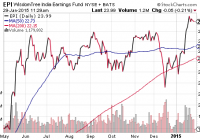
The Fed explains that it is serious about raising interest rates in 2015. Janet Yellen’s Fed expressed confidence that in spite of the failure of QE3 and ZIRP to influence rising prices, those rising prices should gradually reach the target of 2% in a tightening cycle. There are perhaps three investment themes that make sense at this point in the late stage U.S. bull market. Presumably, the Great Recession ended in June of 2009. Three months earlier on March 9, the stock market anticipated the modest recovery that is still intact. In essence, stocks began to rally well in advance of the actual turnaround in the U.S. economy. Similarly, the 10/09/2002-10/09/2007 bull market ended roughly three months before the start of the mammoth economic collapse (12/2007). In a sense, stock barometers were (and are) leading indicators of things to come. For those who wish to believe that stocks will avoid a 20%-plus bearish setback on a combination of monetary policy gamesmanship and perceived economic strength, they might want to consider the history of recessions as well as the history of central bank stimulus. With some 50-odd contractions over the last 225 years, one should expect expansions to falter, on average, every four-and-a-half years. The current recovery? Five-and-a-half and counting. It is also worth noting that past recessions required the U.S. Federal Reserve to lower overnight lending rates by 3%-4% to combat recessionary forces. Even if the Fed manages to get the Fed Funds rate up to 0.5% in 2015 – even if policymakers succeed in pushing it up to a “whopping” 1% in 2016 – wouldn’t they have to return to 0% and more quantitative easing (QE) when the inevitable economic contraction returns? Central bank QE as well as zero percent interest rates (ZIRP) have lowered the costs to service higher household and government debts ; they have increased the rewards for risk-taking in real estate as well as as market-based securities. Yet these policies have not done a great deal to assure prosperity, as median household income is lower than it was in the heart of the Great Recession. Equally troubling, survey stand-out Gallup determined that business closings have exceeded the number of new businesses created each year since 2008. According to some analysts , the opening/closing business data may even be responsible for the Bureau of Labor Statistics ( BLS ) overstating job growth by as much as 600,000 jobs annually. Nevertheless, the Fed explains that it is serious about raising interest rates in 2015. Stock bulls used to relish this type of optimism, particularly with respect to jobs. (You might want to ask the workers at Schlumberger (NYSE: SLB ), IBM (NYSE: IBM ), Haliburton (NYSE: HAL ), American Express (NYSE: AXP ) and U.S. Steel (NYSE: X ) if they share the sentiment.) And then there is the reality that inflation has remained below its 2% target for 30-plus months. Janet Yellen’s Fed expressed confidence that in spite of the failure of QE3 and ZIRP to influence rising prices, those rising prices should gradually reach the target of 2% in a tightening cycle. Really? Do investors even recognize that the Fed projected far greater economic growth than has actually occurred in every single year since 2008? Knowing that, why would anyone have confidence in a Fed expectation of 2% inflation? There are perhaps three investment themes that make sense at this point in the late stage U.S. bull market. First, the entire globe is in the process of stimulating economic growth through conventional and/or unconventional measures. Why fight their central banks? As bond yields around the world continue moving lower, the activity only makes longer-term, dollar-denominated debt more attractive. If you want to buy the proverbial dips, you should probably be buying the bond dips on relative value . Consider the iShares 10-20 Year Treasury Bond ETF (NYSEARCA: TLH ), the Vanguard Long-Term Bond ETF (NYSEARCA: BLV ) and closed-end muni fund like the Nuveen Municipal Opportunity Fund (NYSE: NIO ). The second theme involves buying stimulus-driven stock ETFs. The WisdomTree India Earnings ETF (NYSEARCA: EPI ) has been a tremendous beneficiary of its own country’s unexpected rate cut activity, while the iShares Currency Hedged MSCI Germany ETF (NYSEARCA: HEWG ) should benefit from the markedly lower euro and the negligible German bund yields that push investors into German equities. Third, investors should continue to hold prominent U.S. equity ETFs for as long as they are still working for them. I still maintain an allegiance to the Health Care Select Sect SPDR ETF (NYSEARCA: XLV ), the iShares MSCI USA Minimum Volatility ETF (NYSEARCA: USMV ) as well as the Vanguard High Dividend Yield ETF (NYSEARCA: VYM ). If any of these positions break below a 200-day moving average, however, I would insure against further depreciation by selling the position or increasing exposure to the index that my colleague and I created, the FTSE Custom Mutli-Asset Stock Hedge Index . One can already see the benefits of multi-asset stock hedging over 1 months, 3 months, 6 months and 1 year, where the combination of certain currencies, commodities, foreign sovereign debt and U.S. bonds are achieving desirable results. Disclosure: Gary Gordon, MS, CFP is the president of Pacific Park Financial, Inc., a Registered Investment Adviser with the SEC. Gary Gordon, Pacific Park Financial, Inc, and/or its clients may hold positions in the ETFs, mutual funds, and/or any investment asset mentioned above. The commentary does not constitute individualized investment advice. The opinions offered herein are not personalized recommendations to buy, sell or hold securities. At times, issuers of exchange-traded products compensate Pacific Park Financial, Inc. or its subsidiaries for advertising at the ETF Expert web site. ETF Expert content is created independently of any advertising relationships.