Tag Archives: function

IGR Vs. AWP: What’s A Yield Worth?

CBRE Clarion Global Real Estate Income Fund and Alpine Global Premier Properties Fund both provide access to global real estate. However a comparison between the two brings up an interesting distinction on the distribution front. Do you want yield at the expense of NAV growth or yield and NAV growth? I was recently asked to take a look at the CBRE Clarion Global Real Estate Income Fund (NYSE: IGR ). IGR is a CEF that focuses, as its name implies, on real estate across the globe. This, inevitably brings with it a comparison to a fund like the Alpine Global Premier Properties Fund (NYSE: AWP ). At the core, they both do similar things and could, arguably, be interchangeable. However, income seekers might be drawn to AWP’s nearly 9% yield over IGR’s lower 6.5% yield. And why not, since they do about the same thing? A lot alike In fact, both have similar discounts right now, with each floating around a mid-teens discount to net asset value. So either one would be cheap. Performance is a bit of mixed bag, however, with IGR outdistancing AWP over the trailing five years through May on an NAV total return basis, which includes reinvested dividends. But AWP beating IGR over the trailing three years. More recently, AWP has handily outperformed, posting a year to date gain of nearly 7% versus a 1.5% decline at IGR’s (both including distributions). Looking at standard deviation, a measure of price volatility, IGR was less volatile over the trailing five years and roughly equally volatile over the trailing three years. So it’s hard to make much of a distinction on this point between the two. That said, both make use of leverage , but they have each kept that to a relatively low level recently at around 6% of assets. Cost wise, IGR has a slight edge . It’s expense ratio is roughly around 1.15%. AWP’s expense ratio is a little higher at around 1.3% or so. Neither, however, is so high that they stand out. So here are two funds with roughly similar objectives. Both are trading at steep discounts. But AWP has a notably higher yield and has been performing better of late. The easy answer is buy AWP. That said, you wouldn’t be buying a bad fund if you chose IGR. Pick your poison? Things aren’t that simple, however. And a quick look at the distributions helps explain why. Since it’s IPO in 2004 , IGR has paid investors over $13 worth of distributions. The IPO NAV of the CEF was $14.10. True, the shares currently trade below that level, with an NAV of close to $9.50, but for income investors the benefit has been fairly large despite the NAV decline. Alpine, meanwhile, started life in 2007 with an NAV of around $19 a share. It’s net asset value is roughly $7.50 a share more recently. It’s distributions over that span have been around $6.50 a share. I’m rounding in both cases, but the point should be pretty clear. But just for fun, if you add the current NAV to the total distributions received for both funds you get around $23 for IGR and nearly $16 for AWP. Since IGR had an NAV at IPO of around $14 and AWP’s NAV at IPO was a touch over $19, which one has been the better option? Since 2007 was a pretty awful time to open a fund that may not be a completely fair comparison. But the same trend holds true over shorter periods, too. Let’s look since 2010 instead (using fiscal years for AWP). Over that span, AWP’s NAV has gone from roughly $7.25 a share in October of 2009 (the end of its fiscal year) to $7.50 a share. It’s paid out around $3.75 in distributions. IGR, meanwhile, has seen its NAV go from about $7.50 at the start of 2010 (it’s fiscal year ends in December) to about $9.50. Meanwhile it’s paid out about $2.90 a share in distributions. If all you are looking for is income, yes, AWP paid out more in distributions. But at the cost of NAV growth, since the NAV rose only about 3% over the span. With IGR, there was less income, but your principal grew by around 25%. In other words, if you buy AWP, your return is almost all in the distribution. That’s fine during good times, but when there’s a bad market it makes building back the NAV that much harder to achieve and can result in distribution cuts if the downturn is long enough. Your call, but I like conservative At the end of the day, which option is better for you really depends on your situation and temperament. If you only care about income, AWP is the clear winner. For me, I’d prefer a fund with a lower yield and net asset value growth. So, there’s reasons to like AWP over IGR, but I’d go with the more conservative distribution if I were making the choice. Disclosure: I/we have no positions in any stocks mentioned, and no plans to initiate any positions within the next 72 hours. (More…) I wrote this article myself, and it expresses my own opinions. I am not receiving compensation for it (other than from Seeking Alpha). I have no business relationship with any company whose stock is mentioned in this article.
The Labor Market Could Bring Down GLD

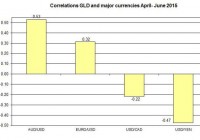
Summary The Greek drama keeps moving the markets and the price of GLD also reacts mainly via the movements in the foreign exchange markets. The price of GLD is likely to keep reacting to the progress of the U.S. economy. The non-farm payroll report could move again the price of GLD and raise the odds of a rate hike in September. The Greek drama continues to lead the news cycle and keeps to move the euro against major currencies including the U.S. dollar. The strengthening of the U.S. dollar against the euro could have an adverse impact on the price of the SPDR Gold Trust ETF (NYSEARCA: GLD ). Besides the ongoing bets of whether Greece exits the Eurozone, this week we also have the release of the non-farm payroll report. This report is likely to keep moving the gold market in general and GLD, as the markets try to figure whether the current economic conditions are good enough for the Federal Reserve to raise rates in September. The decision of Alexis Tsipras to call for a referendum is understandable given the high stakes involved, but should have been made a while back, and not so close to the IMF’s payment deadline. For now, the polls suggest the Greeks are likely to accept this deal. Because they are more frightened of what lies ahead with a Grexit over remaining in the Eurozone or in other words better the devil you know… Behind door number one, in the event of a Grexit, the Greeks could face very weak currency, high inflation, unstable, if at all, banking system for years to come. But door number two isn’t too appealing either: elevated unemployment, much higher taxes, lower pensions, and high debt payments for decades. At least under this status quo option, they keep having a strong currency and a working baking system. Who would want to make this lesser of two evils choice? When it comes to the potential impact of the news about a Greek exit or default on its debt on the euro, the situation isn’t straight forward. For one, investors and traders react to the uncertainty following a messy Greek exit with falling stock prices throughout Europe, Asia and U.S. and falling euro against leading currencies. But over the longer run, such a scenario should move the euro upward as part of the weakness of this currency relates to the high debt European countries including Greece. One fewer highly leveraged country in the EU should lead, down the line, to an appreciation of the euro. For GLD, even though higher uncertainty in the financial markets tends to play in favor of precious metals, the potential appreciation of the U.S. dollar against the euro could drag down the price of GLD. (click to enlarge) Source of data: Author’s calculations The other big news item for the week is the non-farm payroll report. This week, the report will be released on Thursday and could move the price of GLD as it has in the past. Last month, the employment report showed a 280,000 gain in number of jobs, which was higher than expected. This time, the market estimates a gain of 231,000 jobs. If the report were to show a higher increase in number of jobs, this could lead to another drop in the price of GLD. (click to enlarge) Source of data: U.S. Bureau of Labor Statistics and Google Finance Besides the short-term impact of the news of the progress of the U.S. labor market, this news could also raise the odds, which have gone down after the last FOMC meeting, of a rate hike in September. Another issue to keep tabs on is the changes in wages, which have gone up slowly in the past few months – the growth rate reached 2.3% last month. A higher growth rate could also raise the odds of a potential rate hike – it’s another closely monitored data point in the labor report, and so far this year, we have only seen a modest increase in wages. As of the beginning of this week, the implied probabilities for a rate hike in September have reached 14%; for the October meeting, the odds are 28%; and for December, the probabilities are only 50%. These odds still suggest the market isn’t convinced the FOMC plans to raise rates in September. The upcoming non-farm payroll report could have another short-term impact on the price of GLD and move the odds of the possible rate hike in the coming months. The minutes of the last FOMC meeting will be released next week, but aren’t likely to provide more guidance than the last FOMC meeting. So far, the Fed keeps using the same mantra – the decision to raise rates will be “data dependent” – and as such, we will have to continue to closely monitor the progress of the U.S. economy. For more, please see: ” Gold and Inflation – Is there is relation? ” Disclosure: I/we have no positions in any stocks mentioned, and no plans to initiate any positions within the next 72 hours. (More…) I wrote this article myself, and it expresses my own opinions. I am not receiving compensation for it (other than from Seeking Alpha). I have no business relationship with any company whose stock is mentioned in this article.

Backtesting With Synthetic And Resampled Market Histories

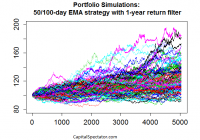
We’re all backtesters in some degree, but not all backtested strategies are created equal. One of the more common (and dangerous) mistakes is 1) backtesting a strategy based on the historical record; 2) documenting an encouraging performance record; and 3) assuming that you’re done. Rigorous testing, however, requires more. Why? Because relying on one sample-even if it’s a real-world record-doesn’t usually pass the smell test. What’s the problem? Your upbeat test results could be a random outcome. The future’s uncertain no matter how rigorous your research, but a Monte Carlo simulation is well suited for developing a higher level of confidence that a given strategy’s record isn’t a spurious byproduct of chance. This is a critical issue for short-term traders, of course, but it’s also relevant for portfolios with medium- and even long-term horizons. The increased focus on risk management in the wake of the 2008 financial crisis has convinced a broader segment of investors and financial advisors to embrace a variety of tactical overlays. In turn, it’s important to look beyond a single path in history. Research such as Meb Faber’s influential paper “A Quantitative Approach to Tactical Asset Allocation” and scores of like-minded studies have convinced former buy-and-holders to add relatively nimble risk-management overlays to the toolkit of portfolio management. The results may or may not be satisfactory, depending on any number of details. But to the extent that you’re looking to history for guidance, as you should, it’s essential to look beyond a single run of data in the art/science of deciding if a strategy is the genuine article. The problem, of course, is that the real-world history of markets and investment funds is limited-particularly with ETFs, most of which arrived within the past ten to 15 years. We can’t change this obstacle, but we can soften its capacity for misleading us by running alternative scenarios via Monte Carlo simulations. The results may or may not change your view of a particular strategy. But if the stakes are high, which is usually the case with portfolio management, why wouldn’t you go the extra mile? The major hazard of ignoring this facet of analysis leaves you vulnerable. At the very least, it’s valuable to have additional support for thinking that a given technique is the real deal. But sometimes, Monte Carlo simulations can avert a crisis by steering you away from a strategy that appears productive but in fact is anything but. As one simple example, imagine that you’re reviewing the merits of a 50-day/100-day moving average crossover strategy with a one-year rolling-return filter. This is a fairly basic set-up for monitoring risk and/or exploiting the momentum effect, and it’s shown encouraging results in some instances-applying it to the ten major US equity sectors, for instance. Let’s say that you’ve analyzed the strategy’s history via the SPDR sector ETFs and you like what you see. But here’s the problem: the ETFs have a relatively short history overall… not much more than 10 years’ worth of data. You could look to the underlying indexes for a longer run of history, but here too you’ll run up against a standard hitch: the results reflect a single run of history. Monte Carlo simulations offer a partial solution. Two applications I like to use: 1) resampling the existing history by way or reordering the sequence of returns; and 2) creating synthetic data sets with specific return and risk characteristics that approximate the real-world funds that will be used in the strategy. In both cases, I take the alternative risk/return histories and run the numbers through the Monte Carlo grinder. Using R to generate the analysis offers the opportunity to re-run tens of thousands of alternative histories. This is a powerful methodology for stress-testing a strategy. Granted, there are no guarantees, but deploying a Monte Carlo-based analysis in this way offers a deeper look at a strategy’s possible outcomes. It’s the equivalent of exploring how the strategy might have performed over hundreds of years during a spectrum of market conditions. As a quick example, let’s consider how a 10-asset portfolio stacks up in 100 runs based on normally distributed returns over a simulated 20-year period of daily results. If this was a true test, I’d generate tens of thousands of runs, but for now let’s keep it simple so that we have some pretty eye candy to look at to illustrate the concept. The chart below reflects 100 random results for a strategy over 5040 days (20 years) based on the following rules: go long when the 50-day exponential moving average (NYSEMKT: EMA ) is above the 100-day EMA and the trailing one-year return is positive. If either one of those conditions doesn’t apply, the position is neutral, in which case the previous buy or sell signal applies. If both conditions are negative (i.e., 50-day EMA below 100 day and one-year return is negative), then the position is sold and the assets are placed in cash, with zero return until a new buy signal is triggered. Note that each line reflects applying these rules to a 10-asset strategy and so we’re looking at one hundred different aggregated portfolio outcomes (all with starting values of 100). The initial results look encouraging, in part because the median return is moderately positive (+22%) over the sample period and the interquartile performance ranges from roughly +10% to +39%. The worst performance is a loss of a bit more than 7%. The question, of course, is how this compares with a relevant benchmark? Also, we could (and probably should) run the simulations with various non-normal distributions to consider how fat-tail risk influences the results. In fact, the testing outlined above is only the first step if this was a true analytical project. The larger point is that it’s practical and prudent to look beyond the historical record for testing strategies. The case for doing so is strong for both short-term trading tactics and longer-term investment strategies. Indeed, the ability to review the statistical equivalent of hundreds of years of market outcomes, as opposed to a decade or two, is a powerful tool. The one-sample run of history is an obvious starting point, but there’s no reason why it should have the last word.