Tag Archives: etf-hub

RCS’ Drop In Share Price Represents A Good Opportunity
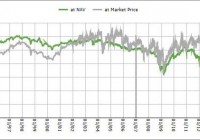
RCS is now trading at NAV, giving investors value. Rates are still low and will continue to stay low, even after initial increases. Bond funds focused on short-term maturities should outperform longer-term bonds. The purpose of this article is to evaluate the PIMCO Strategic Income Fund (NYSE: RCS ) as an investment option. To do so, I will look at recent fund performance, current holdings and allocation, and trends in the market to attempt to determine how well it will do going forward. First, a little about RCS. RCS is a closed-end fund that seeks to generate a level of income that is higher than that generated by high-quality, intermediate-term U.S. debt securities. That is the fund’s stated objective, with capital appreciation as a secondary objective. The fund is currently trading at $8.58/share and pays a monthly dividend of $.08/share, which translates to an annual yield of 11.19%. Recently, RCS, along with most Pimco funds, has been in a serious downtrend. Year-to-date, RCS is down over 9%, and over the past year the fund is down almost 19%, both figures exclude dividend payments. Once dividends are taken in to consideration, RCS’ performance is not quite as poor, but it is still not providing the steady returns bond investors would expect. In comparison, the iShares Barclays Aggregate Bond Fund (NYSEARCA: AGG ) is down about 1.5% year-to-date, and has essentially broken even over the past year, while providing an annualized yield of 2.32%. While RCS has not performed well recently, I will outline a few reasons why RCS will overcome its current headwinds and should improve its performance throughout the rest of the year. First, the drop in RCS has brought the fund down to a reasonable valuation level. The fund now trades at just a slight premium of .23%, which is essentially even with its Net Asset Value (NAV). Many Pimco funds trade at premiums to their NAV, so RCS represents a better value over some of these competing funds. This represents an attractive entry point for RCS, since the fund typically trades at a premium to its NAV, as indicated by the historical chart below: (click to enlarge) As you can see from the chart, RCS has traded at a premium fairly consistently since 2005, well before the financial crisis, so it is not an anomaly that derived out of the recession. To me, this indicates that the selling of RCS has reached its limit, and further downward pressure will be unlikely given its historical trading patterns and high yield to act as a buffer. New investors can use the steep drop in share price to pick up the fund at an attractive valuation. A second reason why I like RCS has to do with its make-up, with the fund sporting an effective maturity average of 3 years , with the vast majority of the bonds maturing in 5 years or less. This compares to other popular funds such as PGP and PHK, which hold average maturity levels of 6 years and 4 years , respectively. This is important because interest rates are set to rise in the near future, so funds with shorter maturity time periods should outperform those with longer maturity periods. This is because the risk increases the further out in the future the maturity date is in a rising rate environment. A rising rate environment is all but a certainty over the next 3-6 months, based on recent Federal Reserve statements and coverage . Therefore, investors want to limit their exposure to longer-term maturities, and focus on bond funds that have shorter durations, such as RCS. A final reason why I like RCS has to do with its high, and reliable, distribution rate. RCS currently sports a yield over 11%, which provides a high income stream for investors in a low rate environment, and will help buffer the fund against further losses. While I just mentioned that interest rates are set to rise, the increases are sure to be modest at first. In fact, Janet Yellen indicated, after the most recent Fed meeting, that interest rates will rise slower than previously anticipated . The current consensus now is that rates will not exceed 2% by the end of 2016, meaning that the U.S. will continue to experience a historically low rate environment for at least another year and a half. This means that investors will continue to be on the hunt for yield, and a mass exodus from bond funds will probably not occur anytime soon because of this. With a yield over 11%, RCS will provide income driven investors a place to continue to earn a high yield while interest rates stay low. Of course, investing in RCS is not without risk. Pimco funds have been in steady downtrends lately, and the selling could continue as investors fret over rising interest rates and over the legacy of Bill Gross’ depature from the company , which continues to plague his former funds. Additionally, interest rates could end up rising sooner, and more aggressively, than anticipated. If this occurs, investors will be able to earn higher returns on safe investments, like US Treasuries, and the appetite for leveraged bond funds will decline somewhat. However, I do not see these scenarios continuing to hurt RCS. For one, investors have been recently reassured that the interest rate increases will be gradual. Also, as stated earlier, RCS’ share price has reached its NAV, providing a nice backdrop against further selling. While many Pimco funds trade at discounts to NAV and that could certainly happen to RCS, the fund has traded at a premium consistently for the past ten years, so the risk is somewhat muted. And, given RCS’ reliable distribution, a further drop in share price will provide investors with a higher yield, helping to make up for the loss in principal. Bottom line: Pimco funds have performed poorly in 2015, and RCS is no exception. These funds have come under pressure due to Bill Gross’ departure, the threat of rising interest rates, and a share price correction towards NAV for many funds that have been trading at large premiums. However, RCS has now reached a level that provides investors with a reasonable valuation and a high yield. With interest rates set to remain low through the end of next year, investors will continue to look for options that provide more income than a 1% savings account or 3% dividend fund. With a reliable monthly distribution, and the risk of further price depreciation muted, I would encourage investors to consider this fund. Disclosure: I/we have no positions in any stocks mentioned, and no plans to initiate any positions within the next 72 hours. (More…) I wrote this article myself, and it expresses my own opinions. I am not receiving compensation for it (other than from Seeking Alpha). I have no business relationship with any company whose stock is mentioned in this article.
URA Declined To Historical Lows, Dragged Down By Uranium Energy Corp.

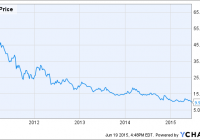
Summary Uranium’s price is still in the $35-$40 range. The Global X Uranium ETF declined by 7.22% this week, as Uranium Energy Corp’s price collapse dragged it down. Uranium Energy Corp. is the fourth biggest holding in URA’s portfolio. If the share price of Uranium Energy Corp. keeps on falling, share price of the Global X Uranium ETF may retest the $9.5 level. The Global X Uranium ETF (NYSEARCA: URA ) created a new historical low, as the $10 support level didn’t resist. URA closed at $9.9 last week, but it reached an intraday low at $9.53 during Friday trading. The breakage of the support level was initiated by the collapse of Uranium Energy Corp’s (NYSEMKT: UEC ) share price. The uranium price still moves in the $35-$40 range, as the restart of idle Japanese reactors takes longer than originally expected. Although application for restart of another reactor was submitted, restart of the Sendai 1 and Sendai 2 reactors was delayed . The long term fundamentals remain strong, but the market lacks enthusiasm and the short term outlook for uranium prices is questionable. Share prices of uranium producers were declining over the last week. Shares of Cameco (NYSE: CCJ ) declined by 4.06%, shares of Denison Mines (NYSEMKT: DNN ) declined by 7.22% and shares of Uranium Participation ( OTCPK:URPTF ) declined by 1.12%. But it was Uranium Energy, that dragged share price of the ETF below the $10 line. Shares of Uranium Energy Corp. declined by 32.2%. At one point in early Friday trading, its share price was 45% below its Monday levels. Uranium Energy is URA’s fourth biggest holding and it represented 10.09% of its assets, as of Thursday, June 18. This is why the Friday’s developments were really bad for URA and it is questionable what to expect next. UEC is an uranium mining and exploration company that owns Palangama in-situ recovery uranium mine and it develops Goliad in-situ recovery uranium mine. Moreover, the company owns processing facility at Hobson. UEC was probably the best performing company of the whole uranium sector over the last two months. Its share price started to grow in late April and it almost doubled in a couple of days. The problem is that there was no reason for such a growth. UEC released its Q2 2015 financial results on March 12 and another news release is dated May 27, when the company announced that it received permits for expansion of the Palangana ISR mine. The huge move happened more than one month after the first news release and approximately one month before the second one. Moreover the uranium price was declining during the whole April and it bottomed in the middle of May. Everything has changed last week. On Thursday in the evening, The Street Sweeper published an article that states that Uranium Energy is significantly overvalued, it has virtually no production, it has only limited cash and it has almost no stocks of uranium for sale left. Author of the article has also expressed suspicion that the share price was pumped up by a series of promotions. The article probably scared a couple of shareholders, as the UEC share price opened 13% lower on Friday. The share price reached its low of $1.55 at 10:18 a.m. Although the share price recovered in the afternoon trading, it closed at $1.96, down by 19%. More than 17 million shares were traded on Friday, although the average trading volume over the last 3 months has been only 1.8 million shares per day, according to Yahoo Finance. UEC released a short statement where it said that the allegations are unfounded and have absolutely no merit. But they didn’t specify which of the allegations were unfounded, as most of them can be supported by UEC’s financial statements. UEC was worth more than $250 million only a couple of days ago. It is really a lot of money for a company that is deep in red numbers year after year, with no change in sight. It seems to me that a speculator or a group of speculators recognized that shares of UEC are overvalued and they orchestrated a bear raid. The question is whether the share price will stabilize in the $2 area, whether it will be pushed back up, or whether it will decline back to its early April levels of approximately $1.5. As I stated above, the share price of UEC increased by 100% on no news, therefore a decline to the $1.5 area would make sense. The development of UEC’s share price may have quite a big impact on URA’s share price, as we could see on Friday. UEC still represents 7.69% of URA’s portfolio. Conclusion The near term development of URA’s share price may be affected by the UEC affair. It is not probable that UEC will return to its recent highs anytime soon. Although UEC started this week positively and it recovered a part of Friday’s losses, the question is whether the share price will stabilize or whether it will keep on falling. I suppose that the second option is more probable, as UEC is still quite expensive. If UEC falls back to $1.5, URA will probably retest the $9.5 level. This is the Friday’s intraday low that occurred when UEC traded at $1.55. Disclosure: I/we have no positions in any stocks mentioned, and no plans to initiate any positions within the next 72 hours. (More…) I wrote this article myself, and it expresses my own opinions. I am not receiving compensation for it (other than from Seeking Alpha). I have no business relationship with any company whose stock is mentioned in this article.

NRG Could Be The Green Victim Of Green Energy

NRG stock is down by one-third in the last year despite its green energy gloss. The company’s problem is that it produces and sells solar and wind but does not own utilities. Next Era Energy has a better economic model. NRG (NYSE: NRG ) CEO David Crane has the reputation of being one of the smartest guys in the energy industry, certainly the smartest in the utility business. He talks big about ruling and overthrowing the utility industry, with a big boost from renewable energy. But over the last year he, and his shareholders, have been getting their comeuppance. NRG shares are down by one-third over that time. Profits have been down for three consecutive quarters, and the March quarter saw the company make a $120 million, 37 cent per share loss. The company raised the dividend a penny in defiance of this, to 15 cents, but the company’s yield of 2.33% is still not awesome compared with its peers, and it looks a lot more threatened. What went wrong? Some might argue the problem lies in its business model. NRG makes most of its money as a “standby” energy producer. It doesn’t control customer accounts. It builds and holds energy production, and makes money on the production cost. When investors look at it, however, they see things like Green Mountain Energy , which works to get consumers using “green” energy and lower their costs at the same time. But NRG is not a utility. It does not control the delivery of the energy it sells. Green Mountain is often confused with Green Mountain Power , a Vermont utility that does do business with NRG but is actually owned by Gaz Metro , a company which, through a web of holding companies and partnerships , is connected to Quebec’s public pension funds and Enbridge (NYSE: ENB ), a pipeline company whose Alberta Clipper pipeline serves the region’s oil sands. Contrast it with NextEra Energy (NYSE: NEE ), the parent of Florida Power & Light, which recently announced a deal to buy Hawaii’s Hawaiian Electric (NYSE: HE ). Th at deal has some in a bad odor but the idea is to run Hawaiian Electric, where renewable energy is abundant, more like Green Mountain Power. That is, the company can make money by financing energy savings for consumers and sharing in the proceeds, as described this week at The New Yorker . When the company delivering energy savings to a consumer is also the consumer’s electric utility, it can be creating multiple routes to profit. It’s selling and financing something other than power generation. It’s actually creating a financial benefit for itself out of lower power use. It’s also gaining control of an account that can help it deal with the costs of solar and wind energy, including its intermittent nature. Utilities don’t have to be opponents of green energy, the story goes, they can make money from being its advocates. If what Green Mountain Power did in Vermont works in Hawaii, it’s a huge win for NextEra Energy. Trouble is, that lower power demand also becomes a huge loss for companies like NRG, whose business depends on selling power, and whose profits depend on maintaining a high price for that power. Perhaps that is the reason that NEE stock has been stable over the last year, and it has nearly double the net income, $1.45/share, it needs to pay the dividend of 77 cents per share, up a nickel from last year’s 72 cents. The dividend means a yield of 3.04% that is quite sustainable, and it has profit opportunities that NRG can only dream of. Disclosure: I/we have no positions in any stocks mentioned, and no plans to initiate any positions within the next 72 hours. (More…) I wrote this article myself, and it expresses my own opinions. I am not receiving compensation for it (other than from Seeking Alpha). I have no business relationship with any company whose stock is mentioned in this article.