Tag Archives: alternative

EQT Corporation Holds Valuable Assets
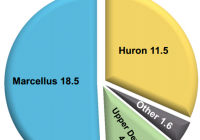
Summary EQT is one of the largest natural gas players in the market that is involved in production and midstream activities. The company also enjoys healthy growth prospects. EQT has announced its plans to drill 181 new wells in the Marcellus Shale in 2015 which is one of the most efficient natural gas plays in the US. EQT is in a good position to report healthy financial performances. The consensus target price and the relative valuation reveals attractive upside at its current price. EQT Corporation (NYSE: EQT ) is one of the largest and most dynamic US natural gas producers involved in production and midstream activities. The company aims to fulfill the growing demand for natural gas in the US. EQT is an efficient company that owns valuable gas reserves in the US. EQT has reported healthy financial performances in the past and despite short-term challenges it is in a strong position to create value for its investors in the coming years. EQT Owns Valuable Natural Gas Assets The Marcellus Shale is one of the most productive and efficient gas plays in North America and EQT has greatly benefited from the growth in reserves in the Marcellus Shale. The Marcellus Shale produces about 40% of the US shale gas production. EQT owns about 580,000 net acres in this shale. The total reserves held by EQT account for about 36.4 trillion cubic feet equivalent (cfe) and about half of these reserves (18.5 Tcfe) are present in the Marcellus play. Source: EQT website EQT has reaped healthy growth in the reserves in the Marcellus play with proven reserves growing by a CAGR of 32% in the past few years. EQT estimates the total resource potential of the Marcellus Shale to be 23.9 Tcfe. EQT has announced its capital investment program for 2015 in which it plans to drill 181 wells in the Marcellus Shale. EQT has the proven ability to develop reserves and this new capital investment for drilling new wells will also prove to be beneficial. (click to enlarge) Source: EQT website EQT plans to make a total capital expenditure of $2.5 billion, out of which $2.3 billion is to be spent on EQT’s production activities. Apart from drilling wells in the Marcellus Shale, EQT has also announced that it will drill 58 Upper Devonian wells, 15 Permian wells, and 5 Utica wells. An Efficient Industry Leader EQT possesses more than a century of experience and this makes it an efficient company with leading cost structure in the industry. EQT’s finding and development cost of $0.88 per Mcfe is well below the industry average of $2.74 per Mcfe. EQT also enjoys very low operating costs compared to the industry. EQT’s operating expense is $0.52 per Mcfe which is well below the industry’s average operating cost of $1.68 per Mcfe. The company’s valuable assets and efficient operations make it a strong business with healthy growth prospects. A Look at Historical Performance EQT has reported healthy financial performances in the past decade. The revenue grew by a healthy CAGR of 7% in the past ten years. EQT managed to increase its gross and operating margins which allowed top line growth to translate to the bottom line. The gross margin improved from 45.4% in 2004 to 80.9% in 2014. The operating margin improved from 24% in 2004 to 44% in 2014. Net income increased by a CAGR of 6% in ten years. This improvement in the financial performance is indicative of the strength of EQT’s business. EQT holds valuable assets that have the ability to create value for its investors in the future. (click to enlarge) Source: Morningstar.com The Consensus Target Price Estimate EQT’s healthy prospects are the basis of the attractive valuation made by analysts covering EQT. The consensus target price reveals upside potential at its current share price of $77.50. The mean target price of $113.11 presents an upside of 46% and the median target price of $114.50 presents an upside of 48% based on the current price. The most optimistic intrinsic value estimate of $134, if realized, presents an upside of 73%. It is worth noting that the most conservative intrinsic value estimate of $93 also presents a very attractive upside of 20%. EQT is a great enterprise with assets that make it an attractive long-term investment. Investors that wish to GAIN exposure in the oil and gas industry should consider investing in EQT. The following is a summary of target price estimates polled by Thomson Reuters from 18 brokers covering EQT. Source: Yahoo Finance Relative Valuation EQT’s price to earnings ratio of 24.92 shows that it is overvalued compared to the industry, sector, and S&P 500. However, after incorporating forecasted growth in the price to earnings multiple, THE RESULTANT PEG ratio shows that EQT is undervalued compared to all the benchmarks used. EQT’s share is an appropriate investment at its current share price. Source: Yahoo Finance Conclusion EQT Corporation is a strong business that has reported healthy financial performances in the past. It is one of the most efficient industry players with a low cost structure. It owns huge reserves of natural gas and has the proven ability to economically develop reserves. EQT has announced its 2015 CAPEX plan worth $2.5 billion with proposals to drill 181 more wells in the Marcellus Shale which is one of the most prolific plays in the US. EQT enjoys healthy growth prospects and this makes it a valuable long-term investment. The consensus target price and the relative valuation show that EQT is an attractive investment based on its current price.

Stock Picking, Intricate As Love

The combination from creating a 20 stock portfolio is a number beyond this earth. A simpler indexing approach provides several benefits like low unsystematic risk and low cost. You can still be active and pursue a source of alpha while also retaining the benefits of index investing. In ABC’s ‘The Bachelor’, the road to love involves weeks of flirting, romance, cat fights, twist and turns, where one guy is introduced to 25 lovely girls. Picking 1 out of 25 girls must be a lot of work. Likewise, researching stocks is a lot of work and arguably not as fun as dating. But you have many choices. The S&P 500, often used as a proxy for the total US stock market, offers 500 choices. If one were trying to create a 20 stock portfolio, how much work would be appropriate and what are the possibilities? Instead of trying to quantify the workload necessary, an especially subjective matter, let’s gauge the implications of the variables involved in picking stocks by looking at all the resulting combinations that are possible. For our group of stocks, let’s take the S&P500, consisting of 500 individual stocks. To take out capitalization weighting effects, we will actually use the S&P 500 equal weighted index, which includes the same constituents as the capitalization weighted S&P 500. Picking a certain number of stocks out of 500 is a simple calculation using binomial coefficients, mathematics used since the 10th century in India. Binomial coefficients are a family of positive integers that occur as coefficients in the binomial theorem. The coefficients that appear in the expansion are usually written as: This method is applicable because selecting stocks from a group is essentially picking k objects from a population of n distinct objects without replacement and without regard to order. If we select 20 stocks for our portfolio, there are 266719851283743829654740530950952475 combinations of selecting 20 stocks out of a group of 500, calculated from simply applying binomial coefficients: To grasp the magnitude of this amount, if each combination was the height of a flat dollar bill, the stack of dollar bills would scale up from the earth to the sun about 195 quintillion times. (quintillion is a billion billions). Likewise, the stack of dollar bills would go from our Sun to its nearest star, Proxima Centauri 726 trillion times. Comparatively, if the Voyager 1 spacecraft (speed=38000mph) were to go to Proxima Centauri, it would take over 73 thousand years to arrive. The many different possible portfolios are staggering, even when limiting selection only within the S&P500. With so many, inevitably one combination, picked arbitrarily at random could beat a combination created by a professional. This sheds light on the often heard claim that a monkey can out-pick a mutual fund manager. But nobody should pick stocks, bonds, or other securities at random. You wouldn’t pick your next boyfriend, girlfriend, potential spouse at random. You would expect a better outcome if you are discerning in your selection. Accordingly, thousands of discerning mutual fund managers seek superior performance and some actually achieve it. Of course, magazines like Forbes report time and again that the majority of professional can’t beat the index. However, the Wall Street Journal ran an expert vs. random dart throwing simulation for 14 years, but declared no clear winner. No clear winner will ever be discovered in this holy war, because of the staggering number of possibilities. One way to simplify investing is to invest in the index. Indexing provides several benefits like low cost and low unsystematic risk, even lower than a 20 stock portfolio. You do not have to be entirely passive. Instead of being active in the securities selection layer, another approach is to be active at asset allocation layer, using index investing. (click to enlarge) When constructing your portfolio, consider where you should put most of your effort. One approach employed by many professionals focuses on a top-down investment strategy attempting to exploit opportunities among a set of assets, positioning a portfolio into assets or sectors that show the most potential for gains. The strategy focuses on the relative performance of asset classes rather than on the performance of individual securities. With more focus on the asset allocation layer, one can still seek a source of alpha while also retaining the benefits of index investing. Further, the derivative securities used to actively asset allocate are highly liquid and low cost to transact for example, (NYSEARCA: SPY ),(NYSEARCA: EFA ),(NYSEARCA: BND ). Additional disclosure: Article is for educational purposes only and does not constitute financial advice.

2 iShares ETFs To Participate In The NYSE Incentive Program

Summary As of Jan. 2, 2015, two iShares ETFs will start participating in the NYSE Arca ETP incentive program. What is the incentives program? How the incentives program will help provide liquidity and help investors execute more efficient trades. BlackRock (NYSE: BLK ), the world’s largest asset manager and parent company of iShares, the world’s largest issuer of exchange traded funds, said today that as of Jan. 2, 2015, two of its ETFs will start participating in the NYSE Arca ETP incentive program. The iShares Interest Rate Hedged High Yield Bond ETF (NYSEArca: HYGH ) and the iShares Asia/Pacific Dividend ETF (NYSEArca: DVYA ) are the two iShares ETFs that will participate in the program, which is “designed to incentivize Market Makers to undertake Lead Market Maker (“LMM”) assignment in exchange-traded products (“ETPs”) listed on NYSE Arca,” according to a statement issued by BlackRock: While the impact of participation in the NYSE Arca ETP Incentive Program, which is optional, cannot be fully understood until objective observations can be made in the context of the NYSE Arca ETP Incentive Program, potential impacts on the market quality of HYGH and DVYA may result, including with respect to the average spread and average quoted size for HYGH and DVYA. HYGH, which debuted in May and now has almost $47 million in assets under management, tries to reflect the performance of the Citi High Yield (Treasury Rate-Hedged) Index, which tracks a basket of high-yield bonds with a built-in hedge against rising interest rates. The fund tracks bond securities issued from the U.S. or Canada with at least one year remaining to maturity. The ETF has an effective duration of 0.36 years and a 30-day SEC yield of 5.67%. DVYA, which will celebrate its third anniversary in February, has almost $55 million in assets. The ETF has a trailing 12-month dividend yield of 6.29%. Australia accounts for 48% of DVYA’s weight while Hong Kong and Singapore combine for another 31%. According to the statement: As a participant in the NYSE Arca ETP Incentive Program, BlackRock will continue to pay the applicable NYSE Arca Listing and Annual fees in addition to an Option Incentive Fee, which would range from $10,000 to $40,000 per year and will in turn be paid by NYSE Arca to the LMM assigned to HYGH and DVYA. iShares Asia/Pacific Dividend ETF (click to enlarge) ETF Trends editorial team contributed to this post.