Tag Archives: alternative

Palladium ETF To Enjoy Another Year Of Strong Fundamentals
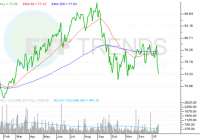
Summary Low gas prices are boosting car sales. As the car industry picks up, increased demand for catalytic converts will help boost palladium prices. Palladium’s role in the industrial space. The palladium-related exchange traded fund could shine this year as low gasoline prices and cheap bank loans help attract more new automobile buyers. The ETFS Physical Palladium Shares (NYSEArca: PALL ) has only increased 1.1% over the past year but could begin to pick up momentum in 2015. The palladium spot price is hovering around $777.3 per ounce Tuesday. Johnson Matthey Plc, a maker of catalytic converters for automobiles that uses palladium to reduce harmful emissions, projects demand for the precious metal will likely exceed supply for a fourth consecutive year in 2015, reports Laura Clarke for Bloomberg . Fueling the increased palladium demand, global car sales increased 3.4% in 2014 to a record 81.6 million vehicles. In the U.S., auto sales rose to an annualized rate of 17.2 million, the highest since November 2003. Morgan Stanley and Deutsche Bank AG both remain bullish on the palladium outlook because 70% of palladium demand comes from car-parts manufacturers. Specifically, an ounce of palladium supplies enough catalytic converters in about 10 vehicles. “Palladium is an exciting place to be because of its exposure to gasoline,” Scott Winship, a fund manager at Investec Asset Management, said in the article. “U.S. auto demand is incredibly strong and might even surpass previous peaks that we saw before the financial crisis.” Bolstering U.S. auto sales, near-zero interest rates, a stronger job market and cheap fuel costs are allowing American consumers to finally purchase some big-ticket items that they pushed off in the wake of the financial crisis. Cheaper fuel “might attract some drivers to buy a car when they otherwise wouldn’t have,” Jonathon Poskitt, the head of sales forecasting for Europe at LMC Automotive Ltd., said in the article. However, palladium investors may be wary of prices rising too quickly. When palladium jumped to a record in 2001, carmakers cut palladium demand by 40% the following year and shifted into platinum as a cheaper alternative. On the supply side, production has lagged consumption since 2012, with output declining in Russia and South Africa, the world’s top producers. Deutsche Bank calculates that the shortfall could diminish to 907,000 in ounces this year, compared to 1.2 million ounces in 2014, and the market will continue to see production deficits until at least 2020. “There’s a very bullish story there that’s going to play out in the long term,” Jeremy Baker, senior commodity strategist at Harcourt Investment Consulting AG, said in the article. “There is a good argument that palladium should outperform other precious metals.” ETFS Physical Palladium Shares (click to enlarge) Max Chen contributed to this article .
Materials ETFs Mauled By Falling Oil Prices

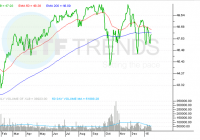
Summary Energy prices are falling. Low oil prices are weighing on the materials sector. Materials are experiencing lower activity on energy fallout. Oil’s slide has identified some winners at the sector level, namely consumer-related shares, but beyond the energy sector, there are some losers as well. Those losers include the materials sector, which was already scuffling heading into 2015. Last year, the Materials Select Sector SPDR ETF (NYSEARCA: XLB ) rose just 7.2%, including paid dividends. XLB’s 2014 showing was 630 basis points worse than the S&P 500, and enough to make the fund the second-worst of the nine sector SPDR ETFs, behind only the Energy Select Sector SPDR ETF (NYSEARCA: XLE ) . To this point in the new year, only three of the nine sector SPDRs have traded higher. XLB is not a member of that trio. In theory, materials stocks should be winner in a low energy price environment, because lower oil and gas prices reduce input costs for energy-intensive materials producers and chemicals manufacturers. In reality, that has not been the case. While the materials sector’s earnings warnings have not yet reached alarming heights, it is clear oil’s plunge is taking a toll on the sector. Of XLB’s top 10 holdings, a group that combines to make up about two-thirds of the ETF’s weight, only three have traded higher to start 2015. “The investment markets reflect these winners and losers in the economy. Consumer driven sectors of the market have performed quite well. The energy and commodity sectors of the market have not. Between oil stocks, the materials sector, and industrial and utility names in commodity-related businesses, roughly 20 percent of the S&P 500 is a loser with falling oil prices.” – Jones & Associates LyondellBasell Industries (NYSE: LYB ), one of XLB’s top 10 holdings, said that in the fourth quarter low oil prices will damp its margins. That after the company helped materials ETFs perform well in the first half of 2014 on the back of rising crude prices . A recent Morgan Stanley report highlighted PPG Industries (NYSE: PPG ), a top 10 holding in XLB, as one materials name that could endure lower oil prices, but the bank also identified Eastman Chemical (NYSE: EMN ), LyondellBasell and Dow Chemical as potentially challenged by lower oil prices. Those stocks combine to make up over 16% of XLB’s weight. XLB’s five-year correlation to The United States Oil ETF (NYSEARCA: USO ) is over 59%, according to State Street data . Materials Select Sector SPDR ETF (click to enlarge)

Alts Pioneer Calamos Launches A Pair Of Alternative Mutual Funds

Calamos Investments was one of the first firms to launch a liquid alts product in the early 1990s, and the firm maintains its tradition as a trailblazer in the industry with the recent launch of two alternative mutual funds: The Calamos Global Convertible Fund and the Calamos Hedged Equity Income Fund, both of which “leverage core competencies of the firm,” according to a statement issued by Calamos. “These new funds are a logical extension of our product suite,” said John Calamos Jr, CEO and co-CIO of Calamos Investments: We have managed global convertible strategies for institutional clients for 20 years, and have managed U.S. convertibles for more than 35 years. Additionally, we were an early leader in the liquid alternatives space. Both funds were launched on December 31, 2014, and join the lineup of other Calamos convertible and alternative mutual funds, including the following: Calamos Convertible Fund (MUTF: CCVIX ) – A $1.3 billion fund that was launched in June 1985 and focuses on the U.S. convertible bond market. Calamos Long/Short Fund (MUTF: CALSX ) – A $57 million long/short equity fund with a focus on the U.S. equity market. The fund was launched in June 2013. Calamos Market Neutral Income Fund (MUTF: CVSIX ) – A $4.2 billion fund that started in September 1990 and aims to maintain a low correlation to the U.S. equity and fixed income markets while generating income through covered call writing and convertible arbitrage strategies. The two new funds will be managed by portfolio management teams led by John Calamos, Sr., Chief Executive Officer and Global Co-CIO, and Gary Black, Executive Vice President and Global Co-CIO. Global Convertible Fund The Calamos Global Convertible Fund blends global investment themes and fundamental research, providing broadly diversified exposure to the global convertible bond universe. The fund seeks to provide upside participation in equity markets with less exposure to downside than an equity-only portfolio over a full market cycle. According to Calamos, the fund can also serve a role within a fixed income allocation, as convertibles have historically performed well during periods of rising interest rates and inflation. The fund is available in five different share classes (A Shares: CAGCX ; C Shares: CCGCX ; R Shares: CRGCX ; I Shares: CXGCX ), has a management fee of 0.85% and expense ratios of 1.35%, 2.10%, 1.60%, and 1.10%, respectively. Further information can be found on the fund’s website . Hedged Equity Income Fund The Calamos Hedged Equity Income Fund invests in a diversified portfolio of stocks and sells options with the aim of generating income while participating in equity market upside with lower volatility over the long term. The Calamos Hedged Equity Income Fund is also available in four share classes ((A Shares: CAHEX ; C Shares: CCHEX ; R Shares: CRHEX ; I Shares: CIHEX ), has a management fee of 0.75% and expense ratios of 1.25%, 2.00%, 1.50% and 1.00%, respectively. Further information can be found on the fund’s website .