Tag Archives: utilities

ERH: A Mix Of Bland And Spicy, But How’s The Taste?

Wells Fargo Advantage Utilities & High Income Fund isn’t a pure utilities fund. What it does provide is an interesting mix of “high” risk and “low” risk assets. Overall, though, I’m not impressed, but it might make sense for those playing premiums and discounts. I recently wrote a couple of articles about infrastructure closed-end funds, or CEFs. One of the comments asked about my thoughts on the Wells Fargo Advantage Utilities & High Income Fund (NYSEMKT: ERH ). My take: It’s an interesting fund, but it’s not easy to pin point what kind of fund it is or provide a good reason for owning it. Not an infrastructure fund As soon as you take a look at the portfolio of ERH you see that it is not an infrastructure fund. Sure, it owns infrastructure assets, primarily in the utility space (though it also owns some pipelines). But it isn’t as broadly diversified as the Reaves Utility Income Fund (NYSEMKT: UTG ), the Cohen & Steers Infrastructure Fund (NYSE: UTF ), or the BlackRock Utility and Infrastructure Trust (NYSE: BUI ). All of which venture well beyond the utility sector, including such things as toll roads. ( I compare UTG and UTF here , and I examine BUI here .) So, if you are looking for broad infrastructure exposure, you’d be better off with a different fund. But, interestingly, this is not the defining difference between ERH and these other funds. The defining difference is that ERH combines utilities with preferred stock and high yield debt. At the end of February , the portfolio breakdown was roughly 60% stocks (mostly utilities), 30% high yield bonds, and 10% preferreds. So about 40% of the fund was invested in fixed income, or at least fixed-income like, assets. Moreover, the 30% in bonds was focused around high-yield bonds, which many would consider living on the complete opposite side of the risk spectrum from utility stocks. But that’s where this fund becomes interesting. It isn’t alone in pairing up different asset classes. For example, the Cohen & Steers REIT and Preferred Income Fund (NYSE: RNP ) is another fund that combines disparate income-focused assets under one roof. A yield kick? For ERH, the benefit of putting utilities, high-yield bonds, and preferred stock together is to create a portfolio that spits out plenty of income. On that front, the fund’s yield of nearly 8% is above UTG and UTF, but about on par with BUI. BUI makes use of options, which helps enhance distributions. ERH does not use options, but does use leverage (about 22% of assets at the end of the first quarter), like UTG and UTF. So it appears that adding high-yield debt to the picture allows ERH to add income over roughly similar funds that focus more on equity investing. That said, it is worth noting that ERH cut its distribution in 2011. Return of capital made up a little over half of the fund’s distribution the previous year, so that 2011 call was likely a good one. In fact, since that time, the fund’s net asset value, or NAV, has grown from $11.20 or so a share to around $12.70. All the while it’s spit out a steady $0.90 a share in distributions each year with none coming from return of capital. An odd ball While it’s hard to complain about that, the fund is an odd mixture of risks. For example, when it comes to bonds, high-yield is among the most aggressive options out there. But, interestingly, even high-yield bonds are lower risk than stocks, using most broad benchmarks. But in stocks, utilities are usually considered low risk. So there’s this interesting low risk/high risk mash up going on. ERH’s trailing five year performance through May provides a good example of what can happen when things go well. Over that span, ERH’s standard deviation was roughly 9.3. The Vanguard High Yield Corporate Fund’s (MUTF: VWEHX ) standard deviation was lower, at 5.4, while the Vanguard Utility Index Fund’s (MUTF: VUIAX ) was higher, at 11.4. Trailing annualized performance, which includes the reinvestment of distributions, meanwhile, fell along the risk lines. VWEHX had a trailing five year return of 8.8%, ERH posted an annualized 12% or so, and VUIAX came in at 13.8%. For comparison, SPDR S&P 500 Index ETF turned in a trailing return of 16.4% with a standard deviation of roughly 12.3. Essentially, the mix of assets in ERH reduced volatility and enhanced return relative to investing in stocks alone. The trailing three year numbers are roughly similar, but the trailing 10-year results are a stumbling block. ERH’s standard deviation was higher and return lower than both VWEHX and VUIAX over that span. So the fund doesn’t always live up to what you might expect. Unique and not right for most I could keep going, but there’s enough here to show that ERH is really an odd duck. It isn’t an infrastructure fund, it isn’t a utility fund, it isn’t a high-yield bond fund, and it isn’t a preferred fund. It’s a little bit of each. And while the idea of mixing different asset types makes logical sense, it hasn’t always work out the way an investor might hope here. While recent performance has been solid, longer-term results have been mixed, at best. Moreover, I’m not sure that ERH would play nicely with your portfolio if you use an asset allocation model. Yes, it could be used to shift allocations on the edges, but I’m not sure utilities, preferred stock, and high-yield are the places you should be looking for flexibility. For most investors seeking utility or infrastructure exposure, I’d suggest going with a fund that is really focused in those spaces. For investors seeking income, I think there are probably better ways to go about finding it. Unless you are looking specifically for a high-yield and utility fund for some reason, I’d suggest passing on this one. That said, if you like to play premiums and discounts, ERH is currently trading hands at a nearly 10% discount to its NAV. It’s trailing three-year discount is around 4%. With such a wide break from historical averages, now could be a good time to try to take advantage of this disparity. Other than that, I can’t come up with a great reason to own this fund. Disclosure: The author has no positions in any stocks mentioned, and no plans to initiate any positions within the next 72 hours. (More…) The author wrote this article themselves, and it expresses their own opinions. The author is not receiving compensation for it (other than from Seeking Alpha). The author has no business relationship with any company whose stock is mentioned in this article.
Dividend Growth And Value Investors Should Own ITC As A Core Holding

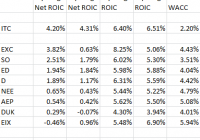
ITC Holdings’ management has earned the highest S&P Quality rating for 10-yr consistence in earnings and dividend growth. No easy feat. Substantially higher Net ROIC, higher allowed ROIC, and a growing regulated asset base are driving earnings and dividend growth higher as well. The current dip is a buying opportunity. The market has not been kind to utility stocks recently, and the current sell-off is offering a few attention-grabbing opportunities. ITC Holdings (NYSE: ITC ) is a company that offers top-ranking management with a record of accomplishment in generating industry-leading investment returns. Add projected annual dividend growth in the 10% to 13% range, along with forward PEG valuations more reminiscent of growth companies than slow growth utilities, and most investors should take notice. S&P Capital IQ offers a rating of 10-yr consistency in earnings and dividend growth known as its Quality Rating and firms are grouped from A+ to D, with B+ being considered average. Of the 500 stocks followed by S&P IQ with a Quality Rating, only 47 carry the A+ rating, and ITC is one of this elite group. ITC has an S&P Credit rating of A- while the industry average is BBB+. Keep in mind the company has been public for only 10 years and would have just qualified for inclusion into the Quality Ratings. One component of management excellence is generating shareholder returns based on total capital deployed that are both higher than its peers and are comfortably above their cost of capital. ITC has generated a 6-yr average return on invested capital ROIC of 6.4% and is higher than the industry average of between 4.5% and 5.0%. More impressive is the low cost of capital at a weighted average cost of capital WACC of just 2.2%, making Net ROIC an impressive 4.2%. While many may see this as small potatoes, investors should compare ITC’s Net ROIC with some bigger, more familiar names, such as those in the spreadsheet below for Exelon (NYSE: EXC ), Southern Company (NYSE: SO ), Consolidated Edison (NYSE: ED ), Dominion Resources (NYSE: D ), NextEra (NYSE: NEE ), American Electric Power (NYSE: AEP ), Duke Energy (NYSE: DUK ), and Edison International (NYSE: EIX ): Source: Guiding Mast Investments, fastgraphs.com, thatswacc.com As shown, ITC management is under-appreciated by most investors for their ability to generate Net ROIC substantially above their peers. One of the keys to ITC’s success is the structural nature of its business focus. ITC is the largest publicly traded electric transmission company with 15,000 miles of FERC-regulated power lines. The subtle difference is the FERC and not individual state utility commissions regulate ITC’s assets, and the FERC has a higher allowed ROE than most states. The chart below from the Edison Electric Institute outlines the progression of lower state allowed ROE since 1990: As shown, the average state-allowed ROE has declined over the past 30 years, and has plateaued at around 10% since 2006. A national energy goal has been the upgrade of the electric grid and the interconnection of new solar and wind generating capacity in areas not historically power generation-oriented. Grid infrastructure investment has been encouraged through offering higher returns on investment dollars, and ITC’s focus has been on those higher return margins. The FERC allows returns in the 10.5% to 11%+ range. To encourage smaller companies, regulated returns offer an additional return incentive of about 1% if the assets are owned by independent firms like ITC. It is estimated that ITC’s long-term allowed ROE will be in the 11.5% range. There is opposition to the higher returns offered by FERC-regulated projects, and last year rates were reduced in the Northeast from as high as 13.4%. With the success of this reduction, consumer advocates are pushing for the formula to apply nationally, and this will negatively affect ITC’s allowed returns with an anticipated allowed ROE reduction from 12.75% to 11.5% by 2016. However, this decline in allowed returns will be offset by a larger network of regulated assets. ITC’s growing asset base and the large quantity of future project opportunities will drive earnings and dividend growth for the next several years. ITC has grown earnings by a three-year average of 12% and raised its dividend by 10%. The consensus is for earnings to continue its 10% to 12% growth rate. The payout ratio is a low 31%, offering management the option to raise dividends faster than earnings growth. Management has targeted mid- to high-30% for a comfortable payout ratio. Last year, the dividend was raised by 14%. ITC is a capital expansion story. Current assets are around $7.1 billion with annual capital expansion budgets of $800 million a year. Operating cash flow will fund a growing portion as ocf increases from $630 million this year to an estimated $770 million in 2018. More information on their cap ex expansion is available in the June 2015 Investor’s Meeting presentation pdf. ITC’s share price has been declining recently due to two factors, general weakness of the utility sector after a lengthy time of outperformance and concerns over the potential for a reduction in allowed ROE. ITC’s share price has followed its peers up and down over the past year until March. At that point, there is a divergence where ITC declined faster than the utility sector. ITC is down about 30% from its high, while the averages are down about 15% and since March, utility stocks have been declined about 5%, while ITC is down 17%. Over the past 12 months, utility stocks are about flat, while ITC is down about 12%. With a 52-wk range of $30.66 and $44.00, the current $32.65 is closer to the low. Another culprit is lower-than-expected first quarter earnings. Analysts were expecting eps of $0.50, but management disappointed by 6% at $0.47. This is a repeat of the previous quarter shortfall of 4%. Management’s guidance for EPS this year is $2.00 to $2.15, with a midpoint of $2.08. Next year’s EPS is estimated at $2.18 to $2.20. Below is the Fastgraph for ITC going back to its IPO in 2005. (click to enlarge) On a forward PEG basis, ITC is trading at a substantial discount to its peers. As described in a previous article , the average forward PEG ratio for the utility sector is 3.2, the average forward P/E is 15.7 and the average EPS growth rate is 4.8%. ITC compares with a forward 2016 PEG of 1.4 based on a 2016 P/E of 15.3 and EPS growth of 11%. While EPS growth is estimated at twice the sector’s growth, ITC’s share prices currently offer no premium valuation. However, in reviewing ITC’s P/E history, it seems it usually trades closer to a P/E of 22 than to 16. If ITC recovers its footing and resumes its premium P/E, it is conceivable share prices could climb to $42 to $48 for patient investors. While the current yield is below the sector average at 2.0%, a high dividend growth rate should overtake the sector average within a few years. The current weakness should be considered a buying opportunity for dividend growth investors and value investors alike. Management has shown its ability to deliver outstanding fundamental returns to shareholders, and the stock warrants a place as a core position in a portfolio. Use this dip to your advantage. Author’s Note: Please review disclosure in Author’s profile. Disclosure: The author is long ITC, AEP, D, EXC, SO. (More…) The author wrote this article themselves, and it expresses their own opinions. The author is not receiving compensation for it (other than from Seeking Alpha). The author has no business relationship with any company whose stock is mentioned in this article.

Cheap Stock With A High Yield Or High Yield With A Cheap Stock? How About Both?

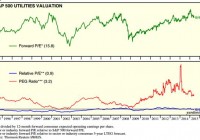
TECO Energy is valued at a substantial discount to its peers based on its forward PEG ratio. TECO Energy offers a current yield of 5.02%. The stigma of its discontinued coal operations along with a dismal dividend growth profile is holding back share prices, but should change with its renewed focus on regulated assets. Are you a value buyer looking for peer undervaluation or are you looking to garner higher income from your invested capital, or a little bit of both? If so, TECO Energy (NYSE: TE ) should be of interest. TE is trading at a comparatively large discount to its anticipated growth rate for the utility sector and the current yield is 5.02%. One measure of fundamental value is the PEG ratio, or price to earnings to earnings growth. Utilities are always on the top of the PEG valuation scale due to slow growth and outsized yields. In most sectors, fair valuation is usually considered at 1.0 for large caps and 1.2 for smaller caps. Over 1.2 is considered overvalued and below 1.0 is undervalued. For utilities, however, it is not uncommon for the PEG ratio to be over 3.0. The PEG ratio for utilities is best used for peer comparisons. One tool that has been used since the early 1970s is the forward PEG ratio, or fundamental valuation based on anticipated 5-yr growth rates and forward earnings estimates. The forward PEG has been one of my personal uppermost due diligence considerations since researching stocks using Value Line in the local library way, way before the internet. The reference librarian got to know me pretty well. However, I digress. Yardeni.com offers an interesting chart of the forward PEG for the utility sector going back 20 years, as represented by the S&P 500 Utility Sector. Below is the chart of the current forward PEG ratio (green line), relative sector P/E to the S&P 500 forward P/E (blue line), and the current forward PEG ratio (red line): (click to enlarge) The current utility sector forward PEG is 3.2 and the average forward P/E is 15.8, reflecting a sector-anticipated growth rate of 4.9%. Enter TECO Energy. The company is going through a transition by selling its coal mining operations to focus solely as a regulated natural gas and electric utility. Its geographic coverage is Tampa Electric (700,000 customers) and Peoples Gas (350,000 customers) in Florida and recently acquired New Mexico Gas (513,000 customers). Earnings per share guidance by management in 2015 is in the $1.08 to $1.10 range, with 2016 consensus estimates of $1.18 to $1.22. Progression in estimates is based on an expansion of its regulated asset base of between 4% and 7%, recent Florida rate case approval with agreed rate increases until 2018, and an allowed ROE in the favorable 10.25% range. TE’s earnings growth rate is offered at between 9.0% and 11.5%, and substantially above the sector average of 4.9%. TECO is trying to sell its coal producing assets in Virginia, Kentucky, and Tennessee. Held as a discontinued asset since third quarter 2014, TECO Coal LLC had a buyer for $80 million in cash and potential future payments of $60 million based on performance targets. However, with the current financial stress of the coal industry, the buyer was unable to acquire the necessary financing and the sale did not close earlier this month. Last week, TE announced a new buyer had stepped in with a 30-day close schedule, but neither terms nor buyers were disclosed. For all intents and purposes, these assets have been written down and the immediate benefit to shareholders from the sale will be a one-time cash inflow of between $0.20 and $0.50 a share. Historically, the coal business has been a large segment of earnings, representing upwards of 30% of net income. As recently as 2011, coal generated over $50 million in income, and coal could be counted on to supply earnings per share of between $0.25 and $0.40 annually. Using the lowest 2016 earnings estimates of $1.13 and the lower project growth rate of 9%, TE’s forward PEG would be 1.7, substantially below the 3.2 of the sector. The current valuation of TE at $17.80 equates to a sector-average forward P/E of 15.7. The undervaluation is based on a much higher growth rate profile. TE’s current yield is 5.02% and represents a substantial income advantage to the sector average 3.5% yield. TE falls in the top tier of utility dividend payers for yield, but offers the disadvantages of a high payout ratio and very low historic dividend growth. While earnings growth is expected to be above average, until the payout ratio declines from around 87% last year to a more comfortable 65% to 70%, investors should not expect dividend growth above a mere nominal level. For example, 3-yr TE dividend growth is 1.3% and 5-yr dividend growth is 1.9%. The best investors should expect over the next three years is inflation-matching dividend growth. However, the current yield of 5.02% should pique the interest of income seekers. Historically, natural gas utilities offer some of the lowest yields in the sector. Using Hennessey Natural Gas Utility Fund (MUTF: GASFX ) and a few of the more popular gas utility stocks as proxies, the representative yield could be between 2.1% and 3.3%. With 50% of customer count from its gas utilities, TE’s yield is comfortably above these averages. Management has generated returns on invested capital in excess of sector average. With peer-average in the 4.5% to 5.0% range, TE’s 5-yr average ROIC is 6.0%, and 3-yr average ROIC is 5.5%. However, their cost of capital is high at 5.7%, according to ThatsWACC.com. TECO could be either an acquirer of smaller utilities, such as its purchase of New Mexico Gas, or as a candidate in the continuing march of utility consolidation. Until the stigma of coal is washed from investors’ memory, TE will trade based on its yield and not its growth prospects. If management delivers on its regulated growth platform, today’s share price and corresponding yield could be looked at as being both cheap and high yield. Author’s Note: Please review disclosure in Author’s profile. Disclosure: The author has no positions in any stocks mentioned, but may initiate a long position in TE over the next 72 hours. (More…) The author wrote this article themselves, and it expresses their own opinions. The author is not receiving compensation for it (other than from Seeking Alpha). The author has no business relationship with any company whose stock is mentioned in this article.