Tag Archives: undefined

Capitalize On Rising Interest Rates With KRE

ETF investing, portfolio strategy, special situations “}); $$(‘#article_top_info .info_content div’)[0].insert({bottom: $(‘mover’)}); } $(‘article_top_info’).addClassName(test_version); } SeekingAlpha.Initializer.onDOMLoad(function(){ setEvents();}); Summary Interest Rates Are Going to Rise. Regional Banks Perform Well When Interest Rates Rise. Invest In KRE To Avoid Overexposure To Individual Stocks. Introduction I have harped on and on and on about the inevitability of rising interest rates, so I’ve determined that this will be my last article forewarning investors to prepare their portfolios for the day, or drawn out period (Remember ” Be Patient “) that interest rates rise. Capital appreciation is a daunting task when industry experts believe a sudden rise in interest rates could lead to a market correction of 20 percent . I find it prudent for investors to find an equity that will inherently perform better under projected future market conditions. Like credit default swaps in 2008 or corporate lawyers after the BP oil spill, I believe the SPDR S&P Regional Banking ETF (NYSEARCA: KRE ) will perform exceptionally when rates finally go up. Why Regional Banks? Regional banks tend to be less widespread and more reliant on net interest margins than their larger corporate adversaries. The theory is that regional banks focus more on lending and less on areas like capital markets and treasury services. A diversified large cap bank such as Bank of America (NYSE: BAC ) will have around 48 percent of its income broken into net interest income. While 48% is clearly significant, many regional banks have an average net interest income around 55%. Other regional banks have net interest incomes as high as 60-65%. Five such stocks are Comerica (NYSE: CMA ), SunTrust Banks (NYSE: STI ), MB Financial (NASDAQ: MBFI ), M&T Bank Corporation (NYSE: MTB ), and Huntington Bancshares (NASDAQ: HBAN ). A more comprehensive list of regional banks for the inquisitive investor include can be found on the bull sector . Due to a prolonged low interest rate environment, many banks are relying on fees and low margins from loans to maintain profitability. Gradually rising rates will benefit regional banks. Why KRE? Choosing a good ETF is a remarkably efficient way to spread risk across an industry. By reducing exposure, one can avoid the pitfalls associated with the poor performance of an individual equity. For any ETF, the three metrics that I place the most value on are: diversification, dividends, and its expense ratio. KRE is well diversified with 94 holdings (none weighted over 1.3%). KRE has an annualized dividend yield of 1.54%, and finally KRE has a very low expense ratio at .35% compared to an industry average .5%. It should also be noted that KRE has returned 9.30% YTD and it is by far the most actively traded ETF with an average volume of 4,051,374. The second most traded regional banking ETF is the iShares U.S. Regional Banks ETF (NYSEARCA: IAT ) with a measly 218,517 average volume. I believe the voice of the market has spoken loudly in favor of KRE. In addition, investing in KRE over another ETF helps one avoid the risks associated with low volume (illiquidity, volatility, etc.). For aesthetic purposes, I included a three year chart that compares 10 year treasury yields to KRE’s year to year performance. I included the chart to drive home the point that interest rates and the regional banks are correlated and interconnected. Conclusion Interest rates are going to rise. Regional banks perform well when interest rates rise. Avoid the pitfalls associated with investing in individual stocks by investing in an ETF. The best regional banking ETF, in my opinion, is KRE. Disclosure: I/we have no positions in any stocks mentioned, and no plans to initiate any positions within the next 72 hours. (More…) I wrote this article myself, and it expresses my own opinions. I am not receiving compensation for it (other than from Seeking Alpha). I have no business relationship with any company whose stock is mentioned in this article. Share this article with a colleague

Thinking In Temporal Extremes Can Be Bad For Your Wealth

Bonds, dividend investing, ETF investing, currencies “}); $$(‘#article_top_info .info_content div’)[0].insert({bottom: $(‘mover’)}); } $(‘article_top_info’).addClassName(test_version); } SeekingAlpha.Initializer.onDOMLoad(function(){ setEvents();}); We dance round in a ring and suppose, but the secret sits in the middle and knows. –Robert Frost One of the biggest problems any asset allocator must overcome is the problem of time in a portfolio. I call this the intertemporal conundrum . This describes how our financial lives are extremely dynamic and multi-temporal. That is, they are not one linear time line. Instead, they tend to be a series of short-terms inside of a long-term. This often makes the textbook application of the “long-term” inapplicable with regards to asset allocation. So, as much as we all know it’s silly to think too short-term it’s not totally irrational. After all, being involved in such dynamic financial markets gives us the urge to act and to try to take control of our outcomes in order to reduce uncertainty. We often act because we know there is an inherent short-termism in our financial lives. As I’ve stressed on many occasions , there’s no such thing as a truly “passive” portfolio. But we should be careful not to confuse this with the idea that being too short-term is intelligent. After all, we know that the financial markets tend to be highly unpredictable in the short-term. We also know that the financial markets tend to become more predictable the longer we hold onto assets. This is because the price changes involve too many random variables to be predictable in the short-term. In addition, we know that taxes and fees create potentially insurmountable hurdles so we should implement portfolios that seek to reduce these frictions as best as possible. Generally, our attempts to “take control” of our outcomes in the short-term end up costing us in the long-run. So, we want to think short-term because this gives us comfort and helps mesh with our inherently short-term financial lives. But we also know that thinking too short-term is bad for our wealth because this just churns up taxes and fees inside of highly unpredictable time frames. Then again, we know that we don’t necessarily have a textbook long-term in our financial lives. And we also know that some degree of activity will be necessary at times during the course of our lives so a static “long-term” view doesn’t mesh with inherently dynamic financial markets and financial lives. So, we have quite a temporal conundrum here. Managing this multi-temporal problem is not always easy. The textbook idea of the “long-term” doesn’t fit our financial lives. But we also know that it’s self defeating to be too short-term. So, the key involves finding that happy medium. This is why I like to think of the markets in a cyclical sense. This gives us the ability to construct portfolios that reduce tax and fee inefficiencies, but also take advantage of the fact that our financial lives are dynamic and so are the financial markets. Thinking in extremes is generally bad for your portfolio. And this is particularly important when applying the problem of time to a portfolio. And so, as is generally the case in life, we find comfort living in the extremes without realizing that the middle is often where the secret sits. Share this article with a colleague

Today’s Most Competitive Wealth-Builder ETF Investment

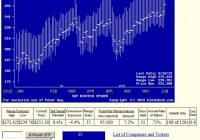
Summary From a population of some 350 actively-traded, substantial, and growing ETFs this is a currently attractive addition to a portfolio whose principal objective is wealth accumulation by active investing. We daily evaluate future near-term price gain prospects for quality, market-seasoned ETFs, based on the expectations of market-makers [MMs], drawing on their insights from client order-flows. The analysis of our subject ETF’s price prospects is reinforced by parallel MM forecasts for each of the ETF’s ten largest holdings. Qualitative appraisals of the forecasts are derived from how well the MMs have foreseen subsequent price behaviors following prior forecasts similar to today’s. Size of prospective gains, odds of winning transactions, worst-case price drawdowns, and marketability measures are all taken into account. Today’s most attractive ETF Is the SPDR Biotech ETF (NYSEARCA: XBI ): The investment seeks to provide investment results that, before fees and expenses, correspond generally to the total return performance of an index derived from the biotechnology segment of a U.S. total market composite index. In seeking to track the performance of the S&P Biotechnology Select Industry Index (the “index”), the fund employs a sampling strategy. It generally invests substantially all, but at least 80%, of its total assets in the securities comprising the index. The index represents the biotechnology industry group of the S&P Total Market Index (“S&P TMI”). The fund is non-diversified. The fund currently holds assets of $2.28 billion and has had a YTD price return of +27.87%. Its average daily trading volume of 1,069,010 produces a complete asset turnover calculation in 8.5 days at its current price of $250.86. Behavioral analysis of market-maker hedging actions while providing market liquidity for volume block trades in the ETF by interested major investment funds has produced the recent past (6 month) daily history of implied price range forecasts pictured in Figure 1. Figure 1 (used with permission) The vertical lines of Figure 1 are a visual history of forward-looking expectations of coming prices for the subject ETF. They are NOT a backward-in-time look at actual daily price ranges, but the heavy dot in each range is the ending market quote of the day the forecast was made. What is important in the picture is the balance of upside prospects in comparison to downside concerns. That ratio is expressed in the Range Index [RI], whose number tells what percentage of the whole range lies below the then current price. Today’s Range Index is used to evaluate how well prior forecasts of similar RIs for this ETF have previously worked out. The size of that historic sample is given near the right-hand end of the data line below the picture. The current RI’s size in relation to all available RIs of the past 5 years is indicated in the small blue thumbnail distribution at the bottom of Figure 1. The first items in the data line are current information: The current high and low of the forecast range, and the percent change from the market quote to the top of the range, as a sell target. The Range Index is of the current forecast. Other items of data are all derived from the history of prior forecasts. They stem from applying a T ime- E fficient R isk M anagement D iscipline to hypothetical holdings initiated by the MM forecasts. That discipline requires a next-day closing price cost position be held no longer than 63 market days (3 months) unless first encountered by a market close equal to or above the sell target. The net payoffs are the cumulative average simple percent gains of all such forecast positions, including losses. Days held are average market rather than calendar days held in the sample positions. Drawdown exposure indicates the typical worst-case price experience during those holding periods. Win odds tells what percentage proportion of the sample recovered from the drawdowns to produce a gain. The cred(ibility) ratio compares the sell target prospect with the historic net payoff experiences. Figure 2 provides a longer-time perspective by drawing a once-a week look from the Figure 1 source forecasts, back over two years. Figure 2 (used with permission) What does this ETF hold, causing such price expectations? Figure 3 is a table of securities held by the subject ETF, indicating its concentration in the top ten largest holdings, and their percentage of the ETF’s total value. Figure 3 source: Yahoo Finance XBI apparently takes a low-concentration approach to holdings, with an average of 1 ½% of its assets in each of its top ten commitments. This provides a wide dispersion of holdings among competitive contestants in an industry where success rewards can be huge, while failures tend to be complete. If the remaining 85% of assets are distributed on a 1% basis 95 separate bets may being made, offering great diversification, as well as dilution of encountered bonanzas. Where ultimate payoffs are less dependent on initial capital commitment size, this may be an advantaged strategy. Figure 4 is a table of data lines similar to that contained in Figure 1, for each of the top ten holdings of XBI. Figure 4 (click to enlarge) In an industry as unpredictably dynamic as this, wide variations in market experience seem to be the rule. Column (5) contains the upside price change forecasts between current market prices and the upper limit of prices regarded by MMs as being worth paying for price change protection. The average of +16.3% of the top ten XBI holdings is well above the population average of all 2600+ equities MM forecasts of +12.9%. It is about double the upside forecast for SPY price change prospects. The other side of the coin is column (6), which shows what actual worst-case price drawdowns have been typical in the 3 months following each time there has been a forecast like those of the present day. Those risk exposures have been nearly -10% in the holdings top ten, less than -9 by equities at large, and only -3.5% on the SPY ETF. But these holdings are attractive reward tradeoffs between returns and risks, with the top ten (column 14) at a ratio of 1.7, compared to equities overall at 1.5 times. Still, the market average of SPY provides a best ratio of 2.5 times risk avoidance. Another qualitative consideration is the credibility of the ten XBI big holdings after previous forecasts like today’s. The net average price change (column 13) of the ten has been 1.1 times the size of the upside forecast average, +17.4% compared to +16.3%. The equity population’s actual price gain achievement, net of losses has been a pitiful +3.7% compared to promises of 12.9%. The ability of XBI holdings to recover from those worst-case drawdowns and achieve profits occurred in 84% of experiences. The equity population only recovered less than two thirds of the time, and while the SPY experiences were more consistent like the ten XBI holdings, the achieved gains were much smaller. SPY has had only +3.3% gains previously from like forecasts of +8.6%. Conclusion XBI provides attractive forecast price gains, supported by equally appealing largest holdings. Both the ETF and many of its major holdings offer very attractive prospects in near-term price behaviors, demonstrated by previous experiences following prior similar forecasts by market makers. Disclosure: I/we have no positions in any stocks mentioned, and no plans to initiate any positions within the next 72 hours. (More…) I wrote this article myself, and it expresses my own opinions. I am not receiving compensation for it (other than from Seeking Alpha). I have no business relationship with any company whose stock is mentioned in this article.