Tag Archives: undefined

My Investment Worries: The Dollar, Large Caps, And More

Originally published on Dec. 28, 2014 Introduction Essentially investment risk is not a number. The price of risk failure is the foregoing of important funding plans. In that light your risk is not the same as my risk. Not only because we have different financial and personality resources, but also different time frames, which is why I developed the TimeSpan L Portfolios. These help isolate the impacts of risk failures; e.g., a disappointing short-term portfolio is different than one to help fund future generations. No matter what the planning time horizon of a portfolio, there is another major difference between two similar portfolios. In this age of optimization many portfolios project funding out of resources with little to spare for unexpected mistakes. For many there are no reserves for mistakes because the investor or his/her manager has supposedly identified all possible disruptions. Thus, they have created an expectation risk and need to examine what could go badly wrong with their expectations. I suggest the biggest impact of an expectation risk is likely to be found in the very assets that most investors have the highest level of confidence. Not only by nature I am a contrarian, I am a student of history that gets uncomfortable when there is excessive enthusiasm. My current worry risk is as follows: The US $ Large Cap Stocks Treasuries-US and some Others ETFs and other market structure changes These worries are not generally recognized in market prices, which I think they should be. Therefore I perceive significant market price distortions that don’t recognize that in the future something could go wrong in most portfolios. The worries Part of my worries is that few if any professional investors are publicly concerned about the concerns that are on my list. The (mighty) US Dollar For those of us who live in a competitive price environment we are very much aware of the price spread for similar, usually not truly identical, items. There are always reasons why the bulk of buyers and sellers can identify with the current price; e.g., availability, ease of transaction, easy to service, and other qualities of merit. As an entrepreneur I always wanted to be the high priced service sold to discriminating, great capital sources. My approach was that my successful pricing was a badge of high quality. I was conscious that this policy was holding up an umbrella over cheaper competition, but in the institutional world quality usually trumps price, within reason. Turning to the current valuation of the US$, the widening price spread versus all other major currencies suggests to me a leaky umbrella. Our current exalted position is not due to our virtuous qualities of protecting the purchasing power of our currency but rather it is due to the perceived decline in the value of other currencies. Some of the weaknesses in other currencies are self imposed by the deliberate mercantile policies of governments to help sales of their exports to the US. In a period of increasingly unpopular governments within their countries and with their neighbors, people are choosing to store some of their wealth in the US, behind its supposed two ocean fortress sitting on valuable natural and human resources. Because the US monetary leadership is having enough trouble attempting to manage the domestic economy and a current Washington political establishment that would like to isolate the US from others’ problems, there is no desire to establish the US dollar as the single world currency. Thus, at some future point the unannounced but real weaker US dollar policy is likely. In the future, various economies will start growing again and become attractive places for investment both by the locals and those from outside. Therefore it would be wise to hedge one’s longer term portfolio against continued dollar strength. A number of mutual fund investors have been doing this for some time. With the exception of the five trading days ending December 24th, traditional US mutual fund investors have been adding to their non-domestic holdings while redeeming some of their domestic fund holdings. (The latter move could very well be a normal pattern of mutual fund investors exiting for retirement and other needs. In most cases the domestic funds are the oldest of their holdings.) The leaky large-cap house If the US dollar is being held up by a potentially leaky umbrella, the investment houses holding large caps may start to leak soon. We acknowledged in last week’s post that in general large cap mutual funds in 2014 were performing materially better than smaller market capitalization funds. At present and historically there is no solid evidence that large cap companies will do better than smaller caps. The foreword of Charlie Ellis’s book, What it Takes , states that “None of the ten largest corporations in the U.S. economy in 1900 still ranked in the top ten 50 years later and indeed only three actually survived as companies.” In addition there is an article by JP Morgan Asset Management that since 1980 the S&P 500 has dropped 320 stocks or roughly 10 per year due to mergers, low volume, and an inversion of their tax headquarters. The problems that caused these results were more widespread with numerous large companies losing their advantage. Some possible victims of these deteriorations today might well be General Motors (NYSE: GM ), IBM (NYSE: IBM ), and Citigroup (NYSE: C ) among others. Turning to the large-cap stocks as distinct from the companies themselves, there are significant changes occurring. First the surge of stock price performance above the level of earnings progress may well be a warehouse effect. In the past when investment managers were concerned about not being invested in a market that was gently rising to flat before a perceived decline, they hid from their clients by investing in stocks of very large companies. AT&T (NYSE: T ) was the best of the warehouses with its $9.00 predictable dividend which hadn’t changed for about 40 years. Today, many of the tactical players have shifted to using Exchange Traded Funds (ETFs). In the week ending Christmas Eve approximately $1 billion flowed into two S&P 500 ETFs (net of their redemptions) out of $23.7 billion. Some of the inflows could be covering shorts. As of December 15th the SPDR S&P500 ETF (NYSEARCA: SPY ) had the second largest short position of 240 million shares. (The largest was our old warehouse name but applied to a different company, AT&T.) More on the changing market structure through ETFs and other derivatives below. The current market sentiment may well be changing from complacency to belief in a general recovery starting in the US and haltingly going global. One clue that this could happen would be that in 2015 small market capitalization stocks once against perform better than larger caps. We could even see some flows from the larger caps into smaller cap funds. Due to ETF players who are mostly faster trading institutions, we could see redemptions in various index funds as sentiment shifts from avoiding losses to picking exploding winners. Treasuries discipline Surprising the US deficit is declining due in part to the sequester in 2013, but it is still a deficit which does not include the off-balance sheet liabilities for various government programs. We have not taken the pledge that except in times of war to produce surpluses to retire our debt. One also needs to recognize our twin infrastructures in terms of roads and bridges as well as our growing educational deficit. We are not alone in our lack of discipline; most other countries are similarly addicted to deficit spending. For those of us who can choose not to invest in various governments’ securities, this lack of discipline is an additional imponderable. However, for our banking institutions it should be a considerable issue as banks in most countries must own local government paper. Often the various authorities treat government paper more favorably than commercial paper in terms of the level of reserves required. Thus, to some extent our whole financial system is exposed to the level of discipline applied to our treasury deficit machine. ETFs and other market structure changes Students of warfare often note that changes of weaponry change how battles are fought and won. Clearly the introduction of the English Long Bow and the Aircraft are two examples. In the investment marketplace battles, some rely on the most current weapon which is often not fully tested. The 1987 market fall is a good example of a market collapse that was not tightly tied to an economic collapse. In a somewhat overpriced market after a multi year rising market, many institutional investors felt secure because of their newly acquired weapon of “portfolio insurance.” This procedure was based on locked-in trades of securities and derivatives largely executed in Chicago. If markets were functioning normally with other investors using the various tactics of the past, a limited amount of portfolio insurance transactions apparently worked. However, as the decline accelerated, many institutions and some trading organizations withdrew from the market and so the locked-in derivative trades were working against each other in driving prices into a free fall. In 2014 and beyond, the popularity of derivatives, particularly ETFs, have grown and now often represent the bulk of trading in an emotional period. To put the size of the ETF power into perspective, the following points are worth noting: While the estimated net inflow into traditional US mutual funds for the Christmas Eve week was $12.8 billion, the highest since March of 2000, almost twice as much ($23.7 billion net) came in through ETFs. As Blackrock’s Larry Fink has been warning for some time, institutions are using ETFs instead of futures to speculate. There are roughly 250 authorized participants in the creation and redemption of ETFs. In many if not most cases these participants are acting for institutional clients. Some of the participants’ purchases may be to aid in setting up short positions or providing securities to meet share lending requirements. To put the importance of the shorting of ETFs shares in perspective, it is worth noting as of December 15th seven of the largest forty short positions on the New York Stock Exchange stocks were ETFs. As of the same day, nine of the thirty largest changes in short positions were for ETFs. Because of particular interest in the S&P Biotech ETF, the short position would take 17 days to cover. The use of derivatives in both fixed income and currency trading is extensive. Some of the regulators and I are wondering whether several of these new weapons will blow up certain users and possible counterparties in the heat of battle. How does one live with the worries? One must recognize that probably there has never been or never will be a period without worries. Long-term investors need to be both flexible and diversified. In our four timespan portfolio structure, I suggest that the Operational Portfolio (1-2 years) stay tactical and not take large losses. In the Replenishment Portfolio (2-5 years) one should develop both tactics that can tolerate at least one to two poor years. The Endowment portfolio (5-10+ years) should shift to a more strategic view to take advantage of periodic declines. The Legacy Portfolio, needed to feed multiple future generations, has a need to separate current fashionable thinking for expected future changes.
A Contrary Play For The Patient Investor In 2015

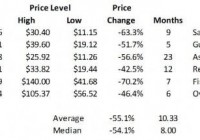
Summary For investors who are looking for inexpensively valued stocks that may be poised to benefit from mean reversion, energy stocks are now on the radar for a rebound in 2015. There are many factors that influence the outlook of energy stocks, but valuation and the price of oil are two places to start. Oil prices had a material decline in 2014. At the same time, energy stocks are showing inexpensive valuation based on their price-to-book-value ratio. By Nick Kalivas The recent plunge in oil prices has created a dramatic re-pricing of stocks in the energy sector. For investors who are looking for inexpensively valued stocks that may be poised to benefit from mean reversion (the theory that stocks move toward their average price over time), energy stocks are now on the radar for a rebound in 2015. Let’s take a look at historically large declines in the oil market and valuations in the energy sector to get some perspective. Examining historical price declines The energy sector is likely to find the most buying interest when the crude oil market is near a bottom, but picking a bottom in any market is never easy and may be a fool’s game. Over the past 10 years, the price of the S&P 500 Energy Sector has a 0.829 correlation to the price of West Texas Intermediate (NYSE: WTI ) crude oil. 1 Since the mid 1980s, there have been five times where the price of WTI has posted a decline of at least 40% from closing month high to closing month low. The table below compares those five historical periods with 2014’s price drop. (At the time of this writing, there were a few days left in December, so I used the Dec. 23 closing price of $56.52 to represent the month-end price.) Major Oil Market Declines Based on Monthly Closing Prices of WTI *Dec 23, 2014 price assumed as month-end close. Source: Bloomberg LP as of Dec. 23, 2014 Past performance is no guarantee of future results. The table indicates that the average and median durations for price declines are 10.3 and 8.0 months. If December 2014 were to mark a current low, the duration of the sell-off would be on the shorter side of history, at just six months. It seems like a bottom may be more likely in January or February 2015. The table highlights that the current decline of 46.4% (using the Dec. 23 close of $56.52) would be on the lower end of the distribution. The average and median declines are 55.2% and 54.1% respectively. The period most like the present (1985/1986, when the market was last awash in excess oil supply) saw a drop of 63.3%. The decline in 2008/2009 seems to be extreme as it was driven by a global economic and financial meltdown. Extrapolating based on historical examples is not without risk, but points 1 and 2 suggest that in 2015, we could see a close in the price of WTI in the $45 to $50 area in January or February, which could represent the bottom of the oil price plunge and lead to a cyclical recovery in energy shares. Examining energy sector valuations One way to examine the value of the energy sector is through the price-to-book-value ratio (P/B), which is affected not only by changes in companies’ stock price, but also by changes in the value of companies’ assets (book value). Monitoring this ratio over time helps to adjust for the impact of industry ups and downs. Oil properties and reserves are subject to impairment charges and changing values based on industry conditions – nonetheless, at some point the potential negatives are reflected in share prices. The P/B per share can shed light on when extremes are priced. Both the S&P 500 and the S&P SmallCap 600 Energy sectors appear to be approaching areas of perceived value based on their P/B ratios. At writing, the P/B of the S&P 500 Energy Sector was 1.78 and on the lower end of the range seen since 1990. The ratio had lifted from a low of 1.605 on Dec. 15, 2014. These P/B ratios compare to an average of 2.39 going back to 1990. 1 (The black dotted lines represent two standard deviations above and below the average price, which would be considered extreme pricing levels.) Source: Bloomberg LP as of Dec. 23, 2014. Past performance is no guarantee of future results. An investment cannot be made directly in an index. Valuation appears even more depressed looking at the S&P SmallCap 600 Energy sector where the price to book value ratio was 0.923. The ratio has lifted from a recent low of 0.78 on Dec. 15, 2014 and compares to an average of 2.02 going back to 1995. 1 Source: Bloomberg LP as of Dec. 23, 2014. Past performance is no guarantee of future results. An investment cannot be made directly in an index. Evaluating energy stocks There are many factors that influence the outlook of energy stocks, but valuation and the price of oil are two places to start. Oil prices had a material decline in 2014, although it is too early to say they have bottomed and history may argue for more weakness into the New Year. At the same time, energy stocks are showing inexpensive valuation based on their P/B ratio, and valuation suggests investors may want to put the energy sector on their shopping list for 2015. Investors seeking exposure to the energy sector may want to consider the PowerShares Dynamic Energy Exploration & Production Portfolio (NYSEARCA: PXE ) or the PowerShares DWA Energy Momentum Portfolio (NYSEARCA: PXI ).* PXE tracks an index that invests in exploration and production companies based on price momentum, earnings momentum, quality, management action, and value. PXI holds stocks that are displaying relative price strength. They are two smart beta solutions for investors looking for non-market-cap-weighted investment in the oil sector. Investors focused exclusively on the small-cap sector may want to consider the PowerShares S&P SmallCap Energy Portfolio (NASDAQ: PSCE ). 1 Source: Bloomberg LP as of Dec. 23, 2014 Important Information *Effective Feb. 19, 2014, changes to the fund’s name, investment objective, investment policy, investment strategies, index and index provider were made. Dorsey Wright & Associates, LLC replaced NYSE Arca, Inc. as the index provider for the fund, and the name of the index changed from Dynamic Energy Sector IntellidexSM Index to DWA Energy Technical Leaders Index. In addition, the name of the fund changed from PowerShares Dynamic Energy Sector Portfolio to PowerShares DWA Energy Momentum Portfolio. Important information The S&P 500 Energy Index is an unmanaged index considered representative of the energy market. The S&P SmallCap 600 Energy Index is a capitalization-weighted index that includes the energy sector companies within the S&P SmallCap 600 Index. Correlation indicates the degree to which two investments have historically moved in the same direction and magnitude. Price-to-book-value ratio (P/B ratio) is the ratio of a stock’s market price to a company’s net asset value. There are risks involved with investing in ETFs, including possible loss of money. Shares are not actively managed and are subject to risks similar to those of stocks, including those regarding short selling and margin maintenance requirements. Ordinary brokerage commissions apply. The fund’s return may not match the return of the underlying index. Investments focused in a particular industry or sector, such as the energy sector and the oil and gas services industries are subject to greater risk, and are more greatly impacted by market volatility, than more diversified investments. The momentum style of investing is subject to the risk that the securities may be more volatile than the market as a whole, or that the returns on securities that have previously exhibited price momentum are less than returns on other styles of investing. Investing in securities of small-capitalization companies may involve greater risk than is customarily associated with investing in large companies. Beta is a measure of risk representing how a security is expected to respond to general market movements. Smart Beta represents an alternative and selection index based methodology that seeks to outperform a benchmark or reduce portfolio risk, or both. Smart beta funds may underperform cap-weighted benchmarks and increase portfolio risk. The information provided is for educational purposes only and does not constitute a recommendation of the suitability of any investment strategy for a particular investor. Invesco does not provide tax advice. The tax information contained herein is general and is not exhaustive by nature. Federal and state tax laws are complex and constantly changing. Investors should always consult their own legal or tax professional for information concerning their individual situation. The opinions expressed are those of the authors, are based on current market conditions and are subject to change without notice. These opinions may differ from those of other Invesco investment professionals. NOT FDIC INSURED MAY LOSE VALUE NO BANK GUARANTEE All data provided by Invesco unless otherwise noted. Invesco Distributors, Inc. is the US distributor for Invesco Ltd.’s retail products and collective trust funds. Invesco Advisers, Inc. and other affiliated investment advisers mentioned provide investment advisory services and do not sell securities. Invesco Unit Investment Trusts are distributed by the sponsor, Invesco Capital Markets, Inc., and broker-dealers including Invesco Distributors, Inc. PowerShares® is a registered trademark of Invesco PowerShares Capital Management LLC (Invesco PowerShares). Each entity is an indirect, wholly owned subsidiary of Invesco Ltd. ©2014 Invesco Ltd. All rights reserved. blog.invesco.us.com

Invest In What You Know: Advice From Peter Lynch Is For Suckers

Summary Peter Lynch is the father of the very popular “invest in what you know” strategy that was very lucrative for him and has always enjoyed mass appeal. Today many names that are popular selections according to this strategy make terrible investments due to extremely overpriced stocks. Most people are not implementing the “invest in what you know” strategies the way Lynch intended. These days it may be more suitable to “invest in what you know” based on a personal edge gained from professional expertise. Peter Lynch is considered one of the greatest investors of all time because he managed the Fidelity Investments’ Magellan Fund in the 1980s, which was the best performing Mutual Fund in the world during that time. With average annual gains of over 29% it regularly more than doubled the yearly gains of the S&P 500. “Invest in what you know” is one of Lynch’s investment strategies that was not only very successful, but was easy to understand for the masses. He outlined his strategy in two highly popular and widely read books, One Up on Wall Street and Beating the Street , and many investors since have adopted the strategy. I also find this strategy very appealing simply for the fact that I can use the products and services that I already consume on a regular basis, but get the added satisfaction of contributing to the success of a company I partly own. However, today I find that Lynch’s philosophy is difficult, if not impossible, for many to profit from due to growth chasers and other investors who believe so strongly in a company that they are willing to pay any price for its stock. Buying a company simply because you like it is enticing and easy, but can lead to sideways performance, high volatility, or huge losses and as I will discuss in this article, is not the only way to “invest in what you know”. How Not to Invest In What You Know Many naive investors don’t know any better and will blindly make purchases of stock at insane multiples of potential future earnings simply because it is a company that they like. What’s worse is these purchases are made at times when reasonable growth is either already priced in or the company has reached its potential and future growth is limited. Three recent examples include: Amazon.com (NASDAQ: AMZN ) which has fallen 24% from a 52-week high of $408.06 to its current share price of $308.52. The stock still sports a very high stock price given the valuation of $145.85B, and the company is not profitable, with a loss of -0.47 per share in the last 12 months due to major expenses on infrastructure, customer subscription acquisition, and low margin contracts designed to gain market share. Netflix (NASDAQ: NFLX ) which has fallen 28% from a 52-week high of $489.29 to its current share price of $348.94. With a very lofty P/E multiple of 92.6, any potential future growth the company can receive is already priced into this stock, and then some. Tesla Motors (NASDAQ: TSLA ) which has fallen 24% from a 52-week high of 291.42 to its current share price of $219.31 These companies all have changed how industry operates and are forcing others to follow its lead by capturing the hearts, minds, and wallets of the public. I would jump at the chance to own NFLX or AMZN at a reasonable price because I love the services they provide and believe they have forced other companies to adopt a more consumer friendly business model to remain competitive. TSLA makes the only luxury electric car that is attractive and it has made huge strides in battery power storage, which makes it highly appealing to investors and consumers (I must confess I personally would not purchase stock in any company that relies on sales of vehicles over $70,000, a price I find ridiculous for any vehicle). The problem with investing in stocks like AMZN, NFLX, and TSLA is two-fold: Despite these companies being positioned for future growth and huge earnings, an investor’s risk of losing capital remains very high. Lofty investor expectations are priced into the current stock price and the risk of a huge drop in a short amount of time is dramatically increased if the company fails to meet the unrealistic expectations. Valuations continue to remain extremely lofty following the fall in share price that results from the company failing to meet unreasonable growth expectations. Even after the fall in stock price, there is no room for the investor to make money, and the investment becomes a speculation that the company will either beat lofty expectations repeatedly or you purchase based on technical analysis and the belief that other people (suckers) will be willing to pay a higher price in the future. I personally prefer to purchase stocks of good companies I believe will provide me a low risk of loss in the future due to a stock price below intrinsic value, and I don’t purchase stocks based on my belief that others will soon find it more desirable than it currently is. AMZN, NFLX, and TSLA are not the only examples of excellent companies with either a dominating market position, huge growth potential, or both, and sporting an extremely overvalued and unattractive stock price. Here are a variety of my favorite companies with overvalued stocks: Chipotle Mexican Grill (NYSE: CMG ) with a P/E of 52.9 The Habit Restaurants (NASDAQ: HABT ) with a P/E of 45.2 Starbucks (NASDAQ: SBUX ) with a P/E of 30.1 Visa (NYSE: V ) with a P/E of 30.8 Google (NASDAQ: GOOGL )(NASDAQ: GOOG ) with a P/E of 27.5 Don’t get me wrong, many investors have amassed huge returns from stocks in the above-mentioned companies and many will see huge returns in the future. However, I am trying to remain a disciplined investor, and the extreme valuations are more speculative to me considering the downside risk despite my natural attraction to stocks of companies I really like and I believe have excellent management and future growth potential. I was highly anticipating the recent IPO of HABT prior to its market debut on November 20th, because I love to eat at its restaurants, its casual dining atmosphere is appealing to customers, and management’s goal of growing from 99 to 2000 total restaurants. the growth potential is amazing, but I can only wait for the price to fall dramatically before I can even consider an investment. How did Peter Lynch do it? How to Properly Invest In What You Know First off, I don’t believe that Lynch’s investing advice is for “suckers” as my title suggests; in fact Lynch was living proof that when the strategy was used properly it was incredibly successful. It was so successful that he coined the term “ten bagger” to refer to investments that achieved a price 10-times greater than his purchase price. I doubt that Lynch would purchase the stocks discussed above at the current price, none of which have ten bagger potential at current prices. Lynch would purchase a stock when the company was small and had huge potential for growth before others in the investing community noticed. Getting in before others is really the key to making huge profits. As we have noticed recently with HBT and the amazing success of CMGs fast casual business model, most companies are good at touting future potential and attracting investors. This leaves little selection for value investors seeking to “invest in what we know” at a discount. Average holding time for one a Lynch investment was 6-7 years, which is how long it typically took for a company to reach its full growth potential, attract the full attention of the investing community, and reach overpriced status. Holding a stock for a long time is a place of common ground for value investors and growth investors, but takes extreme patience. Most investors have a difficult time holding losing stocks, and the volatility that can lead to boom and bust moments for high growth stocks can easily lead to huge losses for investors prone to emotional stock buying and selling, and let’s face facts, that is most of us. Buying companies whose products and services you like is not the only way to “invest in what you know”. Investing in companies or industries where you are a profession expert or you have indirect professional knowledge of can give you an edge. For example, I am a wildlife biologist and environmental impact analyst, and I consult for government agencies and large utilities and infrastructure developers regarding environmental impact avoidance and compliance with environmental laws. My understanding of environmental regulation gives me an edge regarding investments in industries such as solar energy, where solar panel developers may post huge profits in 2015 after prices fell considerably in recent months. The end of tax incentives for solar panel makers in 2016 will lead to increased profit in 2015 because many developers will rush to finish large project ahead of the deadline. My knowledge of environmental regulation and incentives I received from my job gives me an edge in this instance. Anyone can apply this same principle to their own profession and find many great companies that have excellent growth potential and attractive valuations. Closing Remarks I have great admiration for Peter Lynch as an investor, and I believe his philosophy has mass appeal, because it makes investing more personal and can be very lucrative if done well. However, many investors let emotions or naivety get the best of them and invest in what they know with purchases of stocks at the peak of popularity or at excessive earnings multiples and then hastily sell after the stock price drops when the company fails to meet unrealistic earnings goals. Successful purchases of stocks of companies that you like is done when the company is small and growth is ahead of the company, but most importantly before the masses are convinced that the company is the next CMG. Another way to “invest in what you know” is to invest in companies in industries you work in professionally. Knowledge of regulation, new product, successful internal business practices, and other hard to research information impacting companies’ future outlook can give you have an advantage over others. Don’t just look for the easy names of the new hot restaurant or the already established industry leader that commands a rich valuation, and be creative to find names that other investors may overlook or where you may have expert knowledge and information before it is widely known.