Tag Archives: undefined

GAMCO Global Gold, Natural Resources & Income Trust And GAMCO Natural Resources, Gold & Income Trust: Is It Time To Sell?

Summary The discounts at GGN and GNT have booth narrowed since I highlighted them. If you were looking for a quick gain, it might make sense to take or at least look at taking profits. With recent history as a guide, however, there could be a little more narrowing to go. I wrote articles about GAMCO Global Gold, Natural Resources & Income Trust (NYSEMKT: GGN ) and GAMCO Natural Resources, Gold & Income Trust (NYSE: GNT ) earlier this month, highlighting an opportunity to take advantage of discounts that appeared likely to narrow. That’s started to happen. If you were looking for a quick gain, now is the time start thinking about a sale. This pair of closed-end funds, or CEFs, from Gabelli invest in exactly what their names suggest, precious metals and other natural resources. The big difference is that Natural Resources, Gold & Income Trust has a broader mandate, so it includes specialty chemicals, agriculture, and machinery. That makes it a little more diversified, though not by much. In addition, Global Gold, Natural Resources & Income makes use of leverage, something that its sibling does not do. Both CEFs use options to generate income, their main goal. The quickie When I wrote about GGN and GNT on the seventh and eighth of January, respectively, their discounts were roughly 5% and 6%. At the close of trading on the 21st, those discounts had narrowed to around 1% for GGN and 4% for GNT. This is in keeping with recent history. Toward the end of the year, this pairs’ discounts have widened only to narrow as the new year progresses. At this point, the price of GGN has increased around 8% and the price of GNT has advanced about 5.5%. There was also a $0.07 per share dividend that I didn’t included in either return figure. On an absolute basis those aren’t numbers to write home about. However, if the goal was a short term trade, that quick bounce happened in about two weeks. Annualized, that’s a great return. If you were looking to benefit from the discount narrowing, you should be thinking about selling. That said, there could be a little more upside. Based on the price performance of GGN over the last 18 months, it looks like a 3% premium would be a good selling point. Selling GNT when the discount narrows to zero looks about the right point for that CEF. Clearly, I can’t guarantee that either fund will get to those points, but that’s what a rough average of the three narrowest discounts (or widest premiums, as the case may be) over the past year and half suggest as sell targets. That said, if you want the quick gain, you might want to just lock in now. Longer term? There’s another angle here, however, that could merit you sticking around longer. Both GGN and GNT provide exposure to hard assets. This can provide a safe haven during turbulent times. If you think the market is at or nearing a turning point, either of these funds could be a ballast for your portfolio. And if you include distributions into returns (essentially looking at total return), the funds have solid track records. Both have outperformed Vanguard Precious Metals and Mining Fund (MUTF: VGPMX ) over the trailing three year period through year-end 2014, according to Morningstar. And GGN, which has been around longer, also outperformed Vanguard’s offering over the trailing five year period. So, comparatively speaking, they are a decent way to get exposure to this sector. Note that all of the funds lost ground over the trailing three- and five-year periods, so I am discussing relative performance not absolute performance. So, at the end of the day, there’s a reason to sit tight if you bought GGN or GNT for exposure to gold and natural resources. However, if the potential narrowing of the discount was your reason for buying either of these, you could lock in quick gains now. If you are hoping for a little more gain, you should, at the very least, start thinking about when you want to get out. For GGN I think a 3% premium could be a good selling point. For GNT I would be looking to sell when the discount narrows to 0%.
SPDR S&P 500 ETF (SPY) Analysis: Using CapFlow And FROIC

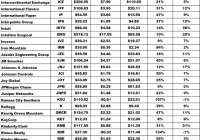
Summary Analysis of the components of the SPDR S&P 500 ETF (SPY) using my CapFlow and FROIC ratios. Specifically written to assist those Seeking Alpha readers who are using my free cash flow system. Part II will concentrate on “Main Street” while Part I in the series concentrated on “Wall Street”. Back in late December I introduced my free cash flow system here on Seeking Alpha, through a series of articles that you can view by going to my SA profile . My purpose in doing so was to try and teach as many investors as I could on how to do this simple analysis on their own as I believe in the following: “Give a person a fish and you feed them for a day, Teach a person to fish and you feed them for life” I have been very pleased with the positive feedback that I have received so far, but included in that feedback were many requests by those using my system, to see if they did their analysis correctly or not. Since the rate of these requests have been increasing with every new article I write, I have decided to start a new series of articles here on Seeking Alpha analyzing the SPDR S&P 500 ETF (NYSEARCA: SPY ), where I will analyze each of its components individually. That way those of you using my system will have something like a “teacher’s edition” that will give you all the correct calculations for each component. Obviously I can’t include the results for all my ratios in one article, so I will thus be doing a series of articles, where each ratio’s results for the SPDR S&P 500 ETF will have its own article devoted to it. Hopefully these articles can be used as reference guides that everyone can use over and over again, whenever the need arises. Having said that, I would suggest that everyone first read Part I by going HERE . There you will find the data on my “Free Cash Flow Yield” ratio which is one of three parts that I use it tabulating my final “Scorecard”. While free cash flow yield is a Wall Street ratio (Valuation Ratio), this article with concentrate on my “CapFlow” and “FROIC” Ratios, which are Main Street ratios. The final Scorecard results will be available in Part III of this series and basically combines all three ratio results to generate one final result. Once completed, my scorecard should give everyone a clearer understanding on how accurate the valuation is that Wall Street has assigned each company relative to its actual Main Street performance. Before we show you the final results of our two Main Street ratios, here is brief introduction to what each of the two ratios, which make up my system as well as what the final “Scorecard” score mean. CapFlow CapFlow is the name I have given to the ratio (Capital Expenditures/Cash Flow). CapFlow allows us to see how much capital spending (or capital expenditures, CAPEX) a company must employ in relation to its cash flow to maintain itself and more importantly grow the company. This ratio is extremely useful as it is both a qualitative and quantitative ratio in that it acts as a laser beam into the inner workings of a company. Quite simply if a company is increasing its profits and doing so by spending less money relative to its growth in cash flow, it should, in theory, outperform on Main Street. When you can have such an occurrence for more than a few years in a row, it clearly shows you have wonderful management in place that knows what it is doing. The ideal again is to consistently have a CapFlow of less than 33% and avoid any company, like the plague, that has a CapFlow of over 100%, as in such a case management is spending more in capital expenditures than it is bringing in from cash flow from operations. That is a recipe for disaster in my opinion. Just using this ratio alone will narrow your list of potential candidates for investment substantially and will give you an easy-to-use tool for judging management effectiveness. FROIC FROIC = Free Cash Flow Return on Invested Capital FROIC= Free cash flow/ (long-term debt + shareholders equity) FROIC basically tells us how much return in free cash flow a company generates for every one dollar of “Total Capital” it employs. I consider FROIC the primary determining factor in identifying growth companies as one can compare every company on an equal basis using this ratio. The question I ask every company I analyze is: “How much return (in percent) in free cash flow are you going to give us for every dollar of total capital you invest?” A FROIC of 20% or more is considered excellent and the higher the result the better. Since long-term debt is included in the invested capital part of the equation, one can see quite clearly by using this ratio, on just how well or how poorly management is managing its debt. So without further ado here are my results for the CapFlow and FROIC ratios for the components that make up the SPDR S&P 500 ETF : Always remember that the results shown above are just for two ratios and that this is not investment advice, but just the results of the ratios. The system outlined in this article and all that will follow, as part of this series, are just meant to be used as reference material to be included as just “one” part of everyone’s own due diligence. So in other words, don’t make investment decisions based on just these two results, but incorporate them as part of your own due diligence.

Shorting China Based On GDP Growth Rate Projections Is Highly Risky

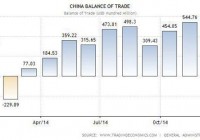
Summary China is looking at record trade surpluses in 2015, which should boost GDP growth. Many China shorts assume GDP growth moves in one direction instead of up and down. Shorting based on projections is risky, especially when there are many factors that can throw off these projections. China’s trade surplus is currently trending up. After a relatively quiet first quarter in 2014, the balance of trade improved drastically throughout the remainder of the year. In fact, the country recorded a record monthly trade surplus of $54.5 billion last November . For the whole of 2014, the trade surplus soared by 47 percent over the previous year and wound up at a record $382.46 billion. (click to enlarge) What’s driving the trade surplus and why they may continue The drastic change in the balance of trade is not all that surprising when the fall in commodity prices is taken into account. Since China is the biggest importer of many commodities, it makes a big difference when it is able to pay less. To illustrate the drop in commodities, the Continuous Commodities Index is down by almost 14 percent over the last 12 months and continues to go down. Crude oil, the most important commodity, is down by more than half. The drop occurred in the second half of the year and accelerated by late November. This will have an impact since China imported 6.17 million barrels per day in 2014, an increase of 9.5 percent over the prior year. With commodities going the way they are, China can expect continued bumper trade surpluses. Trade surpluses should be especially high for at least the next two quarters due to the high base of the preceding year. Barring a drastic rebound in commodity prices, the trade surplus in 2015 is very likely to be substantially higher than the one in 2014, which was already a record setting number. Why China’s trade surplus matters Trade surplus matters because it influences GDP growth. In fact, one of the main components of GDP calculated using the expenditure approach is net exports. The difference between exports and imports, can be a trade surplus or trade deficit. Therefore, a large or increasing trade surplus will boost GDP growth assuming all else remains the same and can help offset weaknesses elsewhere to a certain extent. GDP growth in China is in turn one of the most closely watched metrics by many people. The reason why is simple. As the second largest economy, China is one of the most important markets for many companies around the world. Certain sectors such as commodities are especially sensitive to whatever goes on in China. (click to enlarge) For the fourth quarter of 2014, GDP growth rate came in at 7.3 percent. GDP growth rate for the whole of 2014 was 7.4 percent. The expectation was for 7.2 percent and 7.3 percent respectively. The target set by the Chinese government at the beginning of the year was for “about 7.5 percent” annual GDP growth. China shorts assume that China’s growth rate will go down However, despite GDP growth beating expectations, there are many who remain bearish when it comes to China. For instance, the International Monetary Fund (IMF) projects GDP growth to come in at 6.8 percent for 2015 and 6.3 percent the following year. There are others who are even more bearish. With so much negative sentiment around, it’s no wonder that some may be tempted to short China. The thinking is that a slowing economy will have a negative impact on company earnings, which in turn should affect their valuation. Shorting makes sense in such a situation. However, since there is no one who can accurately predict the future, it’s not possible to say for certain what will happen in the future. It may or may not be true. In other words, expectations that China’s growth rate will continue to go down may be misplaced. (click to enlarge) China shorts will point out that the current growth rate is much less than the double digit growth in previous years. However, contrary to what is often reported, double digit growth in China is actually the exception and not the norm. GDP growth rate does not move in a straight line, but goes up and down along the way. There are many factors that can throw projections off course Record trade surpluses are just one factor that can result in China’s growth rate coming in above expectations. For instance, the IMF originally expected China’s GDP growth for 2014 to come in at 7.2 percent early in the year. They later raised this to match the official government target. In other words, the projections for 2015 could be adjusted upwards in the coming months just like the IMF did the previous year. Furthermore, the Chinese government is a wild card as it has several options available to influence GDP growth. For instance, the one year benchmark lending rate is at 5.6 percent, which is quite high in an era where low interest rates are common. Besides interest rates, reserve requirements for banks is at 20 percent. China also has fiscal reserves that could be used. Depending on what target the Chinese government sets for 2015, it may deploy some or all of the available options. All of which can throw projections way off course, which would have negative implications for shorts that are banking on projections coming true. Shorting China based on GDP growth expectations is therefore highly risky and not recommended.