Tag Archives: undefined

Closed End Funds Vs. ETFs, Which Is Better For You?

CEFs have a long history behind them, but remain an obscure investment option. ETFs are fairly new to the investing world, but have a huge following. Which one is right for you depends on what you want from your investments. Some of the oldest closed-end funds, or CEFs, like Adams Express (NYSE: ADX ), trace their history back as far as the Great Depression. The oldest exchange traded funds, or ETFs, meanwhile, date back to only the early 1990s. But new and exciting things often get the most attention in the market, and ETFs have blossomed while CEFs continue to be the investment world’s unloved step child. That said, it’s worth looking at the pros and cons of the two products. You might just decide that unloved and obscure is more to your liking. What ETFs do well The one thing that ETFs do really well is cheap. Many ETFs have expense ratios in the 0.2% range. And their structure, which is fairly complex, is specifically designed to avoid passing capital gains on to shareholders, although that’s not always possible. This said, the cheapest ETFs are generally pure index following securities, tracking broad indexes like the S&P 500, for example. Newer ETFs are often set up to track more obscure indexes or slices of indexes. Or they have some screening overlay. Whether or not these variants cost more money to run or not is debatable, but ETF sponsors are certainly charging more. For example , the WisdomTree BofA Merrill Lynch High Yield Bond Negative Duration ETF (NASDAQ: HYND ), yes that is the ETF’s real name, has an expense ratio of 0.48%. Some ETFs are even more expensive. Unfortunately, many of the newer funds, like this one, really aren’t meant for novice investors. Closed-end funds, meanwhile, don’t do such a good job when it comes to costs. Adams Express is one of the cheaper options, with an expense ratio of about 0.6% according to the Closed-End Fund Association . It isn’t odd to see CEFs with expense ratios of around 2%. That’s a notable disadvantage compared to ETFs, though higher cost funds often make use of leverage, which elevates expenses but can help augment performance during good markets. (Leverage tends to exacerbate losses in bad markets.) ETFs also do a good job with diversification. With one relatively cheap security you can get exposure to a broad market index, a specialty index, or the list of stocks that pass some unique screening technique. While closed-end funds aren’t usually structured around an index, they too provide diversification. So, too some extent, this issue is a wash and I wouldn’t assign a clear winner either way. In fact, as ETFs have proliferated, they have become increasingly more obscure-a fact that could lead investors to buy something that may not be as diversified as they think. For example, nearly a third of the Energy Select Sector SPDR ETF (NYSEARCA: XLE ) is in just two stocks, Exxon Mobil (NYSE: XOM ) and Chevron (NYSE: CVX ). That’s a lot less diversification then you might be expecting. What ETFs do badly If you believe fully in the efficient market hypothesis, then buying index funds is the only thing you’ll ever do. And ETFs will be a great choice. However, I’ve found that markets are efficient on the whole, but not at all times. Investors often send stocks to unreasonable lows and unreasonable highs. At the low end, savvy investors can pick up bargains. At the high end, capitalization weighted indexes wind up over exposed to the best performers. That can lead to steep sell offs when investing tides start to turn since ETFs can’t decide to take profits and move on to another opportunity. ETFs that use fundamental screening techniques, equal weighting, and fundamental weighting all attempt to deal with this issue. But following an index means you are stuck with whatever that index is doing, even if you Jerry rig the index it to create a good sales pitch. Wisdom Tree’s entire business is built on using screening techniques and different weighting schemes, with products like the WisdomTree LargeCap Dividend ETF (NYSEARCA: DLN ), which invests in large cap dividend payers and is weighted by dividend. It’s a good story if you like dividends, but the yield is around 3.8% , not exactly a huge dividend story. And the portfolio is only rebalanced on an annual basis , look out if something bad happens to a top holding during the year. Closed-end funds, with human beings at the wheel, can make choices. That may be as base as getting out of the market during a downturn (index funds can’t do that) or buying a company that looks horrible based on numbers, but has some other attribute that suggests its luck is about to turn. Examples of that include things like a new contract or a change in management. And with no need to buy and sell shares every day like an open-end mutual funds, manager of closed-end funds have more freedom than the managers of most publicly available pooled investment products to do what they believe is best. This actually leads to one of my biggest pet peeves with ETFs-they can’t discriminate or choose not to. For example, an ETF that invests in the utility industry will likely own whatever utilities are large enough and liquid enough. The biggest utilities get the most money. That’s it, that’s the “magic” behind the ETF. It doesn’t matter what the regulatory environment is in a utility’s region, even though that’s an incredibly important factor in a utility’s future. As long as an ETF knows its a utility and can trade it, it’s in. CEF, the Reaves Utility Income Fund (NYSEMKT: UTG ), on the other hand, looks at regulatory environments , among other things, when assessing an investment. The human touch may raise the price of admission, but it can add value in many situations. What CEFs do exceptionally well One thing that CEFs do well that most other investments don’t, including most ETF and open-end mutual funds, is income. Many closed-end funds are specifically designed to pay investors a set monthly or quarterly distribution. With more and more baby boomers reaching retirement age, a steady income stream is going to be increasingly important. If that’s what you’re looking for, you should at least consider CEFs. There is a legitimate debate to be had about the implications of return of capital, which CEFs can use in bad years to sustain a distribution. That can lead to the fund’s net asset value falling over time if return of capital is used too often. However, in a bad market, you might have to dip into capital, too, if you were managing your own portfolio. And it’s important to note that return of capital is a complex issue. If the funds net asset value, or NAV, is going up, then return of capital isn’t that big a concern because it’s likely more of an accounting issue than anything else. Reaves, for example, has never cut its distribution and never used return of capital. The BlackRock Health Sciences Trust (NYSE: BME ) is another fund that’s done well over the long term with scant use of return of capital. That said, in fiscal 2014 return of capital accounted for roughly 2% of its fiscal 2014 distributions . Since the NAV was up over $5 during that year the $0.07 a share or so of return of capital really wasn’t a big deal. Another thing that closed-end fund do well is bargains. This is because they trade like stocks, but have portfolios like ETFs or mutual funds. Thus, the NAV of a closed-end fund can differ materially from its share price (in a truly efficient market this would be impossible, by my thinking). That can allow an investor to pick up $1 worth of investments for as little as $0.80. ETFs rarely trade far from their NAVs (open-end mutual funds never do). So if you like deals, CEFs win hands down. This or that So what type of investor would want an ETF? The most obvious choice is someone looking for the cheapest and easiest way to gain exposure to a given market or sector. For example, an investor looking for broad stock market exposure might choose the SPDR S&P 500 Trust ETF (NYSEARCA: SPY ), the granddaddy of S&P 500 ETFs, or for even more diversification, the Vanguard Total Stock Market ETF (NYSEARCA: VTI ), which essentially tracks the entire U.S. stock market. SPY’s expense ratio is 0.0945% and VTI’s expense ratio is an even smaller 0.05%. Pair these up with a bond ETF, like the Vanguard Total Bond Market ETF (NYSEARCA: BND ), and you have a diversified portfolio. BND’s expense ratio , by the way, is just 0.08%. With just two ETFs, you’d get exposure to every U.S. stock and bond with minimal expense. That said, not everyone wants to use a hands free approach. For more active investors, ETFs are also good for someone looking to time the market or jump into a hot sector without having to know much about the companies in it. Want exposure to technology because you think it’s about to take off? Try the Technology Select Sector SPDR ETF (NYSEARCA: XLK ). It’s relatively cheap and gives you a portfolio filled with some of the largest and most important tech names in the world. You can find an ETF for just about any sector you might be interest in jumping in and out of quickly. But, as I noted above, there can be drawbacks to investing in an index. The Reaves Utility Income Fund is a great example. Not all utilities are made equal and there are factors beyond being included in the S&P 500 Index that may make a utility worthwhile, or not. So by purchasing the Utilities Select Sector SPDR ETF (NYSEARCA: XLU ) you will quickly own the utilities in the S&P 500, but not necessarily the utilities best positioned within the industry. Reaves takes a broader look at the companies and industry. And if you are looking for income you’ll definitely want to look at CEFs, which do income better than most other pooled investment products. For example, pair the Gabelli Equity Trust (NYSE: GAB ) with the MFS Charter Income Trust (NYSE: MCR ) and you have a broadly diversified portfolio. And since GAB pays out $0.15 a share quarterly for an around 8% yield and MCR pays $0.045 a share every month for an around 7.5% yield, you’ll have a nice income stream to live off of. To some extent, these two funds were picked at random, but they get the point across. For comparison, VTI’s yield is around 1.8% and BND’s yield is about 2.7%. That’s a lot less to live on. In addition, if you like the idea of finding bargains driven by human inefficiencies, CEFs are the way to go. For example, GAMCO Global Gold, Natural Resources & Income Trust (NYSEMKT: GGN ) has a habit of selling for less than its NAV toward the end of the year with the gap closing as the new year progresses. Just such a trading opportunity took place this past month. But, longer term, you can find bargains, too, since many closed-end funds trade at discounts to their NAVs, often for long periods of time. That, in turn, increases the income you earn from the CEFs relative to owning the securities in the fund’s portfolio directly. A fund with a 10% discount to NAV means a fund paying you 10% more than you would get if you bought the same portfolio directly. MFS Charter Income Trust, for example, is trading at an over 10% discount according to the Closed-End Fund Association . Beauty is in the eye In the end, both ETFs and CEFs have their pros and cons. I’ve only touched on the issues I think most salient, I’m sure you can find some more things to like and hate about each. That said, they both have their place in the world of investing. If you believe there are inefficiencies in the market and like the idea of a human being being involved in the investment process, you’ll want to look at closed-end funds despite their negatives. If you prefer computer driven and cheap, then ETFs will be your masterpiece, even though they aren’t perfect. But, regardless of which one you pick, you should take the time to think about how their inherent strengths and weaknesses fit with your portfolio and personality. It could save you from jumping ship at exactly the wrong time or open you up to a whole new area of the investment world that you’ve never looked at before.

Exelon Corporation: A Promising Investment Opportunity

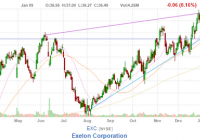
Summary The acquisition of Pepco will grant Exelon enhanced operational capacity as well as increase its ability to serve a greater number of customers in the different counties of the United. This acquisition will also result in expanded regulated business that will improve Exelon’s risk profile and ensure more stable revenue and earning steams compared to unregulated operations. Moreover, the hedging of commodity risk has not only ensured Exelon’s future earnings stability but has also given it a competitive edge in the industry. The company has a significant amount of debt to supports its project financing which will result in a focused business model. Based in Chicago, Illinois in the United States of America, Exelon Corporation (NYSE: EXC ), a well-known energy producer, has been pleasing its investors for a long time and has witnessed a sharp rise of more than 35% in its stock price over the past year. Source: Finviz The impressive performance was mainly due to some smart moves recently taken by the company. These initiatives have not only made the future profits more predictable but they have also given Exelon a competitive edge in the market. I believe Exelon is a promising investment opportunity for the long term. Let us analyze a few factors that support my opinion on the stock. Strategic Acquisitions and Divestitures Have Resulted in a More Focused Business Model Exelon Corporation has been making several acquisitions over the past few years that have not only enhanced its operational capacity but have also enabled it to enter and cater to new and growing markets. In April 2014, Exelon announced it would acquire Pepco Holding, Inc. which is one of the largest energy delivery companies in the Mid-Atlantic region that currently serves approximately 2 million customers in Delaware, the District of Columbia, Maryland and New Jersey. This merger will bring together Exelon’s gas and electric utilities – BGE, ComEd and PECO – and Pepco Holdings’s (PHI’s) electric and gas utilities – Atlantic City Electric, Delmarva Power and Pepco thus improving the combined operational capacity. This acquisition will enhance the company’s operational capacity as well as increase its ability to serve a greater number of customers in the different counties of the United States. As Exelon’s CEO said, “The combination of our companies will provide us an opportunity to take the customer service and reliability improvements we’ve already made in Maryland to an even greater level.” Moreover, the acquisition of Pepco will result in expanded and strong regulated business operations. This merger is expected to increase Exelon’s regulated business exposure to 60% to 65% during 2015-2016 which was previously approximately 55% to 60% on a standalone basis. The expanded regulated business will result in an improved risk profile with more stable revenue and earning steams compared to non-regulated operations. However, the Public Service Commission (PSC) has recently asked for some changes in the merger requirements that Exelon’s president has not agreed with. Since the PSC staff has demanded all the utilities to be managed at micro level with an independent board of directors for Pepco, this would impair Exelon’s ability to exercise control over its subsidiaries. Among the requests, the PSC staff has also demanded a $50 payment to each Delmarva residential customer, a $40 million 10-year set aside for Delaware workers’ job protection and some charitable commitments. These requests, if agreed upon, can result in heavy costs for Exelon thus hurting its future profitability. On the other side, the non-inclusion of these points would force the staff to push the commission to deny the company’s merger application. Presently, Exelon is facing a dilemma regarding the commission’s demands. This posed a possible risk to its future profitability. Perhaps, fair negotiations with the PSC staff could result in a win-win situation. Similarly, Exelon has been selling some of its non-core business assets in order to create a more optimized asset portfolio. To date, the company has divested five non-core assets which has resulted in nearly $1.4 billion of after-tax sales proceeds. This included the sale of its Fore River, Quail Run and West Valley plants for total after tax proceeds of $975 million during the third quarter of 2014. The company can use the sales proceeds to finance the acquisition of Pepco and build two combined-cycle gas turbine (CCGT) units in Texas that will enhance the company’s generation capacity as each unit is expected to add nearly 1,000 MW of capacity to their respective sites. Strategic acquisitions and dispositions have resulted in a more focused business model with improved generation capacity. This will support Exelon’s ability to successfully cater to the growing markets and give it an edge over those in its peer group. Effective Hedging Ensues Stable Earnings in Future Exelon’s energy generation business is exposed to commodity price volatility that can reasonably affect its future top and bottom lines. I believe the company can ensure stable revenue and earning streams in the future because it effectively reduces the commodity risk by hedging a portion of its portfolio on a three-year rolling basis. The hedge targets are approximately 90% – 98% in the first year, 70% – 90% in year two and 50% – 70% in year three. Source: Investor Presentation The hedging activity will help the company to meet its future cash requirements and other financial objectives that include dividends and investment-grade credit rating under a stress scenario. This again gives Exelon a competitive edge in the market and makes it an attractive investment option especially for dividend investors who seek a stable cash flows stream. Significant Debt Financing Supports the Core Business In the past, Exelon raised a significant amount of debt for project financing. Over the past three years it has successfully raised nearly $3 billion to finance several projects including Antelope Valley Solar Ranch, ExGen Renewables, Continental Wind and ExGen Texas Power. These projects have significantly increased the company’s generation capacity with no debt maturing earlier than 2021. Moreover, the company recently announced it would issue $750 million of senior notes maturing in 2020 with a coupon rate of 2.95%. The net proceeds will partially be used to pay-off Exelon’s exiting senior loan notes of $550 million with a coupon rate of 4.55% maturing in June 2015. This would result in interest costs savings of nearly $9 million annually and $4.5 million semi-annually that will boost the company’s future bottom line. Additionally, the remaining proceeds can be used to finance the Pepco acquisition that is expected to benefit Exelon in the long term. Significant debt financing will help Exelon to expand its core business and increase its generation capacity which will in turn support its ability to appropriately cater to the market. Rising Competition can limit its Future Growth Although Exelon is the largest nuclear energy producer in the United States, many alternative energy producing methods can give the company a tough time in the coming years. Presently, natural gas energy producers seem to maintain the lead. Due to the heavy capital outlay required for nuclear power plants and the way their reactors work, it is not easy to stop power generation whenever desired. On the other hand, natural gas fired plants are less capital intensive and the power generation can be easily tailored to meet the desired demand schedule. This gives natural gas energy producers a cost advantage over nuclear energy producers, thus enabling them to easily attract a greater number of customers by offering lower prices. Moreover, rapidly declining natural gas prices are further reducing the electricity production cost for these energy producers. During December 2014, the U.S. natural gas prices fell below $3 per million British thermal units for the first time since 2012. Source: Yahoo Finance Natural gas is the second largest source of power generation in the U.S. and produced nearly 27% of the country’s total electricity in 2013. The continuous decline in the natural gas prices and flexibility offered by less capital intensive natural gas fired plants supports the energy producers’ ability to price electricity at comparatively lower rates than nuclear energy producers thus capturing a major market share. In addition, the conventional energy producing methods including the coal fired and nuclear plants are severely affecting our climates, economies and most importantly, health. The electricity production in the United States accounts for more than one third of the total global warming emissions by the country. The coal fired power plants accounts for nearly 25% of these emissions whereas, natural gas fired plants represent only 6%. The rising concerns about global warming have forced many countries to invest in clean energy. The graph below shows the rising trend of clean energy consumption in the last 5 decades in different countries of the world. Source: Vox As the government is continuously encouraging the use of renewable source of energy, many renewable energy producers will witness a rising demand curve for their services in the near future. PPL Renewable Energy, one of Exelon’s competitors, is concentrating on natural gas and wind energy for power generation and has benefited from the falling natural gas prices in the past. Moreover, the company is continuously increasing its investment in renewable and clean energy production. Its hydroelectric expansion project in Montana has increased its clean energy generation capacity by 70% . The company’s hydro plants in Pennsylvania and Montana have a combined capacity of 757 megawatts of clean energy. Since Exelon is facing intense competition from both natural gas and renewable energy producers, it needs to focus on and invest in alternative energy producing methods for maintaining its market share. Conclusion The sum and substance of my analysis is that Exelon’s recently enacted initiatives have made it is well-positioned to serve the growing market. The strategic acquisitions and dispositions have resulted in a more focused business model along with improved generation capacity. A significant amount of debt financing also supports its future projects. Moreover, the hedging of commodity risk has not only ensured Exelon’s future earnings stability but has also given it a competitive edge in the industry. All of these factors make Exelon a safe and promising investment opportunity for long-term investors. However, Exelon also needs to focus on and invest in natural gas and clean energy producing methods for maintaining a decent market share in this highly competitive environment. Based on my analysis, I give the stock a buy recommendation.

Why Muni Closed-End Funds May Not Do Well In 2015

Summary CEF Muni funds from 1995 to 2014 that show in 2007 and 2011 that highest number has gone down 2 to 3 years to the lowest number. High-Leveraged and Low Leverage, what is the difference? Hedge Funds for municipal bonds. European Central Bank : Since the financial crisis in 2008, the U.S. Federal Reserve, the Bank of England (BOE), and the Bank of Japan (BOJ) have each utilized quantitative easing. Then on Thursday January 22, Mario Draghi revealed that the European Central Bank (ECB) plans to purchase over €1 trillion ($1.157 trillion) in European public and private sector bonds by the fall of 2016. This means purchasing €60 billion a month of government bonds, debt securities issued by European institutions and private sectors bonds. Though the jury is still out regarding the effectiveness of such measures, as of now it is “all over, but for the shouting”. While this policy is expected to push down European yields, rates in the U.S. will likely be moving in the other direction by year-end. So, what does all of this monetary policy mean for CEF Municipal Bond Funds? (click to enlarge) CEF Strategies from 1995 to 2014 : GrowthIncome has provided a table below plotting the annual performance for 11 Closed-End Fund sectors from 1995 to 2014. Each column is ordered from best to worst annual performance. This table also contains a line connecting the position of the MuniBndFnd (Municipal Bond Funds) sector for each year. As you see, MuniBndFnds fund types have its year-to-year rankings both above-and-below its previous year-as with all other fund types strategies As you can see in the left most column of the chart, the MuniBndFnds sector provided the best returns during 2014. MuniBndFnds were also at the top of the list in 2007 and 2011. Yet, in subsequent years (2008 and 2012), the sector plunged from number 1 to number 6, and then even further to the bottom of the pile within the next 2-3 years (2010, 2013). So, if history is any indication, it would be wise to take a closer look at MuniBndFnds after it was the best performing sector the year prior. Municipal Closed-End Funds : There are approximately 181 municipal (national and state) Closed-End funds. On average, MuniBndFnds are leveraged at 33.7%, have a 5.5% tax-free yield, a discount of -6.6%, and a 1.1% baseline fee. The market cap average is $327 million. MuniBndFnds: High & Low Leveraged: To understand this sector a bit better, GrowthIncome has put the 5 highest leveraged funds and the 5 lowest leveraged funds into 2 separate groups: 5 High-Leveraged and 5 Low-Leveraged . Chart 2 contains the results of subtracting the averages of the 5 Low-Leveraged group from the 5 High-Leveraged group. Specifics for each fund and the averages for each group can be found in charts towards the end of the report Subtracting 5 Low-Leveraged from 5 High-Leveraged : Subtracting the averages of the 5 Low-Leveraged group from the 5 High-Leveraged group results in a distribution yield of 2.3% (High: 6.4% – Low: 4.1%) and a leverage of 41.4% (structural leverage: 35.0% and effective leverage: 6.4%). A few other metrics of note are Basic Expense, Interest Expense, and Annual Expense Ratio which come in at 0.91%, 0.12% and 1.03%, respectively. It seems 5 High-Leveraged funds have a portfolios coupon advantage. The coupon between 5 High-Leveraged versus 5 Low-Leveraged is 2.2% (High: 5.2% – Low: 3.0%). This is most likely a result of the 5 High-Leveraged group placing 13.6% of their portfolios in “unrated” municipal bonds while the 5 Low-Leverage group placing only 3.5% (a subtraction of 10.0%). UNII : The Undistributed Net Investment Income (UNII) of the High-Leveraged group is $0.0964 minus the UNII of the Low-Leverage group of $-0.006 results in a UNII of $0.1024 per share. So, the High-Leveraged MuniBndFnds have much more UNII than the Low-Leveraged funds. Dividend Cuts : Of the 5 High-Leveraged funds, only 1 cut their distribution in 2014: PIMCO CA Municipal Income II (NYSE: PCK ) . The 2014 monthly dividend rate dropped from $.0625 to $0.538, a 13.9% decline, in May. However on the Low-Leveraged side, 4 of the 5 funds cut distributions in 2014. The only fund that didn’t was Nuveen CA Muni Value (NYSE: NCA ). Nuveen Select Tax-Fee Income (NYSE: NXP ) cut it monthly distribution in 2014 once by 7.6%. Three (3) funds cut their distributions 2 times in 2014. This was Nuveen Select Tax-Free Income 2 (NYSE: NXQ ) by 12.4%, Nuveen Municipal Value (NYSE: NUV ) by 6.8% and Nuveen Select Tax-Free Income 3 (NYSE: NXR ) by 6.7%. Auction-Rate Preferred Shares : Each of the 5 High-Leverage funds uses Auction-Rate Preferred Shares (“ARPS”) for their structural leverage. Since mid-February 2008, holders of auction-rate preferred shares (“ARPS”) issued by the CEF’s have been directly impacted by a lack of liquidity. These funds have consistently “failed” because of insufficient demand to meet the supply of such securities. However, as their “failure” to issues such securities, the penalty rates for the securities is a average “maximum rate” equal to the higher of the 30-day “AA” Composite Commercial Paper Rate multiplied by a minimum of 110% or the Taxable Equivalent of the Short-Term Municipal Obligations Rate-defined as 90% of the quotient of (A) the per annum rate expressed on an interest equivalent basis equal to the S&P Municipal Bond 7-day High Grade Rate Index divided by (B) 1.00 minus the Marginal Tax Rate (expressed as a decimal) multiplied by a minimum of 110% (which is a function of short-term interest rates). However, the interest rates on “ARPS” have been below 0.25% points for the hundreds of millions of dollars to “ARPS” debt. This debt is highly accretive to leveraged funds. As with PIMCO NY Municipal Income II (NYSE: PNI ), the average EPS as it related to the dividend is -11.6%. This may be out of line for the High-Leveraged CEF’s. PNI premium is 6.9%. (click to enlarge) Low-Leverage Funds : Nuveen manages each of the 5-Low-Leveraged funds, which have an average coupon rate much lower than that of the 5 High Leverage d funds. This may be due to the level of unrated municipal bonds between the two groups. 3 of the 5 High-Leveraged funds are state municipal funds whereas the Low-Leverage funds only have 1. However, the two High-Leveraged funds that are national have an average 5.1% coupon while the 4 national Low-Leveraged funds have an average 2.8%coupon. It’s seems to me that Nuveen, which has a slew of municipal bonds, may not be paying attention to their holdings. (click to enlarge) Hedge Funds : If interest rates go up at the end of the year, both High and Low Leveraged Closed-End Funds will likely go down so. If you don’t have a “hedge” against MuniBndFnd your stock losses may mount up. We have Muni tax-free ETF known as iShares National AMT-Free Muni Bond (NYSEARCA: MUB ). MUB has a $4.12 billion net assets value (NAV), a 2.7% tax-free yield and a 0.25% expense ratio. Additionally, we have taken a counter indicator to the MUB call ProShares Short 20+ Year Treasury (NYSEARCA: TBF ) . This may cancel out each other when the stock price moves. TBF has a Net Asset Value of 1.06 billion with a 0.92% expense ratio with no dividends. Joe Eqcome, GrowthIncome Research & Management, LLC