Tag Archives: stocks

American Century Launches New Fund And New Alternatives Brand

By DailyAlts Staff Although American Century launched its initial alternative mutual fund more than a decade ago, the firm is best known for its traditional strategies involving stocks, bonds, and cash. But American Century has been making more of a push into liquid alts, with the hiring of Cleo Chang as Head of Alternative Investments, and the recent launch of the AC Alternatives Income Fund (MUTF: ALNNX ). The new fund is the first of several to be launched as part of American Century’s new AC Alternatives brand, and the firm’s other alternative products have been re-branded as part of the AC Alternatives line, as well. AC Alternatives Income The newly launched AC Alternatives Income Fund is managed by Perella Weinberg Partners Capital Management, a leading global institutional asset manager with over $9 billion in assets under management. The firm’s sub-advisory team is headed by Chris Bittman, chief investment officer of Perella Weinberg’s outsourced CIO service unit Agility, and rounded out by his Agility colleagues Kent Muckel and Darren Myers. “We’re excited to be collaborating with Perella Weinberg to bring our clients a range of alternative investment solutions,” said Ms. Chang, in a recent statement. “Perella Weinberg’s experience managing both traditional and non-traditional asset classes serves as a nice complement to American Century’s own expertise as a multi-boutique, risk-aware, institutional-quality asset manager.” “For the new AC Alternatives Income Fund, we’ve assembled a team of portfolio managers and subadvisors with deep experience investing across a range of asset classes under varying market conditions,” said Mr. Bittman. “Like American Century, our asset management business is predicated upon the principle that, over time, a client’s success ultimately translates into the success of the firm.” Mr. Bittman and the rest of the Perella Weinberg sub-advisory team seek to provide the fund’s shareholders with “diverse sources of income” by using a “flexible and opportunistic investment strategy” that allocates assets among various underlying subadvisors, each pursuing different investment strategies. Currently, the fund’s sub-sub-advisors include Arrowpoint Asset Management, Sankaty Advisors, Third Avenue Management, and Good Hill Partners. American Century Investments provides additional oversight. ACAlternatives.com In addition to the re-branding of American Century’s two previously existing alternative funds with the AC Alternatives moniker – the AC Alternatives Equity Market Neutral Fund (MUTF: ALHIX ) and the AC Alternatives Market Neutral Value Fund (MUTF: ACVVX ) – American Century has also launched ACAlternatives.com as an alts-education website. A section at the site titled ” What are Alternatives? ” lists 6 reasons to own alts, the evolution of alts, types of liquid alts, and liquid alts versus private structures; another section on ” Using Liquid Alternatives ” provides links to pages on allocating, special goals, and risks. ACAlternatives.com is optimized for tablet users and also features insights from investment professionals, videos, and “other tools designed to help investors make informed decisions when considering alternative investments.” AC’s Other Alts The fund now known as the AC Alternatives Equity Market Neutral Fund was originally launched back in 2005. For the three years ending July 31, the fund’s 2.23% returns ranked in the top one-third of funds in its category, earning it a four-star rating from Morningstar. American Century’s Market Neutral Value Fund was launched in 2011. Its three-year returns of 3.00% through July 31 ranked in the top 22% of funds in its category, earning a matching four-star rating. The AC Alternatives Income Fund, which launched on July 31, is just the first of three Perella Weinberg-advised funds American Century plans to launch this year. The others will include the AC Alternatives Equity and AC Alternatives Multi-Strategy funds. The former will combine several equity-oriented strategies in pursuit of attractive returns with low correlation to the stock market; while the latter will employ several sub-strategies, including long-only equity, long/short equity, and event-driven, in pursuit of the attractive returns with low correlation to the stock and bond markets.
Evaluating U.S. Low-Volatility ETFs: USMV Vs. SPLV

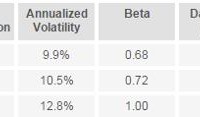
Low-volatility ETFs have close to $20 billion in AUM. Both USMV and SPLV achieve their objectives against the benchmark. USMV has been the more efficient and cheaper choice than SPLV thus far. Ever since I wrote my thesis on minimum-variance portfolios six years ago, I have maintained a strong interest in low-volatility investing. This type of investment has gained popularity over the last few years with the US markets now featuring 21 low-volatility ETFs that have combined assets under management of almost $20 billion. I have decided to take a look at how the largest funds in this space have performed from the risk perspective. For the purpose of this analysis, I have focused on the two flagship low-volatility ETFs – the iShares MSCI USA Minimum Volatility ETF (NYSEARCA: USMV ) and the PowerShares S&P 500 Low Volatility Portfolio ETF (NYSEARCA: SPLV ) – which have around $5 billion of AUM each. Both of these funds invest solely in the US stock market, making them easy to compare. The SPDR S&P 500 Trust ETF (NYSEARCA: SPY ) is used as the benchmark. Utilizing the freely available investor tool on InvestSpy and using the full data history, I obtained the following results: (click to enlarge) The table above reveals that both USMV and SPLV demonstrated substantially reduced beta and realized volatility than SPY. However, the degree of success differed, as USMV had a lower beta (0.68 vs. 0.72) and lower realized volatility (9.9% vs. 10.5%) compared to SPLV, making the former a superior performer from the risk perspective. In addition to that, USMV delivered a 6.7% higher total return than SPLV whilst both low-volatility ETFs trailed SPY. Looking at the correlations computed on the same analytical website, it turns out that both funds had a correlation with SPY of 0.88. Although the figure is relatively high, this is still a favorable finding given that these funds invest pretty much in the same universe of stocks as SPY. Analyzing the data only for the last year yields a similar result, as USMV again outperforms SPLV in all respects. However, the overall benefit from the low-volatility phenomenon has been weaker over the last 12 months, as beta values increased above 0.8 and annualized volatility was much closer to that of SPY’s, particularly in the SPLV’s case. (click to enlarge) The correlation coefficients have also changed in the past year with USMV and SPLV moving even closer together. It is interesting to note that USMV’s correlation coefficient with SPY has increased sharply to 0.95, making it a less desirable portfolio component from the diversification perspective. Summing up, USMV appears to have beaten SPLV thus far virtually in all respects, posting lower beta, lower realized volatility and higher returns. In addition to that, USMV was also a cheaper alternative, charging 0.15% as opposed to 0.25% by SPLV. However, it is important to note that markets constantly evolve and investors should monitor the performance of “smart beta” products on a regular basis. It is hard to make a case for SPLV now, but a simple change such as the recent spike in correlation with the S&P 500 may easily put USMV out of favor. Disclosure: I/we have no positions in any stocks mentioned, and no plans to initiate any positions within the next 72 hours. (More…) I wrote this article myself, and it expresses my own opinions. I am not receiving compensation for it (other than from Seeking Alpha). I have no business relationship with any company whose stock is mentioned in this article.

PIMCO High Income Fund: Is The Pain Over?

Summary PHK’s premium has fallen from over 50% to around 30%. That’s a big drop and well below the CEF’s 3-year average premium. So is the pain over and now the time to buy back in? The PIMCO High Income Fund (NYSE: PHK ) is a contentious closed-end fund, or CEF, that has a long history of trading at an impressive premium to its net asset value, or NAV. Right up front, I’m not a big fan of any CEF trading above its NAV, particularly at such an extreme premium. However, after such a large drop, some investors may be wondering if the hurt is over and whether now might be a good time to buy in. A little background To understand why a closed-end fund trades at a price different than its net asset value, you have to understand how CEFs differ from their mutual fund cousins. Mutual fund sponsors stand ready to buy and sell shares at the close of every trading day at NAV. Therefore, there’s a premade liquid market at NAV. Closed-end funds, meanwhile, sell a set number of shares to the public. Those shares then trade based on supply and demand on the open market. If investors like a CEF for whatever reason, they will demand a higher price to get them to sell. And if investors don’t like a CEF for some reason, they will take lower prices to get out. Thus, CEFs trade above and below their NAV. The NAV is still what the shares are worth – it is their intrinsic value, if you will. But it isn’t always what they will trade for. Using a simple example, if investors are fond of biotechnology a biotech-focused CEF might find itself trading at a 10% premium to NAV. The reason is investor sentiment; essentially investors are saying they expect good things from the CEF in the future. The important take away is that investor sentiment is the driving factor – not the actual value of the CEF’s shares. People really like PHK Closed-end funds normally trade around their NAV or at a discount. It’s unusual to see a CEF with a long history of trading well above NAV. PHK, then, is an exception to the norm. It’s long traded at a premium, and notably, at an extreme premium to its NAV. For example, its three-year average premium is nearly 50%. Its five-year average is just over 50%. People really like PHK. I’ve posited that the reason for this premium was partially because Bill Gross took over managing the fund in 2009, the year in which the premium started to widen. Since he’s no longer there, others have noted the fund’s steady distribution even through a difficult market period – notably the 2007 to 2009 recession. In the end, it’s probably a combination of the two. But whatever the reason, the CEF has a long history of trading well above its NAV. Which is why some argue that the selloff from an over 50% premium to the more recent 30% premium is a buying opportunity. This is a normal investment approach in the closed-end fund space, buying when a CEF is notably below its average premium/discount. The idea being that investor sentiment likely went too far in one direction and will eventually swing back toward the historical level. On the one hand, this makes sense for PHK. The average premium is close to 50% in recent history, so at a 30% premium, it’s fallen pretty far from the norm. In fact, this isn’t the first time there’s been such a drop. In the back half of 2012, PHK went from a roughly 75% premium down to a 25% premium before recovering to a 40% premium and eventually to the 50% and 60% levels seen earlier this year. I’d say, for aggressive investors who like to trade premiums and discounts, this is a CEF you should be looking at. Still too expensive But if you are a conservative investor, you should still avoid PHK. Why? We know with almost no doubt what PHK is worth; that’s the point of net asset value. That’s the value of PHK, no more and no less. If you buy PHK for a 30% premium, you are paying 30% more than its portfolio is worth on a per share basis. One of the reasons why playing premiums and discounts works is because you know the value of the asset you are buying – its NAV. So when a CEF is trading well below its NAV, there’s a clear catalyst for the discount to narrow. As investors realize the disconnect between price and value, they’ll correct it. PHK, however, is trading below its historical premium . Which means that anyone buying now is betting that investor sentiment will improve so that the premium gets wider. That’s akin to momentum investing in which you buy an expensive stock hoping that you can eventually sell it to someone at an even more expensive price – with little regard to its intrinsic value. There’s nothing wrong with this when it works, and it does work for some people. But it can also go horribly wrong when investors have changed their minds. Think back to the carnage in the dotcom bust, when investors realized that they didn’t like Internet companies as much as they thought they did. The companies didn’t change, investor psychology did. So, if you are a conservative investor, why bother buying something you know is overpriced? There are so many investment options in the market that taking such risks just isn’t worth it. And that’s true even taking into consideration PHK’s 15% yield. I’d rather take a yield half that and sleep well knowing that I don’t have to rely on fickle investors to buy my shares at a higher price. Or, better, yet, I’d rather buy something trading below its NAV and below its average discount, and wait for the market to realize the price disparity. With the NAV being a magnet to draw investors in to an undervalued investment opportunity. So, if you are an aggressive CEF investor looking to play discounts and premiums, PHK is definitely worth a look. Just go in knowing the game you are playing. I’d still suggest caution, but the fall from the average at PHK fits the bill for the trade. For conservative investors, don’t get sucked in by a big yield or the fall in the premium. PHK is still expensive even after its premium has fallen some 20 percentage points, and the yield just isn’t worth paying a still high 30% premium. You’ll be better off investing elsewhere. Disclosure: I/we have no positions in any stocks mentioned, and no plans to initiate any positions within the next 72 hours. (More…) I wrote this article myself, and it expresses my own opinions. I am not receiving compensation for it (other than from Seeking Alpha). I have no business relationship with any company whose stock is mentioned in this article.