Tag Archives: setpageviewname

25 Things I Wish I Learned Before I Opened My First Brokerage Account

Portfolio strategy, ETF investing, foreign companies “}); $$(‘#article_top_info .info_content div’)[0].insert({bottom: $(‘mover’)}); } $(‘article_top_info’).addClassName(test_version); } SeekingAlpha.Initializer.onDOMLoad(function(){ setEvents();}); Brett Arends had a great post about what he wished he’d learned before graduating high school. With a nod to Arends; things people should know about finance and investing before they start and should be reminded of every so often as they go along. When someone wants to give you free money, like your employer in your 401k, take it. Brett Arends had a great post about what he wished he’d learned before graduating high school . It was a great mix of financial nuggets, points about not wasting time or money and some other generally sound ideas. With a nod to Arends; here is my list of things people should know about finance and investing before they start and should be reminded of every so often as they go along. Don’t rack up credit card debt but if you do, make a priority of getting out quickly and then staying out. Have an emergency fund that will tide you over X number of months but don’t put it into something that can go down a lot (or at all) in value. X should equal your comfort level. When someone wants to give you free money, take it… like your employer in your 401k. Put in enough to at least max out the match. If a 10% contribution from you is matched by your employer with an additional 3% that is like getting a 30% return. Fund your Roth IRA every year in addition to a 401k or similar workplace plan. Start saving when you are young, the older you will be grateful. The more you save the more options you will have later, you have no idea what the future you might want to do so give him some flexibility. Make an extra mortgage payment every year, the future you will be grateful. Live below your means. Have respect for whatever you did to accumulate however much you have saved. Your savings is one of hopefully several byproducts of your career, don’t disrespect that effort by speculating carelessly. A great advisor will absolutely have your best interests at heart but it is not possible for that advisor to care about your money more than you. If you are going to be a do-it-yourselfer, care enough to have at least some regular engagement with markets, investment products and your portfolio. Occasionally the stock market goes down a lot and scares the hell out of a lot of people. It has happened many times before and I promise will happen again. After it goes down a lot it will then make a new high, the only variable is how long it will take. Your ability to control your emotions when others have had the hell scared out of them will be a huge determinant to your long term investing success or lack thereof. (see number 12) You don’t need to beat the market. You need an adequate savings rate, you need to avoid panic selling (see number 12) and your investments just need to be relatively close to the performance of the indexes. Proper asset allocation is crucial. Finding out you had too much in the “wrong” asset class after it just blew up is a bad place to be. Avoid investment dogma, you don’t need to take up the shield to staunchly defend an investment strategy, a diversified portfolio probably means having several different strategies. If you come to realize you are too afraid of the stock market to invest in it then you need to be prepared to save a lot more or work a lot longer. Never confuse luck with skill. It is human nature to forget what large declines feel like and then conclude “this one is different.” Have some sort of financial plan, even if it is just a spreadsheet with projections and check it regularly. Be prepared to adapt if your financial plan doesn’t end up where you expect it to. Take the time to learn how Social Security works, it is far more complicated than you realize. Take the time to learn about the 4% rule and then remember it is only a guideline. If you have retirement assets in different types of accounts then tax efficiency may dictate depleting one account and then moving on to another and that will be uncomfortable. You may think you don’t need insurance products, and maybe you don’t, but take the time to learn about them so you make an informed decision. Don’t drink soda, get a dog and then get a dog for your dog. Bonus #1 Learn as many handyman skills as you can. Bonus #2 Never underestimate the utility of duct tape. Disclosure: I/we have no positions in any stocks mentioned, and no plans to initiate any positions within the next 72 hours. (More…) I wrote this article myself, and it expresses my own opinions. I am not receiving compensation for it. I have no business relationship with any company whose stock is mentioned in this article. Additional disclosure: To the extent that this content includes references to securities, those references do not constitute an offer or solicitation to buy, sell or hold such security. AdvisorShares is a sponsor of actively managed exchange-traded funds (ETFs) and holds positions in all of its ETFs. This document should not be considered investment advice and the information contain within should not be relied upon in assessing whether or not to invest in any products mentioned. Investment in securities carries a high degree of risk which may result in investors losing all of their invested capital. Please keep in mind that a company’s past financial performance, including the performance of its share price, does not guarantee future results. To learn more about the risks with actively managed ETFs visit our website AdvisorShares.com . AdvisorShares is an SEC registered RIA, which advises to actively managed exchange traded funds (Active ETFs). The article has been written by Roger Nusbaum, AdvisorShares ETF Strategist. We are not receiving compensation for this article, and have no business relationship with any company whose stock is mentioned in this article. Share this article with a colleague
Use Dividend Stocks And ETFs To Augment Long-Term Returns

Long-term investors should use high-quality dividend stocks and ETFs. Dividend stocks provide greater total returns, with dividend reinvestment, over the long term. While high dividends are nice, investors should also focus on high quality. Over the long term, high-quality, dividend-paying stocks and exchange-traded funds could produce outperforming results. Stocks with high dividend yields are the best way for investors to buy income in the current market, and if the positions are held over the long haul through short-term volatility, one may find the investment outperforming the overall market on a total return basis, writes Philip van Doorn for MarketWatch . For instance, the S&P 500 Dividend Aristocrats, which tracks over 50 stocks that have raised their dividends annually over at least 25 years, has outperformed the S&P 500 over long periods. Over the past 10 years, the S&P 500 Dividend Aristocrats have generated a 178% total return, with dividends reinvested. In contrast, the S&P 500 index has returned 117% over the same period. ETF investors can also track the S&P 500 Dividend Aristocrats through the ProShares S&P 500 Aristocrats ETF (NYSEArca: NOBL ) . NOBL has increased 11.4% over the past year, compared to the 10.4% gain in the S&P 500. The ETF also comes with a 1.62% 12-month yield. Additionally, research has found that high-quality, high-dividend stocks tend to outperform and produce better risk-adjusted returns. For instance, Chris Brightman, Vitali Kalesnik and Engin Kose found that among the largest 1,000 U.S. companies, a smaller group of 100 high-yield, high-profitability companies generated the highest total returns with the lowest volatility from 1964 through 2014. Brightman, Kalesnik and Kose also screened for quality, or distress risk, and accounting red flags, and found that the high-quality firms typically outperformed low-quality businesses. However, investors had to give up some dividend growth rates when picking high-quality companies. Investors can also track high-quality, high-dividend stocks through ETF options. For instance, the iShares Core High Dividend ETF (NYSEArca: HDV ) , which tracks high-quality U.S. companies that have been screened for financial health and relatively high dividends, has a 12-month yield of 3.40%. The Vanguard High Dividend Yield ETF (NYSEArca: VYM ) targets the largest and highest dividend-paying stocks and comes with a 2.84% yield. VYM does not sacrifice quality for its quest for yield. Instead, the ETF includes a blend of both approaches and includes about 50% of its assets in stocks with wide economic moats, according to Morningstar . Max Chen contributed to this article . Disclosure: I/we have no positions in any stocks mentioned, and no plans to initiate any positions within the next 72 hours. (More…) I wrote this article myself, and it expresses my own opinions. I am not receiving compensation for it. I have no business relationship with any company whose stock is mentioned in this article.

How To Get More Momentum Out Of A Nasdaq ETF

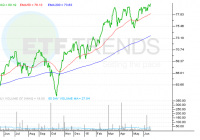
Summary The Nasdaq provides tilts toward more growth-oriented stocks. Growth stock investors can add even more momentum to their Nasdaq exposure through a relatively new smart-beta Nasdaq ETF. A closer look at the PowerShares DWA Nasdaq Momentum Portfolio. By Todd Shriber & Tom Lydon Home to a bevy of growth stocks, many hailing from the biotechnology, Internet and technology spaces, the Nasdaq-100 and Nasdaq Composite offer investors easy access to growth and momentum fare. Investors that want to add some more momentum to their Nasdaq exposure can do so with the PowerShares DWA NASDAQ Momentum Portfolio (NasdaqGM: DWAQ ) , an overlooked, momentum-laden alternative to the widely followed PowerShares QQQ (NasdaqGM: QQQ ) , the NASDAQ-100 tracking exchange traded fund. DWAQ tracks the Dorsey Wright NASDAQ Technical Leaders Index. That index is comprised of “a universe of approximately 1,000 common stocks having the largest market capitalizations and traded on the NASDAQ exchange,” according to PowerShares . Like the other PowerShares ETFs that track Dorsey Wright’s relative strength-based indices, DWAQ is passively managed. However, the relative strength methodology lends itself to increased flexibility in weighting and component selection compared to traditional cap-weighted ETFs. Depending on what individual investors are looking for, DWAQ offers some perks relative to QQQ. As a cap-weighted ETF, QQQ throws almost 21% of its combined weight at Apple (NASDAQGS: AAPL ) and Microsoft (NASDAQGS: MSFT ). Conversely, DWAQ’s largest holding is biotech giant Gilead (NASDAQGS: GILD ), which commands a weight of just 3.2% in the ETF, according to issuer data. Speaking of healthcare and biotech stocks, oft-cited catalysts behind QQQ’s ability to return and exceed dot-com era highs, DWAQ does not short change investors on healthcare exposure, either. The $36 million DWAQ sports a healthcare weight of almost 37%, more than double the 15.4% QQQ allocates to the same sector. Six of DWAQ’s top 10 holdings are healthcare stocks. The ETF’s second-largest sector weight is 22.4% to technology, which includes a 2.9% allocation to Apple. Like the other PowerShares ETFs that track Dorsey Wright’s relative strength-based indices, DWAQ is passively managed. However, the relative strength methodology lends itself to increased flexibility in weighting and component selection compared to traditional cap-weighted ETFs. QQQ’s consumer discretionary weight is nearly 400 basis points higher than DWAQ’s and the latter takes a notably different approach to that sector than the former. For example, DWAQ does not own Amazon (NASDAQGS: AMZN ), Priceline (NASDAQGS: PCLN ) and Starbucks (NASDAQGS: SBUX ), opting for mid- and small-cap discretionary names, such as Papa John’s (NASDAQGS: PZZA ), Sonic (NASDAQGS: SONC ) and Jack in the Box (NASDAQGS: JACK ). DWAQ is up 12.6% this year and has double in price in less than five years. PowerShares DWA NASDAQ Momentum Portfolio (click to enlarge) Disclosure: I am/we are long QQQ. (More…) I wrote this article myself, and it expresses my own opinions. I am not receiving compensation for it. I have no business relationship with any company whose stock is mentioned in this article.