Tag Archives: setpageviewname

5 Ways Kids Can Pay For Father’s Day

Summary Father’s Day is on June 21; here are 5 ways for kids to afford a present. Some are small (starting at $10) and some are large (> $100,000). 3 examples of high yield equity opportunities for the family bank. Father’s Day has a -EV Father’s Day is unavoidably coming up later this month. The utility leakage from gift giving is usually measured at around 50%. Thus holidays such as Father’s Day are the inverse of value investing: turning $1.00 of cash into about $0.50 of value has a terribly negative expected value/-EV. With a houseful of young kids, my pain is especially acute. I am, one way or the other, coughing up the $1.00. As far as the likely gifts, the most common ones are “paper weight” defined herein as anything with mass enough to hold down paper, typically covered in glitter. Glitter Paperweights Do I want a glitter paperweight? One piece of solid evidence would be if I had ever attempted to purchase one on my own. I have not. However, for the sake of research, I found that I could have easily bought one for myself on Amazon (NASDAQ: AMZN ). The fact that I have not and have not ever seriously considering doing so has failed to discourage my kids’ production and gifting of glittery paperweights. Saving and Investing Ideas for Kids So, if I am going to try and improve future Father’s Days, how can I encourage adequate funding and taste? This project benefits from the phenomenon that it is easy to improve in percentage when one starts from an extremely low base on both metrics. 1.) $10/year/kid from Toronto-Dominion Bank (NYSE: TD ) TD offers a summer reading program in which kids can earn $10 each for reading 10 books. You can get the form here . In addition, our TD branch has a coin deposit machine. As it accepts only US$, the rejects slot typically contains a few dollars’ worth of Canadian and other foreign coins for the kids to collect. 2.) $40/year/kid from Airbanking Kids can each earn $40/year in interest in a junior airsavings account . These accounts offer an annual percentage yield/ABY of 4% for accounts up to $1,000 owned by depositors under eighteen years old. 3.) $50/year/kid from DFCU Financial Deposits age 0-17 get $50 in cash per $100 account. If you have an account at DFCU or if you can open one (either via a family relationship or living in their region of Michigan), it might be worth getting your kids set up with accounts too. 4.) $272/year/kid from Fidelity The best credit card deal available is the Fidelity Investment Rewards American Express (NYSE: AXP ) Card. There is no age limit. You can co-sign the agreement, get cards in your kids’ names and start building their credit history. The average American kid’s expenses are $13,611 per year. With the 2% cash back on this card, that comes to a rebate of $272 each year. Once the kids are legitimately earning income from chores, they can start funding their IRAs. 5.) $109,565/year/kid from family bank According to the IRS, the long-term adjusted Applicable Federal Rate/ AFR is currently 2.3%. In order to qualify as a loan, parents need to charge that amount of interest to each kid. However, parents can also gift the interest rate payment up to $28k . So, one can loan up to $1,217,391 from each couple to each of their kids per year without it costing them any net interest. If they can compound at 9% per year, that will come to just under $110k per year per kid. 9% Average Yield Investments Where can you find ideas that compound at an average of 9%? Here are three examples of high yielding equity opportunities that average at a 9% annual yield: 6% Yield From Intel’s Deal With Altera INTC reached a deal with ALTR. This deal was due to a concerted shareholder effort. INTC wanted the deal and ALTR holders did, too. After this effort from the owners, there is still an opportunity. 11% Yield: Integrys, A Safe UTE With A Catalyst Integrys is a safe utility investment. It is currently being bought by WEC. TEG holders get > 11% annualized between now and closing. 10% Yield From IGATE IGATE is getting bought by Capgemini. You can capture a 10% yield. IGTE shares trade about $0.50 beneath the deal price. It will probably close in a month. Maintain control over cash flow After year one, parents can toggle on our off the gift of the interest rate payments as per their choice. Without the gift, the interest payments come to $84,000 per year for a family with three kids, which is in excess of the $75,000 annual income that Nobel laureate Danny Kahneman’s study indicates is the maximum annual income at which money is positively correlated to happiness. Do You Trust Your Wife? This is an important question in terms of maximizing expected value across a family. If you have no one whom you can trust, then the idea of investing in order to achieve some specific payoff structure makes sense. Instead, if you want to maximize expected value across a family, you can use the family bank to move the more equity-like investments down generationally and the more credit-like investments up generationally. This liberates investors from reliance on high nominal yield. In the case of dividends, they are increasingly expensive. I have long advocated certain dividend investments such as the WisdomTree Total Dividend ETF (NYSEARCA: DTD ). Since writing up DTD on Seeking Alpha as a long idea, it has returned over 75%. However, that leaves its prospective dividend rate at a relatively paltry 2.12%. With the family bank you will get a higher 2.3% yield while your children are able to benefit from higher returning equity opportunities. Long-term Goal While I want to have everything organized as efficiently and rationally as possible, my long-term goal is to create independent adults. I have a reminder on my Microsoft (NASDAQ: MSFT ) Outlook calendar to have the locksmith come to change the locks when the youngest kid turns eighteen. After that, I expect them to succeed under their own power. I hope that they will be independent of me. At the same time, I have no plans to be independent of them. I plan to borrow any and all toys that they acquire and I do not intend to reimburse them for the fuel. Finally, if they are reading this, it is time for me to come out with the truth: I do not need any more paper weights and I do not like glitter. Those are my thoughts on financing. As far as tastes, I don’t really have great taste. Fortunately, I know someone who does. So, if they want, they can read more about that on my Father’s Day Wish List . Disclosure: I am/we are long DTD. (More…) I wrote this article myself, and it expresses my own opinions. I am not receiving compensation for it. I have no business relationship with any company whose stock is mentioned in this article. Additional disclosure: Chris DeMuth Jr is a portfolio manager at Rangeley Capital. Rangeley invests with a margin of safety by buying securities at deep discounts to their intrinsic value and unlocking that value through corporate events. In order to maximize total returns for our investors, we reserve the right to make investment decisions regarding any security without further notification except where such notification is required by law.
The Fed Provided A Short-Term Boost To SLV

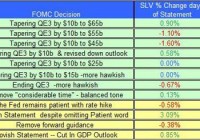
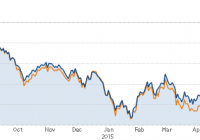
Summary The FOMC meeting concluded with a dovish statement and press conference. The silver market benefits from a dovish Federal Reserve. A potential rate hike could have a modest, negative impact on the price of SLV. The FOMC, as expected, didn’t raise rates and presented a dovish statement without dissenters. This news provided some backwind to the iShares Silver Trust ETF (NYSEARCA: SLV ) that came up in the last few days, albeit it’s still down by 8.5% over the past month. Let’s examine the recent FOMC meeting and its possible implications on SLV. Following the recent FOMC statement and press conference, the market revised down its outlook of the Fed’s rate “lift off”: The implied probabilities dropped to a 17% chance of a rate hike in September and 57% in December. In January 2016, the odds are 72% – nearly the same odds for a December rate hike only a week ago. The statement, which wasn’t changed much and didn’t offer any major headlines, still led to a modest rally in the price of SLV, as presented below. The dovish tone in the statement and Yellen’s press conference that followed suggested that even after the inaugural “lift off”, the FOMC will keep rates low – conditions that benefit the silver market. (click to enlarge) Source of data taken from FOMC and Google Finance The FOMC revised down its projections for the 2015 U.S. GDP growth rate from 2.5% in March to 1.9%. The rate of unemployment slightly increased to 5.25%. There weren’t any other major changes in the FOMC’s economic projections. Since Yellen reiterated that the first rate hike will still be data dependent, this means that if in the next few months the economic data show a stable recovery, e.g. NFP reports keep showing steady growth in jobs, lower unemployment, faster growth in wages, better GDP figures, higher inflation (just to name a few), the FOMC could decide to raise rates this year. As long as the FOMC keeps rates low, the silver market in general and SLV in particular benefit from it. Also, even if the FOMC were to start raising rates, the cash rate is likely to remain low, as Yellen suggested in the press conference, for a while. After all she tried, yet again, to diverge the attention from the historic first rate raise to the pace of subsequent rate hikes. She emphasized that rates will rise gradually; as such, this means the normalization policy is likely to have a modest adverse impact on SLV. In terms of the dot plots, FOMC members are still incline to raise rates this year, perhaps by September – this will allow for at least two rate hikes of 0.25% and bring the cash rate to 0.5% by the end of the year. For 2015, the median target range of the Federal Reserve hasn’t changed – it’s at 0.625% – albeit fewer FOMC members have picked higher rates and the projections are now more concentrated around lower interest rates, as you can see below: Source: FOMC’s website For 2016 and 2017, members slightly lowered their projections so that the median point declined by 0.25 percentage points for each year. This is another dovish indication that the trajectory of the future rate hikes could be more moderate than previously projected. Source: FOMC’s website In a CNBC interview, Richard Fisher, who is considered a hawk and was former president of the Federal Reserve Bank of Dallas and FOMC voting member, stated the dot plot outlook for the coming years is less relevant since the current members may not be there to make rate decisions in 2016-2017. This may be right, but since Yellen will remain at the Fed, we are still likely to see additional dovish FOMC decisions in the coming years. The market’s reaction to the dovish statement also included a depreciation of the U.S. dollar against leading currencies, which also contributed to the modest rise in shares of SLV. Nonetheless, the U.S. dollar could start to rise again especially against the euro – the ECB’s QE program and the ongoing Greek debt crisis are likely to drag down the currency – and yen. A stronger U.S. dollar could play against the price of SLV. The silver market isn’t out of the woods, but the FOMC provided a short-term boost to SLV. The market doesn’t seem convinced that the Fed will raise rates this year. As such, if and once it will occur, it could result in a modest drop in SLV prices. Until such time, as long as the FOMC produces dovish statements, silver will benefit over the short run. For more see: Will Higher Physical Demand for Silver Drive Up SLV? Disclosure: I/we have no positions in any stocks mentioned, and no plans to initiate any positions within the next 72 hours. (More…) I wrote this article myself, and it expresses my own opinions. I am not receiving compensation for it (other than from Seeking Alpha). I have no business relationship with any company whose stock is mentioned in this article.

Hedging The 10-Year? Consider DTYS

Summary DTYS provides a well correlated hedge for 10-year treasury bonds. DTYS, like most alternative investments, is associated with significant risks and is intended for achieving short term goals. Recommended for investors who believe interest rates will rise dramatically over an intermediate time frame. Basic Information The iPath U.S. Treasury 10-year Bear ETN (NASDAQ: DTYS ) is an exchange traded note (ETN). ETNs are unsecured, unsubordinated debt securities. This type of debt security differs from other types of bonds and notes because ETN returns are based upon the performance of a market index minus applicable fees, no period coupon payments are distributed and no principal protections exist. DTYS is intended to move inversely (-1x) to The Barclays Capital 10Y U.S. Treasury Futures Targeted Exposure index. The Barclay’s index is tied to U.S. treasury yields. DTYS seeks investment results for a single day only, not for longer periods. A “single day” is measured from the time the Fund calculates its net asset value (“NAV”) to the time of the Fund’s next NAV calculation. The return of the Fund for periods longer than a single day will be the result of each day’s returns compounded over the period, which will very likely differ from the inverse (-1x) of the return of The Barclays Capital 10Y U.S. Treasury Futures Targeted Exposure index for that period. For periods longer than a single day, the Fund will lose money when the level of the Index is flat, and it is possible that the Fund will lose money even if the level of the Index falls. Longer holding periods, higher index volatility, and inverse exposure each exacerbate the impact of compounding on an investor’s returns. During periods of higher Index volatility, the volatility of the Index may affect the Fund’s return as much as or more than the return of the Index. Expense Ratio: .75% + Portfolio turnover (currently 0% because cash instrument and derivative transactions are not included). How Could it be used? If you are looking for a 10-year hedge, DTYS could be a very beneficial to your portfolio. It is highly correlated to the market, and it is a useful tool any skilled investor should consider. In this article, I’ll attempt to illuminate the risks of investing in an ETN, but with adequate forethought DTYS is not a bad strategy, especially with the threat of rising interest rates. Principal Investment Strategy All investment strategies are used in combination to achieve similar daily return characteristics as -1x of the index: Derivatives – financial instruments whose value is derived from the value of an underlying asset or assets, such as stocks, bond, funds, interest rates, or indexes. Swap agreements – Contracts entered into primarily with major global financial institutions for a specified period ranging from a day to more than one year. In a standard “swap” transaction, two parties agree to exchange the return (or differentials in rates of return) earned or realized on particular predetermined investments or instruments. The gross return to be exchanged or “swapped” between the parties is calculated with respect to a “notional amount,” e.g., the return on or change in value of a particular dollar amount invested in a “basket” of securities or an ETF representing a particular index. Futures Contracts – Standardized contracts traded on, or subject to the rules of, an exchange that call for the future delivery of a specified quantity and type of asset at a specified time and place or, alternatively, may call for cash settlement. Money Market Instruments U.S. Treasury Bills – that have maturities of one year or less and supported by full faith and credit of the U.S. government. Repurchase Agreements – Contracts in which a seller of securities, usually U.S. government securities or other money market instruments, agrees to buy them back at a specified time and price. Repurchase agreements are primarily used by the Fund as a short-term investment vehicle for cash positions. These are the Principal Risks associated with TBX Risks Associated with the Use of Derivatives Compounding Risk Correlation Risk Fixed Income and Market Risk Counterparty Risk Debt Instrument Risk Interest Rate Risk Intraday Price Performance Risk Inverse Correlation Risk Liquidity Risk Early Close/Late Close/Trading Halt Risk Market Price Variance Risk Valuation Risk Non-Diversification Risk Portfolio Turnover Risk Short Sale Exposure Risk As you can see below, estimated returns are volatile, and the funds actual results may be significantly better or worse than the underlying index. Bolded values, not including the x and y axis percentages, are where the fund performed worse than expected. This is meant to illuminate the possibility of under or over performance. Theoretical Fund Returns Index Performance One Year Volatility Rate One Year Index Inverse (-1x) of the One Year Index 10% 25% 50% 75% 100% -60% 60% 147.50% 134.90 94.70 42.40 (8.00) -50% 50% 98.00 87.90 55.80 14.00 (26.40) -40% 40% 65.00 56.60 29.80 (5.00) (38.70) -30% 30% 41.40 34.20 11.30 (18.60) (47.40) -20% 20% 23.80 17.40 (2.60) (28.80) (54.00) -10% 10% 10.00 4.40 (13.50) (36.70) (59.10) 0% 0% (1.00) (6.10) (22.10) (43.00) (63.20) 10% -10% (10.00) (14.60) (29.20) (48.20) (66.60) 20% -20% (17.50) (21.70) (35.10) (52.50) (69.30) 30% -30% (13.80) (27.70) (10.10) (56.20) (71.70) 40% -40% (29.30) (32.90) (44.40) (59.30) (73.70) 50% -50% (34.00) (37.40) (48.10) (62.00) (75.50) 60% -60% (38.10) (41.30) (51.30) (64.40) (77.00) Correlation to 10-year yields I aligned DTYS with 10-year treasury yields. Essentially, DTYS is perfectly correlated to yields. Since bond prices react inversely to yields, it is easy to see why DTYS would be a good choice for hedging rising interest rates. Their are other alternative investment tools like the ProShares Short 7-10 Year Treasury ETF (NYSEARCA: TBX ) . DTYS, in my opinion. is the best direct tool for hedging rates. When rates spike, however, their are a number of other options to consider . My advice for any investor is to expose yourself only to risk you feel comfortable with. Conservative plays often pan out better than risky ones in the long run. DTYS is certainly a risky investment with potential for mediocre to negative returns. Conclusion If you are trying to hedge your investment on 10-Year Treasury yields, then DTYS is probably an ETN you ought to consider. However, it is important for any smart investor to weigh the risks associated with any ETN before jumping into any investment long or short. Disclosure: I/we have no positions in any stocks mentioned, and no plans to initiate any positions within the next 72 hours. (More…) I wrote this article myself, and it expresses my own opinions. I am not receiving compensation for it (other than from Seeking Alpha). I have no business relationship with any company whose stock is mentioned in this article.