Tag Archives: seeking

Cotton Continues Its Bounce Along The Bottom
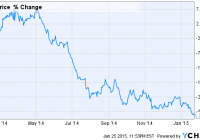
Summary Prices over the last several months have trended lower. Petroleum prices will continue to put downward pressure on cotton. The 2015 U.S. planting season begins in mid-March. Introduction During my last article, the 2015 outlook for cotton , I remained somewhat optimistic that this commodity would find a bottom. Even given that assessment, I recommend that you avoid iPath Dow Jones-UBS Cotton Total Return Sub-Index ETN (NYSEARCA: BAL ). That assessment has again proven to be correct. Let’s take a look at the past years performance: Article Date Recommendation Closing price for BAL 7/18/2014 Avoid 45.65 9/26/2014 Avoid 41.35 Table created by Nathan Buehler As of market close on 1/23/2015, BAL is trading at $39.02 per share. 2015 planting season My outlook last year was that U.S. farmers would choose other, more profitable crops to plant, instead of cotton. This, so long as the downward trend in prices continued. The downward trend has continued and we are now nearing 2015 planting decisions. Below is a good read supporting my position: Agweb.com: 2015 Outlook: Get Ready for a Cotton Crop Swap? Other recent developments, such as the drop in corn prices due to lower oil, have me revisiting this topic. Many other agricultural commodities, not just cotton, have come under pressure recently due to the drop in oil. See the upcoming events below for more insight. Upcoming events Several events in February bear watching. The National Cotton Council will release results of U.S. cotton producers’ survey on February 7th. Per their website, they are expecting a decline in acreage for the 2015/2016 planting season. On February 20th, the USDA will release preliminary estimates on everything from trade to production of cotton. You can view their currently released data here . These events are very important. Both will shed light on what farmers are thinking for 2015. If other crops are seeing the same margin pressures as cotton, we could see farmers hold the line. Even with this sector’s pressures, I see a significant decline in acreage for cotton in the U.S. Supply (click to enlarge) Chart retrieved from Cotton Inc. on 1/26/15 Supply continues to run higher than demand adding to global stocks. Global stocks-to-use are at all-time highs thanks to China’s reserve policies. During the past articles we discussed how technological advances in India have pushed their yield per acre up significantly over the past decade. India is now poised to overtake China as the number one cotton producer in 2015. Will India reduce acreage in 2015? Analysts are saying yes. China continues to have significant stocks and is sticking to its import quota to promote domestic demand. Current reports show that Chinese farmers are predicted to plant 15% less acreage of cotton in 2015. The Delta Farm Press is reporting that globally, acreage could decline about 10%. I recommend a read of their article here . It highlights many global points on production, including the water situation in Australia. Demand On the other side of the coin, demand for cotton has remained relatively steady. (click to enlarge) Chart retrieved from Cotton.org and based on estimates from the World Agricultural Outlook Board of USDA. 1/26/2015 Global economic news over the past several months has not been positive. China has continued to post lower than expected growth. Europe has announced several additional stimulus measures to prop up regional growth. The IMF has revised global growth down to 3.5%. None of these developments are a buy signal for cotton and put further downward pressures on its price. China could be experiencing problems with its reserves. Several mills have reported quality problems. I encourage you to read this article which goes into greater detail on the situation. Should this develop into a larger problem, it could cause a short-term spike in prices. Oil/Polyester Oil is a direct competitor of cotton through polyester. Polyester prices have followed the decline in oil, though not as drastically. Cotton prices have remained depressed and I don’t see the drop in oil as being a huge negative for cotton. If anything, consumers could see more disposable income which could boost demand for cotton products. Chart retrieved from: link I found the below chart interesting and wanted to share: Conclusion To prevent redundancy, as your time is valuable, I have tried to include many links to good reads in this article. February will be a foundational month for cotton futures. Are we going to put a floor or ceiling on prices? After analyzing the supply and demand data, preliminary production outlook, and the possible quality problems in China, I see cotton putting in a floor in February. I am changing my avoid rating of BAL to neutral. I personally believe better opportunities exist in the market right now outside of cotton. For the remainder of 2015, I am looking for oil to be the best performing commodity. This is always dependent on the economic outlook and the stimulus measures in Europe taking hold. I sincerely thank you for reading and I hope this article helps you in your investing decisions.
Gold-In-Euro-Terms ETF Capitalizes On ECB’s QE Plan

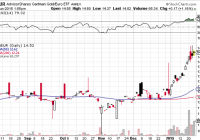
Summary Gold is falling after ECB’s bond purchasing plan. Stronger USD is weighing on gold. However, bullion investors can use a euro-denominated gold ETF to hedge the depreciating value of the EUR. Gold exchange traded funds rose on a knee-jerk reaction Thursday, following the European Central Bank’s aggressive bond-purchasing plan, as traders anticipated a rise in inflation. However, investors soon realized that the ECB actions would benefit the dollar or weigh on USD-denominated bullion. The SPDR Gold Trust ETF (NYSEArca: GLD ) has increased 10.3% year-to-date but was down 0.9% Friday and again Monday. Gold strengthened Thursday after traders assumed the ECB’s quantitative easing would flood the market with cash and induce inflationary pressures, but many soon realized that the money created were euros and not dollars. Since the ECB’s announcement, the euro continued to depreciate toward an 11-year low against the U.S. dollar. Consequently, the stronger USD should hurt gold as it becomes costlier for foreign traders to acquire USD-denominated assets. “What you saw was uncertainty about what the ECB was going to do-I think that’s what lifted gold higher. But I think now that this is all going to kind of settle down,” Anthony Grisanti of GRZ Energy, said on CNBC . “I don’t understand why you would think something that would strengthen our dollar would strengthen gold at this point.” Alternatively, gold ETF traders can take a look at the AdvisorShares Gartman Gold/Euro ETF (NYSEArca: GEUR ) , an actively managed ETF tracking gold in euro terms. While GLD dipped Friday, GEUR gained 1.2%. “Holding gold in a non-U.S. dollar denominated currency may help to limit the downside risk during stressed market environments where the U.S. dollar becomes a safe haven store of value,” according to AdvisorShares . Some gold investors quickly picked up on the GEUR trade as well, with the Gold/Euro ETF trading volume up to 65,000 late Friday, or more than 10 times its average daily volume, according to Morningstar data. Looking at the futures market, COMEX gold traded down 0.7% to $1,291.6 per ounce late Friday, whereas Euro Spot gold rose 0.5% to €1,151.1 per ounce. AdvisorShares Gartman Gold/Euro ETF (click to enlarge) Full disclosure: Tom Lydon’s clients own shares of GLD.

GLD And Its Relation To The Greek Elections, ECB’s QE And FOMC Meeting

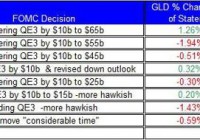
The rise in uncertainty in Europe over the recent Greek elections results in ECB’s QE program play in favor of GLD. Will the upcoming FOMC meeting and GDP update for the fourth quarter impact the direction of GLD? The market has revised down the probabilities of a rate hike in the coming FOMC meetings. The results of the latest elections in Greece along with ECB’s decision to start its quantitative easing program have provided back-wind for the SPDR Gold Trust ETF (NYSEARCA: GLD ). Let’s examine the recent developments in Europe and the upcoming reports in the U.S. including FOMC statement and GDP update. The latest news about election results in Greece, in which the extreme left party Syriza won, is likely to bring this country one step closer towards leaving the European Union, could stir up the markets, raise the uncertainty levels and depreciate the Euro against leading currencies. But it’s not likely to have substantial long-term adverse ramifications on the EU, as suggested in this analysis . This news along with ECB’s decision to implement a $1.3 trillion QE program could still drive higher the demand for precious metals investments including GLD, which tend to strive when central banks devalue their currency and the uncertainty level in the markets rise. Nonetheless, bear in mind that the ongoing rally of the U.S. Dollar against the Euro and other currencies will eventually curb down the rise in the price of GLD. This week the FOMC will convene for the first time this year. In the previous meeting back in December, the FOMC concluded its meeting with the decision to repurpose the term “considerable time” with respect to the timing of the rate hike; the FOMC kept the term as a reference point to its current policy – the normalization process will continue to be data dependent and a rate hike won’t happen anytime soon with the key word being patience: “… the Committee judges that it can be patient in beginning to normalize the stance of monetary policy.” Moreover, in the press conference that followed, FOMC Chair Yellen also pointed out that the FOMC is likely to raise rates in the next couple of meetings. (click to enlarge) Source of data: FOMC’s site and Bloomberg This time, the FOMC meeting will include a press conference or an update for the economic progress of the U.S. But the last updates by the IMF and World Bank showed that the U.S. economy is likely to grow in 2015 by 3.6% and 3.2%, respectively. In both cases, these organizations revised up their assessments from their previous estimates, in part, due to low oil prices. The current low oil prices are also likely to bring down GLD – after all potential rise in inflation is among the main reasons for people to invest in gold assets such as GLD. Well, this doesn’t seem to be the case. Despite the expected higher growth in GDP, the markets have started to revise their expectations about the next rate hike of the FOMC. According to the CME , the probability of a rate hike in the June meeting is currently only 12% – a month ago this probability was around 30%. Further, the implied probability of a rate hike in the July meeting has been updated from 57% a month ago to 28%. So the markets have updated their projections based on the current low inflation. The low inflation could eventually result in the FOMC pushing forward the first and subsequent rate hikes. Such a scenario is likely to keep pushing up the price of GLD: After all, low cash rate tends to translate to low long-term treasury yields. If U.S. treasury yields remain low, this could contribute to the short-term recovery of GLD. But the upcoming FOMC meeting isn’t likely to stir up the markets considering Yellen’s promise not to rock the boat in the next two meetings. Therefore, the market reaction is likely to moderate and GLD isn’t expected to do much – we could see a similar reaction as we did in the last meeting. Another report to consider is the upcoming GDP report – first estimate for the last quarter of the year. The current estimates are for the GDP report to show a gain of 3.1%. In the past, these reports didn’t seem to have much of a strong impact on the prices of GLD, as you can see in the table below. Source of data taken from Bloomberg and BEA Nonetheless, this report is still likely to influence FOMC members with respect to their rate decision. If the U.S. economy keeps showing a steady growth, this is likely to bring the FOMC closer to pushing the trigger on the rate hike. Despite the latest developments in Europe, the direction of GLD is mostly related to the changes in U.S. including the FOMC’s policy and the progress of the U.S. economy. If the FOMC were to push forward its first rate hike, this could keep up the price of GLD. For more see: What are the advantages of GLD?