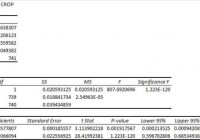
Summary I’m taking a look at CROP as a candidate for inclusion in my ETF portfolio. The expense ratio seems to be justified by not being market weighted, but the diversification within the fund is weak. The correlation to SPY is easily the most attractive characteristic, but it is combined with moderate volatility and very weak returns. I’m not assessing any tax impacts. Investors should check their own situation for tax exposure. Investors should be seeking to improve their risk adjusted returns. I’m a big fan of using ETFs to achieve the risk adjusted returns relative to the portfolios that a normal investor can generate for themselves after trading costs. I’m working on building a new portfolio and I’m going to be analyzing several of the ETFs that I am considering for my personal portfolio. One of the funds that I’m considering is the IQ Global Agribusiness Small Cap ETF (NYSEARCA: CROP ). I’ll be performing a substantial portion of my analysis along the lines of modern portfolio theory, so my goal is to find ways to minimize costs while achieving diversification to reduce my risk level. What does CROP do? CROP attempts to track the total return (before fees and expenses) of the IQ Global Agribusiness Small Cap Index. According to the prospectus, the underlying index “is a rules based, modified capitalization weighted, float adjusted index.” I can appreciate having a weighting system other than simple market capitalization. Weighting by market cap is very easy; the ETF simply buys up the initial amount of shares in each fund and maintains the position. In this case, the ETF is not using a simple market cap weighting. In my opinion, that would justify a slightly higher expense ratio. CROP falls under the category of “Consumer Defensive.” Does CROP provide diversification benefits to a portfolio? Each investor may hold a different portfolio, but I use the SPDR S&P 500 Trust ETF (NYSEARCA: SPY ) as the basis for my analysis. I believe SPY, or another large cap U.S. fund with similar properties, represents the reasonable first step for many investors designing an ETF portfolio. Therefore, I start my diversification analysis by seeing how it works with SPY. I start with an ANOVA table: (click to enlarge) The correlation is excellent at 72%. I want to see low correlations on my investments. Extremely low levels of correlation are wonderful for establishing a more stable portfolio. I consider anything under 50% to be extremely low. However, for equity securities an extremely low correlation is frequently only found when there are substantial issues with trading volumes that may distort the statistics. Standard deviation of daily returns (dividend adjusted, measured since January 2012) The standard deviation is great. For CROP it is .8229%. For SPY, it is .7300% for the same period. SPY usually beats other ETFs in this regard. I like the low correlation and it could be enough to cover the higher standard deviation once we start looking at allocations within a portfolio. Liquidity looks mediocre Average trading volume is pretty low, a bit over 11,000. That isn’t low enough to eliminate it from my consideration, but it is a concern. I’m writing this while the market is open, and the current spread is .36%. That’s a big enough spread to pay attention to when putting in an order. Of course, spreads can change constantly, but investors here should make sure they are using limit orders to prevent crossing a large spread. Mixing it with SPY I also run comparisons on the standard deviation of daily returns for the portfolio assuming that the portfolio is combined with the S&P 500. For research, I assume daily rebalancing because it dramatically simplifies the math. With a 50/50 weighting in a portfolio holding only SPY and CROP, the standard deviation of daily returns across the entire portfolio is .7208%. With 80% in SPY and 20% in CROP, the standard deviation of the portfolio would have been .7121%. If an investor wanted to use CROP as a supplement to their portfolio, the standard deviation across the portfolio with 95% in SPY and 5% in CROP would have been .7238%. Why I use standard deviation of daily returns I don’t believe historical returns have predictive power for future returns, but I do believe historical values for standard deviations of returns relative to other ETFs have some predictive power on future risks and correlations. Yield & Taxes The distribution yield is 1.63%. I like to see strong yields for retiring portfolios because I don’t want to touch the principal. By investing in ETFs I’m removing some of the human emotions, such as panic. Higher yields imply lower growth rates (without reinvestment) over the long term, but that is an acceptable trade off in my opinion. The weak yield makes me less excited about the portfolio from a retirement standpoint, but I have a long ways to go before I’m there. I’m not a CPA or CFP, so I’m not assessing any tax impacts. Expense Ratio The ETF is posting .75% for a gross expense ratio, and .75% for a net expense ratio. I want diversification, I want stability, and I don’t want to pay for them. The expense ratio on this fund is higher than I want to pay for equity securities, but having a better system than a simple market cap weighting provides some justification for the higher ratio. Market to NAV The ETF is at a .96% discount to NAV currently. Premiums or discounts to NAV can change very quickly so investors should check prior to putting in an order. Largest Holdings The diversification within the ETF is very weak. While the weighting method provided some justification for a higher expense ratio, the poor diversification within the holdings severely damages that justification. Rebalancing the fund may require some costs, but having fewer positions to rebalance reduces those costs. (click to enlarge) After looking at the diversification level within the ETF, I’m more critical of the expense ratio. Conclusion I’m currently screening a large volume of ETFs for my own portfolio. The portfolio I’m building is through Schwab, so I’m able to trade CROP with no commissions. I have a strong preference for researching ETFs that are free to trade in my account, so most of my research will be on ETFs that fall under the “ETF OneSource” program. For a correlation of 72% and more volatility than SPY, I would have expected the ETF to have more significant returns. I don’t believe in using past performance to predict future performance, but if an ETF shows moderate or higher correlation and weak performance, it makes me doubtful. During the time period I used (almost 3 years) SPY went up by over 66%. Crop went up by 14%. That isn’t terrible if the ETF is extremely low risk, but for something with even a moderate correlation to SPY it feels like pretty weak performance. I’m going to be knocking CROP off my list. Despite what initially appeared to be solid diversification benefits when combined with SPY, there have been no other positives outside of the discount to NAV. While I like buying an ETF at a discount to NAV, it needs to be an ETF that I actually want to own. Additional disclosure: Information in this article represents the opinion of the analyst. All statements are represented as opinions, rather than facts, and should not be construed as advice to buy or sell a security. Ratings of “outperform” and “underperform” reflect the analyst’s estimation of a divergence between the market value for a security and the price that would be appropriate given the potential for risks and returns relative to other securities. The analyst does not know your particular objectives for returns or constraints upon investing. All investors are encouraged to do their own research before making any investment decision. Information is regularly obtained from Yahoo Finance, Google Finance, and SEC Database. If Yahoo, Google, or the SEC database contained faulty or old information it could be incorporated into my analysis. The analyst holds a diversified portfolio including mutual funds or index funds which may include a small long exposure to the stock.