Tag Archives: seeking-alpha

Dow 20,000: Is 2015 The Year?
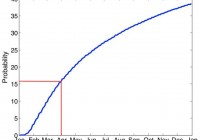
Jeremy Siegel suspects the Dow might hit 20,000 in 2015. There is a (unconditional) 38.6% chance that the Dow closes out 2015 above 20,000. Find out the probability that the Dow will close above 20,000 any day during the year in the analysis below. It’s that time of year again. Yup, that jolly, happy time of year when the soothsayers of Wall Street start trumpeting their views on what’s going to happen in 2015, and how to position portfolios to profit. Esteemed Wharton professor, Jeremy Siegel, author of the permabull bible, Stocks for the Long Run , recently joined the merry parade with his own forecast that Dow 20,000 ‘could happen’ in 2015. Astute investors might take stakes now in large manufacturers of confetti, party horns, and streamers. But I digress. We don’t make forecasts on this blog, but it is constructive to understand generally what the range of probable outcomes might be. Is our hero, Dr. Siegel, taking a brave stand against the bearish hordes, or is he making safe proclamations from behind a sturdy statistical moat? We aim to find out. First, the low hanging fruit. What is the unconditional probability that the Dow Jones Industrial Average, which closed 2014 near 18,000, closes out 2015 above 20,000? First, let’s assume that returns are normally distributed and iid . Next, let’s take long-term average (arithmetic) U.S. stock returns to be 5.3% per year (this is the average 12 month arithmetic price-only returns to U.S. stocks from the Shiller worksheet – remember, index returns do not include dividends), with annual standard deviation of 20%. If the mean annual return to the price index is 5.3%, then the unbiased expected value of the Dow at the end of 2015 is 18,000 * 1.053= 18,950. A finish at 20,000 would represent a return of 20,000/18,000 = 0.111 or 11.1%, which is 11.1% – 5.3% = 5.8% more than expected. Given the standard deviation of returns is 20%, this represents a 5.8/20 = 0.29 standard deviation event. We can now apply the cumulative normal distribution function to determine the probability of a positive 0.29 sd event. In Excel, it is 1 – NORM.S.DIST(0.29,TRUE) = 0.386, or 38.6% So the unconditional probability that the Dow closes at 20,000 or greater at the close on the last trading day of 2015 is almost 40%. This is not quite a coin toss, but Jeremy is not exactly going out on a limb. Keep in mind that stock market price returns approximate a geometric random process. They don’t just climb in a steady curve, and close each day at a new high. Surely Jeremy would take credit for his “Dow 20,000″ call if the index exceeds the magical 20,000 threshold at any point during the year, even if it doesn’t actually finish the year above this level. For simplicity however, let’s just examine the probability that it closes above 20,000 on any trading day of the year; so we won’t take into account intra-day periods. Recall that if the annualized return is 10%, then the expected return at the close on day 1 is (using a 252 trading day year): 1.053^(1/252)-1 = 0.0002, or 0.02% with a range of 20% * sqrt(1/252), or 1.26% Were the Dow to close at 20,000 on trading day 1, that would represent an 11.1% return in 1 day. Given the 1 day expected return is 0.02%, with a 1 day SD of 1.26%, this would be a (0.111 – 0.0002) / 0.0126 = 8.8 standard deviation event. The probability of a positive 8.8 sd event under a normal sample distribution is a decimal number preceded by 20 zeroes. Essentially no chance. But that’s just on day 1. What about on day 63, which is about 3 months into the year? The expected return after 63 days is 1.053^(63/252)-1 = 1.3%, with a standard deviation of 20% * sqrt(63/252) = 10%. Were the Dow to have risen 11.1% to close at 20,000 on trading day 63 (about the end of March), that would represent a (0.11 – 0.013)/0.1 = 0.98 standard deviation event. The probability of a positive 0.98 standard deviation event is about 16.3%. Now we are talking a 1 in 6 chance that the Dow hits 20,000 at the end of March, the same odds as throwing a 6 on a standard die. The following chart was formed by performing essentially the same analysis at each daily period, and shows the probability that the Dow will meet or exceed 20,000 at the close of each sequential trading day of the year. We highlighted the 16.3% probability at a 3 month horizon described above for illustrative purposes. Figure 1. Probability of Dow > 20,000 at each sequential trading day of 2015 (click to enlarge) We now know the probability of the Dow closing above 20,000 on any given day, but we still haven’t answered the question, “What is the probability that the Dow closes at or above 20,000 at any time in 2015?” To answer this, first consider Figure 2, which shows just 20 of the virtually infinite number of possible paths for the Dow over the next year, given our mean return and standard deviation assumptions. Figure 2. Sample paths for the Dow in 2015 (click to enlarge) By visual inspection we can see that a substantial portion of the potential paths in Figure 2 cross above 20,000 at some point during the year. We ran a Monte Carlo simulation of 1 million possible paths, and discovered that about 64% of paths would cause the index to rise above 20,000 at some point during the calendar year. Particularly astute readers may recognize that the former problem, where we solved for the probability of a price exceeding a specific value at a certain point in time, is a problem of similar nature to that of solving for the value of a European call option, which can be exercised only at expiration. This problem has a known closed-form analytical solution. In contrast, the latter problem has elements that are similar to finding the value of an American call option, which can be exercised at any time up to and including expiration. This problem has no known closed-form solution, and must be solved numerically or by simulation, such as our Monte Carlo method. It’s critical to understand the random element in stock market activity so that we don’t get so emotionally attached to silly milestones. There is a 64% chance that the media and the top 0.01% will be able to break out party hats and champagne this year to celebrate an arbitrary milestone in a poorly constructed index. Siegel isn’t making a bold statement; far from it. Rather, he is playing the (unconditional) odds. And that is precisely what you should do as an investor. The question is: do you feel lucky? We can think of a few reasons why you shouldn’t feel so sanguine, and might humbly suggest a better way of thinking about markets anyway.
The ARBS See Crude Oil This Way

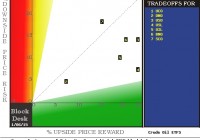
Summary The Arbitrage Community follows (is responsible for) the adages: “Those who talk don’t know; those who know don’t talk” and “Actions speak louder than words”. In the sequence of investing effects, commodities are often the initiators, equities are the derivatives – despite the terminology perspective of many investors, the media, lawyers and politicians. Economists could be (and occasionally are) the early-warning informers in this signal chain, but are inhibited by decades of historical modeling practices, looking largely backwards in time. Arbs provide a way around that trap when we observe and evaluate their actions in a context of rational, intelligent, informed expectation behavior norms. Everyone now knows Crude oil prices are down; what next? And lots of rational, after-the-fact explanations of the past are getting tiring. So also are the speculative opinions of many self-assertively-qualified “experts.” We all know where their mouths are, but where is their money? The money that may carry the most telling messages is in the price structures of markets that get used for hedging at-risk positions of organizations in the normal courses of business, where escape by inaction is not a viable choice. So they attempt to mitigate the anticipated problems by creating exchange-market transactions to their benefit IF their expectations eventuate. If they do not, well the “insurance” so bought is just another cost of doing business, and they are still well ahead of what their worst-case fears might have produced without the protection. Rational, intelligent, informed expectation behavior. The plus in this is that their actions push prices around in the financial markets as well as the spot commodity markets. All of these markets have spider-webs of interconnections transmitted from one to another by the monetary impacts of the hedging actions and the arbitrage opportunities created if those connections are not recognized. In dollar terms, the Financial markets are huge, compared to most commodities markets. But energy, its sources and uses, is pervasive in all occupied parts of the world, so it is the most significant commodity in active trading. The common denominator, its “reserve currency” in financial markets terms, is the (specifications-grade) barrel of Crude Oil. The immediate value influences on that crude barrel are availability and location. Commodity markets provide for availability with contracts for delivery at specific expiration dates. They provide for location at exchange-based delivery points, and the usual transportation costs from those points to other locations in the world are well-known and have their own markets that provide for changing circumstances in that dimension. So Crude is quoted as either West Texas Intermediate [WTI] at NYMEX-COMEX (US) contract specifications, or Brent (North Sea) at ICE Inter-continental Exchange specs for the rest of the world market. But either can be contracted for anywhere in the world and the local cost is quickly translated from the Exchange price. So what do these markets tell us about tomorrow? What makes it easier to handle is that much of the inter-market complexities are condensed into a few Exchange Traded Funds that focus on the commodity itself, not on the producers, refiners, or users of the products. Those commodity-based ETFs only have to identify, and differentiate on exchange base (WTI or Brent), spot (front month) delivery or later, and conventional long ownership or inverse (short position) pricing. Hedging using these ETFs simplifies the bets being made, and provides reliable stake-holders to ensure appropriate payoffs at any date that becomes appropriate for either side of the hedge, at prices provided by replacement stake-takers. Changing expectations by those potential replacements will be reflected in the bids and offers of the replacements. The reasoning behind the changing expectations may never be explained, but their extent and limits are revealed by yet another set of derivatives markets which provide hedging on the ETFs themselves. It is the changing of the price structures of these derivative markets that provide insights into tomorrow’s and next -week’s -months’ ETF prices. Once again, the behavioral analysis of the actions of rational, intelligent, informed market participants displays their expectations. Here is the ETF cast of characters: BNO United States Brent Oil ETF (NYSEARCA: BNO ) USO United States Oil ETF (NYSEARCA: USO ) OIL iPath S&P GSCI Crude Oil Trust ETN (NYSEARCA: OIL ) USL United States 12 Month Oil ETF (NYSEARCA: USL ) DNO United States Short Oil ETF (NYSEARCA: DNO ) SCO ProShares UltraShort Bloomberg Crude Oil ETF (NYSEARCA: SCO ) UCO ProShares Ultra Bloomberg Crude Oil ETF (NYSEARCA: UCO ) All but BNO are based on WTI-spec Crude. All but USL reflect spot or near-future-expiration price quotes. USL takes the rolling average of the next 12-months-expirations future price quotes. DNO and SCO reflect price changes inverse to the long-position price changes of other WTI Crude exchange prices. SCO and UCO are structurally organized to leverage their daily price changes to be double that of DNO or USO. At this point in time hedging in these ETFs imply coming upside likely price changes as indicated along the green horizontal scale of the Reward~Risk Tradeoff map below. Their average worst-case price drawdowns following similar prior forecasts form the other dimension of the tradeoff along the red horizontal scale, with the intersection of the two values marking the numbered ETFs in the blue field. Figure 1 (used with permission) This map compares the various Crude Oil ETFs in terms of an implied promise of an upside price change in the next few months to what typical price drawdown exposure has had to be endured in the past before reaching such a payoff. Cases above the diagonal line are where those pains have exceeded the promised gains. The short-position ETF DNO [2] has the least downside exposure history among current forecast alternatives, but also the least upside payoff prospect. Further upside gains of as much as +15% are indicated for SCO [7] because of its 2x leverage – over DNO’s +7% – but its risk cost is a lot more than 2x DNO’s -5%. USL [4] has lower risk than USO [3] – also without any leverage – because it is based on 12 months of future expirations in Crude futures rather than just the near month expiration. Brent Crude BNO [6] has less upside than USO [3] but as much risk exposure. Least attractive appears to be UCO [1] the leveraged long ETF. A couple of considerations are lacking in this simple map-based comparisons. What are the chances of any of these events actually taking place? How good is the information leading to these observations or expectations? The following table attempts to shed some light on such questions. It is in the same format used in our daily rankings of some 2,000+ stocks, ETFs, and market indexes. Figure 2 (click to enlarge) Of particular interest here should be the Win ODDS in column (8), the Credible Ratio in (13) and the Size of Sample in (12). These deal with qualitative considerations. Sample size (12) tells how many market days of the last 5 years (1261 total) had a similar forecast balance between upside and downside price change prospects as today’s forecast. Samples of less than a dozen are a bit dodgey in many cases. Extreme Range Indexes (7) of zero or less may be an exception. The Credible ratio (13) compares the upside promise of column (5) with the prior forecasts payoffs of (9) to test the current outlook’s believability. Win odds tell what proportion of the experiences of (12) netted in (9) were profitable. None of these should be taken as any guarantee. They are present to help the investor develop perspective. The blue average and totals lines at the bottom of the table provide comparisons of the table with those of the best of our population of alternative long investment prospects, the whole population’s averages, and the specifics for the S&P500 ETF (NYSEARCA: SPY ) as an index-tracking proxy alternative for the equity market. Recent forecast trends Figure 3 The continuing upsweep of expectations pictured in the vertical lines of DNO’s Block Trader Forecast [btf] picture encourage the impression that lower Crude prices are likely, at least in the near-term. The high Range Index of 63 in its historical distribution, and the average of only 18 days typical of holdings to reach top of forecast price range from this level are representative of momentum gains, unlikely to persist for months at a time. But the odds of a profitable experience are favorable in comparison with other Crude oil ETF alternatives. A check of DNO with our population’s better choices suggests that even better odds and markedly bigger payoffs and annual rates of return can be had. Perhaps this whole line of inquiry may not be very advantageous – except to avoid involvements in unfortunate coming investment results. This next btf might best be captioned “catch a falling chain-saw.” Figure 4 At some point a buyer of USL will be right. But prices and forecasts almost double today’s failed to note what Crude futures prices would be here only 6 months out from there. But neither did most other observers of the period. This ETF will be a much better choice when its forecast range vertical lines establish an uptrend that indicates some broad acceptance that a turn has come. Did the US export this problem? Figure 5 The problem is worldwide. Given Europe’s nightmare of eventual recognition that a common currency requires a common King or bureaucracy, breath-holding for demand recovery here is not advisable. The displacement of Saudi Arabian imports by North American expansion of tight oil production puts that lowest-cost oil into contention with all other world supply. The Saudis are making it clear that cost of production will be the supply~demand balancing factor, represented by price. Next? Richard Zeits’ most recent SA analysis of the supply side of that equation makes it very clear that the US and Canada have regained the position as the most influential change agents in providing supply at costs that are very competitive with many world producers using conventional production techniques. The North American producers have no reason to restrain their output as long as they are displacing imported oil, and they continue to expand their share of the world market by taking over supply of the North American market. Christoph Aublinger demonstrates in his SA neatly formatted articles that North American tight oil production has varying costs – as of the most comparable data, 2013 annual reports. But 2014 data is very likely to illustrate that known advances in extraction technologies will improve on those costs in most operations. The pressure on price from increasing North American supply will start to be augmented by other world producers learning the new techniques. The less able and those with control only of poorer deposits may be forced out of the picture at some level of crude price. But so will other world production, particularly those attempting to operate in high-risk environments, including parts of the mid-east, Africa, and various deep-ocean sites. Figure 5 The most profitable Crude Oil ETF has been SCO, the 2x leveraged short of the WTI price. Tripling in price in six months, it continues to be viewed optimistically by the Arbs. At some point it will prove to be overdone, and is in a stage now of momentum rather than of value. Its Range Index of 66 means that two-thirds of its prospective price range is to the downside. Additionally, net gains from prior Range Indexes at this level have been negative, at a -14% level, with only half of such opportunities becoming profitable within a 3 month time limit. Previous 66 RIs have been followed by -18% worst-case price drawdowns – not for the faint of heart. As a further caution, we only have a few examples of forecasts like the present. That is indicated by the red warning background in the data line of the btf above. Not much to rely on, but better than nothing. The three remaining ETFs have even more dismal pictures and data to present, and add little to the discussion. Their expectations and histories are shown in the table labeled Figure 2. Conclusion We are not optimistic that crude oil prices are yet done declining, nor that they will recover in the year 2015 to be much higher than they are at present, the $50-$60 area. Many treasured, “secure” defensive dividend payer individual stocks are likely to be unproductive investments this year. Returns from oilpatch investments in 2015 are likely to come mostly from specific speculations involving timing and resource discoveries. A summary of market-maker hedging for stocks in various energy sectors is in preparation and may be of interest.

McDonald’s Buyer Beware: Spot A Margin Of Safety In The Golden Arches Before Investing

Value investing requires one to find a bargain before investing. This is known as a margin of safety. Some investors may identify value in McDonald’s by examining price compared to property, plant & equipment. At almost four times the level of PP&E, those now considering an investment in McDonald’s must provide a detailed thesis why it makes sense to buy at this price. There are many different ways to make and lose money in the market. There is growth investing, commodity trading, arbitrage, spread trading, big-picture macro trading, currency trading, and then there is value investing. The key is to find a method you are comfortable with. For many successful investors like billionaire, philanthropist, investor and author of Margin of Safety: Risk-Averse Value Investing Strategies for the Thoughtful Investor , Seth Klarman, their method happens to be value investing. Although there are different approaches to value investing, the primary tenet is buying something thought to be a bargain . Although the holding period and entry point may be different for every value investor, the concept is still the same. The community often uses the term, “margin of safety.” Millions of people get exposure to this concept when shopping for groceries each week. Piggly Wiggly grocery store, created by: liberalmind1012 [commons.wikimedia.org/wiki/File:Piggly_Wiggly.jpg] What entry point, how long you hold it and what percentage of your portfolio the security will represent is up to you. Each and every person approaches the market in a different way . N o one recommendation is appropriate for a diverse audience. Beware of the charlatans that tell you otherwise. There are, however, concepts that are important. Value investing with a margin of safety happens to be an often lucrative one. Today we delve into the concept of, “margin of safety,” and how one may choose to find it. Because the margin of safety concept is finding a bargain on something , we must clarify what this something is. This something may happen to be different for every person. Many value investors find safety in buying stocks when there is a discount on earnings. Those investors may use a P/E ratio, or Price to Earnings ratio. Others look to find a bargain on something tangible , like real assets. Just as every ancient civilization’s royalty collected treasures, businesses today collect treasures too. Businesses are modern-day kingdoms. Instead of accumulating marginally useful objects like rubies, the most successful businesses collect assets of a different form. Not the useless assets hoarded by kingdoms of eras past, but productive assets that create things for the wants and needs of society. They are the modern day Crown Jewels . Imperial Crown of India: created by CSvBibra posted at the site: https://www.flickr.com/photos/33257058@N00/3285807144 These Crown Jewels, in fact, have real value. The government mandates corporations state the value of these assets every quarter . Knowing this number and studying its past price is of utmost importance to the fiduciary duty of any investor. It is your choice to use this freely accessible information. Ignore it at your own risk. Have you ever heard some people say McDonald’s (NYSE: MCD ) is a real estate company that sells hamburgers? In fact, there is some validity to this, as observed in the 1987 article: Big Macs, Fries, and Real Estate . Picture of McDonald’s: By Bruce Marlin (Own work) [CC BY-SA 2.5 ( http://commons.wikimedia.org/wiki/File:McDonalds_Museum.jpg )], via Wikimedia Commons The reason why some people say McDonald’s is a real estate company that sells burgers is because their property is a major asset. Property happens to be a very important crown jewel. For, without the land and building there would be no place to enjoy a signature Egg McMuffin. Egg McMuffin Picture: By Evan-Amos (Own work) [Public domain], via Wikimedia Commons [ commons.wikimedia.org/wiki/File:McD-Egg-… ] Displayed below is the value of McDonald’s’ property, plant and equipment . At a figure of $24.99 billion, McDonald’s sure has a lot of Golden Arches. Almost everyone living on this planet would recognize the growth of McDonald’s over the last twenty years. A new McDonald’s location pops up somewhere at a continuous rate. From the start of this chart in 1984 at a level of $3 billion, growth is represented in the blue PP&E line increasing. Graphic: www.Ycharts.com The chart below is the cost to buy McDonald’s’ PP&E. This is what investors call Market Capitalization. It is the cost of buying the entire equity stake in a company. Investors are more familiar with stock price, which is the price of one share out of the total number of shares. At a current figure of $90.18 billion, this line has also increased over time. Graphic: www.Ycharts.com The astute investor should recognize the increase in price was not as steady as the plot of PP&E. This fluctuation is due to the sometimes irrational behavior of Mr. Market. This erratic behavior of the market is what causes heartache for those that overpay and gives wealth to the diligent bargain hunter. Bubble Cartoon of “J.P. Morgan”: By Udo J. Keppler (a.k.a. Joseph Keppler, Jr.; 1872-1956), cartoonist [Public domain], via Wikimedia Commons What is necessary to be successful in the investing world is not commonplace. Only but a few value oriented investors treat investing like grocery shopping. Too frequently, we do not connect price to an asset, as we would with 1-gallon of milk or 1-gallon of gas. Most people do not equate buying a business as buying a company’s assets. Whether it is because the media leads them into believing it is just a piece of paper designed to be traded or they were never taught in school matters not. Thinking this way, we do not see it as an entity that owns property. This way of thinking must change. Examine the chart below. Spaghetti Chart: www.Ycharts.com , Created By: The Socratic Investor The blue line represents price. The orange line represents some, “Crown Jewel,” asset. Observe some of the best times to buy McDonald’s, 1992 and 2009, happened to be when price was near the value of assets. Contrarily, like after 1999, major draw-downs occurred the further the price was from assets. Was this a mere coincidence? Or was Mr. Market simply not willing to pay 3.5 times the value of MCD’s property, plant and equipment holdings anymore? No matter what the answer is, these tangible assets ended up going on sale shortly after. There is a specific dollar value of assets McDonald’s has in possession. For PP&E, the current number is $24.99 billion. There is also a specific price for that PP&E, which is $90.27 billion. The price for nearly $25 billion in PP&E is currently priced about $90 billion. If you are considering MCD as an investment, ask yourself if you think Mr. Market might ever again not be willing to pay 3.5 times the value of McDonald’s’ PP&E. Think about it as purchasing a $266,666 home from a great realtor. She is a well known star realtor. She explains to you the potential for the land to appreciate and the ability for the basement to produce rental income. The only problem is she is asking $1,000,000. Behind the realtor’s back, you speak to the homeowner and find out she would sell it you directly for $266,666. Would you be able to explain to your spouse why buying from the realtor is a good idea? Perhaps you believe the value of the home will triple in five years. There may be a plethora of reasons why you would pay that much for a home. But if you had the chance of buying that same property from the homeowner for 1/3 the price and still had the potential to produce income and increase in value, would that make more sense? Of course, this is not a perfect example. In addition to PP&E, McDonald’s has cash in the bank, receivables, and inventory. It is your job to find the real assets that give value to a company. Every company has different assets . Some companies’ crown jewels are in their inventory, like retailers. For others, their assets might be in receivables, like banks. YouTube Clip: Do your homework to find those assets real value and identify a margin of safety where you could clearly explain to your spouse why it makes sense to pay the asking price. Be able to present a clear argument in its favor. Otherwise, especially if you are responsible for other people’s money, you might just be neglecting your fiduciary responsibility.