Tag Archives: seeking-alpha

Inside The New Target Factor ETFs From iShares

Deflationary fear and a slowdown have started to trouble developed international markets, and most investors in the ETF world are looking out for quality exposure in the area. In fact, some aggressive investors are hunting for high momentum stocks presuming that these might outperform in the days ahead in the prevailing easy money era. Their search looks justified. After all, the Fed withdrew its gigantic QE program last year and might start walking the way of policy tightening later this year. Thanks to such policy differential in the developed world, iShares – the largest ETF issuer in the world – brought about two products targeting the developed international economies probably to quench investors’ thirst. We have detailed the two newly launched funds below. iShares MSCI International Developed Momentum Factor ETF ( IMTM) : For a broad foreign market play with a focus on large-and-mid cap companies, investors could consider IMTM which focuses on 12 developed countries for exposure. Stocks that exhibit a higher price momentum will be included in the fund. This product follows the MSCI World ex USA Momentum Index, holding 269 securities in its basket and charging a pretty low fee of 30 basis points a year for this relatively unique exposure. Though the fund holds about 28% exposure in the defensive health care sector, it is more inclined toward higher beta sectors like financials, industrials companies and consumer discretionary. Top nations include Japan (29.6%), Canada (18.0%), and Switzerland (12.9%) while the U.K. (8.8%) and Germany (4.7%) round out the top five for this well-diversified fund. The fund does not have much company concentration risk with no stock accounting for more than 5.34% of the fund. Novartis (NYSE: NVS ), Roche and Bayer ( OTCPK:BAYRY ) are the top-three holdings of the fund. IMTM Competition: Momentum strategy is not yet popular in the ETF world. Though the domestic economy has a couple of ETFs including the $1.46 billion-First Trust Dorsey Wright Focus 5 ETF (NASDAQ: FV ), $1.61 billion-PowerShares DWA Momentum Portfolio (NYSEARCA: PDP ) and $515 million-iShares MSCI USA Momentum Factor ETF (NYSEARCA: MTUM ), the international arena is relatively less penetrated. Global Momentum ETF (NYSEARCA: GMOM ) made an entry late last year in the international space and has amassed about $26 million in assets so far. Given GMOM’s high expense ratio of 94 bps and iShares’ own product MTUM’s considerable success in a short span, we expect the issuer to replicate the success on its global version as well. However, the issuer should take note of Cambria’s active approach to the momentum theme which might give it an edge over IMTM in volatile markets. iShares MSCI International Developed Quality Factor ETF ( IQLT) : This fund gives investors exposure to quality stocks (excluding U.S.) by identifying companies that have the highest quality scores based on three main fundamental variables – high return on equity, stable earnings year-over-year growth and low financial leverage. The product charges investors 30 basis points a year in fees and tracks the MSCI World ex USA Sector Neutral Quality Index. The fund holds about 289 securities in its basket with a focus on financials (26.9%). Industrials (12.1%), Consumer Discretionary (11.5%), Health Care (10.8%) and Consumer Staples (10.6%) occupy the next four spots. The fund is heavy on the U.K. with about one-fourth of the exposure followed by Switzerland (15.6%). Roche takes the top-most allocation in the portfolio with about 5.2% exposure followed by Novo Nordisk (2.7%) and Nestle (2.31%). IQLT Competition: There are currently a few products operating in the space including PowerShares S&P International Developed High Quality Portfolio (NYSEARCA: IDHQ ), SPDR MSCI World Quality Mix ETF (NYSEARCA: QWLD ) and Market Vectors MSCI International Quality ETF (NYSEARCA: QXUS ). While neither has developed a huge following so far and IDHQ charges a bit high at 55 bps, IQLT has scope for outperformance.
Big Energy ETFs Could Face Big Dividend Cuts

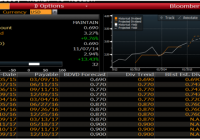
Energy stocks have been pummeled by lower oil prices. Now, energy companies may be forced to cut dividends. The highlight of oil sector ETFs and potential areas of weakness. By Todd Shriber & Tom Lydon Already under considerable pressure with oil prices falling and valuations on the rise, energy sector exchange traded funds are confronting a new problem: The potential, emphasis on “potential,” for dividend cuts from some of the sector’s largest companies. Major equity-based energy ETFs from the Energy Select Sector SPDR ETF (NYSEARCA: XLE ) to the Vanguard Energy ETF (NYSEARCA: VDE ) and the Fidelity MSCI Energy Index ETF (NYSEARCA: FENY ) could be stung by dividend cuts from marquee holdings if oil prices remain and/or fall further, forcing producers to look for ways to conserve cash. If the options market is accurate, the specter of energy sector dividend reductions must be acknowledged. Perusing 2016 at-the-money options data, the options market is pricing in dividend cuts for some of the biggest U.S. oil companies and some of the largest holdings in the aforementioned ETFs. For example, Bloomberg data indicate, based on the company’s recent dividend growth trajectory, Occidental Petroleum (NYSE: OXY ) will grow its payout to $3.20 per share per year over the next 12 months from the current level of $2.88 per share. However, the options market says Occidental’s payout could fall to $2.60. ConocoPhillips (NYSE: COP ), the largest U.S. independent oil and gas producer, assuming the options market is accurate, will also see its annual payout fall to $2.60 from $2.92 per share. ConocoPhillips and Occidental are XLE’s sixth- and seventh-largest holdings, respectively, combining to make up 7.3% of the largest energy ETF ‘s weight. Schlumberger (NYSE: SLB ), the world’s largest oilfield services provider, recently announced a 25% dividend increase, bringing its payout to $2 per share per year. The options market is not impressed, and sees the potential for that dividend to fall to $1.40 a share. Schlumberger is XLE’s third-largest holding, at a weight of almost 7.2%, and the largest holding in the Market Vectors Oil Services ETF (NYSEARCA: OIH ) , at 20.2% of that fund’s weight. OIH and rival oil services ETFs have already endured ample dividend cut speculation, some of which was confirmed in November when Seadrill (NYSE: SDRL ) said it was suspending its $1 per share quarterly dividend until at least the end of 2015. Analysts have noted Diamond Offshore’s (NYSE: DO ) special dividend policy is at risk, while highlighting Transocean (NYSE: RIG ) as a potential dividend cutter . In what could be a real shocker, the options market is also pricing in potential dividend cuts by Exxon Mobil (NYSE: XOM ) and Chevron (NYSE: CVX ), the two largest U.S. oil companies. Based on recent dividend growth, it would be reasonable to expect Exxon’s and Chevron’s dividends to rise to $3 and $4.52, respectively, over the next year. However, options data say $2.71 and $3.99, both below current levels, could be in the cards for Exxon and Chevron. Exxon and Chevron combined for 30.3% of XLE’s weight as of Monday and 34.8% of VDE at the end of December. Several factors should not be overlooked, not the least of which is that the options market could be proven wrong. Second, the companies mentioned here have options for cash conservation before moving to dividend cuts, including reducing capital expenditures and trimming buybacks. Exxon is one of the largest repurchasers of its own shares in the U.S. Third, several of these companies have proven they are highly committed to consistently raising their dividends. For example, Exxon and Chevron are members of the S&P Dividend Aristocrats Index, which requires dividend increase streaks of at least 25 years for inclusion. With its new dividend, Schlumberger’s payout has nearly doubled since 2008. Occidental’s dividend has more than doubled since 2010. Still, even the thought of dividend cuts comes when energy stocks are vulnerable to negative earnings revisions and valuations that are high despite slumping oil prices. “The forward 12-month P/E ratio for the S&P 500 now stands at 16.6, based on (last week’s closing price (2063.15) and forward 12-month EPS estimate ($124.04). Given the high values driving the ‘P’ in the P/E ratio, how does this 16.6 P/E ratio compare to historical averages? What is driving the increase in the P/E ratio? The current forward 12-month P/E ratio of 16.6 is now well above the three most recent historical averages: 5-year (13.6), 10-year (14.1), and 15-year (16.1)” – Rareview Macro founder, Neil Azous. (click to enlarge) Chart Courtesy: Bloomberg

Value Investing: Have You Been Using The Wrong Quality Ratio?

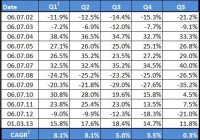
By Tim du Toit Do you think adding a company quality ratio to your investment strategy can make a difference to your returns? As you know we are skeptical, as our experience testing quality ratios in the research paper Quantitative Value Investing in Europe: What Works for Achieving Alpha was mixed. What doesn’t work We found that Return on invested capital (ROIC) and return on assets (ROA) weren’t good predictors of returns. Even though high-quality companies did do better than low-quality companies (low ROIC and ROA) returns did not increase in a linear way as you moved from low-quality to high-quality companies. And if you only invested in high-quality companies, it would not have helped you to consistently beat the market. A better quality ratio? Our thinking on quality ratios changed when we read a very interesting research paper called The Other Side of Value: The Gross Profitability Premium by Professor Robert Novy-Marx in which he defined a company quality ratio performed as well as a valuation ratio. How calculated Professor Novy-Marx defined a quality company as one that had a high gross income ratio (let’s call it Quality Novy-Marx ), which he calculated by dividing gross profits by total assets . He defined gross profit as sales minus cost of sales and assets simply total assets as shown in the company’s balance sheet (current assets + fixed assets). Does it work? In the paper Professor Novy-Marx shows that this simple ratio has about the same predictive return value as the price to book ratio in spite of companies with a high gross income ratio (Quality Novy-Marx) being a lot different if you compare them to undervalued companies with a low price to book ratio. Companies with a high Quality Novy-Marx ratio generated significantly higher average returns than less profitable companies in spite of them, on average, having a higher price to book ratio (more expensive) and higher market values. Because value (low price to book) and profitability (high Quality Novy-Marx ratio) strategies’ returns are negatively correlated (the one goes up when the other goes down), the two strategies work very well together. So much so that Professor Novy-Marx in the paper suggests that value investors can capture the full high-quality outperformance without taking on any additional risk by adding a high quality strategy to an existing value strategy. If you do this he found that this reduces overall portfolio volatility, in spite of it doubling your exposure to the stock market. We also tested it We of course also wanted to test if the Quality Novy-Marx ratio works on the European stock markets. Our back test (on European companies) over just less than 12 years from July 2001 to March 2013 came up with the following result: Source: Quant-Investing.com 1 Quintiles 2 Compound Annual Growth Rate ( OTCPK:CAGR ) As you can see the results are (apart from Q1 to Q2) linear, which means as you move from low-quality companies (Q5) to high-quality companies (Q1) returns increase every time. Also high quality companies (Q1) did substantially better than low-quality companies (Q5). This clearly shows that the Quality Novy-Marx ratio is a very good ratio to add to how you search for investment ideas. Substantially outperformed the market High-quality companies also substantially outperformed the index. The STOXX Europe 600 index over the same period had a compound annual growth rate of -0.82%, worse than even the worse quintile, most likely because of the banks being included in the index (not in the back test universe because you cannot calculate the Quality Novy-Marx ratio for them). In summary From these two back tests you can see that adding quality companies, defined as companies with high gross profits to total assets can definitely add to your investment returns. We have not tested it but Professor Novy-Marx mentions that if you are a value investor, quality companies have the ability to increase your returns and decrease the volatility of your portfolio. But if you add this quality ratio to your screens, you will find companies that are not undervalued, which is something that value investors will have to get used to. Where can you find it? In the screener you can select the gross income ratio (called Gross Margin (Marx)) as a ratio in one of the four sliders as shown below. Or you can select the Gross Margin (Marx) as a column in your screen which will allow you to filter and sort the Gross Margin (Marx) values.