Tag Archives: seeking-alpha

Paring The Leaders, ETF Performance Review: Major Asset Classes
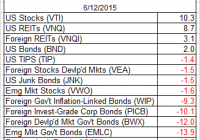
The U.S. equity market has regained front-runner status for the trailing one-year return (250 trading days) among the major asset classes, but the edge is looking considerably less impressive compared with the glory days of recent years. In fact, rolling one-year returns overall are a diminished lot lately, based on our standard set of ETF proxies that track broad measures of the global opportunity set. There are fewer positive returns for the trailing 250-day period while the performance histories that are still in the black reflect relatively modest gains vs. recent history. In short, earning a risk premium isn’t getting any easier. That’s another way of saying that there’s more red ink weighing on the one-year profiles. Ten of the 14 ETFs that track the major asset classes have lost ground over the past 250 trading days. One thing that hasn’t changed: the deeply bearish trend for commodities in broad terms. The iPath Dow Jones-UBS Commodity Index Total Return ETN (NYSEARCA: DJP ) is still the big loser, shedding nearly 28% over the past year. Here’s a graphical recap of the relative performance histories for each of the major asset classes for the past 250 trading days via the ETF proxies. The chart below shows the performance records through June 12, 2015, with all the ETFs rebased to a year-ago starting-value of 100. U.S. equities are again in the lead (blue line at top), but the edge is razor thin over U.S. real estate investment trusts (black line), which is the number-two performer at the moment. Meanwhile, let’s review an ETF-based version of an unmanaged, market-value-weighted mix of all the major asset classes – the Global Market Index Fund, or GMI.F, which holds all the ETFs in the table above. Here’s how GMI.F stacks up for the past 250 trading days through June 12, 2015. This investable strategy is ahead by just 1.7% over that span – well below the performance for U.S. stocks, via the Vanguard Total Stock Market ETF (NYSEARCA: VTI ) and slightly behind the 2.0% return for U.S. bonds via the Vanguard Total Bond Market ETF (NYSEARCA: BND ). Comparing the median dispersion for rolling 250-day returns for the major asset classes via ETFs suggests that the general rebalancing opportunity has fallen for GMI.F vs. recent history after surging in recent months. Analyzing the components of GMI.F with a rolling median absolute deviation via one-year returns for the ETFs implies a moderately diminished potential for adding value by reweighting this portfolio in comparison with recent history. Keep in mind that the implied opportunity for productive rebalancing will vary depending on the choice of holdings and historical time window. Also, any given pair of ETFs may present a significantly greater or lesser degree of rebalancing opportunity vs. analyzing GMI.F’s components collectively, which is the methodology that’s reflected in the chart below. Note, too, that the chart focuses on looking backward. If you’re confident in your forecast for risk and return, the ex ante view of rebalancing opportunity may paint a distinctly different outlook vs. an ex post analysis. Finally, let’s compare the rolling one-year returns for the ETFs in GMI.F via boxplots to review performance momentum in the context of recent history. The gray boxes in the chart below reflect the middle range of historical 250-day returns for each ETF – the 25th to 75th return percentiles. The red dots show the current 250-day return (through June 12) vs. the equivalent from 30 trading days earlier (blue dots, which may be hiding behind red dots in some cases). For instance, the chart shows that the U.S. stock market is currently the top performer among the major asset classes, as shown by red dot. But in a sign of the times, the current performance is a touch below VTI’s median return (horizontal black line).
Sky High Valuations? Lusterless Economy? It Just Doesn’t Matter!

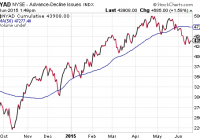
Sky high stock valuations do not matter in an era of worldwide central bank rate manipulation. And yet, there are a few things that may still carry weight with the global investing community as we move forward in 2015. The way that I view it, the appeal of all risk assets in the large-cap universe had shot out of a cannon in the first half of 2013. In 2015, however, the S&P 500 A/D line has flattened out. Several years ago, Rolling Stone ranked the 10 best movies by former cast members of Saturday Night Live. Bill Murray barely made the list with Rushmore – an offbeat comedy from the late 90s. I remember thinking that Murray had been cheated in the editorial; he should have received additional nods for Caddyshack, Stripes, Lost In Translation as well as What About Bob. In that vein, how on earth did they miss the quintessential camper experience from my youth, Meatballs? Granted, Meatballs did not have the critical acclaim of Lost in Translation or the monumental influence of Caddyshack; the writer may not have been alive in the 70s. Nevertheless, Meatballs had one of the most iconic quasi-motivational speeches ever. Murray’s character, head counselor Tripper Harrison, persuades a band of misfit teens to take on the elite athletes from another camp by celebrating nonconformity. Here’s a snippet from the inspirational talk: Murray (Tripper Harrison): Even if every man, woman and child held hands together and prayed for us to win, it just wouldn’t matter, because all the really good looking girls would still go out with the guys from Mohawk ’cause they’ve got all the money! It just doesn’t matter if we win or we lose. Campers and Counselors: IT JUST DOESN’T MATTER! IT JUST DOESN’T MATTER! IT JUST DOESN’T MATTER! Thirty six years since the release of Meatballs, I find my mind drifting back to Bill Murray’s humorous exchange with his dejected campers. (In some ways, he may have been speaking directly to movie-goers.) I address legitimate concerns about risk assets regularly. And yet, sky high stock valuations do not matter in an era of worldwide central bank rate manipulation. I chronicle the good, the bad and the ugly about the economy daily. And still, it just doesn’t matter to the risk-on herd. For example, it has been well-documented that the price-to-book (P/B), price-to-sales (P/S) and P/E) of the median stock on U.S. exchanges have never been higher. Not even during the dot-com craziness in March of 2000. Similarly, U.S. stock market value as a percentage of gross national product is at 150%; that represents the second highest level in U.S. history. Warren Buffett wrote in 2001 that when one buys stocks in the 70%-80% range, the decision is likely to work out well. At present, the “Buffett Indicator” is 2x preferred levels. Does it matter? Not in the immediate term. What about the economy that has been lumbering along at a 2% clip for six-and-a-half years? Those sub-par growth results in the recovery required extraordinary emergency measures of $3.75 trillion in asset purchases by the Federal Reserve System; it also required federal government excess spending of $7.5 trillion. More recently, industrial production – a measure of output for manufacturers, miners and utilities – dropped 0.2% in May and has not increased since November of last year. The Federal Reserve Bank of New York’s Empire State manufacturing survey registered a negative reading (-2.0) in June – its second negative report in the last three months. Does it matter? Not particularly. In contrast, there are a few things that may still carry weight with the global investing community as we move forward in 2015. For instance, the evidence surrounding the potential for a disorderly exit by Greece from the euro suggests that markets may struggle a bit more than most media pundits are willing to acknowledge. More importantly, recent downshifts in market breadth have convinced me that a defensive allocation is warranted. Keep in mind, when investors are gaga for risky assets, they often acquire them across the board. Yet both the NYSE and the S&P 500 have seen a definitive breakdown in the number of advancers compared with the number decliners. The NYSE Advance Decline Line (A/D) has not been this far below its near-term 50-day moving average since the October swoon and the November “Bullard Bounce.” The S&P 500 is also losing some if its participants in the rally. Throughout May and June, less and less of component companies are moving higher in established uptrends. During highs that were established over the last six months, bullish breadth readings clocked in near 75%. Bullishness via the Bullish Percentage Index (BPI) for the S&P 500 is about as weak as it was in February. We can even take a look at the slope of the advance/decline line for the S&P 500. The way that I view it, the appeal of all risk assets in the large-cap universe had shot out of a cannon in the first half of 2013. And while the desire tapered off a bit between the 2nd half of 2013 and the end of 2014, the passion was still there. In 2015, however, the S&P 500 A/D line has flattened out. Granted, the benchmark can still move higher with less and less corporate shares participating; market-cap weighted indexes concentrated in the “Apples” will do that. On the flip side, weakening breadth can also mark a turning point such that stocks will move dramatically higher or dramatically lower. Indeed, we have been approaching a critical crossroads. The Federal Reserve is deciding whether to begin a campaign of tightening borrowing costs slightly or to wait for definitive data that is unlikely to ever confirm genuine economic strength. More importantly, what the Fed actually does will be far less important than the interpretation by the global investing community. The Fed might raise rates 0.125% at a 2015 meeting that is so slow, risk-takers would likely celebrate; the Fed might raise overnight lending rates 0.25% while simultaneously expressing that they won’t do so again until three months of upbeat data. Conversely, the Fed could misread the signals by simply hiking borrowing costs on the belief that the economy is healthy enough to withstand the heat, spiking volatility in treasuries as well as equities. Or, they might sound so downbeat in their assessment, stocks could flounder on recessionary fears. In other words, different things matter at different times. Keep an eye on the iShares 7-10 Year Treasury Bond ETF (NYSEARCA: IEF ). If the price of IEF climbs above and stays above its 200-day moving average, it may suggest that fears of Fed rate hikes were overblown. Stocks would likely benefit from contained borrowing costs. In contrast, if IEF stays below its 200-day and drops significantly below its June low near 104, expect corrective activity for riskier stock assets. Click here for Gary’s latest podcast. Disclosure: Gary Gordon, MS, CFP is the president of Pacific Park Financial, Inc., a Registered Investment Adviser with the SEC. Gary Gordon, Pacific Park Financial, Inc, and/or its clients may hold positions in the ETFs, mutual funds, and/or any investment asset mentioned above. The commentary does not constitute individualized investment advice. The opinions offered herein are not personalized recommendations to buy, sell or hold securities. At times, issuers of exchange-traded products compensate Pacific Park Financial, Inc. or its subsidiaries for advertising at the ETF Expert web site. ETF Expert content is created independently of any advertising relationships.

Cheap Stock With A High Yield Or High Yield With A Cheap Stock? How About Both?

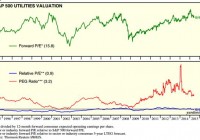
TECO Energy is valued at a substantial discount to its peers based on its forward PEG ratio. TECO Energy offers a current yield of 5.02%. The stigma of its discontinued coal operations along with a dismal dividend growth profile is holding back share prices, but should change with its renewed focus on regulated assets. Are you a value buyer looking for peer undervaluation or are you looking to garner higher income from your invested capital, or a little bit of both? If so, TECO Energy (NYSE: TE ) should be of interest. TE is trading at a comparatively large discount to its anticipated growth rate for the utility sector and the current yield is 5.02%. One measure of fundamental value is the PEG ratio, or price to earnings to earnings growth. Utilities are always on the top of the PEG valuation scale due to slow growth and outsized yields. In most sectors, fair valuation is usually considered at 1.0 for large caps and 1.2 for smaller caps. Over 1.2 is considered overvalued and below 1.0 is undervalued. For utilities, however, it is not uncommon for the PEG ratio to be over 3.0. The PEG ratio for utilities is best used for peer comparisons. One tool that has been used since the early 1970s is the forward PEG ratio, or fundamental valuation based on anticipated 5-yr growth rates and forward earnings estimates. The forward PEG has been one of my personal uppermost due diligence considerations since researching stocks using Value Line in the local library way, way before the internet. The reference librarian got to know me pretty well. However, I digress. Yardeni.com offers an interesting chart of the forward PEG for the utility sector going back 20 years, as represented by the S&P 500 Utility Sector. Below is the chart of the current forward PEG ratio (green line), relative sector P/E to the S&P 500 forward P/E (blue line), and the current forward PEG ratio (red line): (click to enlarge) The current utility sector forward PEG is 3.2 and the average forward P/E is 15.8, reflecting a sector-anticipated growth rate of 4.9%. Enter TECO Energy. The company is going through a transition by selling its coal mining operations to focus solely as a regulated natural gas and electric utility. Its geographic coverage is Tampa Electric (700,000 customers) and Peoples Gas (350,000 customers) in Florida and recently acquired New Mexico Gas (513,000 customers). Earnings per share guidance by management in 2015 is in the $1.08 to $1.10 range, with 2016 consensus estimates of $1.18 to $1.22. Progression in estimates is based on an expansion of its regulated asset base of between 4% and 7%, recent Florida rate case approval with agreed rate increases until 2018, and an allowed ROE in the favorable 10.25% range. TE’s earnings growth rate is offered at between 9.0% and 11.5%, and substantially above the sector average of 4.9%. TECO is trying to sell its coal producing assets in Virginia, Kentucky, and Tennessee. Held as a discontinued asset since third quarter 2014, TECO Coal LLC had a buyer for $80 million in cash and potential future payments of $60 million based on performance targets. However, with the current financial stress of the coal industry, the buyer was unable to acquire the necessary financing and the sale did not close earlier this month. Last week, TE announced a new buyer had stepped in with a 30-day close schedule, but neither terms nor buyers were disclosed. For all intents and purposes, these assets have been written down and the immediate benefit to shareholders from the sale will be a one-time cash inflow of between $0.20 and $0.50 a share. Historically, the coal business has been a large segment of earnings, representing upwards of 30% of net income. As recently as 2011, coal generated over $50 million in income, and coal could be counted on to supply earnings per share of between $0.25 and $0.40 annually. Using the lowest 2016 earnings estimates of $1.13 and the lower project growth rate of 9%, TE’s forward PEG would be 1.7, substantially below the 3.2 of the sector. The current valuation of TE at $17.80 equates to a sector-average forward P/E of 15.7. The undervaluation is based on a much higher growth rate profile. TE’s current yield is 5.02% and represents a substantial income advantage to the sector average 3.5% yield. TE falls in the top tier of utility dividend payers for yield, but offers the disadvantages of a high payout ratio and very low historic dividend growth. While earnings growth is expected to be above average, until the payout ratio declines from around 87% last year to a more comfortable 65% to 70%, investors should not expect dividend growth above a mere nominal level. For example, 3-yr TE dividend growth is 1.3% and 5-yr dividend growth is 1.9%. The best investors should expect over the next three years is inflation-matching dividend growth. However, the current yield of 5.02% should pique the interest of income seekers. Historically, natural gas utilities offer some of the lowest yields in the sector. Using Hennessey Natural Gas Utility Fund (MUTF: GASFX ) and a few of the more popular gas utility stocks as proxies, the representative yield could be between 2.1% and 3.3%. With 50% of customer count from its gas utilities, TE’s yield is comfortably above these averages. Management has generated returns on invested capital in excess of sector average. With peer-average in the 4.5% to 5.0% range, TE’s 5-yr average ROIC is 6.0%, and 3-yr average ROIC is 5.5%. However, their cost of capital is high at 5.7%, according to ThatsWACC.com. TECO could be either an acquirer of smaller utilities, such as its purchase of New Mexico Gas, or as a candidate in the continuing march of utility consolidation. Until the stigma of coal is washed from investors’ memory, TE will trade based on its yield and not its growth prospects. If management delivers on its regulated growth platform, today’s share price and corresponding yield could be looked at as being both cheap and high yield. Author’s Note: Please review disclosure in Author’s profile. Disclosure: The author has no positions in any stocks mentioned, but may initiate a long position in TE over the next 72 hours. (More…) The author wrote this article themselves, and it expresses their own opinions. The author is not receiving compensation for it (other than from Seeking Alpha). The author has no business relationship with any company whose stock is mentioned in this article.