Tag Archives: seeking-alpha

Greece, Puerto Rico Or China? Debt-Fueled Excesses At The Heart Of Them All
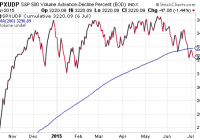
Investors erroneously focus on which human interest story, or combination of issues, is/are of greatest importance. However, the root cause of every high-profile concern is debt-fueled excess. It follows that a responsible media should refrain from concocting unknowable storms and, instead, hone in on the risks associated with ultra-low borrowing costs and/or exceptionally easy credit terms around the world. Lately, I have been fielding a host of “which is worse” questions. Is it the possibility of Greece exiting the euro-zone or is it the potential for Puerto Rico to default on its debt? Is it the 25%-plus bearish retrenchment of China’s Shanghai SSE Composite or is it the likelihood of eventual rate hikes by the U.S. Federal Reserve? In truth, investors erroneously focus on which human interest story, or combination of issues, is/are of greatest importance. However, the root cause of every high-profile concern is debt-fueled excess . It follows that a responsible media should refrain from concocting unknowable storms and, instead, hone in on the risks associated with ultra-low borrowing costs and/or exceptionally easy credit terms around the world. For the purpose of understanding, let’s discuss the debt concerns of Greece, Puerto Rico and China, beginning with the Greek tragedy. Since the origin of the euro-zone, less productive and less economically successful countries had been able to borrow-n-spend at the same favorable rates as the most productive and most successful countries. That’s like giving a $50,000 line of credit to individuals with very different abilities to handle debt – like offering a card to a $200,000 per year earner with a 760 credit score as well as providing a card to a $50,000 per year earner with a 520 credit score. Sooner or later, one of the individuals will not be able to keep up. And in this case, Greece cannot keep up with Germany, Austria or Finland. (Neither can Portugal, Spain or Italy.) Easy borrowing and reckless spending has left Greece with few viable alternatives. Now let’s shift gears to Puerto Rico. Whereas the working-aged population employment rate/labor participation rate in the United States is 62.7%, this number is a mere 40% in Puerto Rico. Over the last decade, corporate tax breaks disappeared for a number of U.S. corporations operating in Puerto Rico, forcing the companies to leave and to take many of those jobs with them. Residents also left over the last decade due to limited job prospects and exorbitant local taxes as high as 33%. Less jobs, less people, high taxation… none of that stopped the Puerto Rican government from borrowing way beyond its means and running enormous deficits. Ironically, U.S. states are not allowed to use debt to increase budget deficits. Puerto Rico did. Eventually, the territory will be bailed out by congressional/While House decree or be permitted to seek some from of bankruptcy protection (after a law or two is passed). Now we come to China. And yes, I will stipulate that the recent turbulence in Chinese stocks as well as China’s underachieving economy as more critical to the performance of risk assets around the globe than Greece or Puerto Rico. This is China – the world’s 2nd largest economy behind only the United States. Of course China matters more than tiny countries or territories. So when loose rules surrounding margin debt helped fuel the miraculous rise in China’s Shanghai SSE Composite, and when the People’s Bank of China (PBOC) recently cut interest rates to ease lenders’ capital settings, and when the Securities Association of China announced that the country’s big brokerages had agreed to put up 120 billion yuan ($26 billion) to prop up Chinese blue-chip equities, one might have hoped for the party to go on. That’s not the case, though. Once again, investors need to take note of why China is struggling at all. Rate cuts mean easier money and excessive margin debt implies debt-fueled excess. As if that weren’t enough, the country’s total government, corporate and household debt load as of mid-2014 is roughly equal to 282 percent of the country’s total annual economic output. China’s debts are growing at a pace that is unsustainable. Debt-fueled excess explained the financial crisis in 2008 for the U.S. Is it any surprise, then, that Greece, Puerto Rico and China have been dealing with similar concerns related to easy credit? (Note: I am not saying that China is a lost cause the way Greece and Puerto Rico are, but simply, noticing the similarity in the genesis of debt-fueled excesses.) What does it all mean for risk assets stateside? Perhaps ironically, there is boundless love for the Federal Reserve in the United States. Nobody seems to believe that the Fed has ever made or will ever make a policy mistake. Yet the Fed erred in its rate policy leading up to the 2000 dot-com collapse; it faltered in keeping rates too low for too long leading up to the 2008 financial crisis, and then failing to recognize the severity of the coming recession in not cutting rates quickly enough. Will Greece, Puerto Rico and even China push the Fed toward keeping zero percent rates in place for all of 2015? Will seven years of zero-percent, ultra-easy rate policy be a good thing, then? And if so, when does it become a bad thing? As I have pointed out in previous columns, sky-high stock valuations and a lusterless domestic economy may not matter in the near-term. Yet they may begin to matter alongside battered faith in the central banks of Europe and/or China; they may begin to matter if waning confidence spreads to the Fed. One of the best ways to determine whether confidence is waning or holding firm is to check in on the market internals (a.k.a. breadth indicators ). Here are three considerations: The Advancing-Declining Volume Line (AD Volume Line) measures the buying and selling pressure behind a market advance or market decline. It goes up when advancing volume is positive; it falls when it is negative. In other words, if there is significant volume behind declining stocks, you have selling pressure and reason for caution. The pressure today is powerful enough for the volume behind decliners to push the AD Volume Line for the S&P 500 below its 200-day moving average for the first time since 2012. We can also look at the Advance/Decline (A/D) Line for the S&P 500. Although there has not been a definitive breakdown in the number of advancers participating in the bull market relative to decliners, the drop-off since mid-May is worthy of continued vigilance. Finally, investors should be mindful of the High-Low Index, This breadth indicator is based on new 52-week highs and new 52-week lows. In essence, when the High-Low Index is above 50, the stock index may be thought to be in an uptrend; when the index is below 50 – when new lows outnumber new highs – the trend may be considered bearish. The S&P 500 Hi-Lo at 56.67 is still positive today, though it sits at its lowest level in 2015. Income assets have been trimmed at the longest-end of the yield curve as well as the middle of the asset risk spectrum. We have concentrated our income in funds like the i Shares 3-7 Year Treasury Bond ETF (NYSEARCA: IEI ) and the BulletShares 2016 High Yield Corporate Bond ETF (NYSEARCA: BSJG ). Most notably, we have raised our cash component of the income picture. Growth assets have been trimmed in the foreign holdings arena. Several had hit stop-limit loss orders , leaving the combined cash from growth-n-income trimmings at roughly 15%-20%. Growth at 50%-55% of most portfolios is primarily comprised of funds that we have held onto for years, including funds like the Health Care Select Sect SPDR ETF (NYSEARCA: XLV ) , the iShares MSCI USA Minimum Volatility ETF (NYSEARCA: USMV ) and the Vanguard Mid-Cap Value ETF (NYSEARCA: VOE ). Disclosure: Gary Gordon, MS, CFP is the president of Pacific Park Financial, Inc., a Registered Investment Adviser with the SEC. Gary Gordon, Pacific Park Financial, Inc, and/or its clients may hold positions in the ETFs, mutual funds, and/or any investment asset mentioned above. The commentary does not constitute individualized investment advice. The opinions offered herein are not personalized recommendations to buy, sell or hold securities. At times, issuers of exchange-traded products compensate Pacific Park Financial, Inc. or its subsidiaries for advertising at the ETF Expert web site. ETF Expert content is created independently of any advertising relationships.
Sell Your XLF

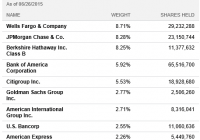
Summary Financials face too many headwinds going forward. Terrible Risk Reward Profile for XLF components. ETF vulnerable to a major sell-off. Quick Background Launched in December, 1998, the Financial Select Sector SPDR ETF (NYSEARCA: XLF ) is an exchange-traded fund comprised of roughly 90 securities with $18.1 billion in assets. It seeks to provide investment results that correspond to the performance of the S&P Financial Select Sector Index and attempts to provide an effective representation of the financial sector of the S&P 500 index. XLF components can be broadly classified as banking (35.5%), insurers (16.5%), real estate (REITs, 15.6%), capital markets (13.8%) diversified financial services (12.7%) and consumer finance (4.9%), as of the end of Q1, 2015. Some Concerns Concentration There is substantial concentration risk in the XLF. The top 3 holdings in the fund, Wells Fargo (NYSE: WFC ), JPMorgan (NYSE: JPM ), Berkshire Hathaway (NYSE: BRK.B ) account for a quarter of the fund’s weighting and the top ten holdings account for almost half (49%). If something goes awry for one of the major components, it would have a very disproportionate effect on the XLF. From the Select Sector SPDR Website : Housing ‘Recovery’ The housing sector has had a great rebound from the depths of the financial crisis. But we think housing is in a countertrend bounce which will work lower once again now that QE and the Feds ZIRP (zero interest rate policy) are ending. Wells Fargo is the main player in this area since it originates about 15% of mortgages in the U.S. and services mortgages with values over $1.7 trillion. Both the originations and servicing metrics are more than Chase and Bank of America (NYSE: BAC ) combined. WFC has rocketed back almost 7.5 fold from the March 2009 lows, or roughly 150% more than the broader averages. When the May numbers for new U.S. single family home sales were released a couple weeks ago, CNBC ran the headline ‘Home Prices near Prior Peak.’ It’s worth noting that Wells Fargo’s stock is about 60% higher now than when house prices peaked in June of 2006 so there is quite a bit of optimism built into that appreciation. WFC directly makes up 8.71% of the fund but if you also add in Berkshire Hathaway’s holdings of Wells Fargo stock, it’s really closer to 11% of XLF. A downturn in the housing sector could disproportionately hurt Wells and the XLF. Let’s not forget that WFC shares lost almost 83% of their value in a seven month stretch during 2008-2009. Even Wells Fargo’s Chief Economist offered some caution at a recent conference when speaking about the San Francisco market and to “put some money aside in the piggy bank.” Derivative Exposure The top 4 investment banks (JPMorgan, Bank of America, Citigroup (NYSE: C ) and Goldman Sachs (NYSE: GS )) hold 91.3% of the total derivatives outstanding ($185 trillion of the $203 trillion outstanding as of Q1 2015), according to the Office of the Comptroller of the Currency, OCC . The combined total assets for these 4 banks are just over $5 trillion which represents just 2.7% of their derivative exposure. I went and took just the cash and cash equivalents of these big 4 banks from the end of the first quarter of 2015 from Yahoo Finance and the sum was $1.97 trillion which represents just 1% of their total derivative exposure. If there is some type of shock to the system (Lehman Brothers, Bear Stearns) with derivative exposure compared to their assets this stretched, these firms are dangerously undercapitalized. Total notional value of all OTC derivatives is $710 trillion, according to the Bank for International Settlements. Granted this is worst-case scenario numbers and netting effects will mitigate much of this exposure but even if a fraction of the exposure goes awry (counterparty or a clearing firm gets into trouble) it would have a serious effect on these firm’s capital base. Just these top 4 investment banks make up 22.5% of XLF. XLF’s second largest holding, JPMorgan has derivative exposure of $52.4 trillion which is 25 times larger than its asset base of $2.1 trillion. (click to enlarge) The exposure for Goldman Sachs is truly worrisome. They rank #3 in total notional derivatives with $44.51 trillion which is a jaw-dropping 348 times larger than their total asset base, $127.77 billion, according to the OCC’s quarterly report. Goldman Sachs survived the financial crisis by (arguably) getting on the short side. Who knows if they will be able to hedge so well again with all the prop trading restrictions? The lines between market-maker and prop trader will be more severely scrutinized this time around. Goldman has made it through the financial crisis (the stock had recovered 87% of its pre-crisis value) but I think the ire of many will be directed towards Goldman the next time around, especially post ‘Muppet-Gate.’ Lastly, Goldman’s value-at-risk, VaR, measured relative to equity is very low at only a tenth of one percent, according to the OCC report. We worry this is understated because 1- they report their VaR at only a confidence level of 95% (versus Banc of America or Citigroup who disclose at a more stringent 99%) and 2- the VIX has been at very low levels for three straight years now, with only the occasional spike which is quickly retraced. VaR tends to follow the VIX and we think a large VIX increase, and more importantly, a more sustained increase is imminent. Even though the VIX has started to move up again, there is still more complacency shown than in prior spikes (the open interest in the VIX’s put-call ratio has barely budged higher). This non-confirmation indicates the VIX could have much more to run. These VaR measures are deceivingly for many of the banks, not just Goldman. They didn’t help during the financial crisis and I doubt they’ll help much during another one. Given the degree of concentration among the three largest holdings in XLF, we must mention Berkshire Hathaway. The conglomerate, with such classic brands as Coca-Cola (NYSE: KO ), Kraft (KRFT) and GEICO, has been run by an absolute legend-two actually. But it’s portfolio of blue chips and now an increased position in cyclical industries like railroads (the Burlington-Northern purchase) leave it susceptible to an economic downswing also. Even Berkshire’s portfolio wasn’t immune to the financial crisis that lopped 57.5% off its shares in 7 months, from a high in December 2007 ($101.18) to a low of $42.95 in July of 2008. It chopped around feverishly and then almost retested the low with the market, reaching $45.02 in March of 2009. Real Estate REITs are especially vulnerable going forward simply because they have been such a crowded trade in the hunt for yield during the ZIRP era. The REIT with the largest weighting in XLF is Simon Property Group (NYSE: SPG ), the giant shopping mall REIT. The U.S. consumer is struggling and shopping malls should prove to be one of the tougher roads ahead in the REIT space. Famed bond investor Jeffrey Gundlach of Doubletree warns of mall REITs and says “we’re in a secular death spiral for malls.” This REIT lost roughly 80% of its value in the financial crisis and that’s as rates were being lowered. What will happen if there’s stress and rates rise? We believe eventually rates will rise for the wrong reasons (not growth in the economy) but because investors will demand more interest for the risk of owning the various country’s or company’s bonds. When they do start to rise, there will be more competition against the alphabet soup of so-called “bond equivalents” high yielders (REITs, MLPs, BDCs, etc.) Insurance Insurers are in a riskier position than many believe. Insurance companies have been so hard-pressed to match their liabilities in a ZIRP environment they’ve been forced to take on all kinds of risky toxic securities in a hunt for yield. Their book values could get decimated when various classes of bonds, junk bonds in particular (insurance company investment portfolio staples) unravel. Life insurers are especially vulnerable ( MetLife, Inc. ( MET) and Prudential Financial, Inc. ( PRU)), both high on XLF’s list. On CNBC , Stanley Druckenmiller, the former partner with George Soros from the famous trade that broke the Bank of England has been mentioning some reservations regarding the corporate bond market. He warns that from the prior high in 2006, 28% of issued debt was B-rated, now its 71%. Covenant lite loans made up 20% of all loans in 2006/2007 and now that number is over 60%. The Barclay’s U.S. Corporate High Yield Spread will be a key metric to watch and if we break above last winter’s peak of 550, it could be off to the races for the spreads to start widening out more severely. This will be bad news for the XLF. The current consensus is that interest rate rises are good for banks because of the net interest margin increases. The net interest margin has as much to do with the shape of the yield curve as the direction of rates. When short-rates rise much faster than long rates, it doesn’t necessarily increase the net interest margin- it portends trouble. We think rates of all durations will work higher, quicker than many think, and any increase in NIM will be offset by credit concerns. A fantastic article on Seeking Alpha was recently written by Donald van Deventer talking about banks, life insurers and reinsurers and higher rates. Here is an excerpt from the article that illustrates that these entities are mostly negatively correlated to rising interest rates, measured against a set of 11 different U.S. Treasury maturities covered by Yahoo Finance: (click to enlarge) Empirical evidence shows that insurance stocks (and bank stocks in his other article) are, in fact, more negatively correlated to rate rises, contrary to what seems to be new conventional wisdom. I highlighted two ‘Top Ten’ holdings of XLF. I believe there is so much built in optimism in the market that almost all data points are being used only for opportunistic purposes without precaution. It’s been quite a long time since we’ve had a sustained uptrend in rates so there’s no telling how this may play out (especially with at least $59 trillion in dollar-denominated debt outstanding in the U.S. and roughly $200 trillion worldwide, see chart from McKinsey report below.) Regulatory The drumbeat of more regulation and fines from the financial crisis seem never-ending. So far, over a quarter trillion dollars have been paid by the big banks for various wrongdoings since the financial crisis. That should continue. We believe another whole round will begin and the ‘hedge clipper’ movement will continue to gain strength. When the market turns down again, populist opinion will accompany the rhetoric and amplify. Hillary Clinton’s campaign has already started the anti-hedge fund/Wall Street talking points and has even hired Gary Gensler, former top federal regulator and CFTC head, as her campaign CFO. A victory for Hillary could mean that this strict enforcer of Wall Street rules could be back in the spotlight. The greater the gap between the 1% and everyone else, the louder and longer this will continue. Many of the names in the XLF are also on the government’s SIFI list which will be a real chain around them in the next downturn, forcing them to maintain various liquidity standards and potentially refrain from ‘riskier’ (and more profitable) activities. More than any other sector, the large financials will be forced to add ever more capital by selling off assets or issuing their own equity to protect the solvency of the financial system. At least twelve XLF components are on the SIFI list, including Wells Fargo, JPMorgan, Goldman, Bank of New York Mellon (NYSE: BK ), Citigroup, State Street (NYSE: STT ), Morgan Stanley (NYSE: MS ) and Bank of America. Non-financial XLF components such as MetLife, Prudential and AIG (NYSE: AIG ) also make the list. Some companies are appealing the designation. The list could extend to asset managers, prime brokers or whoever the government deems too risky to fail in the future. This will eventually mean less lending, whether for individuals or institutions (including hedge funds). The names in the XLF will be the names probably on that list. This should remain another headwind going forward. XLF price target We have a 12-month price target for XLF at $19.75 which represents an approximate 20% discount to current share price. This downside is conservative. We modeled various assumptions including equity market sell-offs (12% U.S. equity market sell-off), interest rate rises (the 3-month LIBOR at 35 basis points, the 30-yr fixed mortgages of 4.50%, the U.S 10- year Treasury above 3%) and U.S. unemployment rate moving higher (to 5.8%, U-6 rate up to 11.3%) and a bottoming of the delinquency rate on Commercial Real Estate (FRED’s ‘DRCR’). Catalysts The main catalyst will be a sell-off in global financial markets or a macro ‘event’ that gets the ball rolling (as I’m finishing this article I see the Greece referendum has just come in with the “No” vote to further austerity prevailing). It won’t be the event specifically; the market environment is long overdue for any excuse to sell. Unlike during the financial crisis, rates don’t have further room to go down so they should actually rise during this sell-off, if for no other “reason” than funds selling the most liquid positions (Treasuries) in a time of turmoil. The extent to the crowding of the bond buying trade of the last few years (resulting in negative sovereign yields, record low junk bond yields, etc) leaves plenty of room for a sustained bond market correction that lasts for years. This will exacerbate the problem for all the various subsectors of the XLF (banking, insurance, real estate, etc). Summary Combine interest rates bottoming off a thirty year downtrend with global debt and derivative exposure pushing one quadrillion dollars and you have a highly actionable time to lessen exposure to financials and/or to sell the Financial Select Sector SPDR Fund .The risk-reward profile is very unattractive at these levels and we think XLF should be sold, reduced, or hedged. The chart below shows a similar pattern in the run up in XLF shares in 2015 compared to 2007. Observe the narrow monthly trading ranges for an extended period of time (about three years) during this run up to now. This ‘calmness’ is not the sign of healthy price action, and the lack of volatility should unwind itself swiftly. In closing, here is a look at what we believe can happen again to XLF: (click to enlarge) Disclosure: I/we have no positions in any stocks mentioned, and no plans to initiate any positions within the next 72 hours. (More…) I wrote this article myself, and it expresses my own opinions. I am not receiving compensation for it (other than from Seeking Alpha). I have no business relationship with any company whose stock is mentioned in this article. Additional disclosure: This is not an investment recommendation and I/we are not a registered investment advisor.

Aetna Finally Agrees To Buy Humana: ETFs In Focus

The insurance corner of the health care sector has been the hottest lately as the five big managed health care insurers are in talks of consolidation. In the latest match-up merger game between Aetna (NYSE: AET )-Humana (NYSE: HUM ) and Aetna-UnitedHealth (NYSE: UNH ), it seems that Humana has finally won following weeks of speculation. Aetna-Humana Deal in Focus In the deal announced on the eve of the July Fourth weekend, Aetna will buy Humana for about $37 billion, or about $230 per share in a cash-and-stock deal. Per the terms, Aetna will pay $125 in cash to Humana shareholders, a 23% premium to its closing price as of June 2, and 0.8375 share for each Humana share. Aetna’s shareholders will own about 74% in the combined company, while Humana’s shareholders will own the rest. The combination, if successful, would be the largest ever in the managed health care insurance space, dwarfing the recently announced $28 billion takeover offer of Chubb Corp. (NYSE: CB ) by ACE (NYSE: ACE ) and Anthem’s (NYSE: ANTM ) $16.6 billion purchase of WellPoint in 2004. The deal would push Aetna close to the second-largest insurer – Anthem – in terms of membership and would nearly triple its market share in the rapidly growing Medicare Advantage business. It will also bolster Aetna’s presence in the state and federally funded Medicaid program and Tricare coverage for military personnel and their families. With this, the combined company is expected to generate revenues of $115 billion in 2015, with 56% coming from government-sponsored programs such as Medicare and Medicaid. The acquisition, expected to be completed in the second half of next year, has already been approved by the board of directors of both companies and is seeking approvals from the shareholders and regulators. The transaction will be neutral to earnings in 2016 but accretive to earnings in mid single digits in 2017 and low double digits in 2018. The proposed merger has put the spotlight on the iShares U.S. Healthcare Providers ETF (NYSEARCA: IHF ), which could be the best way for investors to tap the opportunity arising from the AET-HUM deal. The shares of HUM are up 3.4% in the pre-market trading today while Aetna dropped over 6%. IHF in Focus This ETF follows the Dow Jones U.S. Select Healthcare Providers Index with exposure to companies that provide health insurance, diagnostics and specialized treatment. In total, the fund holds 51 securities in its basket with Aetna occupying the third position accounting for 6.6% share and Humana taking up the seventh spot at 4.6%. The fund has amassed over $1 billion in its asset base while volume is moderate at about 87,000 shares per day on average. It charges 43 bps in annual fees and expenses and has gained 20.4% so far this year. The product has a Zacks ETF Rank of 1 or ‘Strong Buy’ rating with a Medium risk outlook. Other ETF Options While IHF is undoubtedly the solid pick in the health care space to take advantage of the planned merger, other choices are also available from the large-cap space. Among them, the ValueShares U.S. Quantitative Value ETF (BATS: QVAL ) provides a decent exposure to both Aetna and Humana with a combined share of 5.8%. The ETF invests in the cheapest highest quality value stocks, holding 41 stocks in its basket. It has amassed $55.5 million in its asset base while volume is paltry at around 16,000 shares. It charges 79 bps in annual fees. The Direxion iBillionaire Index ETF (NYSEARCA: IBLN ) could also be the way to capitalize gains resulting from the Aetna-Humana deal. The fund provides an opportunity to invest like billionaires by tracking the iBillionaire Index. It has an equal-weighted portfolio of 31 large-cap stocks with Humana as one of its holdings. The product has AUM of $31.7 million and charges 65 bps in fees from investors. Volume is low, exchanging 12,000 shares in hand per day. Original Post