Tag Archives: seeking-alpha

Apollo Joins Competitors With New Funds And Plans For Push Into The Retail Market

By DailyAlts Staff Like many of its peers, Apollo Global Management (NYSE: APO ) is focusing on attracting capital from smaller investors. To this end, the firm is teaming with Ivy Investment Management to launch a pair of alternative income mutual funds: The Ivy Apollo Strategic Income Fund and the Ivy Apollo Multi-Asset Income Fund. Both funds will allocate around 20% of their assets to a total return strategy run by Apollo, according to a July 17 SEC filing . The Funds The Ivy Apollo Strategic Income Fund will divide its assets between three strategies: In addition to its total return strategy overseen by Apollo, the fund’s global bond and high-income allocations will be overseen by Ivy, a unit of Waddell & Reed Financial, in the following weights: Total Return Strategy (Apollo): 20% Target Allocation Global Bond Strategy (Ivy): 10%-70% Flexible Allocation High Income Strategy (Ivy): 10%-70% Flexible Allocation The Ivy Apollo Multi-Asset Income Fund, by comparison, is more structured in its allocation and will pursue four distinct investment strategies: Total Return Strategy (Apollo): 20% High Income Strategy (Ivy): 30% Global Equity Income Strategy (Ivy): 40% Global Real Estate Strategy (LaSalle): 10% Apollo’s total return strategy, common to both funds, focuses on high-yield credit. This category leverages Apollo’s skills in the credit markets and includes traditional “junk” bonds, as well as floating-rate bank loans, and mortgage-backed securities. The Strategic Income Fund will carry a management fee of 0.68% while the Multi-Asset Income Fund will charge 0.70% for management fees. Industry Trends Apollo Global Management joins other big money managers, including Blackstone, Carlyle and KKR in making a push into the market for retail alternatives. As quoted in a Bloomberg article , Luke Montgomery, an analyst at Sanford C. Bernstein & Co. in New York, said, “All the firms are focused on the opportunity in liquid alternatives,” and “You hear there is a lot of demand, but the uptake is a little bit slower.” Apollo is picking up the pace. The company’s co-founder Joshua Harris said during its February earnings call that Apollo had established its first sub-advisory relationship with a registered mutual fund: The $6.1 billion Oppenheimer Global Strategic Income Fund. Mr. Harris’s fellow co-founder Leon Black said he’s focusing “more and more” on individual investors, since they have about 1% of their assets allocated to alternatives, compared to as much as 30% for endowments and foundations.

EXG: The Distribution Is Your Return

Eaton Vance Tax-Managed Global Diversified Equity Income Fund is a mouth full of a name. It isn’t a bad fund, but your return is largely coming from distributions. That may not be a problem for you, but it is something you’ll want to keep in mind. A reader recently mentioned the Eaton Vance Tax-Managed Global Diversified Equity Income Fund (NYSE: EXG ), a fund I haven’t written much about yet. Since I have examined some of this fund’s brethren at Eaton Vance, I figured it was time for a deep dive on EXG, too. At the end of the day, it’s a mixed bag. What’s it do? EXG is a globally diversified option income fund. However, global primarily means developed markets. So the United States and Europe make up roughly 90% of the fund. And the fund’s Asian exposure is primarily in Japan. This is probably the best course of action for a fund that intends to sell options on its holdings with the goal of producing enough current income to support a managed distribution policy. You just need to keep in mind that emerging markets don’t play much of a role here. In addition to investing globally and writing options, the fund also strives to reduce taxes by using such techniques as tax loss harvesting and extending holding periods to at least a year. On one level it’s nice to know that these are a key focus for the fund, on another it seems like such strategies should be the norm for every fund, closed-end or open-end. But I don’t consider this a deal breaker or maker for EXG, it’s just another fact to know. What your return looks like Looking at total return, EXG isn’t a bad fund at all. The fund’s annualized return was 10% over the trailing three- and five-year periods through June. That trails the S&P 500 index and the Vanguard Global Equity Fund Investor Shares (MUTF: VHGEX ) over those spans. However, investing in the S&P or VHGEX would have left investors with yields in the low single digits. EXG’s distribution yield is in the high single digits. So there’s a trade off. And that’s an important thing with EXG. The distribution, especially over the last few years, has been the main source of your return. For example, the fund’s net asset value was $12.30 at the start of the company’s 2010 fiscal year (years end in October). It fell to $10.22 by the end of fiscal 2011 before rebounding to $10.82 at the start of fiscal 2014. It has since been in a downtrend again, recently hitting $10.50 or so. The recent NAV compared to $12.30 isn’t a flattering comparison. However, since 2011, the NAV has been fairly consistent. That, not surprisingly, coincides with a trimming of EXG’s distribution. Effectively the distribution was eating away at NAV, basically destructive return of capital, and Eaton Vance took steps to change that dynamic. For the fund that was a good decision and has clearly been an important part of stabilizing the fund’s NAV. But the second take away here is that the distribution has basically provided nearly all of the return the fund has offered in recent years. If you are looking for income that may not be a bad thing. However, EXG’s 9%+ distribution yield pretty much means you shouldn’t expect much capital appreciation from this fund. And if you are looking for a mix of income and capital appreciation you’re probably best looking elsewhere. Some more things to consider EXG’s expense ratio is roughly 1.07%. While that’s expensive compared to Vanguard’s products (VHGEX, for example, has an expense ratio of around 0.6%) and exchange traded funds, it’s not outlandish for an actively managed fund that invests globally. So it isn’t cheap to own, but nor is it expensive. Interestingly, EXG’s standard deviation is below that of VHGEX by nearly 10% over the trailing five-year period. However, that makes sense based on the fund’s use of option. Essentially, they will help protect a fund from losses because option premiums will offset stock declines. To whit, EXG was down roughly 27% in 2008. VHGEX declined nearly 47%. But options will also hamper returns on the upside, too, since positions with options written on them can be called away. Which is why in 2009 EXG advanced 23% and VHGEX was up a more impressive 33%. EXG’s trend of smaller losses and smaller gains is the norm between this pair. That said, if you are worried about the level of the world’s stock markets, EXG is a way to stay in the game while at least potentially protecting yourself from a severe downdraft. Good for some, not for others At the end of the day, I think EXG is an OK fund. I’m not so excited about it that I think everyone should own it, but for the right investor it could make a lot of sense. The big thing to remember, however, is that the yield is your return. That could turn into an issue if there’s another big market decline. With the NAV stuck in neutral for several years, a market-driven decline in NAV would make it harder to sustain the current payout. So, if you do step aboard here for global exposure, make sure to watch the NAV closely. Eaton Vance has proven willing in the past to trim distributions to protect NAV and I would expect them to do so again. As for premiums and discounts, EXG’s recent discount is narrower than its three- and five-year averages. Thus it isn’t a good candidate for investors looking to play closed-end fund premiums and discounts. So, for income investors looking for global exposure, EXG is worth a look. That’s especially true if you are concerned about the potential for a global market sell off. But EXG probably shouldn’t be the only fund you consider. Disclosure: I/we have no positions in any stocks mentioned, and no plans to initiate any positions within the next 72 hours. (More…) I wrote this article myself, and it expresses my own opinions. I am not receiving compensation for it (other than from Seeking Alpha). I have no business relationship with any company whose stock is mentioned in this article.
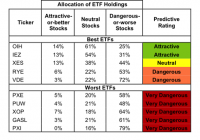
Best And Worst Q3’15: Energy ETFs, Mutual Funds And Key Holdings

Summary The Energy sector ranks last in Q3’15. Based on an aggregation of ratings of 20 ETFs and 90 mutual funds in the Energy sector. OIH is our top-rated Energy ETF and FSESX is our top-rated Energy mutual fund. The Energy sector ranks last out of the 10 sectors as detailed in our Q3’15 Sector Ratings for ETFs and Mutual Funds report. It gets our Dangerous rating, which is based on aggregation of ratings of 20 ETFs and 90 mutual funds in the Energy sector. See a recap of our Q2’15 Sector Ratings here . Figures 1 and 2 show the five best and worst-rated ETFs and mutual funds in the sector. Not all Energy sector ETFs and mutual funds are created the same. The number of holdings varies widely (from 25 to 163). This variation creates drastically different investment implications and, therefore, ratings. Investors seeking exposure to the Energy sector should buy one of the Attractive-or-better rated ETFs or mutual funds from Figures 1 and 2. Figure 1: ETFs with the Best & Worst Ratings – Top 5 (click to enlarge) * Best ETFs exclude ETFs with TNAs less than $100 million for inadequate liquidity. Sources: New Constructs, LLC and company filings The PowerShares Dynamic Oil & Gas Services Portfolio ETF (NYSEARCA: PXJ ) is excluded from Figure 1 because its total net assets are below $100 million and do not meet our liquidity minimums. Figure 2: Mutual Funds with the Best & Worst Ratings – Top 5 (click to enlarge) * Best mutual funds exclude funds with TNAs less than $100 million for inadequate liquidity. Sources: New Constructs, LLC and company filings The Market Vectors Oil Services ETF (NYSEARCA: OIH ) is the top-rated Energy ETF and the Fidelity Select Energy Service Portfolio (MUTF: FSESX ) is the top-rated Energy mutual fund. OIH earns our Attractive rating and FSESX earns our Neutral rating. The PowerShares DWA Energy Momentum Portfolio ETF (NYSEARCA: PXI ) is the worst-rated Energy ETF and the Saratoga Energy & Basic Materials Fund (MUTF: SBMBX ) is the worst-rated energy mutual fund. Both earn a Very Dangerous rating. 187 stocks of the 3000+ we cover are classified as energy stocks. National-Oilwell Varco (NYSE: NOV ) is one of our favorite stocks held by Energy ETFs and mutual funds and earns our Very Attractive rating. Since 2009, National Oilwell has grown after-tax profit ( NOPAT ) by 11% compounded annually. National Oilwell has a return on invested capital ( ROIC ) of 10% and over $4 billion in free cash flow on a trailing twelve-month basis. Due to the recent decline in energy-related securities, NOV can be purchased well below its fair value. At its current price of ~$43/share, NOV has a price to economic book value ( PEBV ) ratio of 0.6. This ratio implies that the market expects National Oilwell’s NOPAT to permanently decline by 40%. If National Oilwell can grow NOPAT by just 3% compounded annually for the next six years , the stock is worth $80/share today – an 86% upside. Marathon Petroleum Corp (NYSE: MPC ) is one of our least favorite stocks held by Energy ETFs and mutual funds and earns our Very Dangerous rating. Marathon’s NOPAT has declined from $3.3 billion in 2011 to -$589 million in 2014. ROIC has also fallen from 15% to 1%. Investors not reading the footnotes would be unaware of the deteriorating business fundamentals. Due to a change in LIFO inventory value we remove $3.4 billion from Marathon’s 2014 income statement. Without making this adjustment the market has been led to believe that profits actually grew in 2014. The disconnect between NOPAT and net income could explain why MPC is up 39% over the last year despite the Energy sector being down 27%. To justify its now overvalued price of $56/share, MPC must grow revenues by 16% compounded annually for the next 13 years while also raising its current NOPAT margin from -0.6% to 2.5%. Marathon has only grown revenue by 8% compounded annually since 2011. Expecting Marathon to double its revenue growth in a weak Energy environment and maintain that high level for over a decade seems rather optimistic. Figures 3 and 4 show the rating landscape of all Energy ETFs and mutual funds. Figure 3: Separating the Best ETFs From the Worst ETFs (click to enlarge) Sources: New Constructs, LLC and company filings Figure 4: Separating the Best Mutual Funds From the Worst Mutual Funds (click to enlarge) Sources: New Constructs, LLC and company filings D isclosure: David Trainer and Allen Jackson receive no compensation to write about any specific stock, sector or theme. Disclosure: I/we have no positions in any stocks mentioned, and no plans to initiate any positions within the next 72 hours. (More…) I wrote this article myself, and it expresses my own opinions. I am not receiving compensation for it. I have no business relationship with any company whose stock is mentioned in this article.