Tag Archives: seeking-alpha

Profit From The China Sell-Off Via These Inverse ETFs

Hard times are refusing to leave the Chinese investing world. News about the Chinese economy and its stock market has been hitting the headlines for the wrong reasons so far this year. It was once a soaring market, which took the valuation to such a scale that occasional pull-backs now look normal and warranted. This was more so given the languishing trend of its economic data. Something of this sort happened yesterday, when the Chinese markets took the deepest single-day plunge since 2007. Doubts over the sustainability of the Chinese government funds’ ability to calm down a maddening market led to a pullback in market support. Meanwhile, industrial profits in China dropped 0.3% in June following two solid months, which caused a panic-induced sell-off. As a result, the Shanghai Composite Index fell 8.5% and the Shenzhen index lost 7%. This year, Chinese equities have seen frequent crashes. To arrest this exasperating sell-off, the Chinese government stopped new companies from selling shares to the public, and introduced a fund to be used for purchasing shares earlier this month. Investors having an over 5% stake , executives and directors have been forbidden to dump their shares for six months, per Chinese securities regulators. However, the latest burst indicates that investors have marked off government intervention and dumped stocks on deepening economic crisis and overvaluation fears. Given heightened volatility and the still-high valuation in the China equities ETF space, the appeal of the China ETFs may dull for the edgy investors. Even after recurrent sell-offs, the P/E (TTM) of the Market Vectors ChinaAMC SME-ChiNext ETF (NYSEARCA: CNXT ) stands at 40 times against the 18 times P/E (TTM) of the broader U.S. market ETF, the SPDR S&P 500 Trust ETF (NYSEARCA: SPY ). As a result, investors who are bearish on China right now may want to consider a near-term short on this market. Fortunately, there are many ETF options for this. Below, we highlight a few choices and some of the key differences between each: Direxion Daily FTSE China Bear 3x Shares ETF (NYSEARCA: YANG ) The fund looks to track the 300% inverse (or opposite) performance of the FTSE China 25 Index. The index consists of 25 of the largest and most liquid companies available to international investors and traded on the Hong Kong Stock Exchange. Yang has amassed about $82 million in assets so far, and charges 95 bps in fees. The fund was 11.8% up on July 27 on three times higher volume. It added over 1.4% after-hours, and advanced over 27% in the last one month (as of July 27, 2015). Direxion Daily CSI 300 China A Share Bear 1x Shares ETF (NYSEARCA: CHAD ) Having debuted in June 2015, the product seeks daily investment results of 100% of the inverse of the performance of the CSI 300 Index. The index is market cap-weighted and comprises the largest and most liquid stocks in the Chinese A-shares market (see all Inverse Equity ETFs here ). Barely a few days old, CHAD has already amassed over $219 million in assets. The fund charges 95 bps in fees, and was up over 8.8% on July 27, though it shed about over 0.9% after-hours. Over the last one month, the fund added over 3%. ProShares Short FTSE China 50 ETF (NYSEARCA: YXI ) This fund seeks daily investment results corresponding to the opposite daily performance of the FTSE China 50 Index. The index includes the 50 largest and most liquid Chinese stocks listed on the Hong Kong Stock Exchange. YXI has accumulated about $11.8 million in assets, and charges 95 bps in fees. The fund was up 3.8% yesterday. It was up over 10% in the last one month. ProShares UltraShort FTSE China 25 ETF (NYSEARCA: FXP ) The fund looks to track two times the inverse exposure of the daily performance of the FTSE China 50 Index. It has gathered over $65 million in assets, and charges 95 bps fees. The fund was up more than 7.8% on July 27 on more than two times the regular volume. It added over 19.5% in the last one month. Original Post
Does Diversifying Damage Performance?

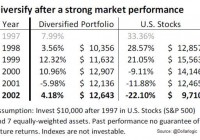
By Ronald Delegge During the 1849 California Gold Rush people sold all their possessions to chase gold. A small minority hit the jackpot, but most did not. Back then, the few people that did get wealthy by not diversifying were the hyper-extreme exception, not the rule. And it’s the same today. In retrospect, investors that overstuffed their portfolios on stocks like Amazon.com (NASDAQ: AMZN ), Netflix (NASDAQ: NFLX ), and other high-flyers have done well. Nonetheless, they’ve taken great financial risk that could’ve turned out to be catastrophic. The truth is that far more people have been damaged than helped by not diversifying their investment risk. History books are filled with people that lost everything by not diversifying. Of course, the history books are also filled with people that gained great wealth by not diversifying, but again, they are the hyper-extreme super rare exception – not the rule. And trying to join their ranks by risking everything you own is theoretically cute but drenched with hazard. Done Right An adequately diversified portfolio never concentrates market exposure to one or two asset classes, but rather spreads risk by maintaining exposure to the five core asset classes: stocks, bonds, real estate, commodities, and cash. Like a thermostat that remains on at all times, a core portfolio will always have exposure to these five major asset classes. Investors can dial up or dial down their exposure to each of these core asset classes based upon their investment goals, liquidity needs, and comfort level. Sadly, certain financial institutions and advisors – even so-called fiduciaries – operate under the false pretext they are “diversifying” client portfolios by overloading customers in “alternative investments” like illiquid securities and highly leveraged funds with juicy dividend yields. Furthermore, many of these same advisors habitually construct undiversified investment portfolios built entirely upon non-core assets like individual stocks, hedge funds, and other narrowly focused high risk securities. A Hedge for Ignorance? It’s been said that portfolio diversification is a hedge for ignorance. For anybody with this misinformed view, I’d like to familiarize you with Yale University’s endowment. Yale’s endowment returned 11% per annum over the 10 years ending June 30, 2014. Over that period, Yale’s return surpassed broad market results for U.S. stocks, which returned 8.4% annually along with U.S. bonds, which gained 4.9% annually. Even more impressive is how Yale’s endowment generated returns of 13.9% over the past two decades compared to the estimated 9.2% average return of college and university endowments. How did Yale do it? By diversifying investment risk across a variety of different assets like commodities, real estate, and stocks! Here’s the lesson: What worked for Yale can work for you. The table shown above, courtesy from our friends at Dollarlogic, further cements the point that diversification after a strong period of equity returns enhances rather than hurts a portfolio’s investment returns. Although a diversified portfolio underperformed the S&P 500 during the sizzling hot bull market from 1997 to 1999, a $10,000 diversified portfolio was worth more ($12,643) at the end of 2002 compared to just $9,710 for an all stock portfolio. In summary, portfolio diversification that is properly executed does not hinder but enhances risk-adjusted investment returns. Disclosure: No positions Link to the original post on ETFguide.com

4 ETFs Unexpectedly Rocked By China Turmoil

After stabilizing for three weeks, the Chinese stock market resumed its decline, with the Shanghai Composite Index tumbling nearly 8.5% in Monday’s trading session. This represents the biggest one-day drop in more than eight years. The index extended its losses, falling nearly 4% early in Tuesday session. The massive plunge came following the disappointing manufacturing numbers that reignited fresh concerns of a slowdown in the world’s second largest economy. This is especially true as the flash Caixin/Markit China Purchasing Managers’ Index (PMI) surprisingly dropped to a 15-month low of 48.2 in July from 49.2 in June. This is also the fifth month in a row when PMI is less than 50. The sharp selloff was not only confined to China but spread worldwide with rough trading in the Asian, European, and U.S. markets. Additionally, it added to the concerns for the emerging markets, which already fear a Fed rate hike later this year, leading to sliding currencies. Further, as China is the world’s largest consumer of raw materials, the slump in the economy has stressed key commodity prices like copper, oil and gold. In fact, the Thomson Reuters CRB commodities index fell to the lowest level in six years. While there have been losers in every corner, we have highlighted four ETFs that were unexpectedly crushed by the China turmoil in Monday session. Interestingly, none of these actually belong to China but are indirectly tied to it. Guggenheim Solar ETF (NYSEARCA: TAN ) This ETF targets the global solar industry by tracking the MAC Global Solar Energy Index. It holds 29 securities in its basket with the largest allocation going to the top firm – SunEdison (NYSE: SUNE ) – at 8.2% of total assets. Other firms hold less than 7% share. Chinese firms dominate the fund’s portfolio at nearly 46.7%, followed by the U.S. (37.4%) and Canada (5.4%). The product has amassed $302.9 million in its asset base and trades in solid volume of around 275,000 shares a day. It charges investors 70 bps in fees per year. The fund lost 2.5% on the day but is up 1.4% in the year-to-date time frame. Global X Central Asia & Mongolia Index ETF (NYSEARCA: AZIA ) This fund provides exposure to 21 stocks of Central Asia that derive revenues or are traded in Mongolia, Kazakhstan, Kyrgyzstan, Tajikistan, Turkmenistan or Uzbekistan. This is easily done by tracking the Solactive Central Asia & Mongolia Index. The product is highly concentrated on the top five firms at 40.4%, while energy and basic materials take the top two spots in terms of sector with roughly one-third share each. This is an unpopular and illiquid ETF in the emerging market space, with AUM of just $2.4 million and average daily volume of around 2,000 shares. Expense ratio came in at 0.69%. AZIA shed about 2.9% on the day and has lost 8.9% so far this year. Global X Copper Miners ETF (NYSEARCA: COPX ) This ETF targets the copper mining industry across the globe and follows the Solactive Global Copper Miners Index. Holding 23 stocks in its basket, it is highly concentrated on the top firm – Sandfire Resources ( OTC:SFRRF ) – at 8.7% while other firms hold no more than a 5.94% share. In terms of a national breakdown, Canada takes the top spot with 30% of assets, while Australia, Mexico and United Kingdom round out the next three spots with double-digit exposure. The product has managed $18.3 million in AUM while charges 65 bps in fees per year. It trades in light volume of 36,000 shares a day on average. The fund lost about 4.5% on the day and has piled up a huge loss of over 25% for the year so far. iPath Pure Beta Industrial Metals ETN (NYSEARCA: HEVY ) This note seeks to match the performance of the Barclays Commodity Index Industrial Metals Pure Beta Total Return Index, which is composed of five futures contracts on industrial metals. Four futures contracts (aluminum, nickel, copper and zinc) are traded on the London Metal Exchange and the other (copper) is traded on the COMEX division of the New York Mercantile Exchange. Unlike many commodity indexes, this product can roll into one of a number of futures contracts with varying expiration dates, as selected, using the Barclays Pure Beta Series 2 Methodology. The ETN manages just $0.5 million in asset base and sees paltry volume of about 300 shares a day, suggesting additional cost beyond the annual fee of 75 bps per year. The note lost 7.2% on the day, bringing the year-to-date loss to 12%. Original Post