Tag Archives: pro

Clean Energy Fuels: Weighing The Pros Against The Cons
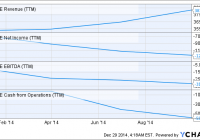
Summary Except for revenue, Clean Energy Fuels saw a decline in other key metrics in 2014. Clean Energy is burning through cash as it invests in infrastructure to tap the natural gas fueling market. Since natural gas-powered vehicles are expected to grow over 20 times in the next six years, it is important for Clean Energy to invest in infrastructure. Clean Energy, however, needs to make a quick turnaround in order to arrest a rapidly rising debt/equity ratio and a declining profit margin. It can be easily concluded that 2014 has been a year to forget for Clean Energy Fuels (NASDAQ: CLNE ), with the stock having depreciated almost 60%. This doesn’t come across as a surprise, because the company’s revenue growth hasn’t led to an improvement in its profitability. In addition, the company is burning through cash. The following chart will give us a bird’s eye view of Clean Energy Fuels’ problematic 2014. CLNE Revenue (NYSE: TTM ) data by YCharts But, the decline in Clean Energy’s net income, EBITDA, and cash from operations isn’t surprising at all as the company operates in an industry that’s making gains at a fast pace. According to Navigant Research , the global market for natural gas vehicles (NGVs) will reach 35 million units by the end of the decade, an impressive increase over 1.5 million units this year. Now, Clean Energy provides fueling infrastructure for these trucks. Considering the rapid pace at which the usage of NGVs is expected to grow in the future, Clean Energy needs to build up its infrastructure. This is the reason why the company’s financial performance has not been up to the mark this year, as it has aggressively invested in its infrastructure. But, the good thing is that it has positioned itself nicely for growth in the future. In fact, in 2015, its loss is expected to drop to $0.83 per share from the expected 2014 loss of $1.07 per share, translating into an improvement of 22.4%. Additionally, its revenue is slated to improve 15%. Moreover, for the next five years, Clean Energy’s bottom line is expected to continue improving at an annual rate of 25%. Factors Driving the Bullish Case The question is: Can Clean Energy actually achieve the expected growth rates? I think it can. The company recently closed two key strategic transactions with Mansfield and NG Advantage , and both these will allow it to tap key growth markets. NG Advantage has a robust compression infrastructure in place. As a result, it can provide cheaper natural gas for the facilities and vehicles of Clean Energy’s customers. Mansfield Energy, meanwhile, is a key behind-the-gate fuel provider in the U.S. It has partnerships with more than 900 petroleum hauling carriers countrywide. Through this venture, Clean Energy will operate closely with Mansfield’s haulers for transitioning their fleets to natural gas. Now, the addressable market opportunity that this joint venture has opened up is worth 3 billion gallons of diesel a year. In comparison, Clean Energy delivered 159 million gallons of natural gas in fiscal 2013. Hence, there is a big market that Clean Energy can tap as a result of the Mansfield deal. Apart from these partnerships, Clean Energy is also spending on the growth of its organic infrastructure. So far this year, Clean Energy has closed 49 station projects, and it has another 28 station projects under development. Driven by these infrastructure improvements, Clean Energy has been able to increase its customer count on the back of improved capacity. For instance, Clean Energy has signed a deal with Dillon Transport, and plans to open three truck-friendly public CNG stations to maintain Dillon’s expanding fleet of 200 natural gas trucks. Once fully deployed, these are expected to use 2.5 million gallons of fuel per year. The Bearish Case However, not everything is rosy about Clean Energy, as the following chart shows: CLNE Profit Margin ( TTM ) data by YCharts Clean Energy’s profit margin has been declining at a very fast pace, while its debt is rising at the same time. Presently, the company has total cash of $248 million, while its debt stands at $619 million. Also, as mentioned earlier in the article, it is burning through cash. The company’s operating cash flow is a negative $58 million in the past one year, while levered free cash flow is also negative at $121 million. Thus, if Clean Energy is unable to make a quick turnaround, its position might deteriorate further. This is a risk that investors need to be aware of. Conclusion As I mentioned in my bullish case, Clean Energy’s bottom line is expected to improve at an impressive pace. Given the prospects in the natural gas fueling market and Clean Energy’s own investments, there is a good probability that the company will be able to make a comeback in the future.
Entergy Corporation: A Derivative Play For The Gulf Coast Petchem Boom

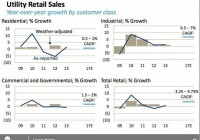
Summary Entergy is building a new power plant and has plans to build new transmission infrastructure. Load demand, not price hikes, is driving earnings growth. Shares are up considerably but I believe they still have a ways to run. It’s difficult to like utilities these days. With interest rates so low, utilities typically yield under 4%. To make matters worse, most states now have ‘renewable energy mandates,’ which means that utility companies are effectively mandated to invest in new energy infrastructure even when load demand is static. This leaves utilities with little choice but to raise rates in the coming years merely to recoup the cost of investment. On August 15th I wrote an article on Entergy Corporation (NYSE: ETR ), a Louisiana-based utility which I thought was the best alternative to the renewable energy hurdle facing US utilities today. Unlike most other states, Louisiana has opted out of renewable energy mandates. Louisiana’s economy is also benefitting greatly from an unprecedented boom in the petrochemicals industry along the gulf coast. This building boom includes everything from chemical plants, NGL crackers, steel mills and LNG export facilities. Since August 15th, Entergy has soared along with the rest of the space. Entergy has leapt from $72 per share to $91, thanks largely to falling interest rates. Right now, most US utilities are trading somewhere above their average P/E multiples, Entergy included. Does that mean it’s time to sell the stock and call it a day? That is what this article will try to answer. Load growth (click to enlarge) Courtesy of Entergy Corp Investor Relations This graphic pretty well sums up what Entergy expects in the coming three years. Residential use is expected to rise modestly, but industrial use will increase by around 6.75% per year, which will drive overall retail load growth by around 3.5% year on year. Utilities love industrial load growth, because it often begets residential load growth, which in turn brings commercial and governmental load growth. The petrochemical boom along the Gulf Coast could bring a decade of good times for utilities such as Entergy, which has business all throughout Louisiana and also in the Texas Gulf Coast. Utility companies must always consider replacing old generation and transmission infrastructure, but it’s easiest to do so when load growth is increasing, because the costs to build more capacity can be spread out on a larger customer base. Entergy is constructing another plant in Louisiana, one which the company believes will support economic growth in the region with low energy prices for years to come. The new power plant, named Ninemile 6, is a gas turbine. Ninemile 6 is scheduled to be ready by the first of next year, and it is the earliest of a very robust construction plan from Amite Parish in southern Louisiana to the Texas Gulf Coast around Houston. Through 2021, Entergy will build transmission lines for the new Cameron LNG plant and a new steel plant. New transmission lines will go up along the Gulf Coast, and eventually the company will upgrade its southeast Louisiana terminal equipment too. Next year, Entergy will spend $665 million. All the while, load demand increases and a focus on the most economical generation sources will keep rates down. With a kilowatt per hour cost of just 7.7 cents, Louisiana has the fourth lowest electricity cost in the nation (behind Kentucky, West Virginia and Washington state). A list of industrial projects underway on the Gulf Coast. Projects range from steel mills to LNG export terminals, and include several world-class companies. Courtesy of Entergy Corporation Investor Relations Valuation As I mentioned earlier, shares of Entergy have jumped up with the rest of the sector. Shares were somewhat below fair value back in August, but they are now just slightly above. Let’s take a look at FAST Graphs for a bigger picture. Courtesy of FAST Graphs In August, shares were well below their fair value and average P/E ratio. Now, however, shares are 13.4% above average P/E and just about at the Graham-Dodd ‘Fair Value’ number. (FAST Graphs measures this by trailing twelve-month earnings.) While Entergy may not be a great deal right here, I would also say that it is way too early to sell shares. Entergy’s 3%-4% retail electricity demand growth makes the company a better choice than most other utility names. Entergy is a multi-year play and I believe this stock has way more room to run. At twenty times trailing earnings Entergy would trade at $120. Given the company’s solid growth prospects, I think twenty times earnings would be a place to consider hopping off. For now, however, I believe that Entergy should be allowed to run for awhile. Conclusion Entergy is in the right place at the right time, and it is one of the only utilities I would consider owning right now. (In fact, it is the only utility which I currently own shares in.) Unlike most other utilities, Entergy is largely unburdened with the need to supply more expensive renewable energy to its customers. The petrochemical boom is fueled by a supply of cheap input costs in natural gas and natural gas liquids. This gives US petrochemical companies an advantage over the rest of the world, and this input cost advantage does not look to be going away anytime soon. Entergy is a relatively low-risk ‘derivative play’ for the petrochemical boom, and I believe shares have a good bit more ways to run before an investor should even consider taking anything off the table.

UNG Is Down For December — Will Cold Weather Pull It Back Up?

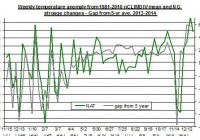
Summary The extraction from storage is projected to be lower than normal again this week. The temperatures are projected to come down in the next two weeks, but this isn’t expected to bring back up UNG. Contango is likely to keep UNG below natural gas prices. The price of The United States Natural Gas ETF (NYSEARCA: UNG ) took another fall in the past week to its lowest level in recent months. The ETF did bounce back earlier this week, but is still down for the month by nearly 24%. The ongoing low oil prices may have contributed to weakness of UNG, but the main issue will remain in changes in weather expectations . The level of underground storage is also likely to play a role in the progress of UNG. This was the case last week. This week’s extraction is likely to also be lower than normal for the season. As I pointed out in the past , the changes in the weather are likely to play a significant role in the changes in U.S. storage levels. Last week’s lower-than-expected withdrawal may have contributed to the drop in UNG on the day of the publication. I say this with caution because the linear correlation between the changes in UNG and storage tends to be low. Nonetheless, there are occasions when the market seems to react to this news, as seems to be the case last week. Looking forward, the storage is expected to show another lower than normal extraction due to last week’s higher than normal average temperature, as presented in the chart below. Source of data: EIA and national climate data center The chart shows the progress of the deviation in the national weather from normal and the weekly changes in natural gas storage with respect to the 5 year average (The data only refer to 2012/2013 and 2014 winter time). Moreover, the linear correlation between the two data sets is a strong and positive linear correlation of 0.62. Last week, the deviation from normal temperatures was, on average, 4.9. So all things being equal, we are likely to see another lower than normal extraction. Keep in mind that even if natural gas prices were to recover, the ongoing Contango in the future markets is likely to result in UNG underperforming natural gas for the near term. Cold weather ahead For the next two weeks, however, temperatures are projected to fall below average temperature throughout the Northeast and Midwest. Nonetheless, on a national level, the heating degrees for this week are expected to be slightly below normal and last year’s levels. This could suggest the demand for heating purposes in the residential/commercial sectors, while may rise in the coming days, won’t necessarily increase more than normal for this time of the year. The recent withdrawal from storage was 49 Bcf, which was well below the 5-year average and last year’s extraction of 138 Bcf and 177 Bcf, respectively. The table below summarizes the changes in storage in the past few weeks and the comparison to last year and the 5-year average levels. Source of data EIA Following the recent extraction the underground natural gas storage is at 3,246 Bcf. This is nearly 5% higher than last year’s storage level and only 5% below the 5-year average. Over the next couple of weeks we are likely to see another lower than normal extraction from storage, which could fuel another fall in the price of UNG or at the very least keep it from recovering. But if temperatures start coming down to below normal levels, UNG may change course and start to rally.