Tag Archives: portfolio

5 Ways To Handle A Low Return On Capital Environment

Summary Basic market valuation fundamentals suggest that investors should prepare for more muted returns from their equity portfolios. Economy wide transformations led by technological progress also support decreasing returns on capital. Although this low return on capital environment is undoubtedly more challenging, there are 5 strategies that can help investors build and manage a portfolio of stocks more effectively. CNBC pundits, analysts, hedge fund gurus and amateur market watchers love to make predictions about the future. They hum and haw about macro forces. They discuss the possible impacts of a rate increase and they debate the importance of China as the world’s growth engine. They try and pinpoint what the next “game-changing” technologies or companies will be and they try and estimate what the overall market will do. This preoccupation with the future is certainly fascinating to seasoned market participants but what does it all mean for the majority of investors who most likely have a large portion of their savings exposed to the stock market or at the very least is considering where to allocate their savings? At the very least market fundamentals and economy wide transformations suggest that investors should prepare for more muted returns from their equity portfolios. Market Fundamentals Suggest More Modest Returns First and foremost, basic market fundamentals support more modest returns. In terms of valuation, the Shiller CAPE ratio for the S&P 500 (NYSEARCA: SPY ) which is a cyclically adjusted price/earnings ratio – has been stuck at around 27 which is high given the median of 16. This represents its highest level since 2000 and suggests that profits are far higher than normal and should either plateau or sink from these highs, a process that may already be underway . In addition, Morningstar’s price/fair value chart suggests that value is becoming harder and harder to find. In addition, the current 12-month forward P/E ratio for the S&P 500 is 16.7. This P/E ratio is above the 5-year average of 13.9 and the 10-year average of 14.1. These valuation indicators are a cause for concern as low starting valuations have historically been one of the best indicators of market performance. Whether we are in a bubble on the verge of popping is unclear, yet what is obvious is that when prices are elevated versus earnings, future gains will be lower. Economy Wide Transformations Suggest Return On Capital Will Continue To Decrease Nevertheless, there is something more significant going on than just above average stock market valuations. More fundamentally, there are transformational economic forces that are re-shaping our societies and thus our markets. The effects of this technological progress indicate that the return on capital (or cost of capital) will decrease as technological progress increases. Why? Because technology makes innovation cheaper and thus capital more abundant. Think back to the industrial revolution. During this period it was virtually impossible for someone to start a business without substantial capital reserves. This was due to the fact that innovation was cap ex heavy (commodities, infrastructure, wages etc.). Fast-forward to today and things have changed dramatically. It has never been cheaper to start a business and thus we have large (by market cap not by employee count) companies like Facebook (NASDAQ: FB ) buying companies with 55 employees like WhatsApp for $19 billion dollars. This is a world in which the barriers to entry are dropping across all industries. Such “new age” businesses generate enormous wealth for shareholders and entrepreneurs, yet result in comparatively few new jobs. Instead, what is generated is a rapidly increasing supply of capital. Corporations are piling record amounts of cash and thus we have a lower demand for capital which causes an increasingly higher supply. The higher the supply of capital, the lower the returns on capital. Yet the transformational change does not stop here. Not only does technology make capital more abundant, it also makes capital markets and the allocation of abundant capital more efficient. This is evidenced by the rapid adoption of algorithmic trading and information technology which makes the flow of information more efficient. In this environment arbitrage opportunities become more difficult to find as information asymmetries become more unusual. There isn’t a day that goes by without a high profile hedge fund manager bemoaning the lack of opportunities for return. Thus, the cycle continues: abundant capital chasing fewer return opportunities leading to even lower returns. Nevertheless, all is not lost. Although this low return on capital environment is undoubtedly more challenging, these 5 strategies can help investors build and manage a portfolio of stocks more effectively. 1) Reset Intuitions and Assumptions Since the market bottomed in March 2009 the S&P 500 has returned around 20% on an annualized basis. This amounts to a tripling in value rising by a staggering $12.8 trillion. So given the forces outlined above which suggests lower future returns what can be expected? Traditionally, for a diversified portfolio of stocks the typical expected annual return has hovered around 6-7% . Is this lower number even reasonable? Some leading investment analysts are suggesting that a more reasonable number would be around an average of 2% annual return, after inflation and fees. Thus, projecting an annual return of around 5% would be a more useful guide. 2) Reduce Investment Costs In light of projected lower future returns, controlling a portfolio’s various costs will yield major benefits over time. For example, paying a 1% expense ratio on a balanced portfolio that earns 10 percent on an annualized basis takes a 10% cut out of the return. Lower that 10% portfolio return to 5% and a 1% expense gets much more significant. As such, purge any mutual funds replacing them with low cost ETFs and be sure to use a low cost broker. 3) Reconsider Asset Allocation Beware of over exposure to bonds. Starting yields on Treasury bonds have explained much of their performance over the subsequent decade and with yields as low as they are, overexposure to bonds will almost guarantee low returns. On the other hand investors who maintain higher allocations to equities will be better positioned to eke out the best returns possible over time. 3) Invest In Quality And Focus On Dividends Effectively dealing with a lower return environment starts with putting together a portfolio of high-quality stocks. Although high-flying growth stocks may be alluring, the risk of a terrible year of returns far outweighs the possible benefits of a fleeting moment of outperformance. Instead focus on ” wonderful businesses ” with high moats that are profitable and that will survive whatever an uncertain economy may throw at them. In addition, focus on dividends and their re-investment. Dividends have historically accounted for the vast majority of all stock returns for the last century. Some have even postulated that dividend growth is the most important factor for creating long-term wealth. Thus, companies with strong returns, consistent earnings and consistently growing payout ratios should see better than expected returns over the long term. 4) Consider Increasing Exposure to Non-U.S. stocks Despite reports of a “relatively stagnant” global economy, research suggests that there are many global markets that are projected to grow at high rates. Although foreign stock outperformance is no sure thing , there are certainly pockets of relative geographic market undervaluation worth considering. In Europe , the UK, Germany and Spain present compelling opportunities. Elsewhere, Singapore, Thailand, Australia and Russia remain significantly undervalued by Prof. Shiller’s CAPE measure. 5) Avoid Chasing Returns And Stay Focused On The Long-Term Common during bull markets yet even more common when markets are going sideways is the impulse to buy stocks that are skyrocketing while your portfolio remains grounded. Yet if you chase the best-performing stocks or sectors you risk leaving your plan behind and jumping in when these assets are reaching their peak. Try and relax, pay attention to valuation and stick to your long-term dividend growth plan. Disclosure: I/we have no positions in any stocks mentioned, and no plans to initiate any positions within the next 72 hours. (More…) I wrote this article myself, and it expresses my own opinions. I am not receiving compensation for it (other than from Seeking Alpha). I have no business relationship with any company whose stock is mentioned in this article.
Does Your Portfolio Have A Margin Of Safety?

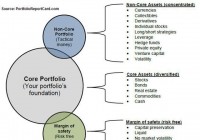
By Ronald Delegge Building an architecturally sound investment portfolio doesn’t happen by chance. A structurally strong and healthy portfolio is organized into three basic parts: 1) the portfolio’s core, 2) the portfolio’s non-core, and 3) the portfolio’s “margin of safety.” All portfolio parts complement each other by deliberating holding non-overlapping assets. Let’s talk about the part of the portfolio that represents the “margin of safety.” The concept “margin of safety” was originally developed in the 1930s by Benjamin Graham and David Dodd, the founders of value investing. Their idea was applied to selecting individual stocks at undervalued prices to help people become better investors. In the context of the individual investor, the “margin of safety” represents the capital or money that a person absolutely cannot afford to risk to potential market losses. Like an insurance premium, this money gets set aside from a person’s core and non-core portfolio to be invested in fixed accounts with principal protection and liquidity. (click to enlarge) Some people have deceived themselves into believing their investments require no margin of safety. This group generally believes they are too wealthy, too experienced, and too smart to have a margin of safety inside their portfolio. Ironically, this same group of people that invest without a margin of safety (or insurance), have insurance (or margin of safety) on their automobile, home, health, and life. Why is there an illogical disconnect between the need to protect physical assets, while simultaneously ignoring the financial ones? “I’m a long-term investor” or “the stock market always bounces back” are common excuses for investing without a margin of safety. Unfortunately, both of these techniques are not a credible form of portfolio risk management. Diligent and proper risk control is always proactive versus being passive or reactive. Others may claim that investing in bonds or physical assets like gold is their portfolio’s margin of safety. This too is erroneous. Why? Because bonds and precious metals are subject to daily fluctuations just like stocks and can lose market value. Gold’s almost 40% loss in value since mid-2011 is a tough lesson on why you shouldn’t use assets that are prone to market losses as a form of portfolio insurance. Similarly, those who have invested in long-term treasuries as a form of portfolio insurance have suffered losses near 8% over the past three-months alone! When is the best time to implement your portfolio’s margin of safety? Like insurance coverage, the prudent investor acquires a margin of safety within their investment portfolio before they need it. Put another way, the timing of when you implement your portfolio’s margin of safety is mission critical. Think about it this way: Would it be logical to attempt to buy insurance coverage after you’ve already had an automobile accident or after your home has been destroyed? Of course not! Similarly, would it be logical to implement a margin of safety after your portfolio has suffered catastrophic losses? Of course not! To be fully protected, you must prepare ahead. In summary, implementing your portfolio’s margin of safety should happen when market conditions are favorable, not when it’s raining cannonballs. And if you’re caught in the unfortunate situation where you failed to implement a margin of safety during good times and market conditions have deteriorated, the next most logical moment to implement your margin of safety is immediately. Disclosure: No positions Link to the original article on ETFguide.com

MSCI Pakistan: Add A Little Green To Your Portfolio

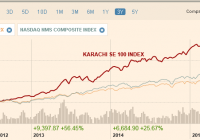
Summary Developed and current emerging markets are not offerings returns as high as frontier markets. Pakistan’s economic outlook is improving, thanks to China’s investment, low oil prices and rate cuts. MSCI Pakistan is a decent bet for a frontier market exposure; it’s cheap on relative valuation. Developed equity markets continue to trend higher. It is hard to predict the end of the current bull market, but the returns would be limited going forward. S&P trades at a PE of 21.24 while NASDAQ composite is trading around 23 times the trailing earnings. European markets are also rising but the upside seems limited given high multiples. Emerging markets are witnessing a slowdown in growth. High return investments are not easily found in the above mentioned markets under current circumstances. However, there are alternatives for investors with a high risk-appetite: the frontier markets. Frontier markets are small to be classified under emerging markets but they often entail a higher return at a higher risk. One such frontier market is Pakistan, which has started to look attractive. Equity market of Pakistan is trading at a substantial discount and can bring considerable gains to investors. Detailed thesis follows: Status of Pakistan might be upgraded to an emerging market. Pakistan is up for consideration to be included in emerging markets. MSCI will review for a potential upgrade in June 2016. According to WSJ, Pakistan is liquid and deep enough to be considered as an emerging market. KSE 100 index is one of the best performing equity markets since the financial crisis of 2008. Note that Pakistan meets most of MSCI’s emerging market requirements. It is highly likely that Pakistan will be upgraded to the emerging market status. If that happens, the PE multiple of Pakistan’s equities will expand resulting in substantial gains for investors. KSE 100 is one of the best performing equity markets trading at a discount. In 2013, KSE 100 rose 37%, in dollar terms, topping S&P 500 and every other benchmark in Europe. It was the third best performing market in 2014 with a 31% return. The index is up ~19% during the trailing twelve months. Despite the run, the index trades at 8.3 times forward earnings, an 18% discount to MSCI’s frontier markets. Source : FT.com Source: Yahoo Finance, MSCI, AHL Research The charts depict that after a decent run, KSE 100 is still trading at quite a discount. Further, the expected benchmark rate is 8%, which is equal to the rate back in 2006. KSE was trading at 11.3x at that time. This indicates that the index is undervalued by more than 20%. According to AHL research, ” When the policy rate stood at almost at the same level in 2006 as today i.e. 8.5%, and the earnings growth also being in close vicinity as today i.e. 10%, the market PE stood at 11.3x then, compared to 8.3x today, showing a substantial 27% discount, which the KSE100 is currently trading at (barring all other factors i.e. level and risk of macros and the market between two different times).” See the following graph to witness the correlation of interest benchmarks to the KSE 100 index. (click to enlarge) Focus Equity Estimates and AHL Research The graph clearly mentions that KSE 100 is negatively correlated to the interest rates. As Government is pursuing aggressive rate cuts, PE multiple is expected to expand. To review, Pakistan’s equity market is trading at a substantial discount based on historical PE levels; it’s also cheap relative to comparable indexes and markets. The economy is in a turnaround mode; related indicators are positive. Economy is getting a boost from several developments. Falling oil prices are a big positive that are keeping a check on inflation. This, in turn, is allowing for rate cuts, which will give a boost to economic activity and the stock market. Pakistan is a net importer of oil; prices of oil are not expected to go up any time soon, think recent U.S.-Iran deal. Oil prices will continue to have a positive impact on the economy of Pakistan. As mentioned above, low interest will also boost the economy. Interest rates are cut by 1% to drop to 7%. The Government is pursuing aggressive rate cuts; they are down from 10% in November 2014 to 7%currently. Other favorable factors include pro-business government and favorable demographics; 54% of the population of Pakistan is under 25 years. The current Government is heavily investing in infrastructure; a $500 million Metro transport project is recently completed in twin cities, Islamabad and Rawalpindi. Other construction projects are expected to boost materials and construction industry. Elimination of circular debt by the Government bodes well for power producers. Further, consumer spending is increasing; 26% p.a. increase in spending was recorded (pdf) during 2010-2012 as compared to Asia’s 7.7% growth. Analysts’ expect the GDP to grow at 4.6% p.a. through 2019. Pakistan’s security forces’ operation against terrorism is proving to be fruitful. Number of civilian casualties has declined by 81% since 2013. Number of drone attacks by the U.S. in Pakistan has decreased 62% since 2013 indicating that terrorist element is being eliminated efficiently. (click to enlarge) (click to enlarge) Source : South Asia Terrorism Portal Regarding the stock market, it was among the best performing markets in 2013 and 2014. In 2013, the market performed better than 2014 as mentioned somewhere else in the report. The point is that investors’ sentiment is not strongly correlated to the security related issues. Drone attacks and terrorism related causalities were higher in 2013 compared to 2014 yet the market performance in 2013 was better than 2014. Now, the security situation is getting better. This will boost investors’ confidence and will help the stocks rally in 2015 and beyond. China’s $46 billion investment in Pakistan makes the bull case a no brainer. China is investing in Pakistan for an economic corridor. $46 billion in investment is expected. Most of the investment will be used for power and infrastructure related development. Financial services, materials and power companies will be the primary beneficiaries of the investment. According to Barrons, Beijing’s investment is expected to boost Pakistan’s GDP by over 15%. The investment will, in time, put an end to Pakistan’s electricity woes, another positive from a business perspective. 10GW capacity is expected to be added by 2018. The economic corridor will link China to the markets in Central Asia and South Asia. ‘If ‘One Belt, One Road’ is like a symphony involving and benefiting every country, then construction of the China-Pakistan Economic Corridor is the sweet melody of the symphony’s first movement.’ – Wang Yi , China’s foreign minister All in all, China’s investment bodes well for the economic growth of Pakistan and its capital markets. For further insight into China-Pakistan economic corridor, see this (pdf) report. There is a turnaround in analysts’ sentiment about Pakistan. David M. Darst, Chief investment strategist at Morgan Stanley, thinks that the rise of Pakistan is just a matter of time. He further points out that Pakistan is among the nine countries in Asia that will add another China in the next 35 years. Commenting on Pakistani stocks he said, “What is important is that the stocks in Pakistan are still very cheap compared to the markets in the industrialised world and they are performing better than many markets in terms of returns,” IMF thinks that Pakistan has succeeded in stabilizing its economy; growth of 4.3% is expected during 2015. World Bank expects expansion of 4.4% during the current year. Goldman Sachs has included Pakistan in “Next 11” list of economies, which will be a key source for economic growth in years to come. Pakistan is an overlooked reform story without reform valuations, says Renaissance Capital. According to CIA Factbook 2015, “Pakistan is one of the larger, more liquid frontier markets and has advantageous demographics. These factors make it an attractive investment destination for investors looking beyond traditional emerging markets, which have been demonstrating slowing growth.” To review, Pakistan’s outlook is getting positive. A rise of status from a frontier a market to an emerging market will be catalytic for the growth of the stock market. Economic growth supported by low oil prices, low interest rate environment and diminishing security problem will add to the capital market’s growth. More importantly, China’s investment in the country will steer Pakistan’s economy in an upward direction going forward. How to Invest? Investors can get exposure to this frontier market through MSCI Pakistan ETF (NYSEARCA: PAK ). This ETF is designed to represent the performance of broad Pakistan equity universe. The ETF offers access to the highly liquid equities in Pakistan. The ETF was launched in 2014. However, the equities in the ETF posted a CAGR of 18% during 2011-2015. The ETF trades at a forward PE of 8.79 making it a cheap proposition. The ETF also compares favorably to other alternatives. (click to enlarge) Source : MSCI Another important factor is the weightage of sectors. PAK ETF is concentrated among financials, materials and energy. See the chart below: (click to enlarge) Source : Global X Funds As mentioned above, financials, energy and materials will be the largest beneficiary of China’s investment in Pakistan. Consequently, this ETF will outperform the market due to dominant weightage of these sectors. Further, the current Government is also focused on infrastructure development, which is another bullish indicator for the ETF. For fiscal year 2015/2016, the government has increased infrastructure expenditure by 27% . Low oil prices will continue to support the energy sectors and the ETF’s growth Another, relatively low-risk/low-return alternative is to invest in MSCI Frontier 100 ETF (NYSEARCA: FM ). Pakistan makes up 10.6% of this ETF. Kuwait, Nigeria and Argentina are the three largest countries in this ETF. Bottom Line Developed and current emerging markets are not offerings returns as high as frontier markets. However, the returns from frontier markets come with added risks. These investments are only suitable for investors with high appetite for risk. Anyhow, Pakistan’s economy is in a recovery mode, thanks to China’s investment, pro-business government, falling oil prices and interest rate cuts. Equity market of Pakistan is an attractive investment option given that the market outperformed developed markets even with worse security and economic conditions. Now, as the economic and security situation is stabilizing, high gains will certainly follow. MSCI Pakistan ETF is looking good amid high concentration in financials, materials and energy. Further, the valuation is cheap as compared to emerging markets. All in all, we rate MSCI Pakistan ETF a buy with more than 30% upside; the valuation is based on historic correlation of interest rate benchmarks to the PE multiples of the market. Risks Low trading volumes and liquidity concerns attached to frontier markets Highly volatile political conditions Re-ignition of the terrorist elements Disclosure: I/we have no positions in any stocks mentioned, and no plans to initiate any positions within the next 72 hours. (More…) I wrote this article myself, and it expresses my own opinions. I am not receiving compensation for it (other than from Seeking Alpha). I have no business relationship with any company whose stock is mentioned in this article.