Tag Archives: nreum

Resolve To Focus On Goals Rather Than Results In 2015

Results, results, results. We frequently hear that we should focus on results. More often than not, focusing on results is a waste of time. Because it is looking in the rear-view mirror, rather than the windshield. Someone asked me today what I thought of Janet Yellen as head of the Federal Reserve. I found this hard to answer. Even though Chairperson Yellen has been in the job since February, her job as lead policy-setter has almost no short-term ramifications. It takes quarters – not months – to see the results of those policy decisions. Even after a year in office, it is very difficult to render an opinion on her performance as Fed leader. The fantastic 5% growth in the U.S. economy last quarter has much more to do with what happened before she took office – in fact, years of policy setting before she took office – than what has happened since she became the top Fed governor. We often forget what the word “results” means. It is the outcome of previous decisions. Results tell us something about decisions that happened in the past. Sometimes, far into the past. We all can remember companies where looking backward all looked well, right up until the company fell off a cliff. Circuit City. Brach’s Candy. Sun Microsystems. Further, “results” are impacted dramatically by things outside the control of management, such as: Changes in interest rates (or no changes when they remain low) Changes in oil prices (which have been dramatically lower over the last 6 months) Changes in investor expectations and the overall stock market (which has been on a record-setting bull run) Inflation expectations (which remain at historical lows) Expectations about labor rates (which remain low, despite trends toward higher minimum wages) Technology advances (including rapid mobile growth in apps, beacons, payments, etc.) We too often forget that last quarter’s (or even last year’s) results are due to decisions made months before. Gloating, or apologizing, about those results has little meaning. Results, no matter how recent, are meaningless when looking forward. Decisions made long ago caused those results. “Results” are actually unimportant when investing for the future. What really matters are the decisions being made today, which can cause future results to be wildly different – better or worse. What we need to focus upon are these current decisions and their ability to create future results: What are the goals being set for next year – or better yet, for 2020? What are the trends upon which goals are being set? How are future goals aligned to major trends? What are the future expected scenarios, and how are goals being set to align with those scenarios? Who will be the likely future competitors, and how are goals being set make sure the organization is prepared to compete with the right companies? Far too often, management will say, “We just had great results. We plan to continue executing on our plans, and investors should expect similar future results.” But that makes no sense. The world is a fast-changing place. Past results are absolutely no indicator of future performance. For 2015 and beyond, investors (and employees, suppliers and communities sponsoring companies) should resolve to hold management far more accountable for future goals and the process used to set those goals. That Amazon.com maintains a valuation far higher than its historical indicates it should, primarily because it is excellent at communicating key trends it watches, future scenarios it expects and how the company plans to compete as it creates those future scenarios. In the 1981 Burt Reynolds’ movie ” The Cannonball Run ,” a character begins a trans-country auto race by ripping the rear-view mirror from his car and throwing it out the window. “What’s behind me is not important,” he proudly states. This should be the 2015 resolution of investors and all leaders. Past results are not important. What matters are plans for the future and future goals. Only by focusing on those can we succeed in creating growth and better results in the time to come.
Crude Oil Price Prospects As Seen By Market-Makers

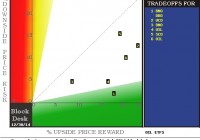
Summary Oil-price ETFs provide a quick look at expectations for change prospects in Crude Oil commodity prices. Market-maker hedging in these ETFs provide an overlay in terms of their impressions of likely big-money client influences on Oil-based ETF prices. But is there a broader story in price expectations for natural gas? And for ETFs in NatGas, following the same line of reasoning? Change is coming, so is Christmas But in what year? Expert oil industry analyst Richard Zeits in his recent article points out how long prior crude oil price recovery cycles have taken, with knowledgeable perspectives as to why. Still, there is also a suggestion that differences could exist in the present situation. Past cruise-ship price experiences of Crude Oil investors on their VLCC-type vessels have marveled at how long it takes to “change course and speed” in an industry so huge, complex, and geographically pervasive. To expect the navigating agility of an America’s Cup racer is wholly unrealistic. Yet some large part of the industry’s present supply-demand imbalance is being laid at the well-pad of new technology and aggressive new players in the game. In an effort to explore the daisy chain of anticipations that may ultimately be reflected by a persistent directional change in the obvious scorecard of COMEX/ICE market quotes, let’s step back a few paces from the supply~demand balance of commercial spot-market commodity transactions to the futures markets on which are based ETF securities whose prospects for price change attract investors in such volume that ETF markets require help from professional market-makers to commit firm capital to temporary at-risk positions that provide the buyer~seller balance permitting those transactions to take place. But that happens only after the market pros protect their risked capital with hedges in the derivative markets of futures and options, which doing so, quite likely provide some much lesser fine-tuning back into the price contemplations back up the ladder that brought us down to this level of minutia. So where to start? Mr. Zeits regularly asserts that his analyses are not investment recommendations, so securities prices are typically unmentioned, and left to the reader’s cogitation. We will start at the other end, where you can be assured that our thinking is in strong agreement with Mr.Z at his end. We convert (by unchanging, logical systemic means, established well over a decade ago) the market-makers [MMs] hedging actions into explicit price ranges that reflect their willingness to buy price protection than to have their perpetual adversaries in (and of) the marketplace take their capital (perhaps more brutally) from them. Using Richard Z’s list of Oil ETFs, here is a current picture of what the MM’s hedging actions now indicate are the upside price changes possible in the next few (3-4) months that could hurt them if their capital was in short positions. The complement to that, price change possibilities to the downside, could be a yin to the upside move’s yang, but we have found better guidance for the long-position investor’s concern in the actual worst-case price drawdowns during subsequent comparable holding periods to the upside prospects. So this map presents the upside gain potentials on the horizontal scale in the green area at the bottom, with the typical actual downside risk exposure experiences on the vertical red risk scale on the left. The intersection of the two locates the numbered ETFs listed in the blue field. (used with permission) Here’s the cast of characters: [1] is United States Brent Oil ETF (NYSEARCA: BNO ) and PowerShares DB Oil ETF (NYSEARCA: DBO ); [2] is ProShares Ultra Bloomberg Crude Oil ETF (NYSEARCA: UCO ); [3] is United States Short Oil ETF (NYSEARCA: DNO ); [4] is United States 12 month Oil ETF (NYSEARCA: USL ); [5] is ProShares Ultra Short Bloomberg Crude Oil ETF (NYSEARCA: SCO ); and [6] is the iPath S&P GSCI Crude Oil Price Index ETN (NYSEARCA: OIL ). Here is how they differ from one another: All are ETFs except for OIL, an ET Note with trivially higher credit risk and possible slight ultimate transaction problems. All except BNO are based on West Texas Intermediate [wti] crude oil availability and product specs, BNO is based on Brent (North Sea oil) quotes, directly influenced by ex-USA supply and demand balances. Most prices are at spot or most immediate futures price quotes, but USL is an average of the nearest-in-time 12 months futures quotes. All are long-posture investments except for SCO and DNO which are of inverse [short] structure. Both UCO and SCO are structured to have ETF movements daily of 2x the long or short equivalent unleveraged ETFs. What is the Reward~Risk map telling us? For conventional long-position investors, items down and to the right in the green area are attractive, to the extent that their 5 to 1 or better tradeoffs of upside potentials to bad experiences (after similar forecasts) are competitive to alternative choices. The closer any subject is to the lower-left home-plate of zero risk, zero return, the less attractive it is to those not traumatized by bunker mentality. SCO, the 2x leveraged short of WTI crude has a +20% upside with a -16% price drawdown average experience with similar forecasts in the past 5 years. It is a slightly better reward than a bet on a long position in Brent Crude and DNO, whose +18% upside is coupled with only -2% drawdowns. SCO’s minor return advantage over DNO comes largely from its leverage which is responsible for its large risk exposure. The same is true for UCO. USL’s trade-off risk advantage over OIL comes largely from smaller volatility in the 12-month average of futures prices that it tracks, rather than only the “front” or near expiration month. Here are the historical details and the current forecasts behind the map. The layout is in the format used daily in our topTen analysis of our 2,000+ ranked population of stocks and ETFs. For further explanation, check blockdesk.com . (click to enlarge) Conclusion In general, this map suggests that we still have ahead of us some further price declines as crude oil equity investors (via ETFs) see advantages in short structures. The spread between WTI crude price and Brent crude may be as narrow now as is likely in the next few months, given BNO’s relative attractiveness here. This analysis will be followed shortly by a parallel on those ETFs focused on Natural Gas and alternative energy fuels.

The Security I Like Best: Cash

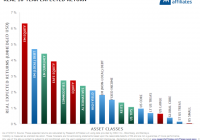
The five year bull market has pushed stock market valuations again into extreme territory. In John Hussman’s recent commentary ‘Hard-Won Lessons and the Bird in the Hand’, he said: Meanwhile, the S&P 500 is more than double its historical valuation norms on reliable measures (with about 90% correlation with actual subsequent 10-year market returns), sentiment is lopsided, and we observe dispersion across market internals, along with widening credit spreads. These and similar considerations present a coherent pattern that has been informative in market cycles across a century of history – including the period since 2009. None of those considerations inform us that the U.S. stock market currently presents a desirable opportunity to accept risk. we presently estimate prospective S&P 500 10-year nominal total returns of less than 1.4% annually . Investors are being offered the choice between a quite large and easily captured bird in the hand, or two ailing, elusive and possibly imaginary birds in the bush. The S&P 500 isn’t the only asset class with dismal projected future returns. Rob Arnott’s ‘Research Affiliates’ group estimates 10-year expected real returns for the major asset classes. Very few asset classes have expected returns greater than 2%. Arnott estimates U.S. Large Cap stocks at less than 1%: (click to enlarge) From Jeremy Grantham’s 3rd Quarter 2014 Letter to Shareholders ‘Bubble Watch Update’, And make no mistake about it, a world in which cash rates average 0% from here on out is a fairly hellish one. It is our belief that investors get paid for taking unpleasant risks. That compensation is in the form of a risk premium over the “risk-free” rate, and while there are no truly risk-free assets out there, T-Bills are a good enough approximation for many purposes. If that rate is going to be zero real, stocks, bonds, real estate, and everything else investors have in their toolkit should have their expected returns fall as well. In that world there are likely to be no assets priced to deliver as much as 5% real, and the expected return to a 65% stock/35% bond portfolio would drop from 4.7% real to about 3.4% real. I use these projected returns from investors such as Arnott, Jeremy Grantham, Hussman, and myself to generate my own asset allocation. The allocation to a particular asset class depends on its projected return against other assets (chiefly expected future inflation), and the asset volatility. My current allocation consists of: HealthyWealthyWiseProject – Current Asset Allocation (This allocation spreadsheet is kept on the Wealthy page of the website) At 21% of the portfolio, cash is currently my largest single asset class. Cash returns are, as we know, lousy; the little that one can get in liquid instruments inevitably being lower than the toll extracted by inflation. And the long-term returns on cash are terrible, lagging behind every asset class and investment strategy this side of setting money on fire. Still, cash is an option to buy value cheaply in the future. It’s premium price is inflation. Cash is worth holding because it is dry powder which gives the owner options. That optionality varies, of course, based on your view of how richly valued assets are, but it is always there. I note that Jeremy Grantham reported a 17% cash position in the 3rd Quarter. Again from Jeremy Grantham: As always, the prudent investor [..] should definitely recognize overvaluation, factor in regression to the mean, and calculate the longer-term returns that result from this process. More easily, such prudent investors can use our seven-year numbers, which have a decent long-term record measured when we have viewed markets as overpriced, as we believe they are today. A Note on the Presidential Cycle We’ve entered the third year of Obama’s presidency. Presidential Year 3 has been by far the most bullish historically. The average total return in year one has been 8 percent followed by 9.8 percent (Year 2), 21.7 percent (Year 3) and 12 percent (Year 4). Third-year stats have been especially impressive. The return has historically been more than double the average return in either years one and two and the S&P has finished down only once. There’s no guarantee that these aren’t just random patterns, but it’s often thought that third-year gains are a result of stimulus being added to the economy as Election Day approaches. It seems like a good time to prime the pump to put voters in a better mood. Jeremy Grantham respects the Presidential Cycle, and believes the Fed will engineer a fully fledged bubble (S&P 500 over 2250) before a very serious decline. The takeaway is – enjoy this last hurrah while it lasts, with an eye toward increasing your cash position as the year progresses.