Tag Archives: loader

Short GLD And Central Gold-Trust Into The Secular Decline Of Gold
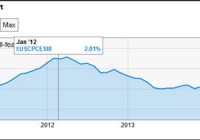
Recovering US economy together with the Fed pushing off inflationary concerns results in a hawkish Fed. This is bullish on the USD and bearish on Gold. Inflation is likely to remain subdued as low energy prices can persist. GLD would be an ideal instrument to short gold efficiently into its secular decline. Gold is priced in United States Dollars (USD) and it is affected by the actions of the Federal Reserve, inflationary pressure and issues of financial stability. In this article, we shall start with recent action by the Federal Reserve as seen in the December 2014 FOMC statement . We are currently in the interim period after the Fed has formally ended QE3 and before the first rate hike since the Great Recession of 2009. In general, a bullish Fed is bearish on the price of gold as it would push the USD higher and reduce inflation. This is exactly what we got as we go through the latest FOMC statement. The FOMC has a upbeat outlook on the US economy as we see in the quote below: “Information received since the Federal Open Market Committee met in October suggests that economic activity is expanding at a moderate pace. Labor market conditions improved further, with solid job gains and a lower unemployment rate. On balance, a range of labor market indicators suggests that underutilization of labor resources continues to diminish. Household spending is rising moderately and business fixed investment is advancing, while the recovery in the housing sector remains slow. Inflation has continued to run below the Committee’s longer-run objective, partly reflecting declines in energy prices.” In the above quote, we can see two drivers of weakness for gold. First, it is clear that the economy is recovering steadily. This is supported by labor market improvement and increasing consumption. Secondly, we are seeing the Fed’s acknowledgment that inflation is running low due to the decline of energy prices. The economy is expanding and the financial system has been cleaned up after the Credit Crunch of 2007, with strong regulatory action. With the benefit of hindsight, regulators have learned the cost of lax oversight and will be more stringent in their supervision. As the economy strengthen, the banks will strengthen accordingly. This has reduced the appeal of gold in the extreme event of a currency collapse when the banking and payment system ends as we know it. Next we see that inflation is low and below the 2% inflation target due to low oil prices. Inflation as measured by broad based measures such as the Consumer Price Index (CPI) is at 1.3% for November 2014, dropping from 1.7% from the prior 3 consecutive months. Even if we take into consideration the Fed’s preferred measure of inflation, the Personal Consumption Expenditure (PCE), it is also low at 1.55%. (click to enlarge) Source: Y-Charts Now I would like to point out that I am referring to broad based measures of inflation and not prices of individual items. A common rebuttal that I get from comments when I mention low inflation is that they would quote price increase of individual items from their grocery shopping increasing more than the mentioned inflation rates. Broad based inflationary measures such as CPI and PCE take into account a basket of goods and services which includes grocery shopping. These are what the Fed considers in its decision making process. What the Fed does have an impact on is the market and price of gold which is the main consideration of this article. Now the attitude of the Fed is crucial in linking the price of gold to inflation. In today’s fast paced world, gold would react first to expected inflation before actual inflation kicks in. One crucial source of expected inflation trend would come from the Fed. Today the Fed is giving more leeway to the below target inflation environment. Currently, the Fed sees this period of low inflation as ‘transitory’ as it expects low energy price to pass. They are not going to ease monetary conditions which would be supportive of gold prices. In this FOMC meeting, we also saw two hawkish dissents urging for an earlier rate hike on the grounds that the economy is strengthening faster than expected. The two hawkish dissents together with the overall bullish majority view outweighs the one dovish dissent urging for more accommodation to meet the Fed’s 2% inflation target. The majority view remains bullish on the US economy even as they urge patience to temper the bullishness of the FOMC Statement. In fact, credit conditions are likely to tighten as the banks pre-empt the Fed’s tightening. In this period of guessing when the Fed will start its first rate hike, the market tendency would be to assume an earlier rate hike rather than a later rate hike as the US economy recovers. As credit conditions tighten marginally and inflation risk remains subdued, gold investors are likely to exit their position and go into more productive assets. Moreover, there are grounds to believe that energy price can remain low for an extended period of time which would continue to keep a lid on inflation. A final piece of the argument acting against the price of gold is the strengthening USD. We can approach this from the theme of divergence of monetary policy in major currencies. Large economies like Japan and Europe are embarking on massive monetary easing programs of 80 Trillion yen per year and 3 Trillion euros respectively. The Fed and the Bank of England are expected to raise rates next year. This will encourage funds to flow into a higher yielding USD especially when the European Central Bank and Swiss National Bank are discouraging deposits with negative interest rates. This would include funds parked in gold, and gold being priced in USD will decline further as the USD appreciates. The chart below will show you the strength of the USD as measured against the Australian Dollar, Euro, Japanese Yen and Great Britain Pound in the spot market. This is the Dow Jones FXCM Dollar Index and these currencies against the USD make up 80% of the spot market and represents a diverse economic makeup. A pictorial view should give you a better sense of the USD strength on the bigger weekly picture. (click to enlarge) There are two ways to sell gold efficiently if you share my bearish view on gold. The first way would be to sell SPDR Gold Trust ETF (NYSEARCA: GLD ). The second way would be to sell the Central Gold-Trust (NYSEMKT: GTU ). Both are listed on the New York Stock Exchange and the prices are closely correlated to each other. GLD has a market capitalization of $27.71 billion and a volume of 7.4 million and it is more liquid than GTU with a market capitalization of $788.17 million and volume of 131 thousand. The reason for mentioning GTU is that it provides unencumbered gold holdings that are not being lent out. This will provide an alternative to investors who take issue with the ‘red flags’ that they see in the GLD prospectus and the gold audit process. (click to enlarge) (click to enlarge) Both the GLD and GTU charts above are almost identical in their trend. This would show that GLD reflects the price of gold as accurately as GTU despite the concerns over it by some investors. As GLD is more liquid than GTU, it would be the ideal instrument to profit from the slide of the gold. However I would note that GTU is a Closed End Fund, not an Exchange Traded Fund like GLD. There are some tax advantages by holding onto GTU compared to GLD. You can read more about GTU here and decide for yourself which is a better instrument for you based on your individual investment status. From both GLD and GTU, we can see that gold had a mini rally for two months from the start of November to mid December 2014 and it is now resuming its downtrend again. (click to enlarge) For a long term view of gold, I have added the monthly chart of XAU/USD. XAU is the currency term for gold and you can see for yourself the current and ongoing secular decline of gold. You can read about the history of the QE programs from the St. Louis Fed . Merry Christmas and a Happy New Year.

Opportunities For Alpha With Event Driven Credit Strategies

Editor’s note: Originally published on December 17, 2014 Many investors are aware of event-driven equity strategies, wherein the stock of the acquired company is held long, while the stock of the acquiring firm is sold short, generating arbitrage profits when the deal closes. But many of the same investors may not be aware that event-driven strategies can also be applied to credit instruments, which is the subject of a recent paper by Franklin Square titled Event-Driven Credit Strategies: Opportunities for Outperformance [.pdf]. The objective of event-driven credit strategy is to generate “equity-like returns” with a risk profile more similar to fixed-income. Event-driven equity strategies invest in the stock of companies after the announcement or in anticipation of a “corporate event” – such as a merger or acquisition, a bankruptcy or corporate restructuring, or a shareholder proxy fight. Event-driven credit strategies work under the same premise, but they add two additional “events” to their list: credit-rating changes and “special situations.” Credit Ratings “Investment grade” is the crucial threshold in credit ratings. Standard & Poor’s (S&P) and Moody’s each have different rating scales, but when a company is upgraded to BBB- by S&P or Baa3 by Moody’s, they officially crossover from “junk” to “investment grade” status – and that makes a big difference in the price investors are willing to pay for a company’s bonds. In the U.S., the difference has averaged 180 basis points over the past three years; or 202 basis points globally. By conducting extensive fundamental research, event-driven credit strategies try to anticipate corporate-credit upgrades from “junk” to “investment grade” – or the reverse. A company that’s upgraded to investment-grade credit quality is called a “rising star;” while a company that’s downgraded from investment-grade to junk is called a “fallen angel.” Event-driven credit strategies aim to invest in the bonds of companies before they become rising stars – or short them in anticipation of them becoming fallen angels. According to Franklin Square, “rising stars have generally outperformed similarly rated bonds by an average of 1.5% in the immediate aftermath of an upgrade event.” Special Situations Special situations are another type of event-driven strategy that tends to be more effective for credit strategies than for event-driven equity investors. A typical “special situation” may involve a company that’s under short-term financial stress, but has long-term promise. Event-driven credit investors often extend short-term loans to (or buy short-term bonds from) such companies, normally at above-market interest rates and with terms favorable to the lender. According to Franklin Square, “the average stressed bond issue outperformed the Barclays High Yield Index by an average of nearly 2% per year” over the past decade. Mergers and Acquisitions In the equities sphere, mergers and acquisitions (M&A) are the most prominent corporate events. In May, Hillshire Brands (NYSE: HSH )– manufacturer of Jimmy Dean sausages, among other popular food products – announced the high-profile acquisition of Pinnacle Foods (NYSE: PF ). Pinnacle’s shares soared, but so did its bonds, rising 9.2% on the day of the merger announcement. The above example shows that M&A provides event-driven opportunities for fixed-income investors, too. Indeed, since the early 2000s, the bonds of companies receiving merger bids have outperformed their benchmarks by 3% in the month following the proposed merger’s announcement. Conclusion Franklin Square’s whitepaper concludes with a list of three keys to event-driven credit strategies: Identify market price inefficiencies Initiate a catalyst Introduce equity-like returns Since employing event-driven credit strategies requires skill, expertise, and substantial capital, most individuals seeking exposure use investment vehicles such as mutual funds and closed-end funds. In the view of Franklin Square, investors should consider an event-driven credit fund’s focus, its strategy, its expenses, and its risk profile before investing. Disclosure : No position

What Do Passive Investors Really Mean By ‘Passive Investing’?

The term “passive investing” is actually a misnomer in the manner that most index fund investors use it. The reason why is simple. There is, at the aggregate level, just one portfolio of all outstanding globally cap weighted financial assets. And as soon as you deviate from that global cap weighted portfolio in your asset allocation, you become an “active asset picker” who believes he/she can generate a better risk-adjusted return than that portfolio can. You are, in essence, making a discretionary portfolio decision as opposed to just “taking what the market gives you.” Okay, so the whole idea of “passive investing” is a bit misleading. If you look at this through the macro lens it becomes clear that we are all active asset pickers deviating from global cap weighting. So what do the “passive” investors really mean? First, it’s nice to look at some of the history here because we can start to see why confusion over this terminology has persisted for so long. In The Intelligent Investor, Ben Graham wrote: “In the past we have made a basic distinction between two kinds of investors to whom this book was addressed – the “defensive” and the “enterprising.” The defensive (or passive) investor will place his chief emphasis on the avoidance of serious mistakes or losses. His second aim will be freedom from effort, annoyance, and the need for making frequent decisions. The determining trait of the enterprising (or active, or aggressive) investor is his willingness to devote time and care to the selection of securities that are both sound and more attractive than the average. Over many decades an enterprising investor of this sort could expect a worthwhile reward for his extra skill and effort, in the form of a better average return than that realized by the passive investor.” That’s pretty clear. To Graham the distinction is about security selection and trying to earn a premium over the market return. So, active managers are essentially stock pickers who try to “beat the market.” Of course, this was written long before there was an index for everything. Today, most of us don’t pick stocks. We pick an asset allocation by holding financial asset that already have a certain allocation to certain assets. We are still selecting securities of certain types. We just do it differently than one might have in Ben Graham’s day. So Graham’s definition is a bit dated. What about Eugene Fama? Fama has stated that active management is any fund that engages in security selection or market timing. Okay, but anyone who deviates from global cap weighting is “selecting” their own securities inside of index funds. So it really comes down to timing. But this too gets messy. After all, indexers engage in all sorts of active endeavors and simply call it something else like “rebalancing,” “factor tilting” or “dollar cost averaging.” These are all discretionary timing based decisions about how to engage in the markets. They’re just not marketed as “active management” for whatever reason. Okay, so it’s becoming even more obvious that the idea of “passive” investing is a bit messy. But that doesn’t mean the defenders of “passive investing” don’t have important points. In my view, they make many crucial distinctions about portfolio management that every investor should adhere to: You shouldn’t try to “beat the market.” Yes, we all deviate from global cap weighting, but you should build a portfolio that’s right for you as opposed to benchmarking yourself relative to some index. In the aggregate, we all underperform the global cap weighted portfolio after taxes and fees so the “beat the market” mantra is an impossibly high hurdle to begin with. You should keep your costs very low. Costs will destroy a much larger portion of your portfolio than you likely think. In general, my rule is never invest in funds or with managers who charge more than 0.5%. Keep your activity low. The more active you are, the more you’ll increase your tax burden. Like fees, taxes will crush you in the long-run. Pick whole asset classes rather than individual securities. This reduces your risk and allows you to take advantage of diversification. Create a plan that has staying power so you avoid tinkering with your portfolio regularly or letting yourself get in the way. That’s it. This really isn’t about “activity.” After all, we are all active by necessity. But we can be smart active investors. And that’s the key to understanding the distinction between what people call “active” investors and “passive” investors.